
How Singapore’s stablecoin rules could boost crypto’s ‘mainstream’ banking role

How Singapore’s stablecoin rules could boost crypto’s ‘mainstream’ banking role
  • Industry executives say the proposed rules by the Monetary Authority of Singapore are timely and will boost investor confidence
  • Recent moves by Hong Kong and Europe on rules governing stablecoins will also spur wider adoption of cryptocurrencies, according to the executives


The unpredictable price fluctuations of cryptocurrencies have been a make-or-break game for myriad investors across Asia for months.

However, only a handful of regional policymakers have ventured to integrate these volatile assets into the mainstream financial landscape.

Now, the latest move by Singapore’s central bank to introduce regulatory guidelines for stablecoins could prove to be a milestone for its rapid adoption in traditional channels like banks, analysts say.

Unlike other cryptocurrencies, stablecoins are viewed as safe haven assets as their values are pegged to traditional currencies or other assets such as government bonds and gold.
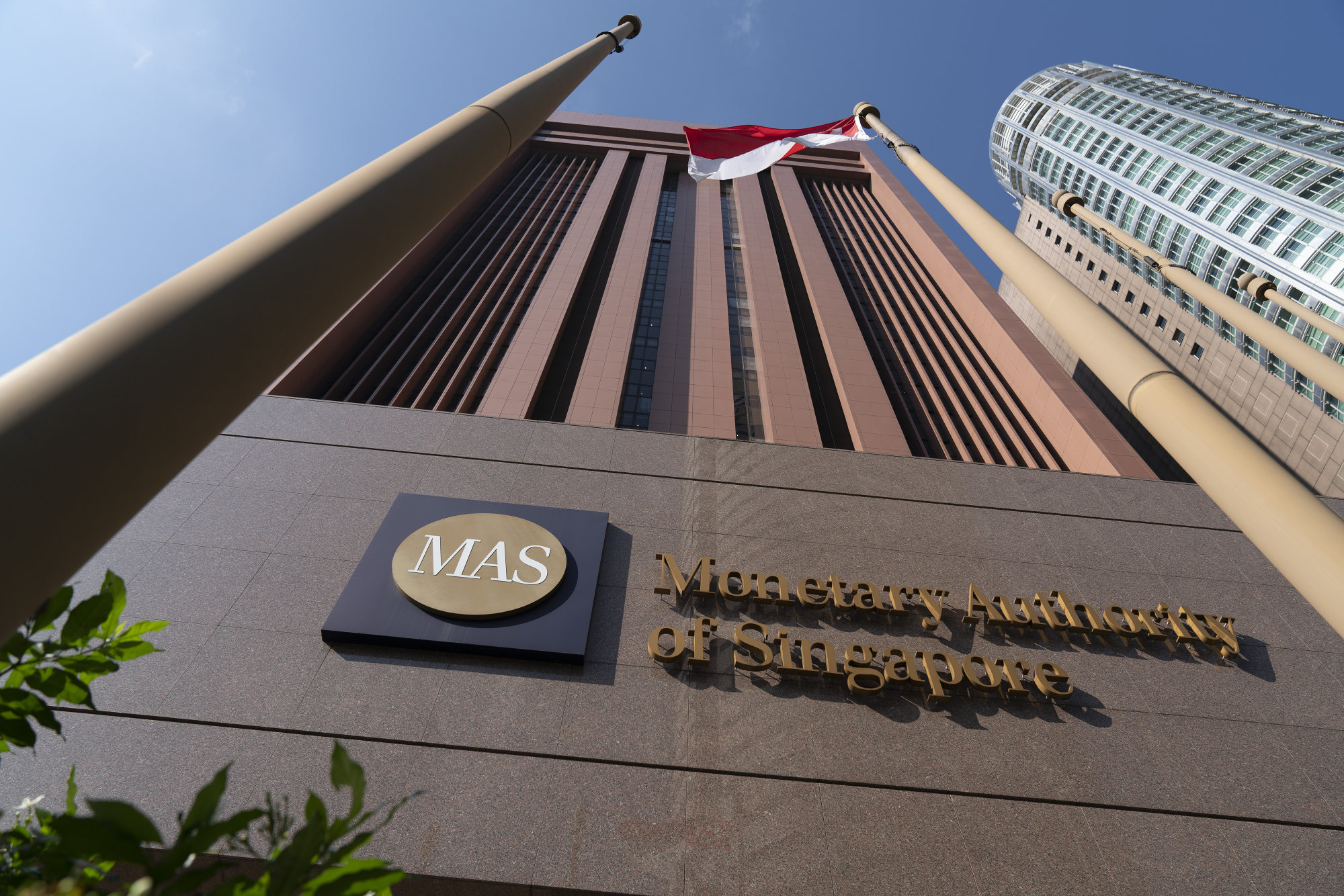
The Monetary Authority of Singapore building in Singapore. Photo: Bloomberg

The Monetary Authority of Singapore’s (MAS) regulations announced last week will apply to nonbank users of single-currency stablecoins pegged to the Singapore dollar, or any currency from the world’s 10 biggest economies, and would require issuers to maintain low-risk reserves and return par value to investors within five days of receiving a redemption request.

“The MAS seems to be paving the way for greater trust and potential formal integration of stablecoins into the banking system.

However, as these regulations are scheduled to come into effect in 2024, their precise impact on bank transactions will [need to] be monitored closely,” said Chen Zhuling, founder and CEO of crypto finance gateway RockX.

The central bank would need to hold legislative consultations before Parliament passes amendments that would bring the framework into force. The coins will be labelled as MAS-regulated stablecoin.

The distinction of having central bank-regulated stablecoins, as opposed to non-regulated cryptocurrencies, is likely to ease concerns about their stability that have curtailed their usage for physical transactions, analysts say.

Stablecoins have been the backbone for cryptocurrency trading and can potentially slash transaction costs associated with traditional banking systems to a nominal amount, while speeding up processing times to seconds.

But stablecoins have in the past failed to make inroads into mainstream financial systems because of a lack of transparency about their reserves.
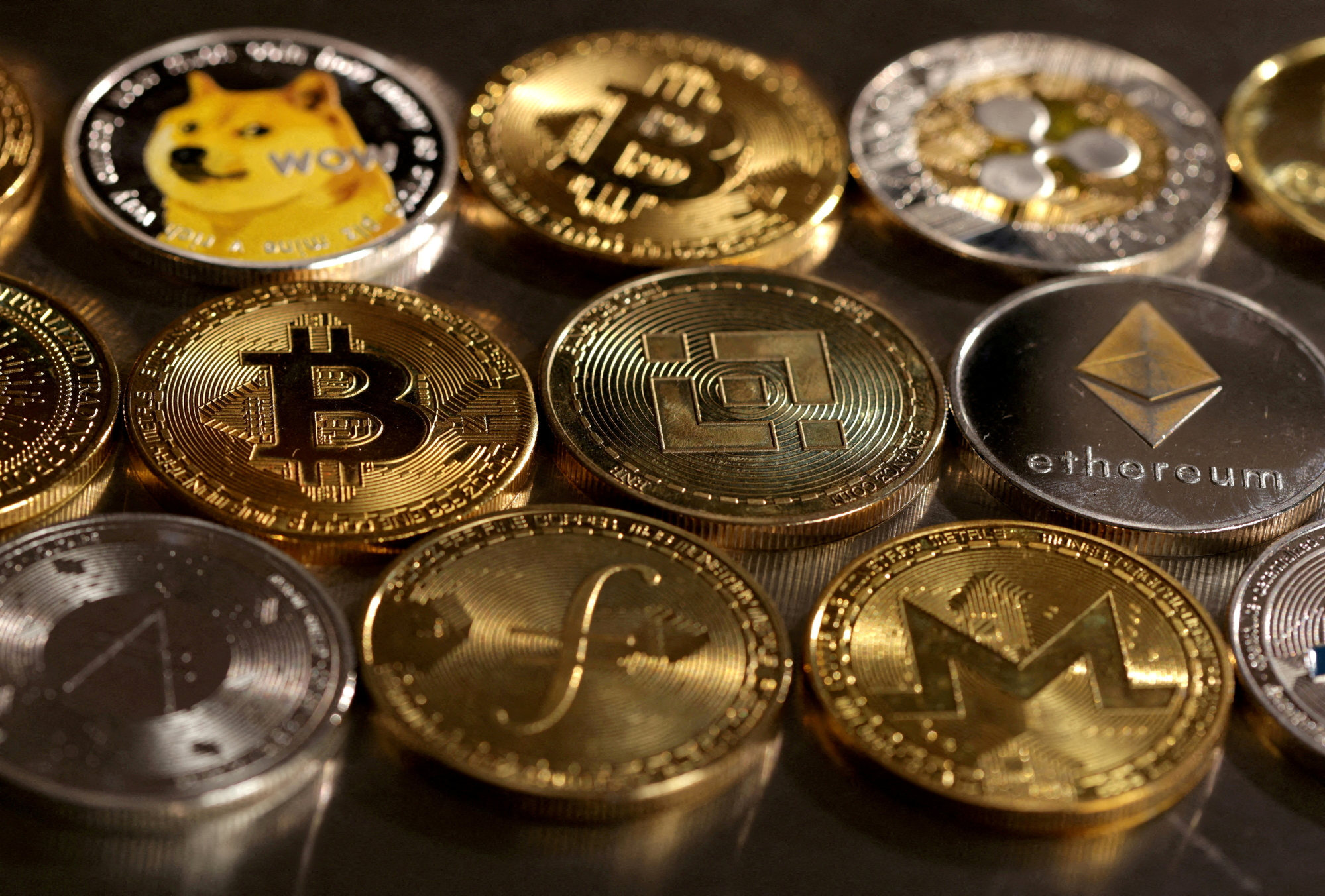
Popular cryptocurrencies like bitcoin and ether tend to suffer from high price volatility. Photo: Reuters

Anndy Lian, author of the book NFT: From Zero to Hero, said Singapore’s guidelines could bridge the gap between fiat currrencies and digital assets.

“But this should not necessarily mean that banks will start to accept all kinds of cryptocurrencies. The volatility of other cryptocurrencies is still a red flag for many,” he said.

Popular cryptocurrencies like bitcoin and ether tend to suffer from high price volatility, whereas stablecoins tend to hold steady since they are linked to fiat currencies and other such assets.

Despite their relative safety, clamours for regulation of stablecoins grew after two such sister currencies – Terra and Luna, whose values were algorithmically pegged to the US dollar and not backed by cash – suddenly collapsed in May last year.

Singapore’s strict guidelines are meant to reassure both investors and institutions that could open new avenues for the asset class, industry executives say.

“Banks may even issue stablecoins for tokenised bank deposits as part of their rapidly developing digital transformations,” said Gerald Goh, co-founder and CEO of Sygnum Singapore, a digital assets fintech group.

“This model – fully regulated, traditional-asset backed and pegged to a high-quality ‘stable’ fiat currency like the Singapore dollar – has the potential to become a blueprint for the industry,” he added.
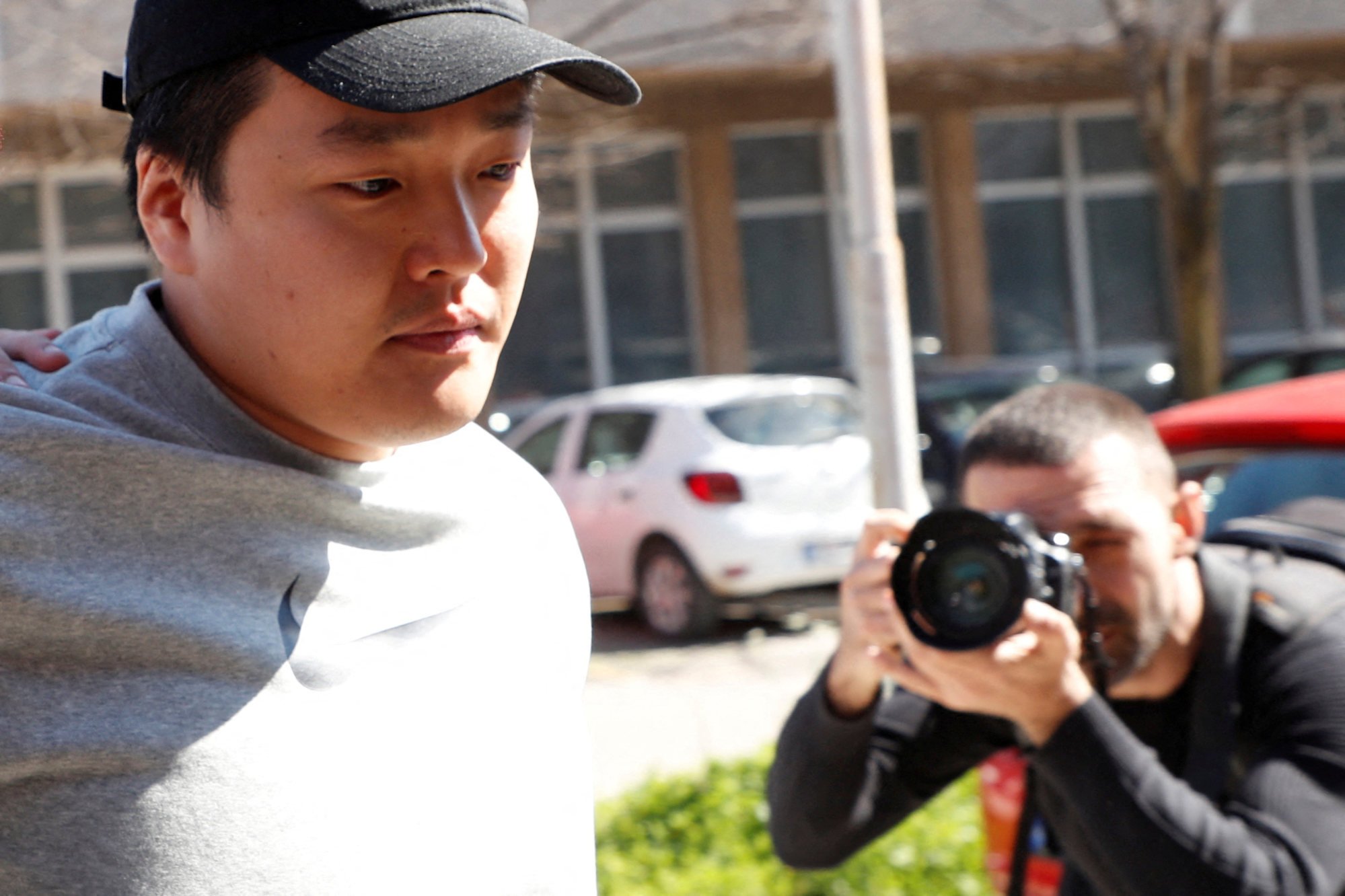
Do Kwon, the cryptocurrency entrepreneur who created the failed Terra stablecoin, is taken to court in handcuffs in Montenegro in March. Photo: Reuters

First among digital equals

Singapore’s stablecoin framework will put it among the first jurisdictions to have rules to prevent mishaps.

Rival financial hub Hong Kong is, meanwhile, undergoing a public consultation on stablecoins and seeks to introduce regulation for them next year.

The European Commission set the ball rolling with the Markets in Crypto-Assets (MiCA) regulation, which it introduced with the purpose of establishing a global benchmark for governing cryptos.

After being proposed by the commission in September 2020, the European Parliament approved the MiCA regulation on April 20. It is due to come into force for stablecoins from June 2024, and for other assets from December.

Anne-Sophie Cissey, head of legal and compliance at crypto firm Flowdesk, said the European legislation has set the tone for markets. “With clarification on the legal status, all crypto actors will feel more at ease to deal with those.”

Singapore’s regulation could speed up stablecoins adoption across the region, industry executives say.

“Regulators now collaborate with international entities, for example, MiCA’s announcement in Europe led to similar guidelines in various countries,” said Danny Chong, co-founder of online asset tracker Tranchess.

“This trend suggests that financial hubs like Singapore and Hong Kong should move towards converging rules. This convergence might take a few years to materialise, rather than happening immediately,” he said.

Hong Kong’s regulations are likely to follow Singapore’s soon, as it has been earnestly trying to woo crypto investors. In June, it introduced retail trading and licensing guidelines for crypto.

Many investors have already begun to gravitate towards tokenised assets.

“We are increasingly seeing more stablecoin adoption in Asia,” said Henry Zhang, founder and CEO of DigiFT, a Singapore-based decentralised digital asset exchange, adding that they were looking forward to introducing MAS-regulated stablecoins.

Tokenised US short-term bills have exploded to US$600 million this year, said Timo Lehes, co-founder of Swarm, a regulated decentralised finance platform based out of Germany, citing data from Coindesk.

The digital assets have also started making inroads past intermediaries in traditional financial channels, he said.

“We are already seeing applications taking tokenised forms of cash and financial products that cut out the middleman. In this new world, financial institutions will need to rethink financial product design that puts consumers at the heart,” Lehes said.

Central banks have laid the groundwork for cyptocurrency adoption with countries like China, India and Australia either planning to or having launched a central bank digital currency that can compete with stablecoins, said an industry executive.

“This will drive the choice and innovation needed in the market that will lead to mass adoption,” said Vincent Chok, CEO of Hong Kong finance firm First Digital.

Source: https://www.scmp.com/week-asia/economics/article/3231578/how-singapores-stablecoin-rules-could-boost-cryptos-mainstream-banking-role

Anndy Lian is an early blockchain adopter and experienced serial entrepreneur who is known for his work in the government sector. He is a best selling book author. The latest book is Web4: The Age of Autonomous Intelligence.

j j j

TerraUSD price prediction: USTC is no longer a stablecoin but can it bounce back?

TerraUSD price prediction: USTC is no longer a stablecoin but can it bounce back?

Since its depeg from the US dollar, the TerraUSD cryptocurrency has gone through a “makeover”. Now known as TerraClassicUSD (USTC) and no longer a stablecoin, the coin is struggling to pick up, fluctuating between the $0.03 and $0.06 levels in July 2022.

Investor sentiment on the coin remains low, as concerns prevail about its trustworthiness following Terra Lana collapse, which caused some investors to lose over 90% of their funds. What do experts have to say, and what other factors shape TerraUSD price prediction?

What is TerraUSD?

TerraUSD (USTC; previously UST) is an open-source blockchain that hosts a number of decentralised applications (dApps) and developer tools within its ecosystem.

Originally, TerraUSD was an algorithmic stablecoin, a cryptocurrency that aims to maintain a 1:1 peg with the reserve currency they back – in UST’s case, the US dollar – through algorithms.

TerraUSD launched in September 2020 in partnership with Bittrex Global and was co-founded by Do Kwon, who is also the founder of Terraform Labs, a software development company behind the creation of the TerraLuna and TerraUSD sister coins.

Terra had a dual-token system that used the stablecoin and LUNC (previously LUNA), the protocol’s native staking token, to create and stabilise UST. LUNC was also used for governance and in mining. UST coins were minted by burning LUNC tokens and could also be swapped for LUNC.

According to its whitepaper, UST was meant to have the features of a “price stable cryptocurrency that combines the benefits of both fiat and bitcoin”. This meant that, ideally, UST had to be worth $1 at all times. However, on 9 May 2022 after several years of holding its value against the US dollar, the stablecoin collapsed, or de-pegged.

The token ended up losing over 80% of its value in less than a week and has never managed to recover from the massive drop. In addition, the cryptocurrency’s de-peg had a whirlpool effect on the cryptocurrency market, dragging down other cryptocurrencies including LUNC (previously LUNA) and BTC.

Following UST’s crash, Kwon proposed forking Terra to a new chain that would entirely cut out UST and focus on decentralised finance (DeFi) applications built on the Terra blockchain. The proposal saw the creation of a new layer-1 Terra blockchain without its algorithmic stablecoin. Meanwhile the old blockchain was renamed from Terra Luna (LUNA)  to Terra Classic (LUNC) and the new blockchain would be called Terra (LUNA).

On 25 May 2022, the proposal was passed. Two days later Terra started to operate from a new blockchain. The UST token was rebranded and is currently known as TerraClassicUSD (USTC).

USTC is a decentralised stablecoin pegged to the US dollar and built on the Terra Classic blockchain. Stablecoins aren’t supported on the new LUNA blockchain launched after the cryptocurrency fork. Instead, USTC is supported by LUNC, whose purpose is to maintain the stability of Terra’s stablecoins.

The total supply of USTC tokens exceeds 10bn, with over 9.828bn tokens currently in circulation, according to data provided by CoinMarketCap,as of 14 July. The USTC cryptocurrency currently has a market capitalisation of over $337.9m and is ranked 87th biggest token.

The aftermath of the TerraUSD collapse

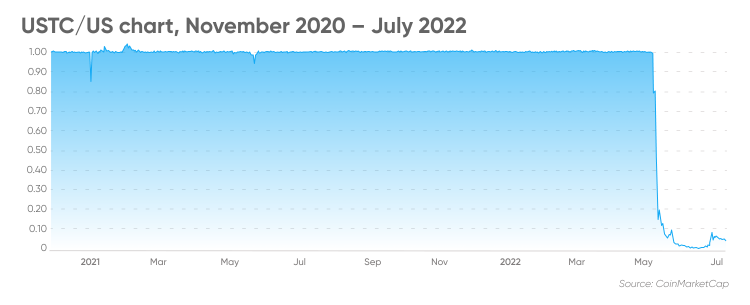
UST lost its peg to the US dollar on 9 May 2022 when the token dipped by 84.5% falling from past $0.9 highs on 8 May to $0.154 by 13 May.

On 25 May, UST saw its first tiny gains when Terra announced that its community voted to pass the proposal for the forking of the blockchain, gaining around 67.5% of its value and surging to $0.09463 from $0.05648 lows four days earlier.

This also meant that after 25 May, UST no longer existed. USTC replaced UST but was no longer a stablecoin.

USTC/US chart, November 2020 – July 2022

However, a positive run did not last long as the token’s value continued to decline and by 8 June had reached its lowest point of just $0.009796 – a 99% decline since its 8 May $0.9964 high.

At the time, the blockchain was celebrating the launch of Terra 2.0  and its one-week anniversary, noting that many dApps had returned to the platform and were “up and running”. However, investors were not as bullish on the cryptocurrency as its price continued to fluctuate between the $0.06 and $0.09 levels.

According to Kwon, the platform has also been struggling with a lot of “misinformation”, which could have further contributed to USTC’s bearish price in June.

In mid-June, Kwon was accused of having cashed out $2.7bn in the months leading up to UST’s collapse, however, the entrepreneur denied all allegations.

“This should be obvious, but the claim that I cashed out $2.7bn from anything is categorically false,” Kwon said in a tweet.

“To reiterate, for the last two years the only thing I’ve earned is a nominal cash salary from TFL [Terra Form Labs], and deferred taking most of my founder’s tokens because a) didn’t need it and b) didn’t want to cause unnecessary finger pointing of ‘he has too much’.

“Hope that’s clear – I didn’t say much because I don’t want to seem like playing victim, but I lost most of what I had in the crash too.”

By 29 June 2022, the token had managed to surge to $0.0811 following the announcement that SafePal Software and Hardware Wallet had started to support Terra 2.0 and LUNA tokens.

Some big news followed on 6 July 2022 when Soil Protocol, a non-fungible token (NFT) infrastructure built for Terra 2.0, announced its launch. The platform allows people to develop NFT projects without having to write smart contracts. Since reaching $0.0811, USTC fell back to $0.03443 on 14 July.

Analyst outlook on USTC

“The collapse of UST gave a wake-up call for many,” said Anndy Lian, chief digital advisor at Mongolian Productivity Organisation and the author of Blockchain Revolution 2030, told Capital.com.
“It has also helped many understand more about stablecoins and how they are designed to hold a steady value pegged to a fiat currency, and that not all stablecoins are stable by default.”

According to Lian, cryptocurrencies are in dire need of a set of rules that will help and lobby crypto rules on a global level.

“It is important to impose strong regulations before it poses more severe financial risks as the market grows bigger over time. I must emphasise again, that the regulations must be made independently and catered to the fast-moving crypto environment, not copy existing rules to crypto.”

Raullen Chai, CEO and co-founder of IoTEX, noted that very few people are bullish on LUNA and USTC.

“Since people are already losing faith in LUNA and UST (and even all algorithmic stablecoins), it is unlikely that they will survive this bear market,” he told Capital.com.

Chai said he remains optimistic about other areas of cryptocurrency markets in the long run, including “store-of-value coins such as Bitcoin and Ethereum”, and “MachineFi that is about connecting the real world into the crypto world or Web3 to address real problems and provide users with real value”.

Lian added that because USTC is still listed on several tier-one exchanges such as Binance, FTX and Kucoin, it means there are people who are still hopeful that the cryptocurrency can make a comeback. However, he urged investors to pay more attention towards projects that are building on the Terra blockchain.

Chai warned that “all cryptocurrencies are vulnerable to crashes as are all stocks.”He added:

“In crypto, as in any other business, the strongest projects with real development and solving real-world problems will always have a better chance of surviving an extreme bear market. In crypto, bear markets have a positive side which is the flushing or purging of bad projects.”

TerraUSD price prediction: 2022-2030

Despite recent bearish price action, algorithm-based forecasting service WalletInvestor gave a bullish TerraUSD price prediction.

As of 14 July, the site called USTC is “an awesome investment”. According to the website’s future USTC price prediction, the token could reach $0.376 in 2023 and jump to $1.671 by 2027.

DigitalCoinPrice supported the positive TerraUSD price prediction, but projected a much slower pace of growth in the following years. Its TerraUSD price prediction for 2022 showed that the cryptocurrency could average at $0.0515 by the end of the year.

The website’s TerraUSD price prediction for 2025 suggested that the coin could average at $0.0729, surpassing the $0.10 barrier by 2028, averaging at $0.12 in that year. Its long-term TerraUSD price prediction for 2030 indicated that the cryptocurrency could average at $0.19 during the year.

Note that price predictions can be wrong. Forecasts shouldn’t be used as a substitute for your own research. Always conduct your own due diligence. And never invest or trade money you cannot afford to lose.


Original Source: https://capital.com/terrausd-token-terraclassicusd-price-prediction

Anndy Lian is an early blockchain adopter and experienced serial entrepreneur who is known for his work in the government sector. He is a best selling book author. The latest book is Web4: The Age of Autonomous Intelligence.

j j j