While stocks stay calm, Bitcoin rockets to US$105K after downgrade

While stocks stay calm, Bitcoin rockets to US$105K after downgrade

Last Friday, Moody’s decision to downgrade the US credit rating from its pristine Aaa status to Aa1 sent a jolt through global financial markets, stirring a wave of subdued risk sentiment that lingered into the new week. The downgrade, rooted in concerns over the United States’ mounting debt burden and the rising cost of servicing it, marked a rare moment of scrutiny for the world’s largest economy.

Moody’s pointed to a debt-to-GDP ratio spiralling toward 134 per cent by 2035 and persistent fiscal deficits as key drivers behind the move—a sobering assessment that echoed earlier downgrades by Fitch and S&P in recent years. For a nation long regarded as the bedrock of global financial stability, this shift might have been expected to unleash chaos across asset classes. Yet, as Monday’s trading session unfolded, the response was anything but panicked. US equities, after stumbling out of the gate, clawed back early losses to close modestly higher.

The S&P 500 eked out a 0.1 per cent gain, the Dow Jones rose 0.3 per cent, and the Nasdaq edged up by 0.1 per cent. This resilience hinted at a market more preoccupied with immediate economic signals than long-term fiscal warnings, a sentiment reinforced by Federal Reserve officials who doubled down on their patient, wait-and-see stance. With no policy shifts anticipated before September, the Fed’s measured tone seemed to steady investors’ nerves, suggesting that the downgrade, while noteworthy, wasn’t yet a tipping point for broader market upheaval.

The bond market, too, offered a nuanced reaction to Moody’s announcement. US Treasuries, often the first port of call in times of uncertainty, initially faltered as the downgrade sparked a brief sell-off.  Yields ticked higher, with the 30-year Treasury yield briefly piercing the five per cent mark—the highest since November 2023—before retreating to close at 4.903 per cent, down 4.1 basis points.

The 10-year yield followed a similar arc, slipping 3.0 basis points to settle at 4.447 per cent. This recovery signalled that, despite the downgrade, investors weren’t ready to abandon US debt as a safe haven. The enduring appeal of Treasuries likely stems from their unparalleled liquidity and the dollar’s status as the world’s reserve currency, factors that continue to outweigh concerns about America’s fiscal trajectory.

Meanwhile, the US Dollar Index took a modest hit, dipping 0.7 per cent to 100.43, a move that might reflect some unease about the downgrade but hardly a flight from the greenback. Gold, ever the barometer of uncertainty, rebounded with a 0.8 per cent gain to US$3,230 per ounce, reinforcing its role as a hedge against perceived cracks in the global financial edifice.

Across the commodity spectrum, Brent crude inched up 0.2 per cent to US$66 per barrel, buoyed not by the US downgrade but by geopolitical currents—namely, tentative truce talks between Russia and Ukraine and whispers of a nuclear deal with Iran. These movements painted a picture of a market absorbing the Moody’s news with a shrug, focusing instead on near-term catalysts and broader macro trends.

Elsewhere, Asian markets offered a contrast to the relative calm in the US. The MSCI Asia ex-Japan index slid 0.66 per cent on Monday, dragged lower by a faltering Chinese equity market. Concerns over weakening consumption in China, coupled with the much-anticipated debut of a major battery manufacturer, weighed heavily on sentiment. This divergence underscored a key dynamic: while the US downgrade rippled globally, regional factors often held greater sway over local markets.

Early trading in Asia on Tuesday showed a mixed picture, with no clear direction emerging, while US equity index futures pointed to a softer open stateside. The muted response across these asset classes suggested that, for now, the downgrade was being filed away as a long-term concern rather than an immediate threat. Investors seemed more attuned to the Federal Reserve’s next moves, inflationary pressures, and geopolitical developments than to Moody’s stern warning about America’s fiscal health.

Amid this complex tapestry of market reactions, Bitcoin emerged as a standout story, surging past the US$105,000 mark over the weekend and igniting a US$250 billion rally across the cryptocurrency universe. By Sunday, Bitcoin’s price had climbed to US$105,424.45, pushing its market capitalisation beyond US$2.05 trillion and lifting the broader crypto market’s total value past US$2.65 trillion in just five trading days.

This 37.5 per cent ascent from its April low of under US$75,000 was no fluke; it was fuelled by a potent mix of macroeconomic tailwinds and shifting investor psychology. Inflation data, which has kept markets on edge, bolstered Bitcoin’s appeal as an inflation hedge—a narrative that gained traction as confidence grew in potential interest rate cuts from the Federal Reserve.

Significant fund inflows from retail enthusiasts and institutional heavyweights poured fuel on the fire, driving Bitcoin’s dominance in the crypto space to 53.2 per cent, its highest level in over three years. Altcoins rode the wave, buoyed by Bitcoin’s momentum and a technical breakout that saw the cryptocurrency shatter key resistance levels. Open interest in Bitcoin futures soared to a record US$36 billion, a clear sign of growing trader conviction and speculative fervour.

What makes Bitcoin’s rally particularly striking is its timing alongside the Moody’s downgrade. While traditional markets digested the downgrade with relative composure, the crypto market’s exuberance suggested a deeper shift in investor behavior. For some, Bitcoin is increasingly seen as a counterweight to the uncertainties plaguing sovereign debt and fiat currencies, precisely the uncertainties Moody’s highlighted in its downgrade rationale.

The cryptocurrency’s rise wasn’t just a technical story; it was a macroeconomic one, amplified by positive conditions like regulatory clarity in major markets and a growing acceptance among traditional financial players. Take JPMorgan Chase, for instance. On Monday, CEO Jamie Dimon announced at the bank’s annual investor day that clients would now have access to Bitcoin, a surprising pivot for a man who once vowed to shut down the crypto industry if he could.

Dimon, a vocal skeptic who has long flagged concerns about money laundering and illicit activities tied to digital currencies, framed the move as a reluctant nod to client demand. “I don’t think you should smoke, but I defend your right to smoke,” he quipped, per CNBC’s report. “I defend your right to buy Bitcoin.” JPMorgan won’t custody or endorse the asset, but its decision to facilitate access marks a watershed moment, bridging the gap between Wall Street and the crypto frontier.

This juxtaposition—Moody’s downgrade on one hand, Bitcoin’s ascent on the other—offers a lens into the evolving financial landscape. The downgrade’s tepid impact on equities and Treasuries suggests that traditional markets remain anchored by faith in the US economy’s resilience, bolstered by the Fed’s steady hand. Yet Bitcoin’s surge hints at a parallel narrative: a growing cohort of investors, from retail traders to institutions, is seeking alternatives to the established order.

The crypto rally, underpinned by inflation fears and low-rate expectations, reflects a bet on a future where digital assets play a bigger role in hedging against fiscal and monetary instability. Gold’s rebound fits into this story too, though its gains pale beside Bitcoin’s meteoric rise. Meanwhile, the mixed performance in Asian markets and Brent crude’s modest uptick remind us that global markets are a mosaic, shaped as much by local dynamics as by headline events like a US credit downgrade.

In the end, the past few days have revealed a market at a crossroads. While significant, the Moody’s downgrade didn’t spark the turmoil one might expect, suggesting that investors are either desensitised to such warnings or too focused on shorter-term horizons to care. US equities and Treasuries held firm, the dollar dipped but didn’t collapse, and gold reclaimed some ground.

Bitcoin, however, stole the spotlight, and its surge is a testament to shifting tides in how value is perceived and stored. Whether this marks a fleeting speculative boom or a lasting realignment remains to be seen, but one thing is clear: the financial world is growing more complex, with traditional and alternative assets increasingly dancing to different tunes.

As the Fed holds its ground and geopolitical currents swirl, the interplay between these forces will shape markets for months to come. For now, the Moody’s downgrade is a footnote in a broader story—one where resilience, innovation, and uncertainty coexist in uneasy harmony.


Source: https://e27.co/while-stocks-stay-calm-bitcoin-rockets-to-us105k-after-downgrade-20250520/


Anndy Lian is an early blockchain adopter and experienced serial entrepreneur who is known for his work in the government sector. He is a best selling book author- “NFT: From Zero to Hero” and “Blockchain Revolution 2030”.

Currently, he is appointed as the Chief Digital Advisor at Mongolia Productivity Organization, championing national digitization. Prior to his current appointments, he was the Chairman of BigONE Exchange, a global top 30 ranked crypto spot exchange and was also the Advisory Board Member for Hyundai DAC, the blockchain arm of South Korea’s largest car manufacturer Hyundai Motor Group. Lian played a pivotal role as the Blockchain Advisor for Asian Productivity Organisation (APO), an intergovernmental organization committed to improving productivity in the Asia-Pacific region.

An avid supporter of incubating start-ups, Anndy has also been a private investor for the past eight years. With a growth investment mindset, Anndy strategically demonstrates this in the companies he chooses to be involved with. He believes that what he is doing through blockchain technology currently will revolutionise and redefine traditional businesses. He also believes that the blockchain industry has to be “redecentralised”.

j j j

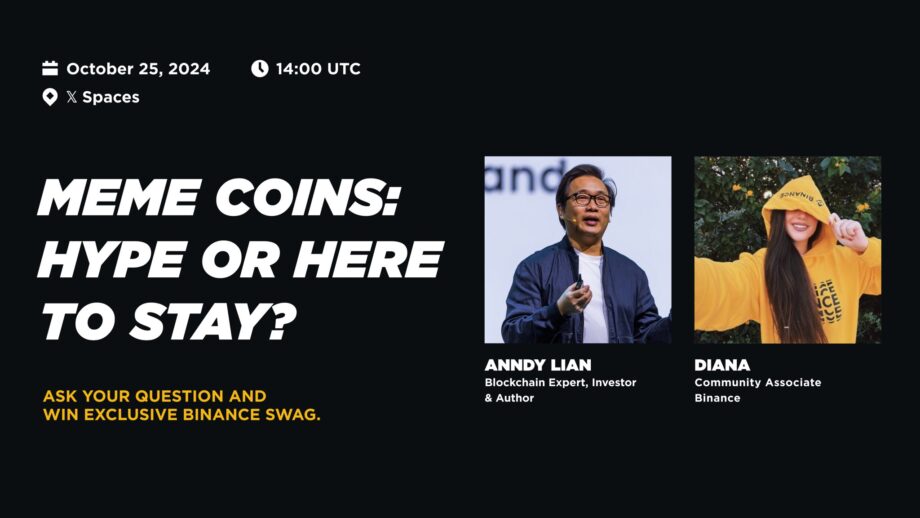
Meme Coins: Hype Or Here to Stay? -AMA Session With Anndy Lian

Meme Coins: Hype Or Here to Stay? -AMA Session With Anndy Lian

Meme coins have swiftly emerged as a distinctive segment within the cryptocurrency ecosystem, harmonizing humor, community engagement, and cutting-edge blockchain technology. In a recent Ask Me Anything (AMA) session titled “Memes to Millions,” hosted by Diana, a Binance Community Associate, on X (formerly Twitter), Anndy Lian—an accomplished book author, fund manager, and blockchain authority—delved into the multifaceted world of meme coins. The discussion illuminated the potential, inherent challenges, and strategic pathways toward mainstream adoption of meme coins, offering a comprehensive analysis grounded in profound industry expertise.

The Significance of Community in Meme Coin Success

A central theme of the AMA was the pivotal role of community in the proliferation and sustainability of meme coins. Anndy underscored that while technological advancements are crucial, it is the vibrancy and engagement of the community that truly distinguishes enduring meme coins from transient phenomena. “Meme coins are more about community than technology,” he emphasized, pointing out that the initial phases of a meme coin lifecycle are primarily propelled by the enthusiasm and active participation of its community members.

Drawing on examples like Dogecoin, Anndy illustrated how grassroots interactions, such as tipping and community-driven initiatives, form the bedrock for broader adoption. The inherent fun and inclusive nature of meme coins attract a diverse demographic, fostering a robust and dynamic community that sustains and drives the project forward. According to Anndy, the technological infrastructure can evolve in response to the community’s needs and aspirations, ensuring that the meme coin remains relevant and functional as the project matures.

Advancing Meme Coins: Utility and Strategic Partnerships

Looking towards the future, Anndy envisions meme coins transcending their playful origins to assume more substantive roles within the blockchain landscape. He advocates for the development of utility-driven meme coins that seamlessly integrate with decentralized finance (DeFi), gaming, and other innovative sectors. This evolution is driven by the strong community support that meme coins possess, which positions them to redefine the perception and utilization of digital assets.

Anndy highlighted various projects that exemplify this vision, particularly those built on advanced platforms like MemeCore—a multi-chain EVM layer 1 solution. They enable meme coins to stake and earn rewards directly from the layer 1 and further their Proof of Memes consensus model. Anndy encourages users to do that because it is a win-win model. MemeCore can secure their blockchain, while meme projects can get rewards that can be used for their marketing needs. The additional rewards work very well for the current CTO project, where they do not have much budget, and also the older memes from the previous bull run who have run out of budget to market.

Citing similar examples, he discussed the potential of AI-driven financial platforms like COPX, where users can leverage AI tools to enhance their trading strategies. The meme community can partner with COPX to trade their meme coins. In return, commissions from exchanges will be rewarded, along with COPX tokens. These additional rewards can be reinvested into the project’s growth and listing endeavors too.

Furthermore, NFTs are slated to play a significant role in the current bull market. Anndy pointed out that meme coin projects do not need to develop proprietary NFT marketplaces but can collaborate with established platforms like Seed.Photo, which recently partnered with Sandbox. This approach allows meme coins to focus on community-building while leveraging existing infrastructures to support their NFT initiatives.

For new users navigating the complexities of fiat on-ramps and off-ramps, Anndy recommended utilizing payfi protocols like AEON within the Ton ecosystem. Such solutions alleviate the burdens of high transaction fees and provide seamless integration for fiat conversions, enhancing user accessibility and experience. Again, there is no need to spend money on development.

All in all, Anndy’s focus is “Community first! Do not waste money on tech. Use existing tech. and always find ways to earn sustainable fees by partnering with good projects.”

Strategic Investments and Risk Mitigation in Meme Coins

Anndy provided critical guidance for investors considering meme coin investments, emphasizing the necessity of comprehensive due diligence and risk management. He reiterated that all cryptocurrencies carry inherent risks, with meme coins being particularly volatile. “All crypto coins are risky,” he stated, underscoring the importance of thorough research before allocating capital.

Investors are advised to clearly define their risk tolerance and investment objectives, whether seeking long-term stability or short-term gains. Evaluating the tokenomics—the economic framework of a cryptocurrency—is essential in assessing its growth potential and sustainability. Key factors include token distribution, utility, and market demand, which collectively influence the coin’s viability and investor confidence.

The Integral Role of Exchanges in Meme Coin Proliferation

During the AMA, Anndy explored the symbiotic relationship between meme coins and cryptocurrency exchanges. He posited that exchanges should adopt bespoke criteria for listing meme coins, acknowledging their unique characteristics compared to more established cryptocurrencies like Bitcoin or Ethereum. Meme coins, often propelled by community-driven hype rather than purely technological innovation, necessitate a distinct evaluation framework.

Anndy advocated for exchanges such as Binance and OKX to implement nuanced listing guidelines that account for community strength, engagement metrics, and real-world utility instead of expecting big communities. “CTO memes do not have money to create fake numbers.”

Additionally, he suggested that exchanges enhance user education and engagement by integrating tools and features that facilitate deeper understanding and interaction with meme coins. This proactive approach by exchanges can significantly contribute to the growth and mainstream acceptance of meme coins, positioning them for sustained success.

Emerging Trends: DeFi, AI, and Layer One Protocol Innovations

Anndy expressed optimism about several nascent trends within the cryptocurrency sector that hold transformative potential for meme coins. The integration of decentralized finance (DeFi) is a key area where meme coins can expand their utility and application. By leveraging DeFi platforms, meme coins can offer a variety of financial services, including staking, lending, and liquidity provision, thereby enhancing their functionality and appeal to a broader audience.

Moreover, the convergence of artificial intelligence (AI) and blockchain technology is anticipated to be a game-changer. Anndy foresees AI-driven projects within the meme coin ecosystem introducing sophisticated automation, predictive analytics, and personalized user experiences. These advancements can streamline operations, improve decision-making processes, and offer tailored services that increase user engagement and satisfaction.

Practical Strategies for Building and Sustaining Meme Coin Communities

For meme coin projects aiming to cultivate and maintain robust communities, Anndy offered several actionable strategies:

  1. Leveraging Established Platforms: Utilize well-known platforms like Twitter, Telegram, and Discord to facilitate community interactions, disseminate updates, and encourage discussions. Maintaining an active presence on these platforms is crucial for visibility and engagement.
  2. Forming Strategic Partnerships: Establish collaborations with other projects, influencers, and key stakeholders within the blockchain ecosystem. These partnerships can amplify reach, attract new members, and create synergistic opportunities for mutual growth.
  3. Ensuring Transparency and Open Communication: Maintain clear and open lines of communication with the community by providing regular updates, addressing concerns, and seeking feedback. Transparency builds trust and fosters a loyal and supportive community.
  4. Incentivizing Community Participation: Implement reward mechanisms such as airdrops, staking rewards, and community competitions to encourage active participation and contributions. Rewarding engagement fosters a sense of ownership and belonging among members.
  5. Conducting Educational Initiatives: Organize educational sessions, AMAs, and workshops to inform the community about the project’s vision, goals, and roadmap. An informed community is better equipped to advocate for and support the project’s development.

Enhancing Meme Coin Ecosystems through Collaboration and Innovation

Anndy emphasized the importance of creating a cohesive ecosystem where meme coins can collaborate, share resources, and develop collective utilities. By fostering partnerships and encouraging collaboration among various meme coin projects, a sustainable and scalable environment can be established, enabling meme coins to thrive and evolve in tandem with the broader blockchain ecosystem.

This ecosystem-centric approach involves leveraging shared technologies, pooling resources for marketing and development, and co-creating utilities that benefit the entire community. Such collaboration not only enhances individual project strengths but also fortifies the overall meme coin landscape, making it more resilient and adaptable to market dynamics.

The Future Outlook for Meme Coins

The future trajectory of meme coins appears promising, driven by continuous innovation and the unwavering support of dedicated communities. As meme coins integrate more deeply with DeFi, AI, and advanced layer one protocols, their utility and functionality are expected to expand, attracting a wider array of investors and users. This evolution positions meme coins not just as speculative assets but as integral components of the decentralized financial ecosystem.

The strategic role of exchanges in nurturing meme coin growth cannot be overstated. By adopting tailored listing criteria and enhancing user education, exchanges can facilitate the seamless integration of meme coins into mainstream financial systems, thereby accelerating their adoption and stability.

Furthermore, the convergence of AI and blockchain technology is set to revolutionize the meme coin space, introducing innovative solutions that enhance efficiency, security, and user experience. These technological advancements, coupled with strategic partnerships and robust community engagement, will likely drive the next wave of meme coin innovation and adoption.

Conclusion

Meme coins have undeniably carved out a unique and influential niche within the cryptocurrency landscape. The insights shared by Anndy Lian during the “Memes to Millions” AMA highlight the critical factors driving the success and sustainability of meme coins. From the paramount importance of community engagement to the strategic integration of utility and advanced technologies, the future of meme coins is poised for significant growth and mainstream acceptance.

As the cryptocurrency ecosystem continues to evolve, meme coins stand at the forefront of innovation, demonstrating that humor and community spirit can coexist with sophisticated blockchain technology. By embracing strategic partnerships, robust investment strategies, and emerging trends such as DeFi and AI, meme coins are well-positioned to transition from digital curiosities to essential pillars of the decentralized financial world.

For investors, developers, and enthusiasts alike, understanding the intricate dynamics of meme coins is essential for navigating this vibrant and rapidly evolving space. With expert guidance and a focus on sustainable growth, meme coins can achieve their potential, transforming from memes to millions and beyond.


Anndy Lian is an early blockchain adopter and experienced serial entrepreneur who is known for his work in the government sector. He is a best selling book author- “NFT: From Zero to Hero” and “Blockchain Revolution 2030”.

Currently, he is appointed as the Chief Digital Advisor at Mongolia Productivity Organization, championing national digitization. Prior to his current appointments, he was the Chairman of BigONE Exchange, a global top 30 ranked crypto spot exchange and was also the Advisory Board Member for Hyundai DAC, the blockchain arm of South Korea’s largest car manufacturer Hyundai Motor Group. Lian played a pivotal role as the Blockchain Advisor for Asian Productivity Organisation (APO), an intergovernmental organization committed to improving productivity in the Asia-Pacific region.

An avid supporter of incubating start-ups, Anndy has also been a private investor for the past eight years. With a growth investment mindset, Anndy strategically demonstrates this in the companies he chooses to be involved with. He believes that what he is doing through blockchain technology currently will revolutionise and redefine traditional businesses. He also believes that the blockchain industry has to be “redecentralised”.

j j j

Web 3.0 marketing: How marketers can stay ahead of the curve- How to excel

Web 3.0 marketing: How marketers can stay ahead of the curve- How to excel

Marketing in Web 3.0 is a complex task that demands a deep understanding of both the technical and cultural aspects of the technology. Successfully marketing a product in this new landscape requires striking a delicate balance between appealing to consumers’ cultural preferences and remaining faithful to the technology’s technical underpinnings. This is what a panel of experts discussed at the World Blockchain Summit held in Dubai.

The panel consisted of three experts from different industries. Anndy Lian, a Singapore-based venture investor and government advisor; Mirko Maccarrone, director of Web3 Lightblue; and Shashwat Eternal, CMO of NFT3.

Anndy initiated a discussion by highlighting the effectiveness and ineffectiveness of marketing campaigns in both web2 and web3 realms. He mentioned that web3, being agile and efficient, can be influenced by negative marketing practices from web2. It is of utmost importance to develop marketing strategies that are intricately designed for web3, meticulously taking into consideration the cultural norms and preferences of the target audience. Only by doing so can businesses effectively advertise their products and services while also forming a deep and meaningful connection with their audience. The ever-evolving marketing landscape requires constant adaptation to stay relevant, incorporating the latest trends and best practices to achieve sustained success.

Mirko, a seasoned professional in the realm of global and regional marketing, possesses a wealth of experience in launching web-free departments for numerous brands. He places immense emphasis on the criticality of culturally-oriented marketing, highlighting the potential of experts in creative writing and fashion marketing to deliver compelling messages that effortlessly resonate with the audience. Such marketing messages must steer clear of technical jargon and unfounded conjecture, ensuring that the audience remains engaged and invested in the brand’s offerings. By embracing cultural insights and staying attuned to the audience’s preferences and values, marketers can craft campaigns that evoke a profound emotional response from the audience. Mirko’s astute observations underscore the pressing need for businesses to foster a sense of closeness with their audience, thus facilitating seamless communication and cultural awareness.

Shashwat, an accomplished marketeer who has been navigating the web3 landscape for the past three years, concurs with Miracle and elaborates that marketers must have a nuanced understanding of the technology’s intricate workings while also catering to the audience’s cultural orientation. His firm, NFT3, is actively developing a cutting-edge face ID system for web3 that streamlines the process of signing in across all web3 platforms, thus paving the way for a seamless and hassle-free user experience. Shashwat’s insights shed light on the ever-increasing demand for marketing professionals who possess a multifaceted skill set, encompassing both technical and cultural expertise. As the web3 industry continues to mature, companies must adapt to meet the evolving needs of their audience, innovating and leveraging technology to deliver an unparalleled user experience.

The panelists also discussed mass adoption, which is crucial for web3’s success. They agreed that mass adoption can only happen when there is a cultural connection between the product and the audience. This connection is possible when marketers understand the audience’s cultural background and can communicate the product’s technicalities in a way that they understand.

One of the major challenges confronting marketers in the era of Web 3.0 is the need to strike a balance between innovation and cultural relevance. Unlike traditional marketing approaches, which rely on generic messaging and branding, Web 3.0 marketing necessitates a more intricate approach that considers the audience’s unique cultural contexts and sensibilities.

To excel in Web 3.0 marketing, it is imperative to be culturally oriented and possess a varied range of experiences and perspectives. This implies collaborating with individuals who have backgrounds in areas such as fashion, literature, and the arts, as well as those who possess technical expertise in blockchain and decentralized technologies.

Another crucial factor for successful Web 3.0 marketing is the ability to adapt promptly to changing market conditions. The swift and ever-evolving nature of the Web 3.0 landscape necessitates marketers to be nimble and agile, capable of rapidly pivoting in response to new trends and emerging technologies.Web 3.0 marketing necessitates a profound understanding of the underlying technologies and concepts that drive this new era of innovation. This requires staying current with the latest developments in fields like decentralized finance, non-fungible tokens (NFTs), and smart contracts, and being able to explicate these complex concepts in straightforward language to non-technical audiences.

Web 3.0 marketing presents a thrilling opportunity to create more engaging and interactive experiences for customers. Decentralized applications (dApps) and NFTs provide new prospects for gamification and social interaction, enabling marketers to create immersive, personalized experiences that drive engagement and loyalty.

In conclusion, marketing in web3 is a delicate balance between the technicalities of the technology and the audience’s cultural orientation. Marketers need to be culturally oriented, speak in a language that people understand, and understand the technicalities of the technology they are marketing. Mass adoption will only happen when there is a cultural connection between the product and the audience.


Source: https://www.financialexpress.com/business/blockchain/web3-0-marketing-how-marketers-can-stay-ahead-of-the-curve-how-to-excel/3056626/

Anndy Lian is an early blockchain adopter and experienced serial entrepreneur who is known for his work in the government sector. He is a best selling book author- “NFT: From Zero to Hero” and “Blockchain Revolution 2030”.

Currently, he is appointed as the Chief Digital Advisor at Mongolia Productivity Organization, championing national digitization. Prior to his current appointments, he was the Chairman of BigONE Exchange, a global top 30 ranked crypto spot exchange and was also the Advisory Board Member for Hyundai DAC, the blockchain arm of South Korea’s largest car manufacturer Hyundai Motor Group. Lian played a pivotal role as the Blockchain Advisor for Asian Productivity Organisation (APO), an intergovernmental organization committed to improving productivity in the Asia-Pacific region.

An avid supporter of incubating start-ups, Anndy has also been a private investor for the past eight years. With a growth investment mindset, Anndy strategically demonstrates this in the companies he chooses to be involved with. He believes that what he is doing through blockchain technology currently will revolutionise and redefine traditional businesses. He also believes that the blockchain industry has to be “redecentralised”.

j j j