The alarming reason crypto now moves like gold but falls like stocks

The alarming reason crypto now moves like gold but falls like stocks

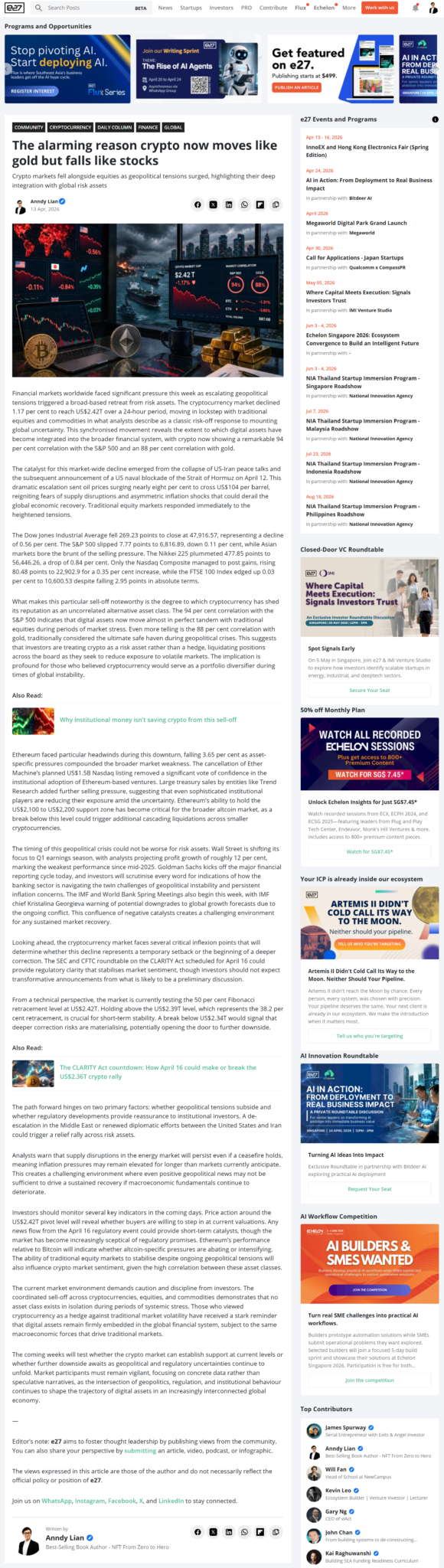
Financial markets worldwide faced significant pressure this week as escalating geopolitical tensions triggered a broad-based retreat from risk assets. The cryptocurrency market declined 1.17 per cent to reach US$2.42T over a 24-hour period, moving in lockstep with traditional equities and commodities in what analysts describe as a classic risk-off response to mounting global uncertainty. This synchronised movement reveals the extent to which digital assets have become integrated into the broader financial system, with crypto now showing a remarkable 94 per cent correlation with the S&P 500 and an 88 per cent correlation with gold.

The catalyst for this market-wide decline emerged from the collapse of US-Iran peace talks and the subsequent announcement of a US naval blockade of the Strait of Hormuz on April 12. This dramatic escalation sent oil prices surging nearly eight per cent to cross US$104 per barrel, reigniting fears of supply disruptions and asymmetric inflation shocks that could derail the global economic recovery. Traditional equity markets responded immediately to the heightened tensions.

The Dow Jones Industrial Average fell 269.23 points to close at 47,916.57, representing a decline of 0.56 per cent. The S&P 500 slipped 7.77 points to 6,816.89, down 0.11 per cent, while Asian markets bore the brunt of the selling pressure. The Nikkei 225 plummeted 477.85 points to 56,446.26, a drop of 0.84 per cent. Only the Nasdaq Composite managed to post gains, rising 80.48 points to 22,902.9 for a 0.35 per cent increase, while the FTSE 100 Index edged up 0.03 per cent to 10,600.53 despite falling 2.95 points in absolute terms.

What makes this particular sell-off noteworthy is the degree to which cryptocurrency has shed its reputation as an uncorrelated alternative asset class. The 94 per cent correlation with the S&P 500 indicates that digital assets now move almost in perfect tandem with traditional equities during periods of market stress. Even more telling is the 88 per cent correlation with gold, traditionally considered the ultimate safe haven during geopolitical crises. This suggests that investors are treating crypto as a risk asset rather than a hedge, liquidating positions across the board as they seek to reduce exposure to volatile markets. The implication is profound for those who believed cryptocurrency would serve as a portfolio diversifier during times of global instability.

Ethereum faced particular headwinds during this downturn, falling 3.65 per cent as asset-specific pressures compounded the broader market weakness. The cancellation of Ether Machine’s planned US$1.5B Nasdaq listing removed a significant vote of confidence in the institutional adoption of Ethereum-based ventures. Large treasury sales by entities like Trend Research added further selling pressure, suggesting that even sophisticated institutional players are reducing their exposure amid the uncertainty. Ethereum’s ability to hold the US$2,100 to US$2,200 support zone has become critical for the broader altcoin market, as a break below this level could trigger additional cascading liquidations across smaller cryptocurrencies.

The timing of this geopolitical crisis could not be worse for risk assets. Wall Street is shifting its focus to Q1 earnings season, with analysts projecting profit growth of roughly 12 per cent, marking the weakest performance since mid-2025. Goldman Sachs kicks off the major financial reporting cycle today, and investors will scrutinise every word for indications of how the banking sector is navigating the twin challenges of geopolitical instability and persistent inflation concerns. The IMF and World Bank Spring Meetings also begin this week, with IMF chief Kristalina Georgieva warning of potential downgrades to global growth forecasts due to the ongoing conflict. This confluence of negative catalysts creates a challenging environment for any sustained market recovery.

Looking ahead, the cryptocurrency market faces several critical inflexion points that will determine whether this decline represents a temporary setback or the beginning of a deeper correction. The SEC and CFTC roundtable on the CLARITY Act scheduled for April 16 could provide regulatory clarity that stabilises market sentiment, though investors should not expect transformative announcements from what is likely to be a preliminary discussion.

From a technical perspective, the market is currently testing the 50 per cent Fibonacci retracement level at US$2.42T. Holding above the US$2.39T level, which represents the 38.2 per cent retracement, is crucial for short-term stability. A break below US$2.34T would signal that deeper correction risks are materialising, potentially opening the door to further downside.

The path forward hinges on two primary factors: whether geopolitical tensions subside and whether regulatory developments provide reassurance to institutional investors. A de-escalation in the Middle East or renewed diplomatic efforts between the United States and Iran could trigger a relief rally across risk assets.

Analysts warn that supply disruptions in the energy market will persist even if a ceasefire holds, meaning inflation pressures may remain elevated for longer than markets currently anticipate. This creates a challenging environment where even positive geopolitical news may not be sufficient to drive a sustained recovery if macroeconomic fundamentals continue to deteriorate.

Investors should monitor several key indicators in the coming days. Price action around the US$2.42T pivot level will reveal whether buyers are willing to step in at current valuations. Any news flow from the April 16 regulatory event could provide short-term catalysts, though the market has become increasingly sceptical of regulatory promises. Ethereum’s performance relative to Bitcoin will indicate whether altcoin-specific pressures are abating or intensifying. The ability of traditional equity markets to stabilise despite ongoing geopolitical tensions will also influence crypto market sentiment, given the high correlation between these asset classes.

The current market environment demands caution and discipline from investors. The coordinated sell-off across cryptocurrencies, equities, and commodities demonstrates that no asset class exists in isolation during periods of systemic stress. Those who viewed cryptocurrency as a hedge against traditional market volatility have received a stark reminder that digital assets remain firmly embedded in the global financial system, subject to the same macroeconomic forces that drive traditional markets.

The coming weeks will test whether the crypto market can establish support at current levels or whether further downside awaits as geopolitical and regulatory uncertainties continue to unfold. Market participants must remain vigilant, focusing on concrete data rather than speculative narratives, as the intersection of geopolitics, regulation, and institutional behaviour continues to shape the trajectory of digital assets in an increasingly interconnected global economy.


Source: https://e27.co/the-alarming-reason-crypto-now-moves-like-gold-but-falls-like-stocks-20260413/

Anndy Lian is an early blockchain adopter and experienced serial entrepreneur who is known for his work in the government sector. He is a best selling book author- “NFT: From Zero to Hero” and “Blockchain Revolution 2030”.

Currently, he is appointed as the Chief Digital Advisor at Mongolia Productivity Organization, championing national digitization. Prior to his current appointments, he was the Chairman of BigONE Exchange, a global top 30 ranked crypto spot exchange and was also the Advisory Board Member for Hyundai DAC, the blockchain arm of South Korea’s largest car manufacturer Hyundai Motor Group. Lian played a pivotal role as the Blockchain Advisor for Asian Productivity Organisation (APO), an intergovernmental organization committed to improving productivity in the Asia-Pacific region.

An avid supporter of incubating start-ups, Anndy has also been a private investor for the past eight years. With a growth investment mindset, Anndy strategically demonstrates this in the companies he chooses to be involved with. He believes that what he is doing through blockchain technology currently will revolutionise and redefine traditional businesses. He also believes that the blockchain industry has to be “redecentralised”.

j j j

While stocks rally, gold hits US$4,780 and crypto correlation tells a hidden story

While stocks rally, gold hits US$4,780 and crypto correlation tells a hidden story

The crypto market’s modest 0.57 per cent gain, bringing total capitalisation to US$2.35T over the last 24 hours, tells a story far more nuanced than the headline suggests. The strength of the Ethereum ecosystem drove this movement, with the network outperforming the broader market by a significant margin. This divergence matters because it reveals where smart capital currently seeks refuge and growth. The 46 per cent correlation between crypto and Gold further underscores a market positioning itself for inflationary pressures, even as traditional risk assets rally on geopolitical hopes. I see this not as contradictory behaviour but as a sophisticated reallocation in which digital assets serve dual roles: as vehicles for speculative growth and as emerging stores of value.

Ethereum’s outperformance stems primarily from an unexpected source: a major security incident on Solana. The Drift Protocol exploit, where an attacker extracted substantial value, triggered a fascinating capital rotation. The exploiter now swaps over US$270M in stolen Solana-based assets into ETH, creating tangible on-chain buying pressure. This dynamic illustrates Ethereum’s evolving role as the preferred settlement layer during periods of uncertainty across competing chains. Rather than fleeing crypto entirely, capital seeks the network with the deepest liquidity, most robust developer activity, and strongest institutional recognition. I interpret this as validation of Ethereum’s long-term thesis: security and decentralisation compound value over time, especially when alternatives face stress. The market rewards resilience, and Ethereum’s ability to absorb this inflow without significant slippage demonstrates the maturity of its infrastructure.

Beyond the hack-driven flows, broader sentiment around Ethereum is supported by credible institutional developments and clarity on the protocol roadmap. Franklin Templeton’s move to launch an institutional crypto division signals traditional finance deepening its commitment to digital asset infrastructure. This is not speculative noise but strategic positioning by a firm managing hundreds of billions. Simultaneously, Ethereum’s 2026 protocol upgrades, including Glamsterdam and Hegotá, provide a tangible catalyst for long-term holders. These upgrades promise meaningful improvements to scalability and user experience, addressing the very concerns that limit broader adoption. Meanwhile, speculative capital rotates into low-market-cap tokens like StakeStone and TrustSwap, which posted triple-digit gains. This risk-taking behaviour indicates healthy market appetite, though I caution that such moves often precede consolidation. The combination of institutional validation and retail speculation creates a supportive, if uneven, foundation for prices.

From a technical perspective, Ethereum’s near-term trajectory hinges on its ability to reclaim the US$2,400-US$2,600 resistance zone. A confirmed close above the 50-day exponential moving average would signal strengthening momentum, potentially opening a path toward US$3,000. Immediate support rests near US$2,200, a level bulls must defend to maintain the current structure. I watch these levels closely because they reflect not just chart patterns but the collective psychology of market participants. The situation remains fluid pending further details on the Drift Protocol exploit. Any new information could alter the flow dynamics currently supporting ETH. Protocol upgrades also warrant attention: successful testnet deployments and clear timelines would reinforce confidence, while delays might trigger profit-taking. Technical analysis in crypto never operates in isolation; it intersects with on-chain data, macro sentiment, and narrative shifts.

This crypto market movement unfolds against the backdrop of a rallying global risk-asset market. On 2 April 2026, major indices posted gains as de-escalating tensions in the Middle East reduced the geopolitical risk premium. The S&P 500 closed at 6,575.32, up 0.72 per cent, while the Nasdaq Composite gained 1.16 per cent to 21,840.95, led by technology stocks. The Dow Jones Industrial Average rose 0.48 per cent to 46,565.74. Crude oil prices pulled back, with Brent futures falling 1.15 per cent to US$100.00 per barrel and WTI slipping to US$98.71 per barrel, as investors anticipated reduced risk of supply disruptions. Treasury yields edged higher, with the 10-year note yielding 4.33 per cent, reflecting capital rotation from safe-haven bonds into equities. Asian markets surged, notably South Korea’s KOSPI, which jumped 8.4 per cent. This global risk-on sentiment typically supports crypto, and Bitcoin traded relatively steady near US$68,103, suggesting digital assets currently follow idiosyncratic drivers more than broad equity beta.

Gold’s strength amid this risk-on environment deserves particular attention. Spot gold rose to approximately US$4,780.40 per ounce despite de-escalation headlines, indicating persistent demand for inflation hedges. The 46 per cent correlation between crypto and Gold suggests a segment of the market treats digital assets as complementary to precious metals in portfolio construction. I find this convergence logical: both assets offer alternatives to fiat currency systems, though through different mechanisms. Gold provides physical scarcity and historical precedent; crypto offers programmable scarcity and network utility. When investors allocate to both, they express a nuanced view: scepticism about long-term fiat stability coupled with confidence in technological innovation. This dual positioning explains why crypto can rise alongside traditional risk assets while maintaining a hedge-like correlation with gold.

The current market structure rewards selective participation. Broad index exposure may underperform focused positions in ecosystems demonstrating clear catalysts and resilient infrastructure. Ethereum’s dual role as a technological platform and a liquidity sink during cross-chain stress events positions it uniquely. I caution against overextrapolating short-term flows: the US$270M in exploited assets represents a transient catalyst, not a fundamental revaluation. Lasting gains require sustained developer activity, user adoption, and regulatory clarity. The convergence of institutional interest, protocol innovation, and macro hedging demand creates a compelling setup, but execution risk remains. I advocate for disciplined position sizing and continuous monitoring of on-chain metrics alongside traditional technical levels.

In this complex environment, my perspective emphasises independent analysis over narrative conformity. The market’s modest gain masks significant underlying dynamics: capital rotation among chains, shifts in institutional strategy, and macro hedging behaviour. These forces interact in ways that simple headlines cannot capture. I believe the next phase of crypto market development will reward those who understand network fundamentals, liquidity dynamics, and macro correlations simultaneously. 


Source:

https://e27.co/while-stocks-rally-gold-hits-us4780-and-crypto-correlation-tells-a-hidden-story-20260402/

Anndy Lian is an early blockchain adopter and experienced serial entrepreneur who is known for his work in the government sector. He is a best selling book author- “NFT: From Zero to Hero” and “Blockchain Revolution 2030”.

Currently, he is appointed as the Chief Digital Advisor at Mongolia Productivity Organization, championing national digitization. Prior to his current appointments, he was the Chairman of BigONE Exchange, a global top 30 ranked crypto spot exchange and was also the Advisory Board Member for Hyundai DAC, the blockchain arm of South Korea’s largest car manufacturer Hyundai Motor Group. Lian played a pivotal role as the Blockchain Advisor for Asian Productivity Organisation (APO), an intergovernmental organization committed to improving productivity in the Asia-Pacific region.

An avid supporter of incubating start-ups, Anndy has also been a private investor for the past eight years. With a growth investment mindset, Anndy strategically demonstrates this in the companies he chooses to be involved with. He believes that what he is doing through blockchain technology currently will revolutionise and redefine traditional businesses. He also believes that the blockchain industry has to be “redecentralised”.

j j j

Decoupling Finally? Why Crypto Is Up 2.57% While Stocks Are Down Today

Decoupling Finally? Why Crypto Is Up 2.57% While Stocks Are Down Today

While equity markets took a beating and Brent crude surged above $100 per barrel for the first time since 2022, crypto is doing the opposite. Escalating Middle East tensions and a blockage in the Strait of Hormuz sent traditional risk assets into freefall, yet the total crypto market cap climbed 2.57% to $2.46 trillion on March 13.

Bitcoin is sitting at $72,479, up 2.91% in 24 hours. Ethereum at $2,127, up 2.72%. On a day when almost nothing else was green, this is interesting.

The Correlation Data Is the Real Story

Crypto’s correlation with the S&P 500 currently sits at -14%, and against Gold it’s -34%. That is evidence that this rally wasn’t carried by broad market optimism.

Intergovernmental Blockchain advisor Anndy Lian noted that “digital assets are beginning to trade on their own fundamental narratives,” arguing this kind of independence signals a maturation that the asset class has long needed to evolve beyond its speculative ties to traditional finance.

Also Read: Did the Clarity Act Pass? Not Yet, But Banks Are Already Buying These 8 Altcoins

BlackRock Just Repackaged Ethereum

The most significant catalyst was BlackRock’s iShares Staked Ethereum Trust (ETHB), which debuted on Nasdaq on March 12 with $15.5 million in first-day volume.

Unlike previous crypto ETFs, ETHB gives investors both price exposure and staking rewards – repositioning Ethereum as a yield-bearing asset rather than a speculative play. Staking also locks up supply, which mechanically reduces sell-side pressure over time.

Altcoins Are Moving Too

Render is up 13.37% to $1.81, Layer 1 tokens advanced 1.58%, and Bitcoin dominance held steady at 58.78%, suggesting fresh capital is flowing into the broader market rather than concentrating in Bitcoin alone.

Analyst Michaël van de Poppe remains bullish, saying he expects Bitcoin to “test the highs and continue to rally towards $75,000 during this month.”

On the regulatory front, the US Senate passed a bill on March 12 blocking the Federal Reserve from issuing a retail CBDC – a clear signal of Washington’s direction on digital assets. Separately, unconfirmed reports of a zero percent crypto tax are circulating on social media, and markets appear to be pricing that in too.

The total crypto market cap is currently at $2.43T, up 2.35% on the day. With RSI sitting at a neutral 56 on the daily chart, there’s no immediate technical ceiling – the question now is whether sustained ETF inflows and policy clarity can keep the momentum going against a backdrop of rising oil and macro uncertainty.


Source: https://coinpedia.org/news/decoupling-finally-why-crypto-is-up-2-57-while-stocks-are-down-today/

Anndy Lian is an early blockchain adopter and experienced serial entrepreneur who is known for his work in the government sector. He is a best selling book author- “NFT: From Zero to Hero” and “Blockchain Revolution 2030”.

Currently, he is appointed as the Chief Digital Advisor at Mongolia Productivity Organization, championing national digitization. Prior to his current appointments, he was the Chairman of BigONE Exchange, a global top 30 ranked crypto spot exchange and was also the Advisory Board Member for Hyundai DAC, the blockchain arm of South Korea’s largest car manufacturer Hyundai Motor Group. Lian played a pivotal role as the Blockchain Advisor for Asian Productivity Organisation (APO), an intergovernmental organization committed to improving productivity in the Asia-Pacific region.

An avid supporter of incubating start-ups, Anndy has also been a private investor for the past eight years. With a growth investment mindset, Anndy strategically demonstrates this in the companies he chooses to be involved with. He believes that what he is doing through blockchain technology currently will revolutionise and redefine traditional businesses. He also believes that the blockchain industry has to be “redecentralised”.

j j j