Global sentiment lifts off: The US-EU agreement’s ripple through stocks, commodities, and digital currencies

Global sentiment lifts off: The US-EU agreement’s ripple through stocks, commodities, and digital currencies

The announcement of a US-EU trade agreement on Sunday has acted as a catalyst, easing tensions that had previously weighed on investor confidence. This development has had a ripple effect across various markets, influencing equities, bonds, commodities, and cryptocurrencies.

As we approach a week marked by high-stakes economic events and corporate earnings, understanding these dynamics becomes increasingly crucial. In my view, the renewed optimism is a welcome change, though the mixed signals in some markets suggest that caution remains warranted.

Let me tell you more.

A boost from the US-EU trade agreement

The US-EU trade agreement has emerged as a pivotal factor in lifting global risk sentiment. For months, trade uncertainty had cast a shadow over markets, with investors wary of escalating tariffs and disruptions to global supply chains.

The deal announced on Sunday has alleviated some of these concerns, fostering a more risk-on environment. Investors are now more inclined to allocate capital to growth-oriented assets like stocks, rather than seeking refuge in traditional safe havens like bonds or gold.

This shift reflects a broader belief that economic stability might be within reach, at least in the short term. However, with major events like the Federal Open Market Committee meeting and US payroll data looming, the sustainability of this optimism remains an open question.

US markets: Choppy trading and rising yields

In the United States, stock markets closed mixed after a volatile session, capturing the complexity of the current environment. The S&P 500 inched up by 0.02 per cent, signalling modest gains, while the NASDAQ climbed 0.33 per cent, driven by strength in technology stocks.

Meanwhile, the Dow Jones Industrial Average dipped by 0.14 per cent, hinting at lingering caution among traders. This uneven performance suggests that while the trade agreement has bolstered confidence, investors are still grappling with uncertainties tied to upcoming economic releases and corporate earnings.

US Treasury yields, which often serve as a barometer of market sentiment, edged higher across the curve. The 10-year Treasury yield rose by 2.2 basis points to 4.410 per cent, and the two-year yield ticked up by 0.2 basis points to 3.926 per cent.

These increases suggest that investors are shifting away from the safety of government bonds, aligning with the broader risk-on sentiment. Higher yields also reflect expectations of stronger economic growth, though they could pressure equity valuations if the trend accelerates.

The US Dollar Index, a measure of the dollar’s strength against major currencies, advanced by 1.01 per cent. A stronger dollar typically accompanies periods of economic optimism, as it did here, fuelled by the trade deal and improving risk appetite. This dollar rally could pose challenges for US exporters, but it also underscores the market’s faith in the resilience of the US economy.

Commodities: Diverging paths for gold and brent crude

Commodities have displayed divergent trends amid the shifting sentiment. Gold, a classic safe-haven asset, extended its retreat, falling by 0.68 per cent to US$3,315 per ounce.

This decline is understandable in the context of a rising risk appetite, as investors reduce their holdings of gold in favor of assets with higher potential returns. I see this as a natural response to the trade agreement, though gold could regain favor if new uncertainties emerge.

In contrast, Brent crude oil surged by 1.9 per cent to US$70 per barrel, propelled by President Trump’s proposal to impose secondary tariffs on nations purchasing Russian oil ahead of a 50-day deadline. This move has raised concerns about a tighter oil supply, which is expected to boost prices.

The rally also reflects the improving global economic outlook, which tends to lift energy demand. The energy market remains vulnerable to geopolitical shifts, and any escalation in trade disputes could alter this trajectory.

Asian markets and US futures: A mixed outlook

Asian stock markets mirrored the uneven performance seen in the US, with Japan’s Nikkei 225 pulling back by 1.1 per cent. This decline likely stemmed from profit-taking after recent gains, though it highlights that not all regions are fully embracing the risk-on wave. Despite this, US equity index futures suggest that US stocks will open higher, pointing to sustained positive momentum.

Investors are now fixated on a packed week ahead, featuring the FOMC meeting, US ISM manufacturing data, non-farm payrolls, second-quarter GDP figures, and earnings from four of the “Magnificent Seven” tech giants. These events will likely determine whether the current optimism persists or wanes.

Cryptocurrencies: Ethereum’s surge and Bitcoin’s mining milestone

The cryptocurrency market has also captured attention, with Ethereum briefly topping US$3,900, its highest level since December, before pulling back. This surge underscores growing investor enthusiasm for Ethereum, driven by its expanding role in decentralised finance and smart contract applications.

Bernstein analysts have noted that Ethereum treasuries, companies holding Ethereum as a reserve asset, are adopting a distinct approach compared to their Bitcoin-focused counterparts. These treasuries generate staking rewards, providing a yield on their holdings, which marks a significant evolution in how institutions utilise cryptocurrencies.

The analysts caution that this model introduces liquidity and security risks. Staking contracts, while generally liquid, can require days-long queues to unstake, forcing Ethereum treasuries to balance availability with yield optimisation. More advanced strategies, such as restaking or DeFi-based yield generation, further complicate matters by exposing firms to vulnerabilities in smart contracts.

This trade-off between yield and risk highlights the maturing nature of the crypto market, where innovation often comes with growing pains. Companies will need to navigate these challenges carefully to sustain Ethereum’s momentum.

Bitcoin, meanwhile, has seen its mining power approach a new record, with the 7-day average hashrate reaching 942 exahashes per second. This figure sits just below the all-time high of 943.6 exahashes per second set in mid-June, according to data from Blockchain.com.

The hashrate, which tracks the total computing power dedicated to mining Bitcoin, offers insight into the network’s security and the confidence of miners. The recent surge suggests that miners remain bullish on Bitcoin’s long-term prospects, despite its price cooling off in recent weeks.

This increase in mining power has persisted despite a new all-time high in Bitcoin’s difficulty, which adjusts to make mining more challenging as more power is added. Miners’ willingness to expand operations under these conditions reflects their belief in future price gains, likely driven by Bitcoin’s historical resilience and growing institutional adoption.

I find this development encouraging, as it signals a robust foundation for Bitcoin, though it also raises questions about energy consumption and profitability if prices stagnate.

My perspective: Optimism tempered by caution

From my standpoint, the advance in global risk sentiment is a positive development, particularly after months of trade-related uncertainty. The US-EU agreement has provided a much-needed lift, and its effects are evident across equities, currencies, and commodities.

The strength in the US dollar and Brent crude, coupled with Ethereum’s price surge and Bitcoin’s mining milestone, paints a picture of a market eager to move forward. Yet, the mixed performance of US and Asian stock markets, along with gold’s decline, reminds us that not all investors are thoroughly convinced.

The week ahead will be crucial in determining whether this momentum is sustained. The FOMC meeting could signal shifts in monetary policy, while economic data, such as payrolls and GDP, will shed light on the health of the US economy. Earnings from tech giants will also play a role, given their outsized influence on market indices.

In my opinion, the current risk-on environment offers opportunities, but investors should remain vigilant. The cryptocurrency space, with its blend of innovation and risk, exemplifies this duality. Ethereum treasuries and Bitcoin miners are pushing boundaries, yet they face hurdles that could temper their progress.


 

Source: https://e27.co/global-sentiment-lifts-off-the-us-eu-agreements-ripple-through-stocks-commodities-and-digital-currencies-20250729/

Anndy Lian is an early blockchain adopter and experienced serial entrepreneur who is known for his work in the government sector. He is a best selling book author- “NFT: From Zero to Hero” and “Blockchain Revolution 2030”.

Currently, he is appointed as the Chief Digital Advisor at Mongolia Productivity Organization, championing national digitization. Prior to his current appointments, he was the Chairman of BigONE Exchange, a global top 30 ranked crypto spot exchange and was also the Advisory Board Member for Hyundai DAC, the blockchain arm of South Korea’s largest car manufacturer Hyundai Motor Group. Lian played a pivotal role as the Blockchain Advisor for Asian Productivity Organisation (APO), an intergovernmental organization committed to improving productivity in the Asia-Pacific region.

An avid supporter of incubating start-ups, Anndy has also been a private investor for the past eight years. With a growth investment mindset, Anndy strategically demonstrates this in the companies he chooses to be involved with. He believes that what he is doing through blockchain technology currently will revolutionise and redefine traditional businesses. He also believes that the blockchain industry has to be “redecentralised”.

j j j

Enhancing Web3.0 security through on-chain data analysis: Insights from industry leaders

Enhancing Web3.0 security through on-chain data analysis: Insights from industry leaders

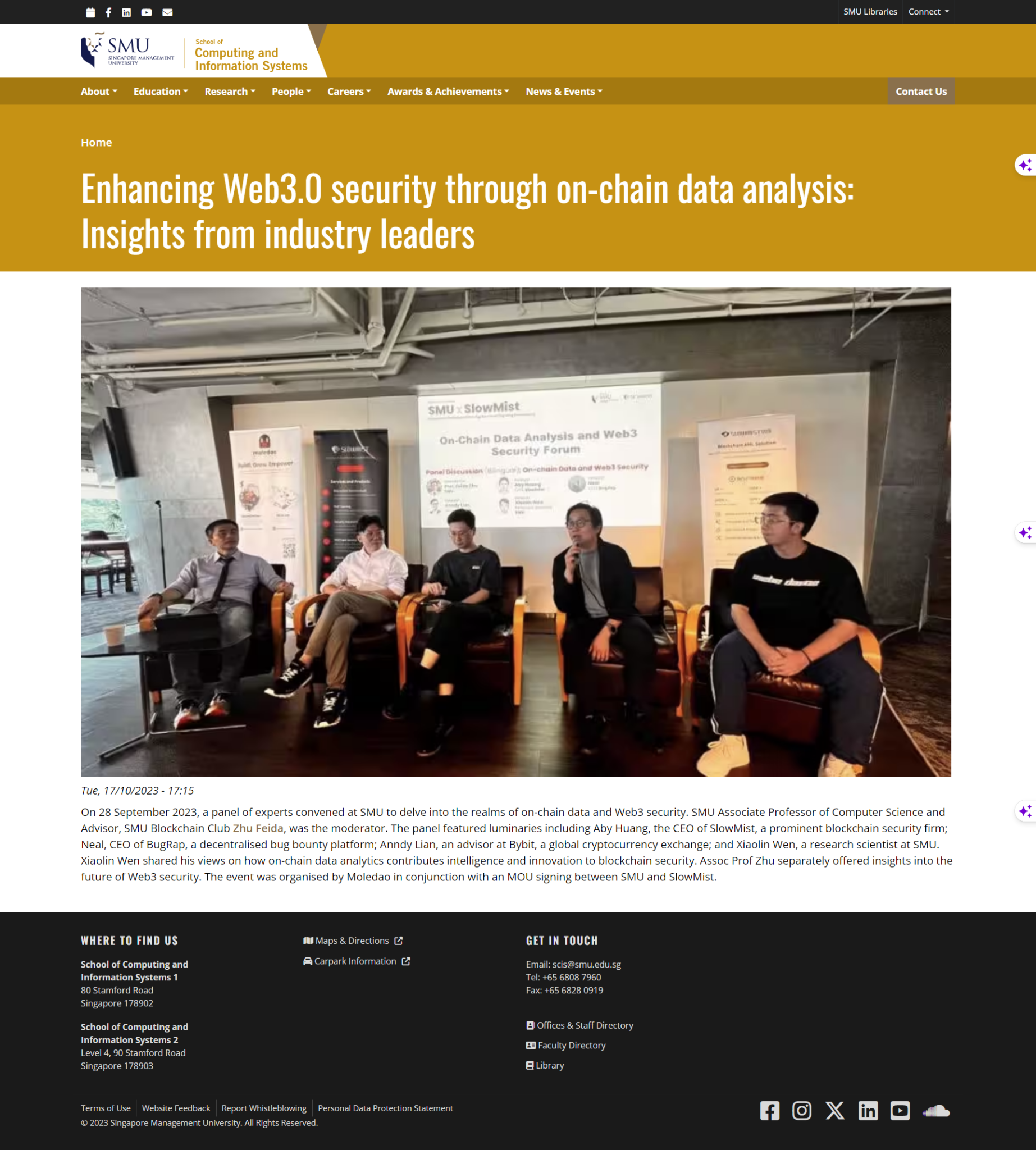
On 28 September 2023, a panel of experts convened at SMU to delve into the realms of on-chain data and Web3 security. SMU Associate Professor of Computer Science and Advisor, SMU Blockchain Club Zhu Feida, was the moderator. The panel featured luminaries including Aby Huang, the CEO of SlowMist, a prominent blockchain security firm; Neal, CEO of BugRap, a decentralised bug bounty platform; Anndy Lian, an advisor at Bybit, a global cryptocurrency exchange; and Xiaolin Wen, a research scientist at SMU. Xiaolin Wen shared his views on how on-chain data analytics contributes intelligence and innovation to blockchain security. Assoc Prof Zhu separately offered insights into the future of Web3 security. The event was organised by Moledao in conjunction with an MOU signing between SMU and SlowMist.

Source: https://scis.smu.edu.sg/news/2023/oct/17/enhancing-web30-security-through-chain-data-analysis-insights-industry-leaders

Anndy Lian is an early blockchain adopter and experienced serial entrepreneur who is known for his work in the government sector. He is a best selling book author- “NFT: From Zero to Hero” and “Blockchain Revolution 2030”.

Currently, he is appointed as the Chief Digital Advisor at Mongolia Productivity Organization, championing national digitization. Prior to his current appointments, he was the Chairman of BigONE Exchange, a global top 30 ranked crypto spot exchange and was also the Advisory Board Member for Hyundai DAC, the blockchain arm of South Korea’s largest car manufacturer Hyundai Motor Group. Lian played a pivotal role as the Blockchain Advisor for Asian Productivity Organisation (APO), an intergovernmental organization committed to improving productivity in the Asia-Pacific region.

An avid supporter of incubating start-ups, Anndy has also been a private investor for the past eight years. With a growth investment mindset, Anndy strategically demonstrates this in the companies he chooses to be involved with. He believes that what he is doing through blockchain technology currently will revolutionise and redefine traditional businesses. He also believes that the blockchain industry has to be “redecentralised”.

j j j

Enhancing Web3.0 security through on-chain data analysis: Insights from industry leaders

Enhancing Web3.0 security through on-chain data analysis: Insights from industry leaders

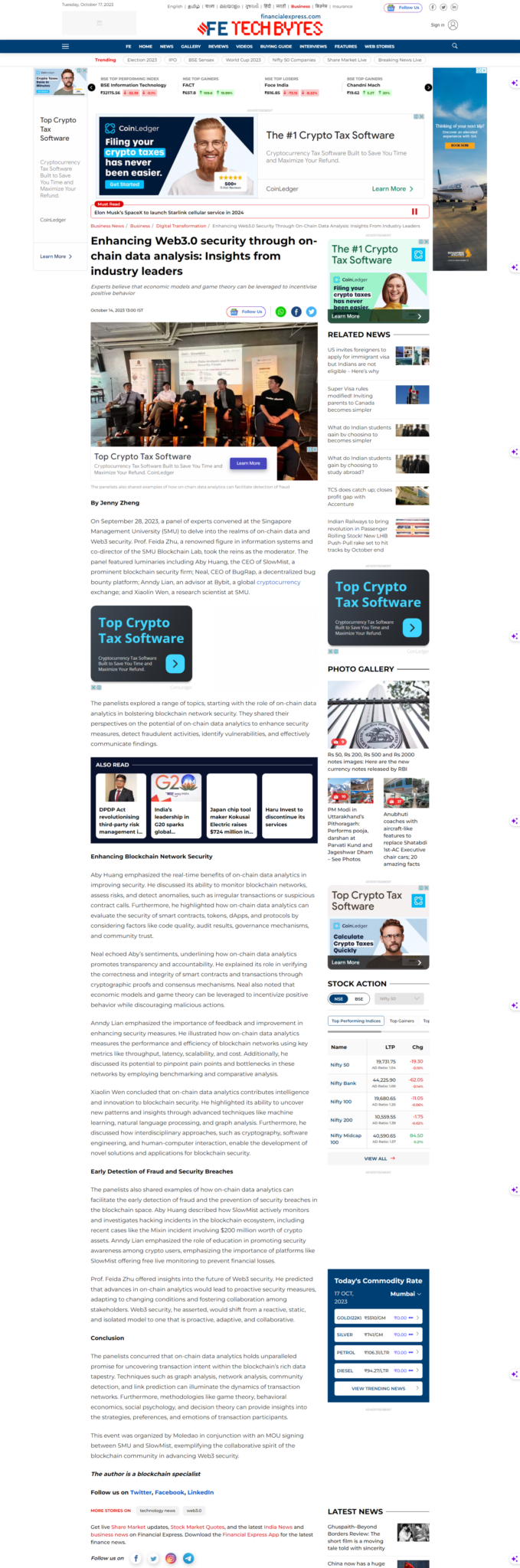
On September 28, 2023, a panel of experts convened at the Singapore Management University (SMU) to delve into the realms of on-chain data and Web3 security. Prof. Feida Zhu, a renowned figure in information systems and co-director of the SMU Blockchain Lab, took the reins as the moderator. The panel featured luminaries including Aby Huang, the CEO of SlowMist, a prominent blockchain security firm; Neal, CEO of BugRap, a decentralized bug bounty platform; Anndy Lian, an advisor at Bybit, a global cryptocurrency exchange; and Xiaolin Wen, a research scientist at SMU.

The panelists explored a range of topics, starting with the role of on-chain data analytics in bolstering blockchain network security. They shared their perspectives on the potential of on-chain data analytics to enhance security measures, detect fraudulent activities, identify vulnerabilities, and effectively communicate findings.

Enhancing Blockchain Network Security

Aby Huang emphasized the real-time benefits of on-chain data analytics in improving security. He discussed its ability to monitor blockchain networks, assess risks, and detect anomalies, such as irregular transactions or suspicious contract calls. Furthermore, he highlighted how on-chain data analytics can evaluate the security of smart contracts, tokens, dApps, and protocols by considering factors like code quality, audit results, governance mechanisms, and community trust.

Neal echoed Aby’s sentiments, underlining how on-chain data analytics promotes transparency and accountability. He explained its role in verifying the correctness and integrity of smart contracts and transactions through cryptographic proofs and consensus mechanisms. Neal also noted that economic models and game theory can be leveraged to incentivize positive behavior while discouraging malicious actions.

Anndy Lian emphasized the importance of feedback and improvement in enhancing security measures. He illustrated how on-chain data analytics measures the performance and efficiency of blockchain networks using key metrics like throughput, latency, scalability, and cost. Additionally, he discussed its potential to pinpoint pain points and bottlenecks in these networks by employing benchmarking and comparative analysis.

Xiaolin Wen concluded that on-chain data analytics contributes intelligence and innovation to blockchain security. He highlighted its ability to uncover new patterns and insights through advanced techniques like machine learning, natural language processing, and graph analysis. Furthermore, he discussed how interdisciplinary approaches, such as cryptography, software engineering, and human-computer interaction, enable the development of novel solutions and applications for blockchain security.

Early Detection of Fraud and Security Breaches

The panelists also shared examples of how on-chain data analytics can facilitate the early detection of fraud and the prevention of security breaches in the blockchain space. Aby Huang described how SlowMist actively monitors and investigates hacking incidents in the blockchain ecosystem, including recent cases like the Mixin incident involving $200 million worth of crypto assets. Anndy Lian emphasized the role of education in promoting security awareness among crypto users, emphasizing the importance of platforms like SlowMist offering free live monitoring to prevent financial losses.

Prof. Feida Zhu offered insights into the future of Web3 security. He predicted that advances in on-chain analytics would lead to proactive security measures, adapting to changing conditions and fostering collaboration among stakeholders. Web3 security, he asserted, would shift from a reactive, static, and isolated model to one that is proactive, adaptive, and collaborative.

Conclusion

The panelists concurred that on-chain data analytics holds unparalleled promise for uncovering transaction intent within the blockchain’s rich data tapestry. Techniques such as graph analysis, network analysis, community detection, and link prediction can illuminate the dynamics of transaction networks. Furthermore, methodologies like game theory, behavioral economics, social psychology, and decision theory can provide insights into the strategies, preferences, and emotions of transaction participants.

This event was organized by Moledao in conjunction with an MOU signing between SMU and SlowMist, exemplifying the collaborative spirit of the blockchain community in advancing Web3 security.


Source: https://www.financialexpress.com/business/digital-transformation-enhancing-web3-0-security-through-on-chain-data-analysis-insights-from-industry-leaders-3272181/

Anndy Lian is an early blockchain adopter and experienced serial entrepreneur who is known for his work in the government sector. He is a best selling book author- “NFT: From Zero to Hero” and “Blockchain Revolution 2030”.

Currently, he is appointed as the Chief Digital Advisor at Mongolia Productivity Organization, championing national digitization. Prior to his current appointments, he was the Chairman of BigONE Exchange, a global top 30 ranked crypto spot exchange and was also the Advisory Board Member for Hyundai DAC, the blockchain arm of South Korea’s largest car manufacturer Hyundai Motor Group. Lian played a pivotal role as the Blockchain Advisor for Asian Productivity Organisation (APO), an intergovernmental organization committed to improving productivity in the Asia-Pacific region.

An avid supporter of incubating start-ups, Anndy has also been a private investor for the past eight years. With a growth investment mindset, Anndy strategically demonstrates this in the companies he chooses to be involved with. He believes that what he is doing through blockchain technology currently will revolutionise and redefine traditional businesses. He also believes that the blockchain industry has to be “redecentralised”.

j j j