
CeFi, a ‘necessary evil’ today: 7 reasons why trustless DEX is the future

CeFi, a ‘necessary evil’ today: 7 reasons why trustless DEX is the future

An increasing number of DEXes are integrating scaling solutions that will massively increase transaction workload while keeping costs low

Amidst talks of growing adoption and decentralisation becoming the norm, the great decentralised exchange (DEX) vs centralised exchange (CEX) debate is more prominent now than ever. This debate has many case studies for us to refer to.

The latest would be FTX. FTX owes nearly US$3.1 billion to the top 50 creditors and is estimated to have “more than 100,000” creditors.

Why trustless DEX is the way forward

  • Individual data and asset control

CEX holds custody of your deposited assets and all your personal information. You have no control over how the assets and data are being used. While in a DEX environment, it is non-custodial; typically, only an individual wallet address is connected to the exchange. In other words, you have complete control over your assets.

  • Liquidity and market depth

Historically, CEX is known for deeper liquidity and market depth. DEXes, in general, are trying to catch up with CEX’s efficiency in matching and executing orders. But the top DEXes have good enough liquidity and market depth for the major coins, and in fact, DEX’s liquidity is more accurate and traceable.

  • KYC and accessibility

KYC is often required for withdrawals exceeding a specific amount or specific trading products, and it is typically region-locked for most CEXes. While DEX has no KYC, traders only need a wallet address. This helps to drive accessibility to true financial freedom.

  • User-friendliness

CEX provides a wide range of products, including spot and fiat on-ramps, which is most familiar to traditional and crypto traders, especially beginners. DEX products may be harder to grasp with insufficient onboarding guidelines for traders. Again, this point for DEX is changing.

The user interface and experience have significantly improved; some of the newer DEXes look and function exactly like CEX.

  • Transaction costs

CEX is known for high transaction or platform costs, especially when the system is hugely loaded with trades at a single point in time. An increasing number of DEXes are integrating scaling solutions that will massively increase transaction workload while keeping costs low and passing the savings on to traders.

  • Community involvement

CEXes, are often one-way, non-reciprocal communication from a central operator to traders. Individual traders are seen as clients utilising as service that the CEX provides. While DEXes focus on community-building and involvement, where traders can become stakeholders and have a say in protocol changes or share in transaction fees on the platform.

  • Transparency

DEXes offer strong execution guarantees and increased transparency into the underlying mechanics of trading. Trades are trackable, traceable and data is permanently on-chain. This is one of the core basics and the beauty behind the ideology of DEXes.

A new DEX era

The challenge with CeFi and CEXes boils down to a lack of trust and security. This is continually reinforced time and again; this year is no different, with funds, exchanges and even established projects hitting the buffers and leaving behind affected, concerned investors and traders fearing for their assets.

News of increased risk with CEXes come into question of insolvency and possible withdrawal delays, causing widespread panic amongst traders.

I would like to discuss the following DEXes for your reference and research purposes.

dyxX

dYdX is a decentralised exchange (DEX) platform that offers perpetual trading options for over 35 popular cryptocurrencies, including Bitcoin (BTC), Ether (ETH), Dogecoin (DOGE) and Cardano (ADA).

Non-custodial exchange dYdX has climbed to the top of the DEX rankings by trading volume, beating out Uniswap, for the first time. More than US$9 billion has been exchanged on the trading platform in the last 24 hours in 2021, according to data provider CoinMarketCap.

Also during the same time, according to CoinGecko, dYdX has facilitated more than US$4.3 billion worth of trades in the past 24 hours, beating out Coinbase’s  US$3.7 billion

They changed how DEXes were perceived back then.

ApeX Pro

ApeX Pro is set out to be a dynamic non-custodial derivatives DEX powered by StarkWare’s Layer two scalability engine StarkEx — all to deliver a made-to-order, permissionless platform designed for precision trading.

This comes after ApeX Protocol’s initial ApeX elastic Automated Market Maker (eAMM) launch, where popular inverse perpetual contracts were supported; automatic, fully permissionless and without needing KYC. With full spectrum asset support, ApeX Protocol was able to uplift decentralised derivatives trades.

To add on, they are multi-chain supported. This responded well to the demand from the market.

Just Ex

Another multi-chain DEX is Just Ex. They are relatively new, and currently, they support APTOS, SUI and Solana. They will support Ethereum and BNB Chain later on. This strategy is also different, as we all know that most of these multi-chain DEXes are usually based on Ethereum first.

At the point of publishing, I have not tried the DEX yet, but the fact that it has no slippage, open trade and infrastructure API ready and that they are order-book based are worth exploring.

As usual, I will end with a quote:

The answer is to return to the basics of what blockchain is supposed to be. It is decentralisation and transparency. DeFi is one of the solutions, and we need to work together to build the future. For now, it cannot replace CeFi completely for obvious reasons, but this will not stop us from trying.


Source: https://e27.co/cefi-a-necessary-evil-today-7-reasons-why-trustless-dex-is-the-future-20221123/

Anndy Lian is an early blockchain adopter and experienced serial entrepreneur who is known for his work in the government sector. He is a best selling book author- “NFT: From Zero to Hero” and “Blockchain Revolution 2030”.

Currently, he is appointed as the Chief Digital Advisor at Mongolia Productivity Organization, championing national digitization. Prior to his current appointments, he was the Chairman of BigONE Exchange, a global top 30 ranked crypto spot exchange and was also the Advisory Board Member for Hyundai DAC, the blockchain arm of South Korea’s largest car manufacturer Hyundai Motor Group. Lian played a pivotal role as the Blockchain Advisor for Asian Productivity Organisation (APO), an intergovernmental organization committed to improving productivity in the Asia-Pacific region.

An avid supporter of incubating start-ups, Anndy has also been a private investor for the past eight years. With a growth investment mindset, Anndy strategically demonstrates this in the companies he chooses to be involved with. He believes that what he is doing through blockchain technology currently will revolutionise and redefine traditional businesses. He also believes that the blockchain industry has to be “redecentralised”.

j j j

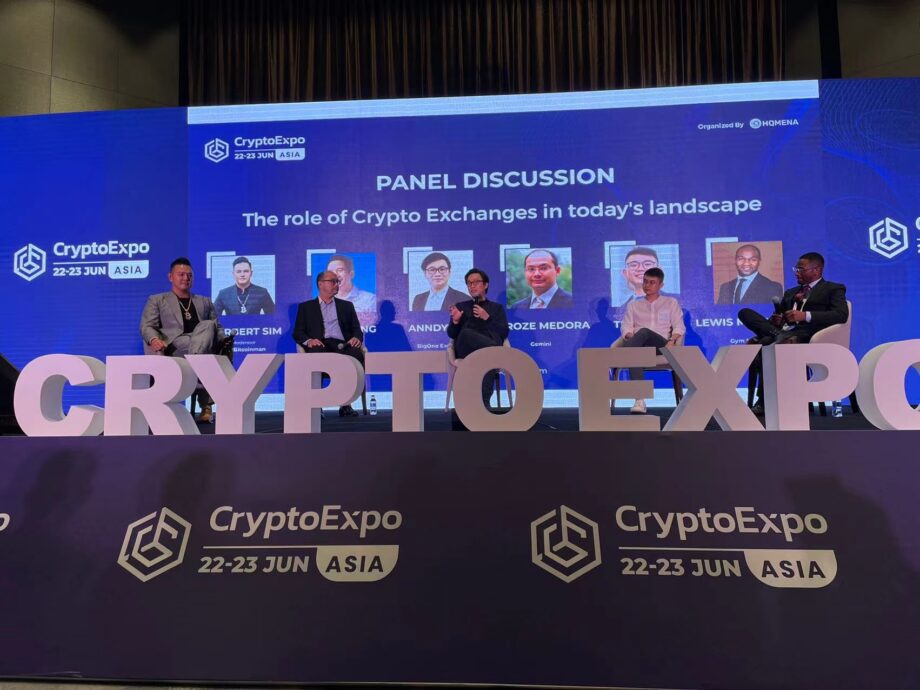
Crypto Expo Asia 2022 Singapore: The Role of Crypto Exchanges in Today’s Landscape

Crypto Expo Asia 2022 Singapore: The Role of Crypto Exchanges in Today’s Landscape

Crypto Expo Asia is the largest event in Asia for Investors and Crypto industry leaders to network and explore more business opportunities in the crypto space. They provide the market’s leading content & updates on the Crypto and Blockchain industry that will help you explore the investment opportunities available as smartly and securely.

A crypto exchange is a platform on which you can buy and sell cryptocurrency. You can use exchanges to trade one crypto for another — converting Bitcoin to Binance Coin, for example — or to buy crypto using regular currency, like the U.S. Dollar. Cryptocurrencies make it easier for people in different countries to pay each other, negating financial borders currently controlled by banks and governments. The panel comprises experts and practitioners from centralized exchanges. They will share insights on the role of Crypto Exchanges in today’s landscape.

The session is moderated by Herbert Sim, Bitcoin Man and with panelists Feroze Medora, Gemini; Anndy Lian, BigONE; Travis Teo, Tokenize and Lewis Mahlanga, Gym Network.

The following questions were addressed:

#1 The explosion of thus many crypto exchanges is the white-labelling phenomena, which allows for almost instant creation of an exchange. With all this proliferation, the nature of platforms continues to diversify. What is the current role of exchanges today, besides crypto trading?

Lewis Mahlanga: “We need to educate the market about cryptocurrencies.”

#2 Centralized Exchanges versus Decentralized Exchanges. What are your thoughts? Pros and cons?

Travis Teo: “As a new user, you might not know how the wallets work. You are also may not know where to obtain ETH or SOL. CEX will act as a bridge for these new users to guide them through the process.”

#3 To list out some more roles that a crypto exchange could play – Payment services (Remittance, Escrow Service, Micropayments, Merchant Services – Gateway processor, Mobile PoS card reader, Debit card; and more); Mobile wallet, ATM. What are the differentiating factors which sets apart each of the exchanges?

Herbert Sim: “Security of the exchange, how credible it is.”

#4 A big challenge for centralized crypto exchanges over the years is custodial. Users are required to perform mandatory tasks to sign up and verify their identity. Fees can be expensive because platform takes a percentage of initial investment, and off every trade. While there is high level of trust in the CEX from the users, the CEX actually holds the private keys to the tokens and the funds, which makes it subject to hacking. And we have all seen massive multi-million, even close to billion dollar hacks taken place, even in the present day. What are your thoughts about CEX’s custodial today?

#5 Possibly the toughest, most controversial question for crypto exchanges. What are your thoughts on wash-trading? And rankings on CoinMarketCap?

Feroze Medora: “Even though we are in a very new industry, I like the expression ‘Nothing is new under the sun’. Wash trading falls under the border category of market manipulation. Which are features of regular financial market for very time.”

#6 The question that is probably the biggest challenge for crypto exchanges. What are your thoughts on regulations by regulators across the world – from US SEC, to China’s PBoC, and here in Singapore Monetary Authority of Singapore (MAS)?

#7 Let’s talk about crypto trading specifically. Mobile Financial Trading, Derivatives Trading, Future Trading, Financial Trading. What’s next? What do you think is the future of trading?

Anndy Lian: “I think derivatives trading would be the strongest and will be one of the key crypto highlights. NFT trading and NFT marketplace would be the next to look at too. The current NFT market has not reached its fullest potential in terms of trading, because it has not hit a critical volume. We should look at this market seriously, build products on top of NFT, facilitate it with real utility and link back to spot/ derivatives trading to optimize its full potential.”

Crypto Expo Asia 2022 is held on 22 – 23 June 2022, at Raffles City Convention Centre, Singapore. The second day of the event will feature speakers from ConsenSys, UOB, OKX, Bybit, Fireblocks and many more. More information can be obtained at https://cryptoexpoasia.com/.

This article is produced by BLOCKCAST.CC.

Anndy Lian is an early blockchain adopter and experienced serial entrepreneur who is known for his work in the government sector. He is a best selling book author- “NFT: From Zero to Hero” and “Blockchain Revolution 2030”.

Currently, he is appointed as the Chief Digital Advisor at Mongolia Productivity Organization, championing national digitization. Prior to his current appointments, he was the Chairman of BigONE Exchange, a global top 30 ranked crypto spot exchange and was also the Advisory Board Member for Hyundai DAC, the blockchain arm of South Korea’s largest car manufacturer Hyundai Motor Group. Lian played a pivotal role as the Blockchain Advisor for Asian Productivity Organisation (APO), an intergovernmental organization committed to improving productivity in the Asia-Pacific region.

An avid supporter of incubating start-ups, Anndy has also been a private investor for the past eight years. With a growth investment mindset, Anndy strategically demonstrates this in the companies he chooses to be involved with. He believes that what he is doing through blockchain technology currently will revolutionise and redefine traditional businesses. He also believes that the blockchain industry has to be “redecentralised”.

j j j

“CBDC is the beginning of another evolution” Anndy Lian told Blockchain Today Magazine

“CBDC is the beginning of another evolution” Anndy Lian told Blockchain Today Magazine

South Korea leading blockchain magazine “Blockchain Today Magazine” published Anndy Lian’s thoughts on CBDC. This quote can be found on Blockchain Today Magazine, Volume 29 Special Edition, page 43.

암호 화폐 지불에 대한 수요가있을 때 암호 화폐 채택 으로 시장을 이끌 것이고, CBDC는 또 다른 진화의 시작입니다. 개인 적으로 가장 매력적인 사용 사례는 CBDC라고 생각합니다. 투명한 외환으로 연중 무휴 24 시간 국제 거래를 돕는 디지털화는 믿을 수 없을만큼 강력합니다. XRP, BNB, LTC 또는 스 테이블 코 인은 CBDC 이니셔티브에 맞춰 디 지털 법정 화폐를 교환하기위한 브리지 자산 역할을 할 것입니다. 블록 체인 및 암호 화폐 회사가 코 인과 블록 체인 기술이 미래 CBDC의 형성에 어떻게 도움이 될 수 있는지 보여주기 위해 이제 첫 번 째 단계를 밟아야합니다.- Anndy Lian, Advisory Board Member, Hyundai DAC

When there is demand for cryptocurrency payments, it will lead the market to cryptocurrency adoption, and CBDC is the beginning of another evolution. Personally, I think the most attractive use case is CBDC. Digitization is incredibly powerful, helping international trading 24/7 with transparent foreign exchange. XRP, BNB, LTC, or stablecoin will serve as a bridge asset to exchange digital fiat currencies in line with the CBDC initiative. Blockchain and cryptocurrency companies must now take the first step to show how coins and blockchain technology can help shape the future CBDC. (Direct translation by Google Translate)

CBDC stands for “central bank digital currency,” a new type of currency that governments around the world are experimenting with. Central banks have constantly evolved through the centuries, and history shows that. CBDCs is one o which. For a start, CBDC would ensure that economies go digital. It is more than just another way to pay. It is a catalyst for currency innovation.

Original Source: https://ebook.etarae.com/blockchain_today/02/#p=43


Anndy Lian is an early blockchain adopter and experienced serial entrepreneur who is known for his work in the government sector. He is a best selling book author- “NFT: From Zero to Hero” and “Blockchain Revolution 2030”.

Currently, he is appointed as the Chief Digital Advisor at Mongolia Productivity Organization, championing national digitization. Prior to his current appointments, he was the Chairman of BigONE Exchange, a global top 30 ranked crypto spot exchange and was also the Advisory Board Member for Hyundai DAC, the blockchain arm of South Korea’s largest car manufacturer Hyundai Motor Group. Lian played a pivotal role as the Blockchain Advisor for Asian Productivity Organisation (APO), an intergovernmental organization committed to improving productivity in the Asia-Pacific region.

An avid supporter of incubating start-ups, Anndy has also been a private investor for the past eight years. With a growth investment mindset, Anndy strategically demonstrates this in the companies he chooses to be involved with. He believes that what he is doing through blockchain technology currently will revolutionise and redefine traditional businesses. He also believes that the blockchain industry has to be “redecentralised”.

j j j