Biggest Friend.tech whale dumps tokens as users struggle to claim airdrop

Biggest Friend.tech whale dumps tokens as users struggle to claim airdrop

The largest airdrop recipient on Friend.tech has sold all their tokens just hours after the airdrop, leading to concerns over the token’s price action.

Just hours after the Friend.tech airdrop went live on May 3, the largest whale, known as “Murphys1d,” sold over 55,000 of the newly-issued Friend tokens, blockchain data shows.

Beyond the sell-off, some users were unable to claim their airdrop tokens, including crypto investor Luke Martin, who wrote in a May 3 X post:

“Watching the value of my airdrop go from 7 figures to 5 figures in the span of 2 hours while I keep refreshing the page trying to claim….still can’t claim. Adds insult to injury.”

Martin added that the whale wallet seems to be linked to a fake X account with no activity, enabling it to farm over 500,000 Friend.tech points risk-free.

The new Friend.tech (FRIEND) token has fallen over 52.5% since its launch, from $3.26 to just $1.32 as of 9:50 am UTC. The token’s price fell over 32% in the last hour before publication, according to CoinGecko data.

While the selling by the largest Friend.tech whale may impact the market in the short term, it doesn’t necessarily dictate a token’s long-term trajectory, according to Anndy Lian, intergovernmental blockchain expert and author of NFT: From Zero to Hero. Lian told Cointelegraph:

“While it might cause a short-term dip in price due to increased supply and potential panic selling, it doesn’t always mean a long-term downtrend. To me, it is a good thing […] The sell-off would mean a more decentralized distribution of tokens. A broader distribution reduces the risk of a single entity having excessive control over the project.”

However, Lian noted that the token’s value will mainly rely on the community’s trust in Friend.tech and how the team manages the current situation.


Airdrop farmers continue to plague token launches

The mysterious Friend.tech whale is another example of a professional airdrop farmer (squatter) who interacts with emerging protocols solely for the airdrop rewards, often with multiple wallets to compound rewards.

The main issue with airdrop farmers is that they tend to market sell all their airdropped tokens, creating significant sell pressure and resulting in more panic selling by legitimate protocol users.

An example of this came at the end of April, when the Omni Network’s OMNI token fell 55% in less than 18 hours following its airdrop, losing over half its market capitalization.

In March 2023, it was revealed that airdrop hunters consolidated $3.3 million worth of tokens from Arbitrum’s ARB airdrop from 1,496 wallets into just two wallets they had controlled.


Source: https://cointelegraph.com/news/friend-tech-airdrop-largest-recipient-sells-tokens

Anndy Lian is an early blockchain adopter and experienced serial entrepreneur who is known for his work in the government sector. He is a best selling book author- “NFT: From Zero to Hero” and “Blockchain Revolution 2030”.

Currently, he is appointed as the Chief Digital Advisor at Mongolia Productivity Organization, championing national digitization. Prior to his current appointments, he was the Chairman of BigONE Exchange, a global top 30 ranked crypto spot exchange and was also the Advisory Board Member for Hyundai DAC, the blockchain arm of South Korea’s largest car manufacturer Hyundai Motor Group. Lian played a pivotal role as the Blockchain Advisor for Asian Productivity Organisation (APO), an intergovernmental organization committed to improving productivity in the Asia-Pacific region.

An avid supporter of incubating start-ups, Anndy has also been a private investor for the past eight years. With a growth investment mindset, Anndy strategically demonstrates this in the companies he chooses to be involved with. He believes that what he is doing through blockchain technology currently will revolutionise and redefine traditional businesses. He also believes that the blockchain industry has to be “redecentralised”.

j j j

New Crypto Trend: Trading Tokens Before Release

New Crypto Trend: Trading Tokens Before Release

A new trend is taking off in the cryptocurrency community — as investors start to purchase tokens before waiting for them to hit the markets.

In a fast-paced industry, being an early investor is a crucial step as it allows individuals to potentially capitalize on significant price appreciation as innovative projects gain traction and adoption.

And now, investors are finding ways to start buying before the firing pistol has signaled the start of the race.

Here’s everything you need to know.

Key Takeaways

  • Investing in tokens before their release allows investors to potentially benefit from significant price increases as projects gain traction.
  • Platforms like AEVO and Hyperliquid have introduced new opportunities to speculate or hedge against future token prices, marking a shift from traditional ICOs to more dynamic pre-token trading environments.
  • Pre-token and point market sales have seen $50 million in trades despite low liquidity.
  • The pre-token and point markets are heavily dominated by buyers, a sign of potential investor confidence.
  • Despite the enthusiasm and high trading volumes, these markets face challenges such as lower liquidity and higher volatility compared to post-TGE markets.

Pre-Token & Point Markets Take Off

Until recently, investors could purchase cryptocurrencies prior to their official launch through their initial coin offering (ICO), a fundraising mechanism used by new decentralized finance (DeFi) projects to raise capital by selling tokens to investors prior to a project’s full development.

This allows anyone to speculate on or hedge against the price of a token before its launch, creating a new era of crypto investing.

In short, pre-token and point markets are platforms that allow people to buy or sell the promise of receiving tokens or points at a future date, often before the official release of the token.

Such markets are divided into two main types: one where trades are settled with cash and another where the actual tokens or points are exchanged. Such a setup lets investors speculate on the future value of tokens or points, potentially profiting from changes in their price before they become available.

According to Anndy Lian, an inter-governmental blockchain adviser, by participating in pre-sales, investors get the opportunity to directly support the development and growth of new projects, as well as create a sense of community and alignment with the project’s goals.

He said:

“This community effect can drive demand as more people become involved and invested in the token’s success. Effective marketing campaigns can generate significant hype around a token before its release, leading to increased demand as investors don’t want to miss out on what is being promoted as a promising opportunity.”

A Keyrock report released on April 30 uncovered that the crypto community has seen a notable surge in interest and participation in these pre-tokens and point markets with $50 million already being traded.

This high level of activity reflects a growing enthusiasm among investors to engage with new crypto projects at an early stage.

The markets predominantly cater to buyers, with the majority of orders coming from users eager to purchase tokens or points ahead of their public release. This eagerness is driven by the potential for high returns on investments as token values can increase significantly upon official launch.

Pre-token & Point Markets See Higher Buyer Dominance

According to the Keyrock report, the markets showed a pronounced buyer dominance, with most tokens analysed displaying a higher buying than selling volume.

This trend suggested that investors were more interested in acquiring tokens rather than selling them, believing in the potential for token value appreciation after their Token Generation Event (TGE).

The report highlighted:

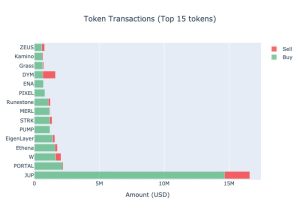
“Most tokens exhibit a buying volume significantly higher than the sell volume. Only 5 out of 57 tokens that have been traded on Whales Market show a selling volume that exceeds the buy volume. Participants in Whale Markets demonstrate a strong preference for buying tokens, points, and runes.”

Data on buying vs selling tokens from Whales Market. Source: Keyrock Data Intelligence

Data on buying vs selling tokens from Whales Market. Source: Keyrock Data Intelligence

Liquidity Remains Low

Despite optimistic trading volumes, pre-token and point markets still face challenges related to liquidity.

The Keyrock report highlighted that compared to traditional post-TGE markets, pre-token and point markets are relatively less liquid, meaning they have relatively fewer buyers and sellers, which could lead to price volatility and make it harder to execute larger orders without affecting the market price.

Additionally, sometimes the demand for a pre-release token is driven more by hype and marketing than by the project’s fundamentals, which could lead to an inflated valuation that does not reflect the token’s true worth, Lian explained.

“Projects that prioritize transparency, communication, and community trust are more likely to succeed in pre-release trading. Investors will gravitate toward projects they believe in.”

Technical issues could also serve as a major potential risk in purchasing cryptocurrencies before they fully launch since the technology behind the asset is only just being developed.

The Bottom Line

As the landscape of pre-token and point markets continues to evolve, strategic considerations and forward-thinking approaches are essential for both investors and project developers.

The surge in trading volumes and the enthusiasm observed in these markets suggest a robust interest in early-stage investment opportunities.

According to Lian, this has been an ongoing trend since the beginning of the crypto ICO period, and the act of trading tokens before their official release is likely to continue into the future as well. However, investors should exercise caution when investing in new projects and never invest money they cannot afford to lose.


Source: https://www.techopedia.com/news/exploring-crypto-pre-token-and-point-markets

Anndy Lian is an early blockchain adopter and experienced serial entrepreneur who is known for his work in the government sector. He is a best selling book author- “NFT: From Zero to Hero” and “Blockchain Revolution 2030”.

Currently, he is appointed as the Chief Digital Advisor at Mongolia Productivity Organization, championing national digitization. Prior to his current appointments, he was the Chairman of BigONE Exchange, a global top 30 ranked crypto spot exchange and was also the Advisory Board Member for Hyundai DAC, the blockchain arm of South Korea’s largest car manufacturer Hyundai Motor Group. Lian played a pivotal role as the Blockchain Advisor for Asian Productivity Organisation (APO), an intergovernmental organization committed to improving productivity in the Asia-Pacific region.

An avid supporter of incubating start-ups, Anndy has also been a private investor for the past eight years. With a growth investment mindset, Anndy strategically demonstrates this in the companies he chooses to be involved with. He believes that what he is doing through blockchain technology currently will revolutionise and redefine traditional businesses. He also believes that the blockchain industry has to be “redecentralised”.

j j j

How ERC-404 Brings Fungible Tokens and NFTs Together

How ERC-404 Brings Fungible Tokens and NFTs Together

Non-fungible tokens (NFTs) have been one of the hottest trends in the crypto world, attracting millions of dollars and users to the digital art, collectables, gaming, and metaverse sectors.

However, NFTs also have some limitations, such as high transaction costs, low liquidity, and lack of interoperability. To address these challenges, a new token standard has emerged on the Ethereum blockchain called ERC-404. This standard combines the features of fungible tokens (FTs) and NFTs, creating a new type of token that can be both fungible and non-fungible, depending on the use case.

Today we explore what ERC-404 is, how it works, what are its benefits and drawbacks, and whether you should invest in it or not.

Key Takeaways

  • ERC-404 is an experimental token standard aiming to merge fungible and non-fungible tokens on the Ethereum blockchain.
  • It addresses NFT limitations like high costs and low liquidity and offers flexibility and enhanced interoperability, including features like fractional ownership.
  • However, it’s not yet an official standard and may lead to complexities and competition.
  • While ERC-404 brings innovation, some view it as over-hyped and potentially overshadowed by existing standards like ERC-1155.
  • Its true impact remains to be seen in both technology and market adoption.

What is ERC-404?

ERC-404 is an experimental token standard built on the Ethereum blockchain that aims to combine the functionalities of ERC-20 tokens (fungible tokens) and ERC-721 tokens (non-fungible tokens, or NFTs) into a single standard.

This means that ERC-404 tokens can be both fungible and non-fungible, depending on the specific implementation. For example, a token can start as an FT and be traded with other tokens of the same kind without losing any value, but once it is used or redeemed, it can become an NFT and gain unique characteristics and value. Alternatively, a token can start as an NFT and be fractionalized into smaller units that can be traded as FTs, but once the units are recombined, the token can regain its NFT identity.

The idea was proposed by the Pandora team, a project that is building a metaverse platform where users can create, explore, and trade digital worlds and assets. The first token to use this standard is the $pandora token, which represents a Pandora Box, an NFT that contains a Replicant, a unique digital creature that can evolve and interact with other Replicants. The $pandora token can be traded as an FT on decentralized exchanges (DEXs) like Uniswap, but once it is opened, it reveals the Replicant NFT inside, which can have different attributes and values.

How Does ERC-404 Work?

ERC-404 works by linking every issued token to an NFT, which acts as the source of truth for the token’s state and ownership. The NFT can have a base unit, which defines the minimum amount of tokens that can be transferred or exchanged.

For example, if the base unit is 100, then the token can be divided into 100 fractions, each representing 1% of the NFT. The token can also have a total supply, which defines the maximum number of tokens that can be issued for the NFT. For example, if the total supply is 1000, then the token can be minted up to 1000 times, each representing 0.1% of the NFT.

The standard defines four main functions for the token contract:

  • Mint: This function allows the token creator to issue new tokens for a given NFT up to the total supply limit. The function also checks if the NFT exists and if the token creator is the owner of the NFT.
  • Burn: This function allows the token holder to destroy tokens and reduce the total supply. The function also checks if the token holder owns enough tokens to burn and if the NFT exists.
  • Transfer: This function allows the token holder to send tokens to another address. The function also checks if the token holder owns enough tokens to transfer and if the NFT exists. Additionally, the function updates the ownership of the NFT according to the token balance. For example, if the token holder transfers all their tokens to another address, the NFT ownership is also transferred to that address. Conversely, if the token holder receives enough tokens to reach the base unit, the NFT ownership is also transferred to them.
  • BatchTransfer: This function allows the token holder to send multiple tokens to multiple addresses in one transaction. The function also checks if the token holder owns enough tokens to transfer and if the NFTs exist. Additionally, the function updates the ownership of the NFTs according to the token balances.

What Are the Benefits of ERC-404?

ERC-404 offers several advantages over the existing token standards, such as:

  • Increased liquidity: Being able to trade NFTs as fungible tokens on DEXs massively increases liquidity. This solves a major limitation with existing NFTs, which often suffer from low trading volume and high price volatility due to their uniqueness and scarcity.
  • Lower costs: Being able to batch transfer multiple tokens in one transaction reduces gas fees and saves time. This also solves another limitation with existing NFTs, which often incur high transaction costs due to their individuality and complexity.
  • Greater flexibility: Being able to switch between fungible and non-fungible modes gives token creators and users more options and possibilities. For example, token creators can use ERC-404 to create dynamic and interactive NFTs that can change their state and value based on certain events or actions. Token users can use it to access fractional ownership of NFTs, which lowers the barrier to entry and expands the potential market.
  • Enhanced interoperability: ERC-404 tokens can interact seamlessly with protocols and platforms in both the fungible token and NFT spaces, bridging these previously disconnected areas. For example, ERC-404 tokens can be used as collateral, governance, or utility tokens in DeFi protocols, or as assets, rewards, or currencies in NFT platforms.

What Are the Drawbacks of ERC-404?

ERC-404 is not without its challenges and limitations, such as:

  • Experimental status: As mentioned above, the ERC-404 is not an official Ethereum standard yet, but rather an experimental one that is subject to change and improvement. This means that there may be bugs, vulnerabilities, or compatibility issues with the standard, which could pose risks for token creators and users. Moreover, there may be legal and regulatory uncertainties regarding the status and treatment of such tokens, especially in jurisdictions that have strict rules for crypto assets.
  • Complexity: It is a complex and novel token standard that requires a deep understanding of blockchain technology and smart contracts. As this is new, developers who want to create them need to study the standard and its functions. Users who want to interact need to have a clear grasp of the token’s behaviour and logic, as well as the risks and benefits involved.
  • Competition: ERC-404 is not the only token standard that aims to combine fungibility and non-fungibility. There are other standards that have similar or different approaches, such as ERC-998 and ERC-1155. These standards may offer different features, advantages, or disadvantages than ERC-404, and may attract more adoption or support from the crypto community. Time will tell.

Should You Invest in ERC-404?

The answer to this question depends on your risk appetite, investment goals, and research. ERC-404 is a new and innovative token standard that has a lot of potential but also a lot of uncertainty. Investing in them could be rewarding but also risky. Therefore, you should do your own due diligence before investing in any crypto asset and only invest what you can afford to lose. Here are some factors to consider before investing:

  • The token’s use case: What is the purpose and value proposition of the token? How does it benefit from the ERC-404 standard? What problem does it solve, or what opportunity does it create? How does it compare to other tokens in the same or similar sector?
  • The token’s performance: How has the token performed in terms of price, volume, and market capitalization? What are the factors that influence its demand and supply? What are the trends and patterns that indicate its future direction?
  • The token community: How large, active, and engaged is the token community? How do they support and promote the token? How do they interact with the token team and other stakeholders? What are their feedback and opinions on the token?

Looking Forward

Taking this opportunity, I spoke to people in the industry asking how they look at this new standard. The feelings on the ground are mixed.

Batulzii, former chairman of the board at Cryptocurrency & Blockchain Association of Mongolia highlighted that ERC-404 increased liquidity for NFTs: “By making NFTs divisible and tradable like tokens, it helps overcome the inherent illiquidity issue of traditional NFTs. This can attract more investors and boost the overall NFT market.

“Fractional ownership unlocks new possibilities for ownership and investment, as people can now access valuable NFTs they couldn’t afford entirely, opening up participation to a wider audience.”

Batulzii, who is also the technology lead and founder of Sanchirtech, also warned that this new standard is still experimental and untested and that its complex design could harbour security vulnerabilities that haven’t been fully explored.

Alex Atashkar, co-founder of Seed.Photo, articulated the vision of their platform as the NFT marketplace dedicated exclusively to photographers. He emphasized the significance of not just showcasing art but anchoring it in genuine ownership and said that Seed.Photo’s is integrating the ERC-404 standard

Atashkar highlighted the team’s excitement about the potential of the ERC-404 standard for its unique capability to enable shared ownership of a single NFT by multiple wallets, a breakthrough in the digital art space. This feature opens up myriad possibilities, including tokenization for diverse purposes such as securing loans, staking, and collective art ownership.

From a crypto exchange perspective, I have asked John Inzo, Social Media Manager at HTX to comment on the topic. “This will be an interesting experiment to see how this will help or hurt Ethereum long-term.”

The Bottom Line

To sum things up, ERC-404 is a hybrid token standard that combines the features of fungible and non-fungible tokens, creating a new type of token that can be both fungible and non-fungible, depending on the use case.

I must say that ERC-404 is an exciting and innovative token standard that is revolutionizing the NFT space, but it is not for everyone. To be very honest, I personally think that ERC-404 is more hype than reality. The previous ERC-1155 could almost achieve the main functions of ERC-404, and ERC-1155 is more mature than ERC-404. The latter now seems to be just a modified version of the former. But we shall wait and see how the technology — and market reaction — plays out.


Source: https://www.techopedia.com/how-erc-404-brings-fungible-tokens-and-nfts-together

 

Anndy Lian is an early blockchain adopter and experienced serial entrepreneur who is known for his work in the government sector. He is a best selling book author- “NFT: From Zero to Hero” and “Blockchain Revolution 2030”.

Currently, he is appointed as the Chief Digital Advisor at Mongolia Productivity Organization, championing national digitization. Prior to his current appointments, he was the Chairman of BigONE Exchange, a global top 30 ranked crypto spot exchange and was also the Advisory Board Member for Hyundai DAC, the blockchain arm of South Korea’s largest car manufacturer Hyundai Motor Group. Lian played a pivotal role as the Blockchain Advisor for Asian Productivity Organisation (APO), an intergovernmental organization committed to improving productivity in the Asia-Pacific region.

An avid supporter of incubating start-ups, Anndy has also been a private investor for the past eight years. With a growth investment mindset, Anndy strategically demonstrates this in the companies he chooses to be involved with. He believes that what he is doing through blockchain technology currently will revolutionise and redefine traditional businesses. He also believes that the blockchain industry has to be “redecentralised”.

j j j