
Top 5 Decentralized Finance Trends to Expect in 2024: Analyst Insights

Top 5 Decentralized Finance Trends to Expect in 2024: Analyst Insights

The decentralized finance (DeFi) space is leaving the bear winter behind and entering a bull summer as industry interest continues to pick up and the market moves into incentive-driven growth that focuses on real utility and technological innovations.

Or at least, that is what experts in the DeFi space are saying.

A recent report published by Exponential found that the “latest indicators signal not just growth but a transformative shift” within the DeFi space with significant growth in interest in DeFi yields.

The total value locked (TVL) in yield-generating DeFi protocols has steadily increased from $26.5 billion in the third quarter of 2023 to $59.7 billion in the first quarter of 2024, according to the report.
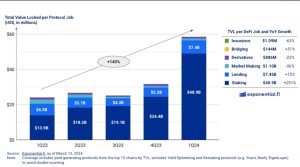
Total Value Locked per Protocol Job.
Total Value Locked per Protocol Job. Source: Exponential.fi

This growth signifies a return of confidence and liquidity to the DeFi markets.

We spoke to experts to find out the latest DeFi trends for 2024.

Key Takeaways

  • The DeFi industry continues to evolve with $43 billion already locked in low-risk yield contracts, indicating a shift towards more stable and reliable investment avenues.
  • The merging of traditional financial systems with DeFi is a significant trend, with financial institutions expected to use DeFi innovations such as smart contracts and decentralized lending to improve their services.
  • The DeFi space faces potential regulatory hurdles, exemplified by the SEC’s actions against Uniswap.
  • The development of Layer-2 scaling solutions and crypto bridges are pivotal in enhancing transaction speeds and reducing costs, thus supporting the broader adoption of DeFi.
  • Increased international regulatory cooperation is likely to result in a unified global framework for digital assets, balancing innovation with financial stability and opening up new opportunities for the DeFi sector.

DeFi Industry Is Maturing

As central banks signal towards more rate cuts, the DeFi yields space is gaining significant popularity as an attractive investment form with DeFi markets maturing, Anndy Lian, an inter-governmental blockchain advisor, told Techopedia.

This was also backed by the Exponential report, which noted that over $43 billion were locked into very low-risk DeFi yield contracts.

75% of DeFi total value locked (TVL) is currently in pools offering 0-5% of annual percentage yield (APY).
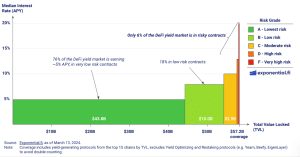
Total Value Locked in DeFi Yield Markets.
Total Value Locked in DeFi Yield Markets. Source: Exponential.fi

Additionally, new trends in the market are pointing towards more mainstream adoption, with DeFi projects continuing to grow and integrate more and more with traditional finance.

Lian said:

“The focus [of the DeFi space in 2024] seems to be on sustainable growth, improved security, and real-world applications that could lead to wider acceptance and use of DeFi platforms.”

Igor Telyatnikov, CEO and co-founder of AlphaPoint, a digital asset and cryptocurrency trading and investing platform, added that with over $90 billion locked in DeFi protocols, the DeFi market could very much reach and even surpass previous heights of $150 billion locked as previously seen in 2021. He said:

“Despite the challenges faced, DeFi has continued to attract both developers and users, showcasing its ability to innovate and adapt. We are seeing a maturing ecosystem with more robust infrastructure, improved user experiences, and increasing collaboration among projects.”

Decentralized Finance Trends 2024

Over the last year, DeFi applications have undergone significant changes, with a number of new trends starting to show up in the industry, stemming from crypto bridges to a number of Layer-2 (L2) scaling solutions.

Here are some of the biggest DeFi trends experts are paying attention to in the second half of 2024.

1. Traditional Finance Integration

The traditional finance market entering the DeFi space is perhaps the biggest trend in the current DeFi landscape.

Lian noted that the integration of traditional markets into the DeFi space could become a “significant step towards a more inclusive and efficient financial ecosystem,” with traditional financial institutions expected to collaborate more closely with the DeFi space, utilizing features like smart contractstokenization, and decentralized lending to enhance their products and services.

Lian said:

“A growing number of financial institutions are projected to adopt DeFi solutions, with significant investments to streamline operations and offer innovative services. The 24/7 operational model of DeFi breaks down traditional barriers of time and geography, offering constant accessibility and borderless transaction capabilities.”

Telyatnikov added that as regulatory clarity improves, the DeFi space could see a lot of exploration of new use cases in collaboration with more traditional institutions.

“Furthermore, the lines between DeFi and centralized finance will blur, leading to hybrid solutions that combine the best of both worlds.”

2. Layer-2 Scaling Solutions

Layer-2 scaling solutions are a prominent tech DeFi example that is expected to play a crucial role in the second half of 2024, AlphaPoint’s Telyatnikov noted. These solutions will enable faster and cheaper transactions while also maintaining the security of the underlying blockchain.

Lian added that the ability of L2 solutions to enhance the scalability and efficiency of blockchain networks is also vital for the growth of DeFi technology.

3. Crypto Bridges

However, major DeFi platforms have seen other emerging trends in the past year, including the development of crypto bridges and Know Your Customer (KYC’d) DeFi, according to Lian. He said:

“The emergence of crypto bridges has facilitated asset transitions to faster layer 2 networks like Arbitrum and Polygon, enhancing ERC-20 token trading while maintaining exposure to Ethereum.”

4. Regulation

AlphaPoint’s Telyatnikov added that over the past year, one of the most significant changes in the DeFi landscape was the heightened regulatory scrutiny.

One example is recent enforcement actions by the U.S. Securities and Exchange Commission (SEC) aimed at Uniswap Labs, which noted that the commission was planning to recommend legal action against the company.

Telyatnikov said:

“The recent Wells notice issued to Uniswap, the largest decentralized exchange by volume, and the ongoing Tornado Cash case have sent shockwaves and warning signals through the DeFi community, particularly in the US. Uniswap, being a significant utility in the DeFi ecosystem, is now facing a direct attack from regulators, creating uncertainty that may take a long time to resolve, similar to the Coinbase lawsuit.”

5. KYC’d DeFi

Such lawsuit cases bring direct challenges to the legal status of DeFi products, their tokens and use cases, which is why there could also be a potential rise of KYC’d DeFi. Know Your Customer procedures are known to align with regulatory standards and reduce illegal activities, which could serve as a limelight for a number of DeFi platforms.

For example, Singularity, a startup developing a protocol to provide institutions with confidential access to DeFi, attracted $2.2 million to develop a KYC-compliant DeFi platform for institutions.

Miko Matsumura, the managing partner at Gumi Cryptos Capital, said in a press release on February 22, 2024:

“Singularity addresses a crucial need in the market, providing institutional users with both the compliance and the commercial confidentiality necessary to participate in DeFi.”

Additionally, the SEC’s new regulatory definitions have the potential to bring decentralized exchanges (DEXs) within the scope of regulations for US broker-dealers, affecting their operations, which could also play a significant impact on the future of the DeFi space in the coming year.

However, global regulatory cooperation and the balance between innovation and safeguarding against financial stability risks will be crucial for further development of the DeFi space.

“The [current] focus seems to be on creating a regulatory environment that supports innovation while ensuring the security and integrity of the financial system,” Lian said.

The Bottom Line

As DeFi transitions from its speculative phase into a more mature and stable environment, the integration with traditional finance and the adoption of advanced technologies like Layer-2 solutions signify a robust future.

Despite facing regulatory challenges, the sector’s innovative response showcases its resilience and potential for sustained growth.

The growing acceptance and implementation of KYC procedures in DeFi could further enhance its legitimacy and foster broader adoption.

Overall, the future of DeFi looks promising, poised to redefine financial landscapes globally as it bridges the gap between traditional and decentralized finance while navigating regulatory challenges.


Source: https://www.techopedia.com/decentralized-finance-trends

Anndy Lian is an early blockchain adopter and experienced serial entrepreneur who is known for his work in the government sector. He is a best selling book author- “NFT: From Zero to Hero” and “Blockchain Revolution 2030”.

Currently, he is appointed as the Chief Digital Advisor at Mongolia Productivity Organization, championing national digitization. Prior to his current appointments, he was the Chairman of BigONE Exchange, a global top 30 ranked crypto spot exchange and was also the Advisory Board Member for Hyundai DAC, the blockchain arm of South Korea’s largest car manufacturer Hyundai Motor Group. Lian played a pivotal role as the Blockchain Advisor for Asian Productivity Organisation (APO), an intergovernmental organization committed to improving productivity in the Asia-Pacific region.

An avid supporter of incubating start-ups, Anndy has also been a private investor for the past eight years. With a growth investment mindset, Anndy strategically demonstrates this in the companies he chooses to be involved with. He believes that what he is doing through blockchain technology currently will revolutionise and redefine traditional businesses. He also believes that the blockchain industry has to be “redecentralised”.

j j j

Blockchain for Business: Top Use Cases, Benefits & Pitfalls in 2024

Blockchain for Business: Top Use Cases, Benefits & Pitfalls in 2024

blockchain is a shared and immutable data storage technology that is used for payments, supply chain management, trade operations, tokenization, and privacy solutions.

The technology is finding its way into the corporate world because of its unique properties that allow the creation of programmable, transparent, accessible, secure, and trustless systems.

Anndy Lian, an intergovernmental blockchain experttold Techopedia:

“It is not just financial systems; blockchain can empower individuals to take control of their personal data and privacy, mitigating risks associated with centralized data storage. We’re at the early stages of understanding how blockchain and crypto can revolutionize various industries. From supply chain management to healthcare, the potential applications are vast.”

What are the benefits of blockchain applications? What are the challenges that companies may face when adopting blockchain tech? We explore these and highlight some of the most popular use cases of blockchain for businesses in various sectors.

Key Takeaways

  • Blockchain tech has unique properties that allow the creation of programmable, transparent, accessible, secure, and trustless systems.
  • Blockchains are used for payroll, supply chain management, trade operations, tokenization, privacy, and retail operations.
  • Businesses can use public blockchains like Ethereum or create their custom private blockchains.
  • Businesses can use blockchain to build trust, improve privacy, reduce costs, facilitate cross-border payments, and more.
  • Uncertainty around crypto regulation is a key hindrance in adopting blockchain technology.

What Are the Major Blockchain Applications Across Industries?

Here are some of the most popular blockchain use cases and examples of using blockchain for small businesses and large corporations.

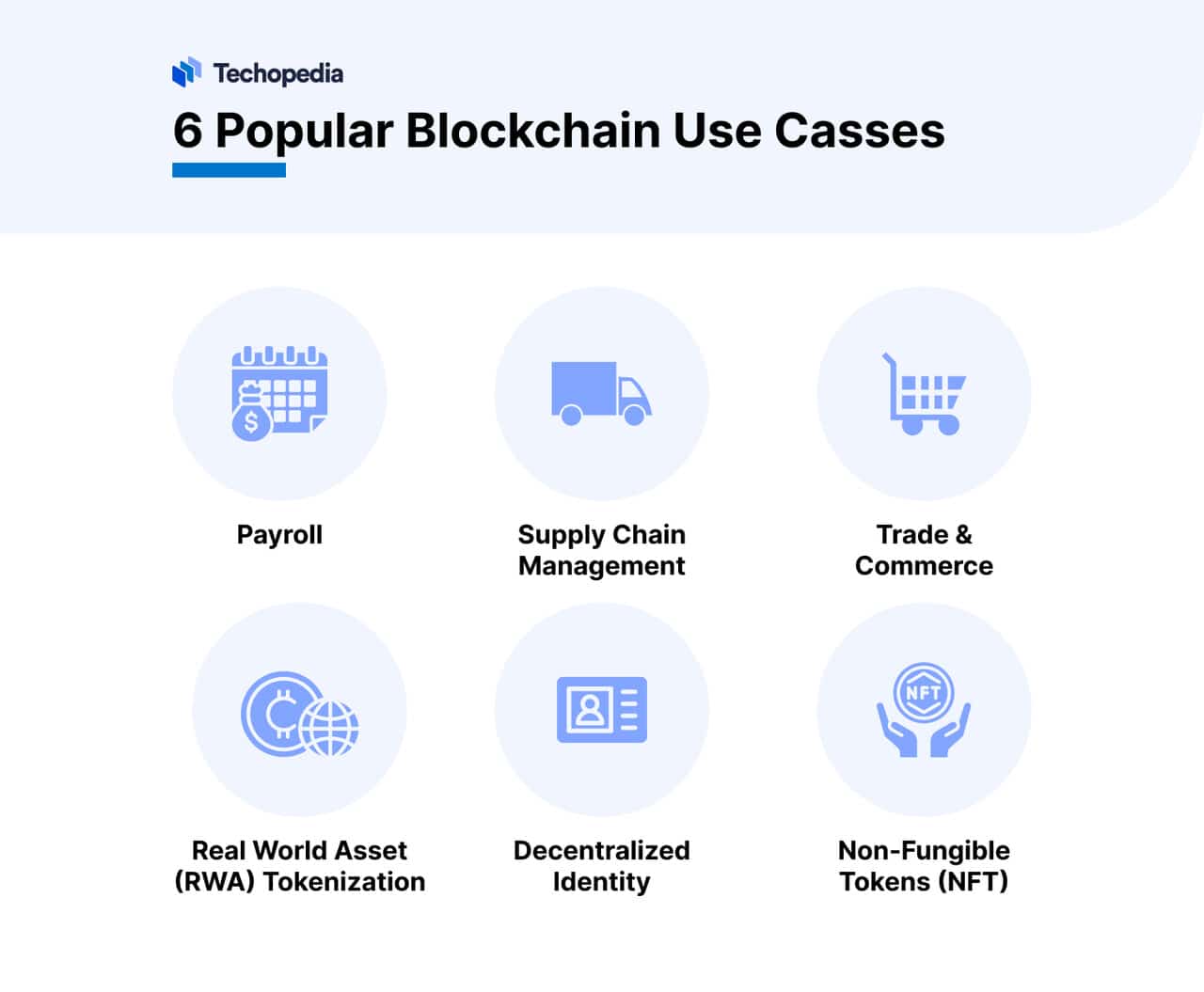
Six Popular Blockchain Use Cases

Payroll

Payments are an obvious use case of blockchain technology. The cryptocurrency industry has used blockchain technology as a bedrock to build peer-to-peer payment systems, while governments are leveraging blockchain technology to create central bank digital currencies (CBDCs).

The growth of remote work has also helped this trend grow as crypto payments facilitate easy, quick, and cheap cross-border payments.

For example, the human resources (HR) management platform Deel allows companies to pay and contractors to receive their salaries in BTCETHUSDC, Dash (DASH), Solana (SOL), and BUSD.

Supply Chain Management

Blockchain supply chain management solutions modernize complex chains that have numerous intermediary parties, processes and endpoints.

The transparent and immutable nature of a blockchain ledger ensures that all concerned parties have a single trusted source of information while providing information in real time to all concerned parties.

Blockchain supply chain solutions also reduce paper-based processes and email exchanges and allow automation, thereby increasing transaction speeds.

Trade management company Covantis created a network to process the execution of bulk agricultural trade operations from the appointment of third-party providers to sharing of documentary instructions and generating drafts and final documents.

Trade & Commerce

Blockchain solutions for trade and commerce created a reliable platform to help buyers find sellers, negotiate with each other, and complete the trade without having to meet each other.

These trading platforms store agreed-upon contracts on the blockchain, while smart contracts custody funds and automate payments when real-world conditions are met. All the information remains visible to all parties on the blockchain.

IBM created a blockchain-based trade management platform we.trade that solves the issue of lack of trust. Importers and exporters that don’t know each other can securely connect with each other on we.trade.

Real World Asset (RWA) Tokenization

Tokenization of real world assets is a promising blockchain use case for businesses that want to increase market liquidity for illiquid assets like real estate. Tokenization can also be used to safeguard intellectual property like copyrights and patents by storing them on an immutable blockchain network.

RWA tokenization is among the top five crypto market trends and technologies in 2024. Traditional finance companies are tokenizing illiquid real estate and fine art into thousands of digital tokens, bringing down the entry barrier for small investors. At the same time, the global nature of public blockchains like Ethereum (ETH) has allowed RWA tokens to reach investors from across the world.

Lian said:

“I believe that tokenization has the potential to democratize access to investment opportunities, allowing individuals from diverse backgrounds to participate in previously inaccessible markets.”

The world saw the first tokenization of real estate in June 2019 when a luxury property called ​​AnnA Villa in France was divided into thousands of digital tokens on the Ethereum blockchain with a minimum entry ticket of investment of €6.5. The tokens came with ownership rights, voting rights, and a one-year vesting period for initial token holders.

Decentralized Identity

Data privacy and security are key issues that businesses have to deal with every day. Using blockchain technology, corporations can leverage a privacy-preserving identity management system called decentralized identity.

Decentralized identities are stored on the blockchain and are not controlled, managed, and stored by centralized third parties. The use of zero-knowledge proof technology, which is gaining popularity on public blockchains, allows organizations to create identifications and certificates that can be verified without revealing any information. Decentralized identification prevents certificate fraud, fake credentials, slow verification processes, and data leaks.

Health-focused enterprise enablement company BurstIQ provides a blockchain-powered platform called LifeGraph that manages sensitive health data. Healthcare and life sciences companies can secure customer data to a single source where participants can control others’ access to their data. Permissioned data can be analyzed, without violating data privacy norms, for improved efficiency, better decision-making, and increased effectiveness in medical processes.

Non-Fungible Tokens (NFT)

Although crypto NFTs are typically associated with absurd market prices, their broad use cases are often misunderstood. Consumer brands like Nike, Puma, and Louis Vuitton have used NFTs as a marketing tool and as a way to digitize and enhance shopping experience.

Since acquiring digital art studio RTFKT in 2021, Nike has occasionally released exclusive NFTs that can be redeemed for physicals. Similarly, in 2023, French luxury fashion house Louis Vuitton sold “phygital” NFTs called Treasure Trunks – worth €39,000 a piece, as reported by Vogue – that granted owners access to goods and experiences.

In September 2022, Starbucks piloted a customer rewards program powered by NFTs called Starbucks Odyssey. However, the company later shut the program in March 2024.

Benefits & Pitfalls of Blockchain for Business

Benefits

  • Trust
  • Improved Privacy & Security
  • Reduced Costs
  • Faster Settlements
  • Programmability & Customizability
  • Tokenization

Challenges

  • Technical Expertise & Investment
  • Regulation Uncertainty
  • Risk of Hacks
  • Limited User Adoption
  • Energy Consumption
  • Scalability & Interoperability

Benefits of Blockchain for Business

Here are the key benefits of using blockchain tech for business operations:

1. Building Trust

Blockchains when paired with smart contract technology can create trustless systems that are immutable, transparent and objective in nature. In a world where there is growing distrust over corporate practices, the use of blockchain technology can help generate trust.

2. Improved Privacy & Security

Although blockchains are not immune to hacks, the development of cryptographic technologies such as zk-proof can ensure data privacy and safety. ZK-proof technology is especially useful in protecting private data as it allows data verification without revealing any information.

Businesses can also leverage public blockchains such as Ethereum to store data and transact upon. The decentralized nature of public blockchains ensures that no centralized party has the power to modify or delete stored data.

3. Reduced Costs


Blockchain technology can help organizations reduce costs by making supply chain and trade management systems efficient, transparent, and accountable. This is especially useful for corporations that have to conduct business operations on the assumption of trust.

4. Faster Settlements

The use of blockchain technology shines when it comes to payments. Cryptocurrency blockchains are global in nature and operate 24/7 making them perfect channels for cheap and immediate cross-border payments.

Unlike the traditional banking sector, businesses will not have to wait for banking hours for settlement and will not incur multiple fees applicable in international money routing.

5. Programmability & Customizability

Businesses have the choice to use different types of blockchains depending on their needs. For example, public crypto blockchains are suitable for handling payrolls, while private blockchains can be developed to allow access to only concerned parties within a supply chain or trade operation.

Furthermore, the use of programmable smart contracts allows the development of applications that use the underlying blockchain networks for data storage and transaction settlement. Smart contracts also allow automation where transactions self-execute when specific conditions are met.

6. Tokenization

Tokenization fits financial use cases. The borderless nature of public blockchains like Ethereum and Solana allows tokenized financial assets to attract a wider pool of investors from across the globe.

Potential Challenges & Pitfalls

Here are the biggest barriers to blockchain adoption in business:

1. Requirement of Technical Expertise & Investment

Businesses will incur costs when recruiting blockchain experts and implementing blockchain technology. The use of public blockchains will require businesses to pay gas fees and auditing fees when setting up applications and smart contracts. Meanwhile, the development of private blockchains from scratch may be expensive and time-consuming due to its complexity.

2. Regulation

The uncertainty around cryptocurrency regulations is one of the biggest challenges in implementing blockchain technology for businesses. Cryptocurrency and blockchain applications often face difficulty finding banking partners in regions with unfriendly and unclear crypto regulations.

The uncertain crypto rules and regulations can hamper business progress and discourage customers from using blockchain-based applications.

3. Hacks

Blockchains are not immune to hacks. 51% attacksdouble-spending, and sybil attacks are key risks to public blockchains. Furthermore, businesses must conduct thorough audits of their smart contracts before deployment or risk being compromised.

4. Limited User Adoption

Blockchain technology is relatively nascent, and therefore, businesses may encounter resistance from trade partners, supply chain management parties and consumers when they introduce blockchain-based solutions. Low awareness about blockchain and cryptocurrency technology among concerned parties is a major hurdle in this area.

5. High Energy Consumption of Proof-of-Work Blockchains

Proof-of-work (PoW) blockchains like Bitcoin are criticized for their high energy consumption rates and carbon footprint. Businesses looking to use these blockchains may attract criticism from customers and investors.

6. Scalability

Public blockchains like Bitcoin and Ethereum often face scalability issues that have resulted in limited network throughput. High transaction volumes on these networks can result in transaction execution failure, exorbitant transaction fees, and delayed transaction processing.

7. Interoperability

Blockchains are often referred to as “data silos” as they tend to exist in isolation from other blockchain networks.

The lack of interoperability between blockchains leads to inefficiencies as businesses will have to rely on third-party solutions to retrieve data from a foreign blockchain.

Fragmentation of data can also hinder collaboration and stifle innovation between businesses or departments within a corporation.

The Bottom Line

Blockchain is a revolutionary technology that offers unique value propositions like trustlessness, transparency, immutability and decentralization.

When duly implemented, blockchain can help corporations make their business operations more efficient and bring about a social and cultural change where trustless and transparent systems become the norm.


Source: https://www.techopedia.com/blockchain-for-business-your-enterprise-guide

Anndy Lian is an early blockchain adopter and experienced serial entrepreneur who is known for his work in the government sector. He is a best selling book author- “NFT: From Zero to Hero” and “Blockchain Revolution 2030”.

Currently, he is appointed as the Chief Digital Advisor at Mongolia Productivity Organization, championing national digitization. Prior to his current appointments, he was the Chairman of BigONE Exchange, a global top 30 ranked crypto spot exchange and was also the Advisory Board Member for Hyundai DAC, the blockchain arm of South Korea’s largest car manufacturer Hyundai Motor Group. Lian played a pivotal role as the Blockchain Advisor for Asian Productivity Organisation (APO), an intergovernmental organization committed to improving productivity in the Asia-Pacific region.

An avid supporter of incubating start-ups, Anndy has also been a private investor for the past eight years. With a growth investment mindset, Anndy strategically demonstrates this in the companies he chooses to be involved with. He believes that what he is doing through blockchain technology currently will revolutionise and redefine traditional businesses. He also believes that the blockchain industry has to be “redecentralised”.
j j j

Top 5 Billionaires Who Lost the Most Money in Crypto

Top 5 Billionaires Who Lost the Most Money in Crypto

From the collapse of Sam Bankman-Fried (SBF) and Gary Wang’s FTX to the fall of Binance’s Changpeng Zhao (CZ), the cryptocurrency industry has witnessed some of the biggest pitfalls in the last couple of years, with a number of notable individuals losing millions if not billions of dollars-worth in crypto.

Who lost the most money in crypto in past years, and why are even seasoned investors and billionaires prone to lose money in the industry?

We talked to experts about the major reasons for such dire losses and identified the key best practices crypto investors could use to protect their money.

Key Takeaways

  • Crypto investments are prone to fall victim to high volatility and risks, as evidenced by massive losses experienced by key figures in the industry.
  • Understanding the underlying technology and market dynamics is crucial for navigating the complexities of the crypto space.
  • Seasoned investors can also face significant losses, highlighting the unpredictability of crypto markets.
  • Implementing strong security practices and risk management strategies is essential for protecting investments.

Who Lost the Most Money in Crypto?

The cryptocurrency market continues to be highly volatile, which is why investors must be able to grasp the fundamentals before judging the risks or getting caught up in the hype and fear of missing out (FOMO) of many decentralized finance (DeFi) projects, Dr. Fardad Zand, the co-founder and CEO of Wisdomise, told Techopedia.

“Poor security practices can also lead to losses from scams and hacks. In addition, overleveraging amplifies potential gains and losses for traders — many get liquidated when the volatile market turns against them.”

The lack of a solid risk management strategy that would dictate to investors when the right time to exit a trade is regardless of its outcome is also another reason why individuals could be prone to lose large sums of money while trading cryptocurrencies, Jonathan Solomon, the co-founder and co-CEO of ARIA, added.

So, who were the people who lost the most money in crypto in recent years?

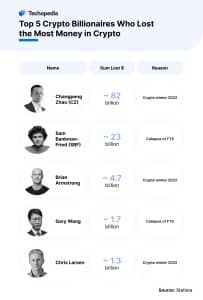
Top 5 Crypto Billionaires Who Lost the Most Money in Crypto
Source: Statista

Changpeng Zhao (CZ): $82 Billion

One of the most prominent names in the cryptocurrency industry, the former CEO of Binance Changpeng Zhao, allegedly lost around $82 billion during the crypto winter of 2022, data on Statista showed.

However, since then, the crypto billionaire’s net worth continued to decline, as he pleaded guilty to violating anti-money laundering requirements enforced by the U.S. Department of Justice in late November 2023 and paid a $4 billion settlement.

Despite the losses, it is estimated that CZ has a net worth of $33 billion as of April 2024.

Sam Bankman-Fried (SBF): $23 Billion

Another prominent name in the cryptocurrency industry, Sam Bankman-Fried, was the former co-founder of the doomed crypto exchange FTX, who lost about $23 billion, according to Statista, as the value of FTX and related assets collapsed.

ARIA’s Solomon noted that in SBF’s case, his losses could have been attributed to high-risk strategies that led to significant financial losses.

However, SBF had also faced allegations of fraud for his role in the collapse of FTX, including defrauding the exchange’s customers. His actions led to a significant loss of customer funds and investments, resulting in his arrest and a trial where he was found guilty.

On April 1, 2024, SBF revealed that he was planning to appeal his 25-year sentence in an exclusive interview with ABC News.

Brian Armstrong: $4.7 Billion

Brian Armstrong, the co-founder and CEO of Coinbase, is another big name in the cryptocurrency space who lost a significant amount of money when the market plummeted in 2022.

Armstrong’s wealth was closely tied to Coinbase’s performance and the overall health of the crypto market. Therefore, when the crypto winter occurred in 2022, and the industry faced substantial losses, so did Armstrong’s net worth.

Still, even with the loss of $4.7 billion, estimated by Statista, Brian Armstrong’s net worth is $10.9 billion as of April 2024.

Anndy Lian, an inter-governmental blockchain adviser, further explained how the 2022 crypto winter could have affected investors:

“Many investors are drawn to the allure of quick profits without fully understanding the assets they’re investing in. This, coupled with the market’s notorious volatility, can lead to substantial financial losses.


Prices in the crypto market can swing dramatically, and without a solid grasp of market trends and the factors driving them, investors can find themselves buying high and selling low.”

Gary Wang: $1.7 Billion

Gary Wang, the former co-founder and CTO of FTX, also faced a substantial loss of about $1.7 billion following the collapse of the FTX cryptocurrency exchange, according to Statista.

Most of his fortune was tied up in a 16% stake in FTX and a share of its FTT tokens. As of April 2024, Garry Wang dropped off all the Forbes ratings.

Chris Larsen: $1.3 Billion

Chris Larsen is known as a pioneering force in cryptocurrency, having co-founded Ripple, a digital payment protocol and currency exchange.

In 2022, he also faced a significant loss of $1.3 billion due to the downturn in the cryptocurrency market, according to Statista.

As of April 2024, Larsen’s net worth is $3.2 billion.

Other Prominent Losses: TerraUSD/LUNA Crash

Meanwhile, the collapse of the TerraUSD (UST) stablecoin and its sister cryptocurrency, LUNA, is not directly linked to one person losing all their assets. Industry experts allege this collapse was one of the most “catastrophic” losses in the crypto market.

The pitfall of TerraUSD and Luna in May 2022 wiped out almost $45 billion in crypto market capitalization in just one week.

Do Kwon, the co-founder of Terraform Labs, is often blamed for this collapse; however, his losses are not mentioned in public sources.

Why Even Seasoned Investors Lose Money on Crypto?

Many might think that seasoned investors are rarely ever prone to face substantial losses in the crypto space, but that is rarely true.

Wisdomise’s Dr. Zand explained:

“Sometimes, overconfidence leads them to misjudge the actual risks involved. The technological complexities of blockchain and smart contracts are easy to overlook or misunderstand.

The crypto market is susceptible to manipulation by wealthy “whale” players, which can catch experienced investors off guard with volatile price swings. Some black swan events like major exchange hacks or new regulations can also unpredictably impact the entire market.”

Lian added that the complexity of the market, which is often characterized by its rapid evolution and the development of new technologies, could also pose significant challenges that even seasoned investors cannot evade.

Additionally, the crypto space is prone to high-profile scams and security breaches, which can also lead to financial losses.

Lian added:

“Market manipulation is another hazard that can lead to losses. Influential players can distort market prices, affecting the entire market and catching even the most vigilant investors off guard.”

Best Practices to Protect Your Money: Risk Management & Research

Lian highlighted that some of the critical takeaways from situations like these are the importance of risk management and research. He said:

  • Understanding the assets, the technology behind them, and the market dynamics is crucial for making informed decisions.
  • Emotional discipline is also essential; investors must learn to control their emotions and avoid making impulsive decisions based on fear or greed.
  • Moreover, the significance of security practices cannot be overstated.
  • Investors should prioritize the security of their investments by using reputable platforms, enabling two-factor authentication, and being wary of too-good-to-be-true schemes that could be fraudulent.

Additionally, developing a long-term investment strategy could also act as a safety net for many investors.

ARIA’s Solomon said:

“The historical performance of Bitcoin illustrates that holding investments over the long term has been profitable for those who have stayed the course, unlike many traders who have faced challenges in recent years. This emphasizes the importance of patience and the potential benefits of a long-term investment horizon in the crypto market.”

The Bottom Line

The dramatic losses in the crypto world underline the high volatility and risk inherent in cryptocurrency investments, as well as the market’s complexity and rapid evolution.

From the collapse of FTX, affecting Sam Bankman-Fried and Gary Wang, to the regulatory challenges faced by Changpeng Zhao and the market downturns impacting Brian Armstrong and Chris Larsen, these events highlight the precarious nature of wealth in the crypto industry.

They serve as a reminder of the importance of having robust risk management, a deep understanding of blockchain technology, and the importance of navigating the market with caution.


Source: https://www.techopedia.com/crypto-biggest-losers-who-lost-the-most-money-in-crypto

Anndy Lian is an early blockchain adopter and experienced serial entrepreneur who is known for his work in the government sector. He is a best selling book author- “NFT: From Zero to Hero” and “Blockchain Revolution 2030”.

Currently, he is appointed as the Chief Digital Advisor at Mongolia Productivity Organization, championing national digitization. Prior to his current appointments, he was the Chairman of BigONE Exchange, a global top 30 ranked crypto spot exchange and was also the Advisory Board Member for Hyundai DAC, the blockchain arm of South Korea’s largest car manufacturer Hyundai Motor Group. Lian played a pivotal role as the Blockchain Advisor for Asian Productivity Organisation (APO), an intergovernmental organization committed to improving productivity in the Asia-Pacific region.

An avid supporter of incubating start-ups, Anndy has also been a private investor for the past eight years. With a growth investment mindset, Anndy strategically demonstrates this in the companies he chooses to be involved with. He believes that what he is doing through blockchain technology currently will revolutionise and redefine traditional businesses. He also believes that the blockchain industry has to be “redecentralised”.

j j j