The Treasury Trap: How Crypto-Backed Stocks Are Trading Below Their Own Assets

The Treasury Trap: How Crypto-Backed Stocks Are Trading Below Their Own Assets

I’ve looked into the financial markets for over two decades, from the dot-com bubble to the global financial crisis, from the rise of passive ETFs to the wild west of crypto winters. But nothing in my career has felt quite as structurally precarious as the current collapse of the digital asset treasury company (DATC) model. It’s not just a market correction. It’s the implosion of a financial illusion built on leverage, narrative, and a dangerous assumption that arbitrage would hold forever. Today, the numbers speak for themselves: market-to-Net Asset Value (mNAV) ratios, the very heartbeat of these firms, are collapsing. Strategy, once the gold standard, now trades near an mNAV of 1.5. That might sound healthy until you realize it’s a steep discount from the 3x, 4x, even 5x premiums it once commanded. Worse, companies like Bitmine Immersion and SharpLink have already dipped below 1.0, meaning their stock prices are now less than the value of the Bitcoin or Ethereum they claim to hold. In plain terms, you could buy their shares, liquidate the company, and walk away with more crypto than the market is currently pricing in. That’s not a bargain, it’s a red flag waving violently in a hurricane.


Why is this happening? Because the model is breaking. Not bending. Breaking. And the cracks are spreading fast.

At the core of the rot is nonstop dilution. These companies rely heavily on At-The-Market (ATM) equity programs to raise capital. The idea was elegant in theory: when the stock trades above NAV, issue new shares, use the proceeds to buy more BTC or ETH, and watch the cycle compound. But in practice, it’s a self-cannibalizing machine. Every time they flood the market with new shares, Forward Industries, for instance, has an ATM program sized at $4 billion, the share price gets hammered by supply overload. This happens even as their crypto holdings grow. The result? A paradoxical situation where the company’s balance sheet strengthens while its equity valuation weakens. Retail investors, who bought in expecting to ride the coattails of Bitcoin’s rallies, are instead watching their holdings lag, or worse, decline, while BTC soars. Confidence evaporates. They exit. And that retail selling, combined with relentless dilution, creates a textbook death spiral: more shares issued, lower price per share, wider mNAV discount, more retail panic, even more pressure to raise capital via dilution. The gap between asset value and market perception doesn’t just widen; it yawns open like a fault line.


So what can these firms do? The options are grim, and none are sustainable without fundamental change.

One path is issuing high-yield preferred shares. On the surface, it sounds attractive: offer 8%, 10%, even 12% to lure yield-hungry investors back. But let’s be brutally honest, how does a company with no real revenue, no operating profits, and a stated mission to hold crypto forever generate the cash to pay that yield? The only liquid asset they have is the very Bitcoin or Ethereum they swore never to sell. To pay a dividend would be to betray their core thesis and signal desperation. It’s a non-starter.

Another idea is share buybacks. In normal markets, buybacks are a powerful tool to support valuation and signal confidence. But these companies don’t have cash reserves. They survive on new issuance. Their entire financial engine runs on selling equity to buy crypto. Where would the money for buybacks come from? It’s like trying to fill a bucket with a hole in the bottom using water from the same bucket. The math simply doesn’t work.

That leaves the nuclear option: direct redemptions. Allow shareholders to exchange their stock for the underlying BTC or ETH at NAV. This would instantly restore mNAV parity. No more discount. No more illusion. But this move would effectively transform these entities into exchange-traded funds. And that’s a regulatory line they cannot cross. The SEC has spent years carefully approving spot Bitcoin and Ethereum ETFs under strict custody, transparency, and investor protection rules. A backdoor redemption mechanism would trigger immediate regulatory intervention, likely a halt in trading, enforcement actions, or forced restructuring. The moment they offer redemptions, they’re no longer a strategic treasury; they’re an unregistered investment company. The legal risk is existential.

This entire house of cards was built on a playbook pioneered by Michael Saylor’s Strategy, which raised $27 billion to accumulate Bitcoin. The market rewarded it with massive premiums because it was first, credible, and operated with a degree of transparency. But imitation is not innovation. Companies like Metaplanet in Japan tried to copy the model, and dozens more rushed in, believing the premium was a permanent feature, not a temporary anomaly of early-mover advantage and market euphoria. Now, as the arbitrage breaks, when the stock no longer reliably tracks or outperforms the underlying asset, the cycle ends. These firms weren’t Bitcoin treasuries. They were volatility wrappers. And every wrapper, no matter how shiny, eventually unwinds.


But the deeper, more troubling truth is how these companies are born and funded. This isn’t public finance as we know it. It’s a shadow system of corporate alchemy.

The creation process bypasses traditional IPO safeguards entirely. There are three dominant playbooks, all designed for speed and opacity. The first is the reverse merger: find a dying public shell, no revenue, few shareholders, trading on fumes, take control, rebrand, and emerge as a digital asset treasury. TRON did this with SRM Entertainment. Janover became DeFi Development Corp. overnight. The second is the SPAC route: merge with a special purpose acquisition company that’s already public, clean, and hungry for a deal. The third is the silent takeover: quietly buy 51% of a microcap stock from insiders or on the open market, stage a board coup, and pivot the company’s entire identity without a formal merger filing. Over 30 companies in 2025 alone have used one of these three models. The infrastructure is now industrialized. You don’t need a product, a team, or a track record. You just need legal control of a broken ticker and a compelling crypto narrative.

Funding follows the same pattern of opacity. These aren’t startups raising from VCs based on technology or traction. They’re capital markets machines built to convert stock price hype into crypto holdings. They use three high-speed mechanisms. First, PIPEs, Private Investment in Public Equity deals, where institutional insiders buy large blocks of stock at a steep discount, behind closed doors. TRON raised $100 million this way. Strive Asset Management pulled in $750 million. Forward Industries secured $1.65 billion for Solana plays alone. These aren’t seed rounds, they’re pre-arranged liquidity events for insiders.

Second, convertible notes: debt instruments that convert into equity if the stock price rises. GameStop raised $2.7 billion this way to buy Bitcoin. Nano Labs prepped $500 million for BNB. It’s debt disguised as equity, a ticking time bomb of future dilution that explodes the moment the stock rallies.

Third, ATM programs, which we’ve already discussed. The reflexive loop is clear: hype the narrative, stock trades above NAV, sell shares, buy crypto, re-hype, repeat. It’s a closed loop that works beautifully, until it doesn’t. And when it breaks, retail investors are left holding the bag.

This brings us to the most corrosive element of all: insider trading isn’t an exception in this space, it’s the operating model. Information leaks at every stage. Legal firms drafting merger documents. Exchanges prepping wallet integrations. Advisors whispering to favored funds. But the most egregious leaks happen during roadshows, the private investor meetings that precede public announcements. SharpLink’s stock was flat until day two of its roadshow. Then, it spiked 1,000% before the deal even closed. That’s not organic market discovery. That’s privileged information being weaponized. Insiders get in early, often for pennies, then dump on retail once the hype hits social media. This is the new digital IPO: no lockups, minimal disclosure, zero accountability.

I have seen cycles come and go, I’m deeply skeptical that this model survives another bull run. The structural flaws are too severe, the incentives too misaligned, the regulatory risks too high. The mNAV collapse is the market’s verdict: these wrappers add cost, risk, and opacity without delivering the promised premium. If mNAV stays below 1, the illusion is over. There’s no magic. No alchemy. Just underperforming shells trading at a discount to the very assets they’re supposed to represent.

To founders, traders, and investors: if you’re not asking who minted the company, who funded it in private, and who front-ran the announcement, you’re not an investor, you’re exit liquidity. And in this game, the house always wins. Until it doesn’t.


Source: https://www.benzinga.com/Opinion/25/10/48273792/the-treasury-trap-how-crypto-backed-stocks-are-trading-below-their-own-assets

Anndy Lian is an early blockchain adopter and experienced serial entrepreneur who is known for his work in the government sector. He is a best selling book author- “NFT: From Zero to Hero” and “Blockchain Revolution 2030”.

Currently, he is appointed as the Chief Digital Advisor at Mongolia Productivity Organization, championing national digitization. Prior to his current appointments, he was the Chairman of BigONE Exchange, a global top 30 ranked crypto spot exchange and was also the Advisory Board Member for Hyundai DAC, the blockchain arm of South Korea’s largest car manufacturer Hyundai Motor Group. Lian played a pivotal role as the Blockchain Advisor for Asian Productivity Organisation (APO), an intergovernmental organization committed to improving productivity in the Asia-Pacific region.

An avid supporter of incubating start-ups, Anndy has also been a private investor for the past eight years. With a growth investment mindset, Anndy strategically demonstrates this in the companies he chooses to be involved with. He believes that what he is doing through blockchain technology currently will revolutionise and redefine traditional businesses. He also believes that the blockchain industry has to be “redecentralised”.

j j j

DefiLlama to Delist Aster Volume Data Over Suspected Wash Trading

DefiLlama to Delist Aster Volume Data Over Suspected Wash Trading

DeFiLlama has removed perpetual futures volume data for Aster, a decentralized exchange backed by figures linked to former Binance CEO Changpeng Zhao, after detecting trading volumes that mirrored Binance’s nearly 1:1 across multiple trading pairs.

Co-founder 0xngmi announced the delisting on October 5, 2025, citing concerns over data integrity.

According to the announcement, Aster’s volumes for pairs like XRP/USDT matched Binance perpetual volumes with a correlation ratio of approximately 1, whereas competitor Hyperliquid showed decorrelation in similar pairs.

The analytics platform cannot access lower-level data, such as maker and taker order information from Aster, to verify whether wash trading occurred, prompting the temporary removal until such verification becomes possible.

0xngmi noted that correlation patterns appeared even more extreme for other assets, such as ETH, with similar patterns visible across all trading pairs.

The DeFiLlama co-founder emphasized that the decision centered on maintaining data integrity for users who make investing decisions based on the platform’s analytics.

Crypto Community Splits Between Wash Trading Accusations and Liquidity Migration Defense

The delisting triggered sharp divisions within the crypto community, with critics questioning DeFiLlama’s centralization while defenders attributed the correlation to legitimate liquidity migration from Binance.

Blockchain investigator ZachXBT criticized industry figure Anndy Lian for normalizing wash trading, after Lian argued that “all crypto projects have washed trades” and questioned why observers were “acting so saintly” about the situation.

Lian, who holds positions in both leading perpetual DEX tokens, claimed that most projects are not fully decentralized and that alignment in open interest and price action is common across top projects that draw charts similar to Bitcoin.

He argued that if a project and its backers agree to spend money acquiring market share, the level of spending is their prerogative.

ZachXBT countered that Lian’s post history showed zero mentions of HYPE and only two posts referencing Hyperliquid, where Aster was also mentioned, while almost every other post focused on Aster.

Supporters of Aster argued that Binance’s liquidity was moved on-chain to the platform, explaining why volumes appeared to be synchronized.

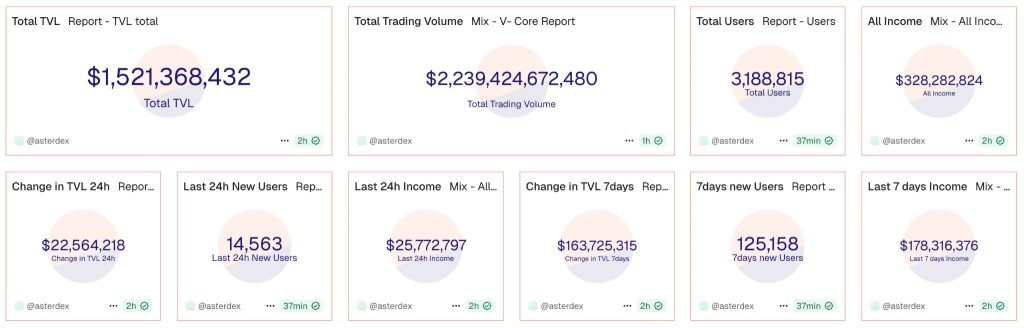
Multiple community members pointed to Dune Analytics data showing Aster’s total trading volume exceeding $2.2 trillion, with a total value locked of $1.52 billion, 3.18 million total users, and $328.28 million in all-time income.

The platform added 14,563 new users in the last 24 hours and 125,158 over seven days, according to the dashboard.

DefiLlama to Delist Aster Volume Data Over Suspected Wash Trading
Source: Dune Analytics

Dashboard creator Odbtc clarified that he used DeFiLlama’s public API as the data source, while Dune served only as a visualization layer to compare Aster, Hyperliquid, and Lighter.

He defended DeFiLlama’s decision, noting that the platform aggregates protocol-reported data while Dune allows users to query or visualize it, with dashboard quality depending entirely on the builder’s query logic.

Aster Launches Stage 3 Rewards Program as Binance Confirms Listing

Aster concluded its Genesis Stage 2 rewards program on October 5 and immediately launched Stage 3 Dawn, offering participants either their ASTER airdrop or a full refund of Stage 2 trading fees.

The claim page opens on October 10 for 48 hours, with airdropped tokens available on October 14.

Stage 3 runs for five weeks, ending November 9, introducing spot trading rewards, multi-dimensional scoring, symbol-specific boost multipliers, and team boosts that accumulate throughout the stage rather than resetting weekly.

At the same time, Binance announced it will list ASTER with a Seed Tag applied, while Aster implemented VIP fee tier updates starting October 6.

The platform updated its Market Maker Program with preferential fees and a monthly reward pool to strengthen liquidity.

The moves come as Aster recorded $493.61 billion in 30-day trading volume according to earlier DeFiLlama data, capturing nearly 50% of the perpetual DEX market share before the delisting.

At the time of publication, ASTER trades at $2.08 with a fully diluted valuation of $16.5 billion, having increased by over 29 times within four days following CZ’s endorsement, before reaching above $2.

The token was launched with an initial fully diluted valuation of $560 million at its token generation event.

On the other end, Hyperliquid’s HYPE token trades at $48.89 with a fully diluted valuation of $48.9 billion, maintaining approximately 70% of the perpetual DEX market share despite rising competition.


Source: https://cryptonews.com/news/defillama-to-delist-aster-volume-data-over-suspected-wash-trading/

Anndy Lian is an early blockchain adopter and experienced serial entrepreneur who is known for his work in the government sector. He is a best selling book author- “NFT: From Zero to Hero” and “Blockchain Revolution 2030”.

Currently, he is appointed as the Chief Digital Advisor at Mongolia Productivity Organization, championing national digitization. Prior to his current appointments, he was the Chairman of BigONE Exchange, a global top 30 ranked crypto spot exchange and was also the Advisory Board Member for Hyundai DAC, the blockchain arm of South Korea’s largest car manufacturer Hyundai Motor Group. Lian played a pivotal role as the Blockchain Advisor for Asian Productivity Organisation (APO), an intergovernmental organization committed to improving productivity in the Asia-Pacific region.

An avid supporter of incubating start-ups, Anndy has also been a private investor for the past eight years. With a growth investment mindset, Anndy strategically demonstrates this in the companies he chooses to be involved with. He believes that what he is doing through blockchain technology currently will revolutionise and redefine traditional businesses. He also believes that the blockchain industry has to be “redecentralised”.

j j j

DefiLlama to Delist Aster Volume Data Over Suspected Wash Trading

DefiLlama to Delist Aster Volume Data Over Suspected Wash Trading

DeFiLlama has removed perpetual futures volume data for Aster, a decentralized exchange backed by figures linked to former Binance CEO Changpeng Zhao, after detecting trading volumes that mirrored Binance’s nearly 1:1 across multiple trading pairs.

Co-founder 0xngmi announced the delisting on October 5, 2025, citing concerns over data integrity.

According to the announcement, Aster’s volumes for pairs like XRP/USDT matched Binance perpetual volumes with a correlation ratio of approximately 1, whereas competitor Hyperliquid showed decorrelation in similar pairs.

The analytics platform cannot access lower-level data, such as maker and taker order information from Aster, to verify whether wash trading occurred, prompting the temporary removal until such verification becomes possible.

0xngmi noted that correlation patterns appeared even more extreme for other assets, such as ETH, with similar patterns visible across all trading pairs.

The DeFiLlama co-founder emphasized that the decision centered on maintaining data integrity for users who make investing decisions based on the platform’s analytics.

Crypto Community Splits Between Wash Trading Accusations and Liquidity Migration Defense

The delisting triggered sharp divisions within the crypto community, with critics questioning DeFiLlama’s centralization while defenders attributed the correlation to legitimate liquidity migration from Binance.

Blockchain investigator ZachXBT criticized industry figure Anndy Lian for normalizing wash trading, after Lian argued that “all crypto projects have washed trades” and questioned why observers were “acting so saintly” about the situation.

Lian, who holds positions in both leading perpetual DEX tokens, claimed that most projects are not fully decentralized and that alignment in open interest and price action is common across top projects that draw charts similar to Bitcoin.

He argued that if a project and its backers agree to spend money acquiring market share, the level of spending is their prerogative.

ZachXBT countered that Lian’s post history showed zero mentions of HYPE and only two posts referencing Hyperliquid, where Aster was also mentioned, while almost every other post focused on Aster.

Supporters of Aster argued that Binance’s liquidity was moved on-chain to the platform, explaining why volumes appeared to be synchronized.

Multiple community members pointed to Dune Analytics data showing Aster’s total trading volume exceeding $2.2 trillion, with a total value locked of $1.52 billion, 3.18 million total users, and $328.28 million in all-time income.

The platform added 14,563 new users in the last 24 hours and 125,158 over seven days, according to the dashboard.

DefiLlama to Delist Aster Volume Data Over Suspected Wash Trading
Source: Dune Analytics

Dashboard creator Odbtc clarified that he used DeFiLlama’s public API as the data source, while Dune served only as a visualization layer to compare Aster, Hyperliquid, and Lighter.

He defended DeFiLlama’s decision, noting that the platform aggregates protocol-reported data while Dune allows users to query or visualize it, with dashboard quality depending entirely on the builder’s query logic.

Aster Launches Stage 3 Rewards Program as Binance Confirms Listing

Aster concluded its Genesis Stage 2 rewards program on October 5 and immediately launched Stage 3 Dawn, offering participants either their ASTER airdrop or a full refund of Stage 2 trading fees.

The claim page opens on October 10 for 48 hours, with airdropped tokens available on October 14.

Stage 3 runs for five weeks, ending November 9, introducing spot trading rewards, multi-dimensional scoring, symbol-specific boost multipliers, and team boosts that accumulate throughout the stage rather than resetting weekly.

At the same time, Binance announced it will list ASTER with a Seed Tag applied, while Aster implemented VIP fee tier updates starting October 6.

The platform updated its Market Maker Program with preferential fees and a monthly reward pool to strengthen liquidity.

The moves come as Aster recorded $493.61 billion in 30-day trading volume according to earlier DeFiLlama data, capturing nearly 50% of the perpetual DEX market share before the delisting.

At the time of publication, ASTER trades at $2.08 with a fully diluted valuation of $16.5 billion, having increased by over 29 times within four days following CZ’s endorsement, before reaching above $2.

The token was launched with an initial fully diluted valuation of $560 million at its token generation event.

On the other end, Hyperliquid’s HYPE token trades at $48.89 with a fully diluted valuation of $48.9 billion, maintaining approximately 70% of the perpetual DEX market share despite rising competition.

The post DefiLlama to Delist Aster Volume Data Over Suspected Wash Trading appeared first on Cryptonews.


Source: https://cryptorank.io/news/feed/6fb66-defillama-to-delist-aster-volume-data-over-suspected-wash-trading

Anndy Lian is an early blockchain adopter and experienced serial entrepreneur who is known for his work in the government sector. He is a best selling book author- “NFT: From Zero to Hero” and “Blockchain Revolution 2030”.

Currently, he is appointed as the Chief Digital Advisor at Mongolia Productivity Organization, championing national digitization. Prior to his current appointments, he was the Chairman of BigONE Exchange, a global top 30 ranked crypto spot exchange and was also the Advisory Board Member for Hyundai DAC, the blockchain arm of South Korea’s largest car manufacturer Hyundai Motor Group. Lian played a pivotal role as the Blockchain Advisor for Asian Productivity Organisation (APO), an intergovernmental organization committed to improving productivity in the Asia-Pacific region.

An avid supporter of incubating start-ups, Anndy has also been a private investor for the past eight years. With a growth investment mindset, Anndy strategically demonstrates this in the companies he chooses to be involved with. He believes that what he is doing through blockchain technology currently will revolutionise and redefine traditional businesses. He also believes that the blockchain industry has to be “redecentralised”.

j j j