
The scourge of NFT wash trading — and how not to get suckered in

The scourge of NFT wash trading — and how not to get suckered in

What are the different kinds of NFT wash trading, and what are the red flags that a prospective investor should look for? Anndy Lian explains.

Wash trading is not a new word for people in the financial world. You probably have heard from friends that cryptocurrencies are highly “washed” and round-tripping with the same buy and systematically sell price. Since you are familiar with this term, let me tell you the NFT market has similar issues with wash trading.

In a nutshell, wash trading makes it difficult for non-fungible token enthusiasts to gauge genuine market interest in NFT collections. It also inflates and skews the amount of trading in marketplaces, misleading analysts about what’s going on on trading platforms.

All in all, NFT wash trading is one of the biggest impediments to accurately evaluating projects and assets in the NFT industry, which includes NFT collections, NFT tertiary tokens (think $X2Y2 and $LOOKS) and the studios and developers who bring products to market.

Using Footprint Analytics’ data set to detect and filter wash trading, let us take a closer look at how wash traders operate and how on-chain data could be analyzed to detect suspicious activity.

What is wash trading?

Wash trading is a form of market manipulation where an investor simultaneously sells and buys the same financial instruments to create misleading, artificial activity in the marketplace.

In terms of NFTs, wash trading occurs when the same user is behind both sides of an NFT transaction. It means that both the seller and buyer address is actually owned by the same person. At the moment, wash trading is very common in NFT markets, which are not subject to government regulation or supervision, unlike traditional securities.

Why do people wash trade NFTs? 

There are two main motives behind wash trading in the NFT space.

Type 1: To earn platform rewards 

Type 2: To create an appearance of value or liquidity 

To create a false sense of liquidity and an inflated value of a specific NFT collection or asset, some unscrupulous creators turn to wash trading to deceive buyers. They profit when genuine buyers are tricked into buying an NFT from them at a pumped-up price. This type of wash trader hides their activities with new wallet addresses that are self-funded from central exchange wallets. This type of wash trading generates a relatively small volume, which is not as disruptive to the market as Type 1 wash trading.

How is wash trading done?

Due to Type 1 wash trading transactions’ disruptiveness to NFT transaction data, Footprint Analytics aimed to filter them out as much as possible. To understand this type of wash trading, we have to understand the token reward system of X2Y2 and LooksRare. In simple terms, X2Y2 and LooksRare distribute tokens daily to both sellers and buyers based on the address’s trading volume as a portion of the marketplace platform’s daily total volume. Token rewards are fixed daily, so wash traders can wash trade and earn reward tokens repeatedly when the daily distribution resets.

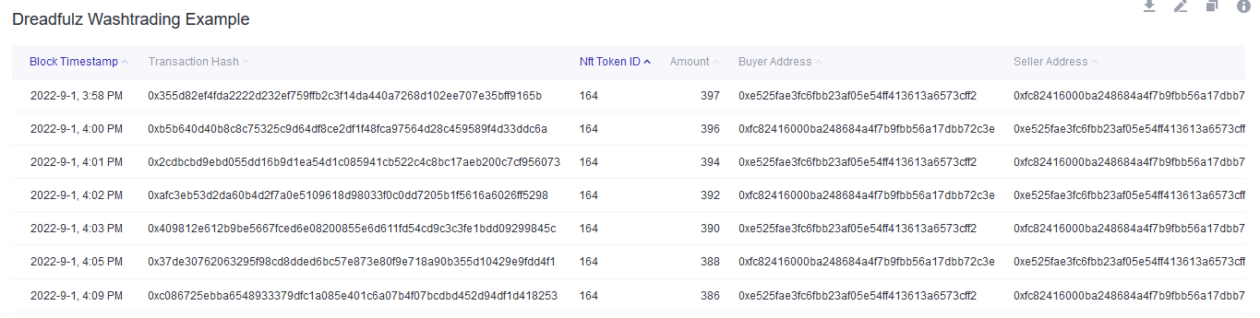
Figure 1 shows an example of wash trading activities on the X2Y2 marketplace— the NFT collection is Dreadfulz.
unnamed
Figure 1 –  Dreadfulz Wash Trading Example (Source: @Hanson520 Footprint Analytics)

As we can see from the figure above, the same NFT (ID 164) was bought back and forth between the same two wallets several times in a day with 300+ ETH sale prices per transaction. On Sept. 1, 2022, these two addresses traded 19 times, generating 7228 ETH in volume and paying 36.14 ETH in X2Y2 platform fees. Keep in mind that the royalty fee rate for Dreadfulz was not set on X2Y2; therefore, no creator fees were paid. Wash traders will choose collections with 0% creator fees to minimize their wash trading costs.

How to detect wash trading

I have looked at how a few analytics platforms, including Footprint Analytics, do their detection and followed their logic. Their methodologies are somewhat similar, to be honest. Along with my own knowledge and analysis, here is a checklist of suspicious data and activity that should trigger any prospective NFT buyer’s alarm bells:

  • A particular NFT is traded by the same address more than X times a day while the rest of the collection remains untouched.
  • The same address is trading the same NFT in a high-frequency manner.
  • A collection of NFT goes into a self-selling in a high-frequency manner when there is no marketing or promotion backing the sale.
  • The average historical price transacted is X times higher on marketplace A vs. B.
  • The sale price of an NFT is transacted X times higher than the lowest-priced NFT available for sale.
  • The same wallet addresses funding all the suspicious wallets that buy and sell the NFTs.
  • An abnormal high trading volume on a constant basis.

The above assumptions are not perfect, and I hope to work with researchers on developing a more comprehensive scorecard to determine NFT trends and behaviors more effectively. The ability to trace multiple wallets over time to identify various levels of relationships would be vital too.

How wash-traded are the top NFT collections?

In Figure 2, Footprint Analytics applied their detection rules to the collections with the most trading volume on X2Y2 and LooksRare.

XljL7xeoh7v7vlHCQfP7GTP5KqAIU2ekU4Q8js1vN7tV39jHQ5m9Z9D7p6wvqsPR 2SLeu0w6Alrf ziAKPaYUW5M9FMhxOUEZ kP70tKaB60k 3aFhbLfwbI1NjIbCVjYCLMulHsKbTP0VYreenoaC9JRIbRnLEjDkmDgpiy40IbK f8NDODMRl47s
Figure 2 – Wash Trades Stats of Selected Collections (Source: Footprint Analytics)   

Based on their rules, they have detected that 95% or more of the trading volume of these collections is wash trading transactions. Wash trading makes up an extremely high percentage of trading volume for these collections, which paints a misleading picture of the collections’ historical volume and sale activities. You can review all the transactions they have filtered at ud_suspicous_txn dataset on their website.
unnamed 1
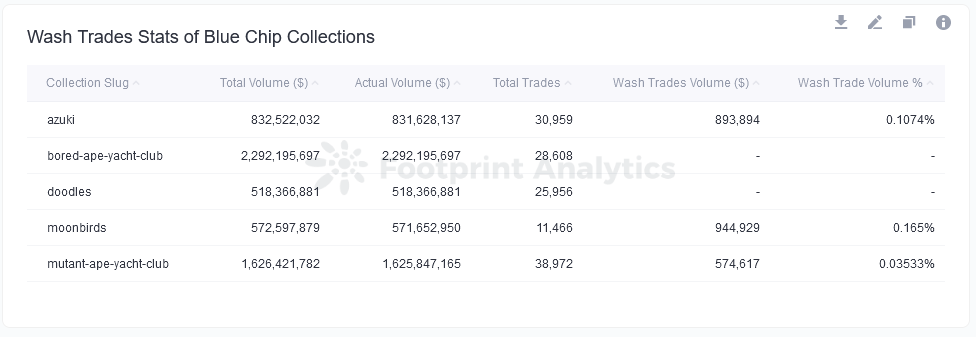
Figure 3 – Wash Trading Stats of Blue Chip Collections (Source: Footprint Analytics) 

For Footprint Analytics to ensure their rules are working as intended, they have applied them to blue chip collections that are not subjected to wash trading activities in Figure 3. You can view the ud_suspicious_txn_bluechip_collections dataset and review the filtered transactions.

unnamed 1
Figure 4 – Wash Trading Stats of LooksRare and X2Y2 (Source: Footprint Analytics) 
unnamed 1
Figure 5 – Unfiltered Trading Stats of Opensea, LooksRare and X2Y2 (Source: Footprint Analytics) 

Figure 4 indicates that 94.71% and 81.04% of the trading volume on LooksRare and X2Y2 are wash trading transactions, which appears consistent with the marketplace statistics, as shown in Figure 5. We can see from the unfiltered data that the average price per transaction on Looksrare almost reaches US$85,000, which is around 90 times the average price of OpenSea and unrealistically expensive.

You can view the ud_suspicious_txn_x2_looks dataset and review the filtered transactions for X2Y2 and Looksrare marketplaces, as shown in Figure 4.

Final takeaways 

zCHJVo912xNmdAG9KAOksGzSoQszjreQog BrjtrjwKiAfBeGavDbf59EI HPAh96tb12h2cJSaPoA7hJwkKd77pCVsnqWWl0ePfWb4I jEKZPxXbe dlOauPS0xE x31 b8eOzFLcnn2sCruNPTYyHzzIZG9Ali0ESy f58G8EBfXQi7CyzdGpasIbKls9lUDq
Figure 6 – Monthly NFT Volume Stats of OpenSea, LooksRare and X2Y2 (Source: Footprint Analytics) 

Looking at the monthly trading statistics of the NFT market since January 2022 in Figure 6, we can see that wash trading volume makes up more than 50% of total volume almost every month. Even though total volume is down by a substantial amount from January highs, the percentage of wash trading volume in the NFT market remains similar every month. This underscores how disruptive wash trading is to having accurate NFT transaction data and the importance of filtering out wash trading for any meaningful NFT data analysis.


Source: How to detect NFT wash trading and not get suckered in (forkast.news)

Anndy Lian is an early blockchain adopter and experienced serial entrepreneur who is known for his work in the government sector. He is a best selling book author- “NFT: From Zero to Hero” and “Blockchain Revolution 2030”.

Currently, he is appointed as the Chief Digital Advisor at Mongolia Productivity Organization, championing national digitization. Prior to his current appointments, he was the Chairman of BigONE Exchange, a global top 30 ranked crypto spot exchange and was also the Advisory Board Member for Hyundai DAC, the blockchain arm of South Korea’s largest car manufacturer Hyundai Motor Group. Lian played a pivotal role as the Blockchain Advisor for Asian Productivity Organisation (APO), an intergovernmental organization committed to improving productivity in the Asia-Pacific region.

An avid supporter of incubating start-ups, Anndy has also been a private investor for the past eight years. With a growth investment mindset, Anndy strategically demonstrates this in the companies he chooses to be involved with. He believes that what he is doing through blockchain technology currently will revolutionise and redefine traditional businesses. He also believes that the blockchain industry has to be “redecentralised”.

j j j

With bitcoin price hovering around the $20,000 mark, market observers expect its trading to continue between $18,000 and $22,000

With bitcoin price hovering around the $20,000 mark, market observers expect its trading to continue between $18,000 and $22,000

According to market observers and its volatile conditions, cryptocurrency trading has maintained the range between $18000 and $22000 for a month. Additional thoughts were shared.

Bitcoin price has a lot to do with the supply and holders too. If you have looked at Glassnode’s data, over 80% of the total USD-denominated wealth invested in bitcoin has been moved for at least three months. When supply is dormant, the price is dormant, and this means that holders are unwilling to spend at a lower price.

Another possible reason is that SEC chair Gary Gensler said in an interview with Yahoo Finance on 15 July 2022 that they will continue to speak to the crypto industry, saying that they may suggest rules that apply to traditional brokerage to protect investors in the event of crypto failure. This piece of news in a timely manner, and gives more confidence to the investors at large.

The news of South Africa will go all in to regulate crypto as a financial asset is another plus point for this week. With all the news today alone, many people on Twitter turned bullish upon seeing the crypto market cap was traded closer back to the $1 trillion mark. Investors have to look at the following dates:

1) 27 July- Federal Reserve Interest Rates;

2) 28 July- US GDP Figures.

These are important dates to note as they can drive the crypto prices up or down.

________________________________________________________________

With bitcoin price hovering around the $20,000 mark, market observers expect its trading to continue between $18,000 and $22,000

According to market reports, volatility in cryptocurrency markets is because of factors such as the global pandemic, world governments, and Web3.0’s bullish nature.

After a topsy-turvy ride, it seems bitcoin has stabilised with it being predicted to trade between $18,000 and $22,000, based on its price range for the last couple of months. On July 17, cryptocurrency bitcoin’s price fell below the $21,000 mark. At the time of writing (12.19 pm, Indian Standard Time), the global cryptocurrency market capitalisation reached a $1.01 trillion valuation while bitcoin traded close to the $22,000 value, according to cryptocurrency assets price-tracking website CoinMarketCap. “Bitcoin is hovering close to the $20,000 mark because of the community and investors who still believe in the currency. Due to the cryptocurrency’s nature and limited supply, its price is expected to increase in the future,” Agam Chaudhary, a serial entrepreneur and investor in Web3.0 space, told FE Digital Currency.

Various market reports stated that volatility in cryptocurrency markets is because of factors such as the global pandemic, influence of stock markets, decisions by governments, and the bullish nature of Web3.0 space. According to the Twitter handle of blockchain analytics firm Glassnode, over 80% of the total United States Dollar (USD) denominated wealth has been held on by investors for around 3 months, irrespective of market volatility. “Rules must be suggested for traditional brokerage to protect investors in the event of cryptocurrency failure. Investors need to follow the Federal Reserve Interest rates and US gross domestic product (GDP) figures, as they can drive cryptocurrency prices up or down,” Anndy Lian, chief digital advisor, Mongolian Productivity Organisation, a governmental organisation, stated.

Anndy Lian is an early blockchain adopter and experienced serial entrepreneur who is known for his work in the government sector. He is a best selling book author- “NFT: From Zero to Hero” and “Blockchain Revolution 2030”.

Currently, he is appointed as the Chief Digital Advisor at Mongolia Productivity Organization, championing national digitization. Prior to his current appointments, he was the Chairman of BigONE Exchange, a global top 30 ranked crypto spot exchange and was also the Advisory Board Member for Hyundai DAC, the blockchain arm of South Korea’s largest car manufacturer Hyundai Motor Group. Lian played a pivotal role as the Blockchain Advisor for Asian Productivity Organisation (APO), an intergovernmental organization committed to improving productivity in the Asia-Pacific region.

An avid supporter of incubating start-ups, Anndy has also been a private investor for the past eight years. With a growth investment mindset, Anndy strategically demonstrates this in the companies he chooses to be involved with. He believes that what he is doing through blockchain technology currently will revolutionise and redefine traditional businesses. He also believes that the blockchain industry has to be “redecentralised”.

j j j

The growing popularity of crypto social trading: Quick review

The growing popularity of crypto social trading: Quick review

Social and copy trading tools are relatively new in the cryptocurrency scene. Basically, their trades are reflected in your account. Their profits are your profits and their losses are your losses.

Such tools are simple to use and have all the features that any trader will need. How would DeFi and social trading work together? Let’s look into it now.

Community-powered DeFi protocol Pollen aims to shake up the asset management industry with its bold attempt to really put the community in the driving seat, led by top-performing traders that emerge from the community.

As the first really tangible step to making that happen after two years’ development and several months of testing involving 7,000+ beta users, Pollen has now launched its trading simulation product after 99 per cent backing in a 100K strong community vote in line with Pollen’s merit-based DAO structure.

But in a growing market for social trading globally how does it stack up against existing startups in the space, such as eToro and League of Traders?

The mainnet launch is designed to create a community of crypto traders, so-called ‘Pollinators’ which in turn will identify a talent pool of the top performers. These users will provide the trading insights to power the asset-backed Pollen Indexes.

How it works is that Pollen Virtual enables traders to try out their trading strategies in a safe sandbox environment, based on staked tokens, in a portfolio composed of assets available on Pollen with the ability to rebalance the proportion of each asset to improve performance in real-time.

In turn, this encourages traders to compete in a leaderboard to earn reputation points and PLNs. Those less willing to risk their tokens can delegate them to the best performers for an 80% share of the trading profits.

Pollen’s social model fits a post-Terra DeFi world, where the trust is put in the decentralised community rather than the founders. Of course, the downside is the gains are not going to be crazy DeFi gains where you stake a dollar and have a million in your wallet in a couple of days!

Instead, as Agova explained, the aim of Pollen is to bring some much-needed balance to DeFi and reduce the risk, reduce the volatility through indexes. “DeFi for grownups. It’s DeFi if you’re not necessarily crypto savvy, but an average person with some disposable income that wants to get into DeFi but can’t get into DeFi.”

The virtual assets users allocate in their Pollen Virtual portfolio (with the protocol based on the Avalanche and Ethereum ecosystem) represent real assets, meaning that they rise and fall depending on each asset’s performance in real life.

However, there is no exposure to the underlying assets in the Pollen Virtual portfolio: they are purely simulations, with only PLN earned or burned depending on the portfolio’s performance. The Pollen Virtual protocol actually has two tokens available to users, the PLN is the native token, and vePLN is what they call the “voter escrow token” which users obtain when they lock their PLN.

While you can earn PLN as a reward you cannot earn vePLN, as a locked token, it simply allows you to earn rewards up to 20 per cent more. However, to add a gamification element you can lose vePLN as a result of poor performance of your trading activity.

How eToro compares

In comparison one of the market leaders eToro offers is the ability to see how other investors and traders manage their crypto portfolios which allows you to take advantage of their tactics.

In addition, eToro provides a service called copy trading which automates the copying of the best-performing investors. A third layer of social trading is access to forums where traders can discuss their strategies.

In a way similar to Pollen eToro also offers a virtual trading account. However, a key difference is that you don’t need to buy eToro’s own token to participate, instead, you use US$100,000 in fake money so the quality of the learning is probably not as great as with Pollen where you can lose PLN and reputation ranking for poor performance.

Bethany Garner of Forbes Advisor in reviewing eToro confirmed that it lets users buy and sell more than 60 crypto assets and offers its own crypto wallet for users to store their tokens.

Plus, as well as the social trading tools. “Anyone, even those who aren’t users, can visit eToro and gain access to lessons on investment terms, interpreting the markets, and different types of assets through the eToro Academy.”

That educational support is certainly lacking from Pollen currently, but no doubt will be something they’ll want to develop once the asset management service launches later in the year.

Gamifying trading

A neat twist on the social trading concept is the leading social trading service in Asia League of Traders, a crypto app that runs a leaderboard similar to Pollen, where the best performers are rewarded.

League of Traders has ‘doubled down’ on social trading by gamifying crypto trading with features including real-time leaderboards, monthly competitions, and trader profiles, transforming trading into a social, competitive experience. Each user’s profile includes a growth chart, token distribution pie chart, volatility risk assessment and current positions which allows speedy insight into one’s portfolio’s strength.

And unlike Pollen, which works as a closed ecosystem, or eToro which aims to make money from your crypto purchases, using the app you can link your portfolios across different exchanges to see their performance aggregated in one place. Like eToro however you can also click on the profile of top traders to check out their portfolio, with the option to copy another account.

Barrister and Attorney at Law at BlockchainLex.io, Brian Sanya Mondoh, said, “In my view, the delegation of tokens to make profits by delegators is likely to interact with the Howey Test, as there is an investment of money in a common enterprise with a reasonable expectation of profits to be derived from the efforts of others.”

Mondoh added that crypto regulation is rapidly underway with many DeFi protocols presented as real risks to consumers, businesses, national security, and the financial system. The recent Terra collapse is still fresh in our minds and has further highlighted the need for appropriate regulation to help mitigate consumer, market integrity and financial stability risks,” he added.

Anndy Lian, Chairman of BigONE Exchange said Pollen was a great example of what DeFi can offer following the Terra collapse. “The risky returns offered by Terra’s Anchor Protocol proved that you need to base DeFi on sound first principles, a decentralised offering which empowers users rather than encouraging them to take unsustainable risks.

“I’m impressed by Pollen’s careful stepped approach to their social offering driven by community-led adoption and testing to get it right. I particularly like the fact that anyone can create their own asset pools, and then turn successful indexes public, and earn tokens. But of course, for the newcomer, a service like eToro or League of Traders has a lot to offer where you can learn from the best traders.

“And while eToro like Pollen wants you to stick to its ecosystem I like the flexibility of League of Traders, aggregating your traders under one roof, while also gamifying the experience through the regular trading competitions. Clearly, the social trading market in crypto is only going to grow further in the future, as Web3 is the perfect architecture for a networked decentralised people-led approach to trading and investing.”


Original Source: https://e27.co/the-growing-popularity-of-crypto-social-trading-quick-review-20220620/

Anndy Lian is an early blockchain adopter and experienced serial entrepreneur who is known for his work in the government sector. He is a best selling book author- “NFT: From Zero to Hero” and “Blockchain Revolution 2030”.

Currently, he is appointed as the Chief Digital Advisor at Mongolia Productivity Organization, championing national digitization. Prior to his current appointments, he was the Chairman of BigONE Exchange, a global top 30 ranked crypto spot exchange and was also the Advisory Board Member for Hyundai DAC, the blockchain arm of South Korea’s largest car manufacturer Hyundai Motor Group. Lian played a pivotal role as the Blockchain Advisor for Asian Productivity Organisation (APO), an intergovernmental organization committed to improving productivity in the Asia-Pacific region.

An avid supporter of incubating start-ups, Anndy has also been a private investor for the past eight years. With a growth investment mindset, Anndy strategically demonstrates this in the companies he chooses to be involved with. He believes that what he is doing through blockchain technology currently will revolutionise and redefine traditional businesses. He also believes that the blockchain industry has to be “redecentralised”.

j j j