New Crypto Trend: Trading Tokens Before Release

New Crypto Trend: Trading Tokens Before Release

A new trend is taking off in the cryptocurrency community — as investors start to purchase tokens before waiting for them to hit the markets.

In a fast-paced industry, being an early investor is a crucial step as it allows individuals to potentially capitalize on significant price appreciation as innovative projects gain traction and adoption.

And now, investors are finding ways to start buying before the firing pistol has signaled the start of the race.

Here’s everything you need to know.

Key Takeaways

  • Investing in tokens before their release allows investors to potentially benefit from significant price increases as projects gain traction.
  • Platforms like AEVO and Hyperliquid have introduced new opportunities to speculate or hedge against future token prices, marking a shift from traditional ICOs to more dynamic pre-token trading environments.
  • Pre-token and point market sales have seen $50 million in trades despite low liquidity.
  • The pre-token and point markets are heavily dominated by buyers, a sign of potential investor confidence.
  • Despite the enthusiasm and high trading volumes, these markets face challenges such as lower liquidity and higher volatility compared to post-TGE markets.

Pre-Token & Point Markets Take Off

Until recently, investors could purchase cryptocurrencies prior to their official launch through their initial coin offering (ICO), a fundraising mechanism used by new decentralized finance (DeFi) projects to raise capital by selling tokens to investors prior to a project’s full development.

This allows anyone to speculate on or hedge against the price of a token before its launch, creating a new era of crypto investing.

In short, pre-token and point markets are platforms that allow people to buy or sell the promise of receiving tokens or points at a future date, often before the official release of the token.

Such markets are divided into two main types: one where trades are settled with cash and another where the actual tokens or points are exchanged. Such a setup lets investors speculate on the future value of tokens or points, potentially profiting from changes in their price before they become available.

According to Anndy Lian, an inter-governmental blockchain adviser, by participating in pre-sales, investors get the opportunity to directly support the development and growth of new projects, as well as create a sense of community and alignment with the project’s goals.

He said:

“This community effect can drive demand as more people become involved and invested in the token’s success. Effective marketing campaigns can generate significant hype around a token before its release, leading to increased demand as investors don’t want to miss out on what is being promoted as a promising opportunity.”

A Keyrock report released on April 30 uncovered that the crypto community has seen a notable surge in interest and participation in these pre-tokens and point markets with $50 million already being traded.

This high level of activity reflects a growing enthusiasm among investors to engage with new crypto projects at an early stage.

The markets predominantly cater to buyers, with the majority of orders coming from users eager to purchase tokens or points ahead of their public release. This eagerness is driven by the potential for high returns on investments as token values can increase significantly upon official launch.

Pre-token & Point Markets See Higher Buyer Dominance

According to the Keyrock report, the markets showed a pronounced buyer dominance, with most tokens analysed displaying a higher buying than selling volume.

This trend suggested that investors were more interested in acquiring tokens rather than selling them, believing in the potential for token value appreciation after their Token Generation Event (TGE).

The report highlighted:

“Most tokens exhibit a buying volume significantly higher than the sell volume. Only 5 out of 57 tokens that have been traded on Whales Market show a selling volume that exceeds the buy volume. Participants in Whale Markets demonstrate a strong preference for buying tokens, points, and runes.”
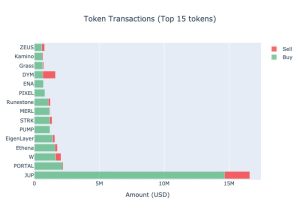
Data on buying vs selling tokens from Whales Market. Source: Keyrock Data Intelligence

Data on buying vs selling tokens from Whales Market. Source: Keyrock Data Intelligence

Liquidity Remains Low

Despite optimistic trading volumes, pre-token and point markets still face challenges related to liquidity.

The Keyrock report highlighted that compared to traditional post-TGE markets, pre-token and point markets are relatively less liquid, meaning they have relatively fewer buyers and sellers, which could lead to price volatility and make it harder to execute larger orders without affecting the market price.

Additionally, sometimes the demand for a pre-release token is driven more by hype and marketing than by the project’s fundamentals, which could lead to an inflated valuation that does not reflect the token’s true worth, Lian explained.

“Projects that prioritize transparency, communication, and community trust are more likely to succeed in pre-release trading. Investors will gravitate toward projects they believe in.”

Technical issues could also serve as a major potential risk in purchasing cryptocurrencies before they fully launch since the technology behind the asset is only just being developed.

The Bottom Line

As the landscape of pre-token and point markets continues to evolve, strategic considerations and forward-thinking approaches are essential for both investors and project developers.

The surge in trading volumes and the enthusiasm observed in these markets suggest a robust interest in early-stage investment opportunities.

According to Lian, this has been an ongoing trend since the beginning of the crypto ICO period, and the act of trading tokens before their official release is likely to continue into the future as well. However, investors should exercise caution when investing in new projects and never invest money they cannot afford to lose.


Source: https://www.techopedia.com/news/exploring-crypto-pre-token-and-point-markets

Anndy Lian is an early blockchain adopter and experienced serial entrepreneur who is known for his work in the government sector. He is a best selling book author- “NFT: From Zero to Hero” and “Blockchain Revolution 2030”.

Currently, he is appointed as the Chief Digital Advisor at Mongolia Productivity Organization, championing national digitization. Prior to his current appointments, he was the Chairman of BigONE Exchange, a global top 30 ranked crypto spot exchange and was also the Advisory Board Member for Hyundai DAC, the blockchain arm of South Korea’s largest car manufacturer Hyundai Motor Group. Lian played a pivotal role as the Blockchain Advisor for Asian Productivity Organisation (APO), an intergovernmental organization committed to improving productivity in the Asia-Pacific region.

An avid supporter of incubating start-ups, Anndy has also been a private investor for the past eight years. With a growth investment mindset, Anndy strategically demonstrates this in the companies he chooses to be involved with. He believes that what he is doing through blockchain technology currently will revolutionise and redefine traditional businesses. He also believes that the blockchain industry has to be “redecentralised”.

j j j

BTC / USD forecast: Can bitcoin reverse downward trend as crypto winter bites?

BTC / USD forecast: Can bitcoin reverse downward trend as crypto winter bites?

Since its November 2021 all-time high, Bitcoin (BTC), the world’s biggest cryptocurrency, has lost over 70% of its value, in line with the broad cryptocurrency markets. The harsh crypto winter was sparked by surging inflation, risk-off sentiment amid recession fears and the crash of the TerraUSD (UST) stablecoin.

Will the cryptocurrency pioneer ever resurface? We take a look at the key factors driving the BTC/USD forecast in 2023 and beyond.

What is BTC/USD?

BTC/USD is the exchange rate of bitcoin against the US currency. BTC to USD measures how many USD are required to purchase one bitcoin.

Created in 2009, Bitcoin, the first ever decentralised digital currency, acts as a peer-to-peer payments system. It uses no central authorities or banks to manage transactions, which are instead organised “collectively by the network”.

The cryptocurrency was invented  by an anonymous person or group of people under the pseudonym Satoshi Nakamoto. It has since established itself as one of the most popular digital assets. The first ever BTC token, the so-called genesis block, was mined in January 2009.

Bitcoin’s blockchain uses a Proof-of-Work (PoW) consensus mechanism, which is secured by miners verifying BTC transactions in exchange for BTC reward. The process is known as crypto mining.

These rewards are cut in half after every 210,000 blocks are mined, or approximately every four years, in halving events, thus reducing the amount of overall BTC coins in circulation and raising the cryptocurrency’s price by cutting supply.

The most recent halving event took place on 11 May 2021, when bitcoin’s block reward was reduced to 6.25BTC. The next halving event is estimated to take place in 2024.

In addition to being a “peer-to-peer version of electronic cash” bitcoin is also now used as a store of value. Bitcoin has a maximum supply of 21 million tokens.

BTC/USD price history

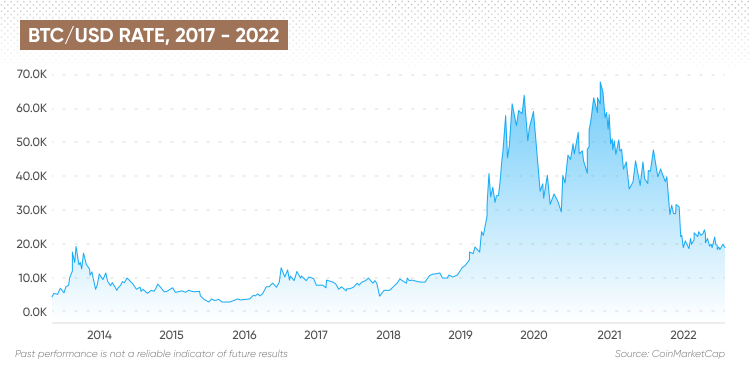
It has taken BTC to USD around eight years to surge past $1,000 since its launch in 2009. In 2017, the cryptocurrency saw a good run, rising by 1,600% within a year from $1,044.4 at the start of January 2017 to $17,760.3 by 20 December 2017 – a then all-time high.

However, a steep sell-off at the start of 2018 interfered, bringing the bitcoin’s price down to $7,637.86 by 8 February 2018. BTC continued to decline falling to $3,000 by 10 December 2018.

The cryptocurrency peaked once again in the beginning of July 2019, surpassing $12,000 for a brief time before losing over 58% of its value and dropping to $5,000 by 13 March 2020.

BTC/USD RATE 2017-2022

In 2021, the cryptocurrency enjoyed another bull run, the biggest in its history. By 8 January 2021, the token was valued at around $ 39,000. On 16 April 2021, bitcoin reached its first peak at $63,258.51 – a surge of around 62%. BTC’s price continued to rise, reaching the all-time high of $67,549.74 on 9 November 2021.

In 2022, the coin has been experiencing one of the harshest crypto winters yet, losing nearly 72% since the November 2021 highs, and is currently (12 October) hovering at $19,000.

What’s shaping the BTC/USD forecast?

The cryptocurrency market has been affected by a number of factors in 2022 such as with the war in Ukraine, the collapse of the TerraUSD (UST) stablecoin and rising inflation. Peter Eberle, president and chief investment officer of Castle Funds, told Capital.com:

“The first half of 2022 was horrible for equity, bond and crypto markets. A confluence of macro factors such as Russia’s invasion of Ukraine, US Policy makers’ slow realisation that inflation was real, then the aggressive pivot to higher interest rates, supply chain issues due to China’s Covid polices all led to a steep sell off across markets.”

Eberle added that Terra’s “meltdown”, which led to the subsequent fall of its sister cryptocurrency, LUNA, “created cascading liquidations across multiple platforms”, affecting not only the BTC/USD price but also several hedge funds, including Three Arrow Capital and Celsius Network.

On 9 June, bitcoin briefly traded above $31,000, however, this soon turned into a selloff, which saw the cryptocurrency lose over 90% of its minor gains, falling to $19,000 10 days later. Since then, BTC has been fluctuating, trading between $23,000 and $19,000.

“At the end of the 2nd quarter many in the industry were waiting for the proverbial ‘next shoe to drop’, but fortunately things calmed down,” Eberle noted.

Anndy Lian, chief digital advisor at the Mongolian Productivity Organisation and author of NFT: From Zero to Hero, said that bitcoin’s price depends on the outcomes of the Federal Reserve’s (Fed) meetings and decisions on monetary policy tightening, as well as latest inflation readings such as Producer Price Index (PPI) and the Consumer Price Index (CPI).

“However, I am not pessimistic. The mining companies have endured tough times. Despite the high hash rate, bitcoin’s price has not significantly increased. This signals that the miners are not piling the network to obtain big gains on bitcoin, they are confident that the mining business will do well now that the network has proven staying power.”

Historically, October has been a good month for cryptocurrencies, with bitcoin’s price change averaging at 14.6% gain in October since 2011, Capital.com’s seasonality research showed. Yet this year proves to be different.  Castle Fund’s Eberle noted:

“The third quarter of 2022 showed consolidation in the crypto market while equities and bonds continue to slump. The Dow Jones Industrial Average dropped 6.2%, Bitcoin dropped 2% but saw significantly lower volatility and the broader crypto market capitalization increased by 8.5%.”

Bitcoin to US dollar forecasts are currently focusing on macro events, Eberle added, specifically the Fed’s interest decisions, the future outcomes of the Russia-Ukraine conflict and the US midterm elections that are due to take place on 8 November. In addition, Eberle added some historical outlook concerning bitcoin’s past halving events:

“In 2015 BTC bottomed 547 days before the halving and in 2018 is occurred 517 before. The next halving is estimated to happen in April or May of 2024 so if history repeats we should be nearing the beginning of the next bull market.”

BTC/USD forecast 2022 and beyond

Despite the latest downward price action, algorithm-based forecasting service Wallet Investor gave a bullish BTC/USD forecast at the time of writing (12 October). The site noted that BTC was “a very good long-term investment”.

Based on its analysis of past price performance, WalletInvestor predicted that BTC/USD could trade at $25,373.90 in 2023 and surge to $47,496.74 in 2027.

DigitalCoinPrice supported the positive BTC/USD forecast but saw a speedier pace of growth in the following years, expecting the cryptocurrency to reach $24,206.47 by the end of 2022 and $43,340.43 by the end of 2023.

Its BTC/USD forecast for 2025 showed the cryptocurrency reaching $77,238.07 on average and $94,929.40 in 2027. The platform’s long-term BTC/USD forecast for 2030 expected the cryptocurrency to surge to $266,189.92 on average.

Lian did share the bullish sentiment on BTC to USD forecast:

“Bitcoin price hovers around $19,400, up 1.9% in the last week. Zooming out, it has gained 1% in value for the past 30 days. Unless we see the S&P 500 go down to 3200, bitcoin can go below the $13,000 region, else I think it will continue to trend sideways for the next few weeks.”

However, Lian noted that a positive aspect to highlight would be bitcoin’s hash rate which continues to surge.

Note that BTC/USD predictions can be wrong. Analysts’ and algorithm-based predictions shouldn’t be used as a substitute for your own research.

Always conduct your own due diligence on the stock before trading, looking at the latest news, a wide range of analyst commentary, technical and fundamental analysis. Note that past performance does not guarantee future returns. And never trade money you cannot afford to lose.


Source: https://capital.com/btc-usd-forecast-dollar-bitcoin-price

Anndy Lian is an early blockchain adopter and experienced serial entrepreneur who is known for his work in the government sector. He is a best selling book author- “NFT: From Zero to Hero” and “Blockchain Revolution 2030”.

Currently, he is appointed as the Chief Digital Advisor at Mongolia Productivity Organization, championing national digitization. Prior to his current appointments, he was the Chairman of BigONE Exchange, a global top 30 ranked crypto spot exchange and was also the Advisory Board Member for Hyundai DAC, the blockchain arm of South Korea’s largest car manufacturer Hyundai Motor Group. Lian played a pivotal role as the Blockchain Advisor for Asian Productivity Organisation (APO), an intergovernmental organization committed to improving productivity in the Asia-Pacific region.

An avid supporter of incubating start-ups, Anndy has also been a private investor for the past eight years. With a growth investment mindset, Anndy strategically demonstrates this in the companies he chooses to be involved with. He believes that what he is doing through blockchain technology currently will revolutionise and redefine traditional businesses. He also believes that the blockchain industry has to be “redecentralised”.

j j j

ADA/BTC prediction: Will Vasil hardfork turn around Cardano’s downward trend?

ADA/BTC prediction: Will Vasil hardfork turn around Cardano’s downward trend?

Bitcoin (BTC), the first cryptocurrency and the most valuable coin, is losing steam in 2022 amid a wider shift in market sentiment. Meanwhile, Cardano’s (ADA) long-awaited Vasil hard fork failed to trigger bullishness.

What does it mean for the ADA/BTC forecast? Here we take a look at the Cardano (ADA) to Bitcoin (BTC) cryptocurrency pair and factors shaping the ADA/BTC exchange rate.


What is ADA/BTC?

ADA/BTC represents the exchange rate between ADA, the native cryptocurrency of the Cardano blockchain, and BTC, the native coin on the Bitcoin Network.

Maxim Shilo, digital assets analyst at CoinLoan, explained that to determine the ADA/BTC rate, the coins’ prices are calculated separately, then added together, noting:

“If BTC rises 4.5%, and ADA rises 2.5% at the same time, then ADA/BTC price is down 2% respectively…There might be some differences, which are for market makers to spread on.”

Bitcoin was created in 2009 as a digital alternative to cash. Since its launch, the cryptocurrency has started to act as a store of value. It’s been compared to gold as a hedge against inflation.

Bitcoin’s key feature is mining. This is done through a blockchain that connects all public BTC transactions together. The blockchain uses a Proof-of-Work (PoW) consensus mechanism through which miners compete to solve mathematical equations and confirm the legitimacy of transactions. Miners are rewarded in BTC.

BTC tokens also undergo halving events roughly every four years. This is when the number of the BTC coins in circulation is reduced by half, making the token scarcer and raising its price.

Cardano was launched in 2017 as a third-generation crypto platform that uses the Proof-of-Stake (PoS) consensus mechanism. The blockchain prides itself in being the first ever crypto platform “to be founded on peer-reviewed research and developed through evidence-based methods”.

Cardano’s key focus is on being sustainable. In September 2021 the platform introduced smart contract capability, which means that the blockchain can now also support the creation of decentralised apps (dApps), new tokens, decentralised finance (DeFi) games, non-fungible tokens (NFTs) and more – one of the key factors that makes it stand out compared to BTC.

The platform was developed in “eras”, each named after a prominent historical figure in the fields of literature and computer science, such as Byron, Shelley, Goguen, Basho and Voltaire.

As of 30 September, the blockchain’s era is Basho, which introduced more scaling and optimisation to Cardano. Voltaire will be the last era in the blockchain’s development, which will bring governance to the system.

ADA/BTC historical rate chart

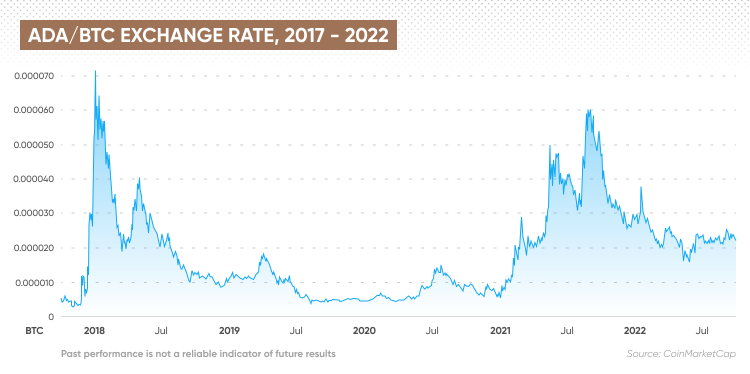
The ADA/BTC exchange rate surged 1,373.4% in the four months after the launch of the ADA token, trading at 0.00007103BTC in January 2018. At the same time the ADA price in USD jumped more than 4,800% to $1.0797. This was when ADA reached its all-time high against BTC.

Between 2018 and 2020 the exchange rate moved sideways, peaking at 0.00001811BTC and 0.00001495BTC in April 2019 and July 2020, respectively. In 2021, ADA regained its momentum against bitcoin.

ADA/BTC EXCHANGE RATE, 2017-2022

Between January and September 2021, the ADA/USD rate surged over 800%, with ADA enjoying the peak of 0.00006008BTC. The jump was mostly driven by bullish sentiment for Cardano, with ADA trading at a record high of $2.9682 in September 2021.

But, wider sentiment in the cryptocurrency markets shifted. ADA/USD swinged lower, losing over 20% year-to-date. Separately, ADA and BTC have lost 68% and 58% of their value in 2022, respectively (as of 30 September).

Is the Vasil fork driving ADA/BTC?

Cardano’s long-awaited Vasil mainnet upgrade, which aims to improve the blockchain’s scalability and increase the network’s capacity, was launched on 22 September after several delays. The Cardano Foundation said on Twitter.

Full Vasil capability became available on 27 September. In addition to that, the Cardano blockchain activated the Plutus V2 cost model, which delivered lower transaction costs for smart contracts.

This update was expected to boost ADA’s value, but failed to do so. According to Anndy Lian, chief digital advisor at the Mongolian Productivity Organisation and author of NFT: From Zero to Hero, “this is mainly due to the financial uncertainty globally.”

“Marco risks led by a very hawkish US Fed have also weighed down ADA’s price movement after Vasil’s launch,” he told Capital.com.

The ADA/BTC exchange rate dropped by 5.5 % between 22 and 29 September, during the hype in the run-up to the fork’s launch.

Shilo agreed that this phenomenon was linked to wider macro-economic factors stemming from a troubled global economy and a wider bear market. “Macro doesn’t really care about the updates or future promises,” he said.

Shilo added that Cardano was not the only token affected by macroeconomics on the brink of a big upgrade, using Ethereum’s Merge as an example.

Lian noted that although ADA failed to jump after the Vasil fork, their voting power has increased by 53%, noting:

“This means that more ADA was being used across proposals in Project Catalyst with 11% of all the circulating ADA being used in Catalyst Fund9, which is a community-driven initiative that allows users to vote and determines the future direction of the ecosystem.”

According to Lian “more utility and support from the community means better potential for the development of the token”.

In other news, the Cardano Foundation is preparing for an events season, which will kick off in October 2022. The Foundation is due to participate in a number of key crypto events that could affect an ADA/BTC forecast.

In November, Cardano will hold the Cardano Summit 2022 in Switzerland, which will focus on presentations and updates from developers of Cardano’s decentralised applications (dApps).

ADA/BTC forecast for 2022 and beyond

Based on the analysis of ADA’s past price performance, as of 30 September, the algorithm-based forecasting service WalletInvestor predicted that ADA/USD could fall to $0.0423 in 2023. The platform did not provide a price prediction for 2027.

In terms of its bitcoin prediction, the site saw BTC/USD trade at $30,274.06 in 2023 and reach $74,480.14 by 2027.

While WalletInvestor did not provide a direct Cardano/Bitcoin forecast, data suggested that the exchange rate could be 0.000000567BTC in 2023.

DigitalCoinPrice predicted that ADA/USD could rise to $0.46 by the end of 2022, $0.99 in 2023 and $1.76 in 2025. Its long-term prediction saw the coin reaching $6.04 in 2030.

The site also gave an upbeat BTC/USD forecast, expecting the coin to average at $20,403 in 2022, $44,579 in 2023, $79,430 in 2025 and surpass $273,000 in 2030.

DigitalCoinPrice’s ADA/BTC forecast for 2022 expected the pair to reach 0.00002255BTC. In 2023, the ADA/BTC prediction saw the exchange rate falling to 0.00002221BTC. The site’s ADA/BTC forecast for 2025 stood at 0.00002216BTC. Its long-term ADA/BTC forecast for 2030 was 0.00002212BTC.

Shilo stressed that bitcoin has relative strength to altcoins and added that in his opinion the ADA/BTC forecast is pointing downwards:

“It’s unlikely that [ADA] will outperform BTC. I can’t see it happening in the near term. Only very few selected coins have done so in the long term, and historically the chances are very slim. Given that the price is trading in the range and is in no man’s land against BTC, it’s clearly pointing toward a downward trend.”

Note that analysts’ and algorithm-based forecasts can be wrong and shouldn’t be used as a substitute for your own research. Always conduct your own due diligence before trading, and never trade money you cannot afford to lose.


Source: https://capital.com/ada-btc-prediction-cardano-bitcoin-vasil-hardfork

Anndy Lian is an early blockchain adopter and experienced serial entrepreneur who is known for his work in the government sector. He is a best selling book author- “NFT: From Zero to Hero” and “Blockchain Revolution 2030”.

Currently, he is appointed as the Chief Digital Advisor at Mongolia Productivity Organization, championing national digitization. Prior to his current appointments, he was the Chairman of BigONE Exchange, a global top 30 ranked crypto spot exchange and was also the Advisory Board Member for Hyundai DAC, the blockchain arm of South Korea’s largest car manufacturer Hyundai Motor Group. Lian played a pivotal role as the Blockchain Advisor for Asian Productivity Organisation (APO), an intergovernmental organization committed to improving productivity in the Asia-Pacific region.

An avid supporter of incubating start-ups, Anndy has also been a private investor for the past eight years. With a growth investment mindset, Anndy strategically demonstrates this in the companies he chooses to be involved with. He believes that what he is doing through blockchain technology currently will revolutionise and redefine traditional businesses. He also believes that the blockchain industry has to be “redecentralised”.

j j j