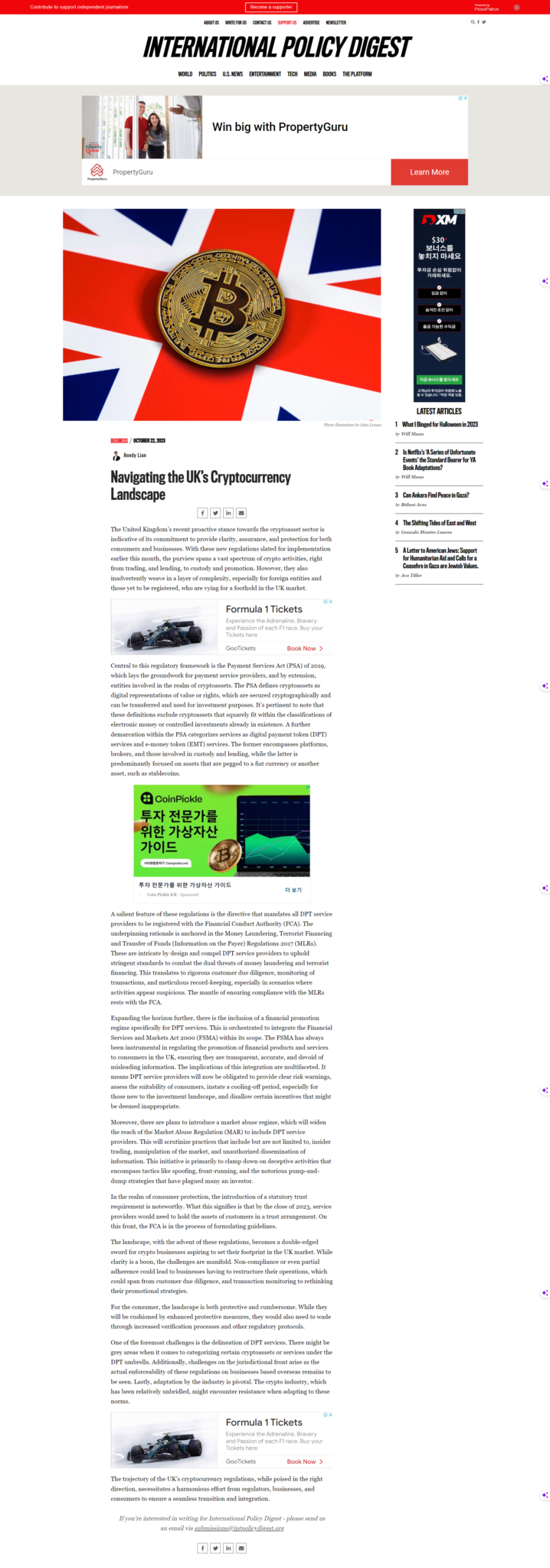
Building a Crypto Hub on Quicksand: The UK’s Regulatory Contradictions

Building a Crypto Hub on Quicksand: The UK’s Regulatory Contradictions

On paper, Britain wants to be a global center for digital-asset innovation. In practice, the way the government and the Financial Conduct Authority (FCA) are building the rulebook could smother the very ecosystem they claim to champion. The ambition is real. The execution, so far, is wobblier.

The Draft Statutory Instrument (SI) on crypto assets is a genuine milestone. It signals a desire to move past the reactive, enforcement-first posture that dogged the U.S. for years. Instead of waiting for firms to implode—or to break rules—the UK is attempting a structured, rules-based approach from the outset. That’s commendable. But good intentions don’t outweigh bad design or halting rollout.

Consider retail access. In August, the FCA green-lit crypto exchange-traded notes (ETNs) for UK investors—a cautious but welcome gesture toward mainstream exposure. Yet it still bars crypto exchange-traded funds (ETFs), even as the U.S., Canada, and parts of Europe have normalized them. The split is hard to justify. If ETNs are tolerable for retail, why not ETFs, which typically offer comparable exposure with greater transparency and liquidity? The inconsistency reads less like risk-based regulation and more like institutional inertia, and the mixed signals feed skepticism about what, exactly, the UK is trying to protect.

Then there’s decentralized finance. DeFi is no longer a boutique experiment; it’s a rapidly scaling pillar of the crypto economy, with billions locked across protocols that operate without central intermediaries. Yet the UK has drawn no clear line between DeFi and regulated centralized finance (CeFi). Without definitions and boundaries, firms don’t know when they fall under FCA oversight. That uncertainty is toxic to investment and hiring: startups hesitate to build, investors hesitate to allocate, and talent gravitates to jurisdictions where rules—strict or not—are at least legible.

The compliance burden compounds the problem. Take the proposal for automated tax reporting to HMRC. As an anti-evasion tool, it sounds sensible. But crypto’s founding ethos—privacy and user sovereignty—doesn’t vanish at the first sight of a spreadsheet. Requiring granular, near-real-time reporting from exchanges is likely to push privacy-conscious users offshore to less transparent venues, ironically heightening systemic risk. And the costs won’t be shared evenly: global incumbents can absorb new teams and bespoke systems; a London-based DeFi protocol or early-stage wallet provider may find the overhead prohibitive. Regulation should widen the field, not entrench the biggest players.

To its credit, the FCA has not tried to do this in a vacuum. Its Crypto Roadmap aims to phase in rules, consult widely, and avoid the blunt instruments seen elsewhere. The emphasis on operational resilience and anti-financial-crime controls is prudent. Crypto markets remain vulnerable to hacks, scams, and manipulation; insisting on basic hygiene borrowed from traditional finance helps professionalize an industry that has too often resembled the Wild West.

But professionalism isn’t the same as suffocation. The missing word in much of the current approach is proportionality. Not every firm presents the same risk profile. A non-custodial wallet developer should not face the capital and control obligations of a centralized exchange holding billions in customer assets. The Draft SI’s trajectory suggests a one-size-fits-all mindset that will send builders underground—or abroad.

Founders in the UK ecosystem are cautiously optimistic, but their optimism is conditional. They want regulation—clear, predictable rules calibrated to the realities of open-source software, smart contracts, and programmable finance. What they fear is a regime that looks progressive in speeches and consultation papers but functions, day to day, as a bureaucratic moat—shielding legacy finance while feigning enthusiasm for disruption.

Meanwhile, the global race is already on. After stumbling, the U.S. regained momentum with approvals of spot Bitcoin ETFs. The EU’s MiCA, for all its complexity, offers a comprehensive rulebook firms can plan around. Singapore and Switzerland—traditionally conservative—have cut discernible paths for digital-asset businesses. If the UK keeps moving in half-steps, opening one door while bolting the next three, it will drift from contender to spectator.

What’s needed now is less process theater and more decisions. Finalize the SI with workable definitions for DeFi. Rationalize the treatment of listed crypto products so ETFs and ETNs aren’t arbitrarily split. Build tiered, risk-scaled obligations so small non-custodial developers aren’t treated like systemically important custodians. And use the FCA’s Roadmap to publish guidance in gray areas quickly, rather than waiting for perfect legislation to catch up with imperfect reality.

Regulation that ignores how the industry actually operates will fail, however noble the preamble.

The UK has advantages others envy: deep financial expertise, credible courts, and a tech-savvy public ready to participate in a digital economy. But advantages are not entitlements. If the government and the FCA truly want a crypto hub, they must stop treating rules as barricades and start treating them as infrastructure—built thoughtfully, collaboratively, and with an eye on where finance is heading, not where it’s been. Otherwise, the next wave of financial innovation will break—just not on British shores.


Source: https://intpolicydigest.org/building-a-crypto-hub-on-quicksand-the-uk-s-regulatory-contradictions/


Anndy Lian is an early blockchain adopter and experienced serial entrepreneur who is known for his work in the government sector. He is a best selling book author- “NFT: From Zero to Hero” and “Blockchain Revolution 2030”.

Currently, he is appointed as the Chief Digital Advisor at Mongolia Productivity Organization, championing national digitization. Prior to his current appointments, he was the Chairman of BigONE Exchange, a global top 30 ranked crypto spot exchange and was also the Advisory Board Member for Hyundai DAC, the blockchain arm of South Korea’s largest car manufacturer Hyundai Motor Group. Lian played a pivotal role as the Blockchain Advisor for Asian Productivity Organisation (APO), an intergovernmental organization committed to improving productivity in the Asia-Pacific region.

An avid supporter of incubating start-ups, Anndy has also been a private investor for the past eight years. With a growth investment mindset, Anndy strategically demonstrates this in the companies he chooses to be involved with. He believes that what he is doing through blockchain technology currently will revolutionise and redefine traditional businesses. He also believes that the blockchain industry has to be “redecentralised”.

j j j

How is the UK-US trade deal shaping cryptocurrency and stock market trends?

How is the UK-US trade deal shaping cryptocurrency and stock market trends?

I’m excited to dive into the multifaceted implications of the recent UK-US trade deal and its ripple effects across macroeconomic indicators, equity markets, foreign exchange, commodities, fixed income, and even the booming cryptocurrency sector.

This deal, alongside other economic developments, paints a complex yet fascinating picture of where the world economy might be headed in the coming months.

Below, I’ll offer my detailed perspective on these topics, weaving together the facts and data provided to give you a comprehensive view of what’s happening and why it matters.

Macroeconomic developments: A trade deal with big implications

The UK-US trade deal is a landmark agreement that’s making waves in the global economic landscape. At its core, it maintains a 10 per cent tariff on UK goods entering the US—a compromise from the steeper tariffs initially floated by the Trump administration. This tariff level strikes a balance, protecting some US industries while still fostering trade with a key ally.

What really stands out, though, is the deal’s hefty commitments: the UK will purchase US$10 billion worth of Boeing planes, a massive win for the American aerospace giant and a boost to US manufacturing jobs.

Meanwhile, Rolls Royce gets a golden ticket to export parts tariff-free, which could supercharge its revenue and strengthen the UK’s position in the high-tech engineering sector. The goal here is clear—both nations are aiming to juice up their export opportunities and rake in more revenue, a strategic move in a world where trade tensions have been simmering for years.

But this deal doesn’t exist in a vacuum. President Trump’s upbeat comments about upcoming tariff talks with China add another layer of intrigue. If those negotiations—set to kick off in Switzerland this weekend—go well, we could see a broader easing of trade barriers, which would be a game-changer for global markets.

Imagine a scenario where the US, UK, and China start aligning their trade policies more closely; it could unlock a flood of economic activity and calm jittery investors who’ve been on edge since the trade wars kicked off.

On the domestic front, though, the US economy is sending mixed signals. Nonfarm labor productivity dropped by 0.8 per cent in the first quarter, which sounds alarming until you dig into the details. Oxford Economics chalks this up to one-off quirks—think temporary disruptions or statistical noise—rather than a sign of deeper trouble.

At the same time, labor costs shot up by 5.7 per cent , but here’s the kicker: this doesn’t seem to point to runaway wage growth. Employers might just be shelling out more for benefits or overtime rather than hiking base salaries across the board. Jobless claims offer a brighter spot, falling to 228,000 against expectations, with continued claims steady at 1.879 million.

Even with tariffs in play, the labor market’s holding firm—last week’s uptick was just a blip tied to New York’s school spring break. Looking ahead, we’ll get a clearer read on labor trends by the July FOMC meeting, but for now, don’t hold your breath for a June rate cut. The Fed’s likely to sit tight until the data paints a sharper picture.

Equity markets: Riding the wave of trade optimism

Over in the equity markets, the mood is unmistakably upbeat, and it’s easy to see why. The S&P 500 climbed 0.6 per cent , the Nasdaq leapt 1.1 per cent , and the Dow tacked on 255 points—all fuelled by this trade deal and a sigh of relief over cooling geopolitical tensions. Trump’s been vocal about this, urging investors to “buy stocks now” and calling the UK deal a breakthrough for American exports.

Sure, that 10 per cent tariff lingers, but the Boeing purchase and Rolls Royce perk more than offset the sting for many market watchers. His hint at possible tariff cuts with China, depending on those Switzerland talks, only adds to the bullish vibe.

Tech stocks are the stars of this rally. Tesla revved up 3.1 per cent , Palantir rocketed 7.8 per cent , and heavyweights like Apple and Alphabet clawed back some recent losses. It’s a classic case of trade optimism lifting all boats—well, almost all. Arm stumbled 6.2 per cent after a gloomy forecast, and Eli Lilly shed 3.2 per cent as healthcare stocks took a hit across Europe and North America.

After hours, Coinbase tripped too, dropping 2.6 per cent after missing revenue targets and reporting a jaw-dropping 94 per cent plunge in net income, thanks to a markdown on its crypto holdings. It’s a reminder that even in a rising market, not every company’s riding the same wave.

Europe’s markets echoed this positivity on Thursday, with the STOXX 50 up 1.1 per cent and the STOXX 600 edging up 0.4 per cent. Tech and financials led the charge—ASML, UniCredit, Santander, and Intesa Sanpaolo all jumped over three per cent —while AB InBev toasted a 3.2 per cent gain on solid earnings.

But it wasn’t all rosy: pharmaceuticals dragged things down, with Novo Nordisk sliding four per cent after slashing guidance on its obesity drug, and Mercedes Benz tanked six per cent after cutting dividends amid economic headwinds.

The EU’s keeping a close eye on this US-UK deal, too, warning of retaliatory tariffs on US goods if its own trade talks falter. Meanwhile, central banks are in a holding pattern—the Riksbank and Norges Bank stood pat, but the Bank of England trimmed rates, adding another twist to the monetary policy mix.

In Hong Kong, the Hang Seng Index rose 0.8 per cent to 22,881, stretching its winning streak to six sessions. The Fed and HKMA holding rates steady, paired with Trump’s trade deal buzz, lit a fire under consumer and tech stocks.

China’s central bank, the PBoC, pitched in with rate cuts and growth-friendly policies, though financials lagged, and worries about Beijing’s fiscal plans and looming economic data kept gains in check. It’s a delicate balance—optimism is high, but there’s still plenty of uncertainty in the air.

Cryptocurrencies: Bitcoin and Ethereum steal the spotlight

Now, let’s talk crypto, because it’s impossible to ignore the fireworks here. Bitcoin’s charging toward its January 2025 peak of US$109,000, recently blasting past US$99,800. What’s driving this? A perfect storm of institutional buying, ETF inflows, and the buzz from these US-UK-China trade talks.

If it punches through that psychological US$100,000 barrier, analysts see it soaring to US$110,000 or even US$120,000. State-level regulations in the US are turning more crypto-friendly, too, giving this rally some serious legs. It’s not just hype—Bitcoin’s becoming a legit player in the financial world.

Ethereum’s no slouch either, trading at US$3,762.59 with a whopping 29.61 per cent gain this week alone, including a US$120 spike in 24 hours. Analysts are more cautious here, pegging a May price around US$1,665 and a year-end range of US$1,445 to US$2,900.

But don’t sleep on ETH—it’s the backbone of hot trends like DeFi, NFTs, and tokenisation. While Bitcoin grabs headlines, Ethereum’s quietly building the infrastructure for the next wave of digital finance.

Currencies and gold feel the heat, yields shift with the tide

The trade deal’s shaking up the forex market, too. The British pound’s getting a lift as investors cheer the UK’s Boeing buy and Rolls Royce boost, even with that 10 per cent tariff in place. The Japanese yen, though, is lagging—likely a victim of the dollar’s muscle flexing on the global stage.

Speaking of which, that dollar strength is hammering gold, which has slumped for two straight days. It’s a textbook move: when the greenback shines, safe-haven assets like gold tend to take a backseat.

In the bond world, yields are getting cheaper, especially at the front and belly of the curve. Think shorter- and medium-term Treasuries here—this shift suggests markets are recalibrating after the trade news and mixed economic data.

Investors might be betting on steady or slightly higher rates down the line, or just adjusting to a world where trade deals could juice up growth without sparking inflation fears just yet.

My POV: A pivotal moment with plenty of unknowns

So, what’s my view on all this? The UK-US trade deal is a big deal—pun intended. It’s a pragmatic step that keeps trade flowing while dodging the all-out tariff wars some feared. That US$10 billion Boeing haul and Rolls Royce’s tariff-free exports are concrete wins, and if Trump’s China talks bear fruit, we could be on the cusp of a broader trade thaw.

Economically, the US is in a weird spot—productivity’s down, labor costs are up, but the job market’s steady as a rock. It’s not screaming recession, but it’s not exactly a boom either. The Fed’s got a tough call ahead, and I’d bet they hold off on any big moves until summer.

The equity markets are loving this trade optimism, and I get it—stocks thrive on stability and growth signals. Tech’s leading the pack, but those healthcare and crypto stumbles show how uneven this rally is. Europe and Hong Kong are in sync, though local quirks like pharma woes and China’s fiscal tightrope keep things interesting.

Crypto’s the wild card—Bitcoin’s on a tear, and Ethereum’s got staying power. If you’re an investor, this feels like a moment to watch closely, not jump in blind.

The pound’s pop and gold’s dip make sense in this dollar-driven world, and those yield shifts hint at markets still figuring out what’s next. Overall, this deal’s a shot in the arm for global trade, but it’s not a cure-all. The China talks, labor trends, and sector shakeouts will tell us whether this is a turning point or just a blip.

For now, I’m cautiously optimistic—there’s potential here, but plenty of hurdles too. Stay tuned; the next few months could be a wild ride.


Source: https://e27.co/how-is-the-uk-us-trade-deal-shaping-cryptocurrency-and-stock-market-trends-20250509/

Anndy Lian is an early blockchain adopter and experienced serial entrepreneur who is known for his work in the government sector. He is a best selling book author- “NFT: From Zero to Hero” and “Blockchain Revolution 2030”.

Currently, he is appointed as the Chief Digital Advisor at Mongolia Productivity Organization, championing national digitization. Prior to his current appointments, he was the Chairman of BigONE Exchange, a global top 30 ranked crypto spot exchange and was also the Advisory Board Member for Hyundai DAC, the blockchain arm of South Korea’s largest car manufacturer Hyundai Motor Group. Lian played a pivotal role as the Blockchain Advisor for Asian Productivity Organisation (APO), an intergovernmental organization committed to improving productivity in the Asia-Pacific region.

An avid supporter of incubating start-ups, Anndy has also been a private investor for the past eight years. With a growth investment mindset, Anndy strategically demonstrates this in the companies he chooses to be involved with. He believes that what he is doing through blockchain technology currently will revolutionise and redefine traditional businesses. He also believes that the blockchain industry has to be “redecentralised”.

j j j

Navigating the UK’s Cryptocurrency Landscape

Navigating the UK’s Cryptocurrency Landscape

The United Kingdom’s recent proactive stance towards the cryptoasset sector is indicative of its commitment to provide clarity, assurance, and protection for both consumers and businesses. With these new regulations slated for implementation earlier this month, the purview spans a vast spectrum of crypto activities, right from trading, and lending, to custody and promotion. However, they also inadvertently weave in a layer of complexity, especially for foreign entities and those yet to be registered, who are vying for a foothold in the UK market.

Central to this regulatory framework is the Payment Services Act (PSA) of 2019, which lays the groundwork for payment service providers, and by extension, entities involved in the realm of cryptoassets. The PSA defines cryptoassets as digital representations of value or rights, which are secured cryptographically and can be transferred and used for investment purposes. It’s pertinent to note that these definitions exclude cryptoassets that squarely fit within the classifications of electronic money or controlled investments already in existence. A further demarcation within the PSA categorizes services as digital payment token (DPT) services and e-money token (EMT) services. The former encompasses platforms, brokers, and those involved in custody and lending, while the latter is predominantly focused on assets that are pegged to a fiat currency or another asset, such as stablecoins.

A salient feature of these regulations is the directive that mandates all DPT service providers to be registered with the Financial Conduct Authority (FCA). The underpinning rationale is anchored in the Money Laundering, Terrorist Financing and Transfer of Funds (Information on the Payer) Regulations 2017 (MLRs). These are intricate by design and compel DPT service providers to uphold stringent standards to combat the dual threats of money laundering and terrorist financing. This translates to rigorous customer due diligence, monitoring of transactions, and meticulous record-keeping, especially in scenarios where activities appear suspicious. The mantle of ensuring compliance with the MLRs rests with the FCA.

Expanding the horizon further, there is the inclusion of a financial promotion regime specifically for DPT services. This is orchestrated to integrate the Financial Services and Markets Act 2000 (FSMA) within its scope. The FSMA has always been instrumental in regulating the promotion of financial products and services to consumers in the UK, ensuring they are transparent, accurate, and devoid of misleading information. The implications of this integration are multifaceted. It means DPT service providers will now be obligated to provide clear risk warnings, assess the suitability of consumers, instate a cooling-off period, especially for those new to the investment landscape, and disallow certain incentives that might be deemed inappropriate.

Moreover, there are plans to introduce a market abuse regime, which will widen the reach of the Market Abuse Regulation (MAR) to include DPT service providers. This will scrutinize practices that include but are not limited to, insider trading, manipulation of the market, and unauthorized dissemination of information. This initiative is primarily to clamp down on deceptive activities that encompass tactics like spoofing, front-running, and the notorious pump-and-dump strategies that have plagued many an investor.

In the realm of consumer protection, the introduction of a statutory trust requirement is noteworthy. What this signifies is that by the close of 2023, service providers would need to hold the assets of customers in a trust arrangement. On this front, the FCA is in the process of formulating guidelines.

The landscape, with the advent of these regulations, becomes a double-edged sword for crypto businesses aspiring to set their footprint in the UK market. While clarity is a boon, the challenges are manifold. Non-compliance or even partial adherence could lead to businesses having to restructure their operations, which could span from customer due diligence, and transaction monitoring to rethinking their promotional strategies.

For the consumer, the landscape is both protective and cumbersome. While they will be cushioned by enhanced protective measures, they would also need to wade through increased verification processes and other regulatory protocols.

One of the foremost challenges is the delineation of DPT services. There might be grey areas when it comes to categorizing certain cryptoassets or services under the DPT umbrella. Additionally, challenges on the jurisdictional front arise as the actual enforceability of these regulations on businesses based overseas remains to be seen. Lastly, adaptation by the industry is pivotal. The crypto industry, which has been relatively unbridled, might encounter resistance when adapting to these norms.

The trajectory of the UK’s cryptocurrency regulations, while poised in the right direction, necessitates a harmonious effort from regulators, businesses, and consumers to ensure a seamless transition and integration.


Source: https://intpolicydigest.org/navigating-the-uk-s-cryptocurrency-landscape/

Anndy Lian is an early blockchain adopter and experienced serial entrepreneur who is known for his work in the government sector. He is a best selling book author- “NFT: From Zero to Hero” and “Blockchain Revolution 2030”.

Currently, he is appointed as the Chief Digital Advisor at Mongolia Productivity Organization, championing national digitization. Prior to his current appointments, he was the Chairman of BigONE Exchange, a global top 30 ranked crypto spot exchange and was also the Advisory Board Member for Hyundai DAC, the blockchain arm of South Korea’s largest car manufacturer Hyundai Motor Group. Lian played a pivotal role as the Blockchain Advisor for Asian Productivity Organisation (APO), an intergovernmental organization committed to improving productivity in the Asia-Pacific region.

An avid supporter of incubating start-ups, Anndy has also been a private investor for the past eight years. With a growth investment mindset, Anndy strategically demonstrates this in the companies he chooses to be involved with. He believes that what he is doing through blockchain technology currently will revolutionise and redefine traditional businesses. He also believes that the blockchain industry has to be “redecentralised”.

j j j