Silvergate Bank’s crisis: A wake-up call for risk management in crypto banking

Silvergate Bank’s crisis: A wake-up call for risk management in crypto banking

The cryptocurrency market has recently been shaken by a significant crisis at Silvergate Bank, a financial institution that specialises in digital assets. The effects of this crisis have been widespread and have caused a great deal of concern among investors. Shares of Silvergate Bank have experienced a sharp drop, hitting an all-time low of $4.86 on Friday, representing a decline of nearly 98% since the institution’s record high close in November 2021. As a result, the market capitalisation of Silvergate Bank has suffered a total loss of over $7 billion. The impact of this crisis has not been limited to Silvergate Bank alone. The wider crypto industry has also been affected, with major players such as Coinbase Global and Ebang International experiencing a noticeable drop of around 1% each. Additionally, even the popular cryptocurrencies Bitcoin and Ethereum have both taken a hit, experiencing a decline of roughly 4.8% over the past week.

The crisis at Silvergate Bank started when the bank delayed filing its annual report. The delay sparked a sell-off of Silvergate’s shares, triggering a domino effect across the crypto market. The situation worsened when Silvergate Bank announced that it had made a risk-based decision to discontinue the Silvergate Exchange Network, it’s crypto payments network. This caused Silvergate’s shares to tumble by nearly 50% on Thursday’s New York stock exchange. The fall in crypto stocks is a reminder that the crypto market is still highly volatile and susceptible to sudden shifts. The fact that one bank’s crisis can greatly impact the entire market is concerning. However, it is worth noting that this crisis does not necessarily indicate a fundamental flaw in the crypto market. Instead, it may be an indication that some players in the market, such as Silvergate Bank, were not adequately prepared for the risks associated with the market.

The Silvergate Bank incident highlighted some significant issues with the bank’s risk management and financial reporting approach. One of the key revelations from the crisis is that Silvergate’s bad debts were not its assets but its deposits. In simple terms, this means that Silvergate had been using its customers’ deposits to invest in risky assets rather than holding those deposits in more secure and stable investments. This is a major red flag for any bank, and it particularly concerns the context of a bank that focuses on digital assets and cryptocurrencies.

It has become evident that Silvergate, a financial institution dealing with digital assets, was not adequately prepared to handle the volatile market. As a result, their customers and investors have suffered significant losses. To avoid such situations, managing risk is critical to dealing with digital assets and cryptocurrencies. Banks must remain vigilant in identifying, assessing, and mitigating potential risks. There are several key areas that banks should consider in their risk management approach.

Firstly, banks should identify various risks of digital assets and cryptocurrencies, including market risks (such as price volatility), operational risks (such as security breaches), legal and regulatory risks (such as compliance with AML and KYC regulations), and reputational risks (such as negative publicity). Once risks have been identified, banks should assess the potential impact and likelihood of each risk. This approach will enable banks to prioritise risks and allocate resources accordingly. Banks should take steps to mitigate risks by implementing robust security measures, conducting due diligence on clients and counterparties, and diversifying their digital asset portfolios. Banks must monitor risks continually and adjust their risk management strategies accordingly. This may involve using risk metrics, conducting stress tests, and staying up-to-date on industry developments.

Alongside risk management, banks should also consider how to report their books when dealing with digital assets and cryptocurrencies. Banks need to accurately report their holdings and transactions in real time because the value of these assets can change rapidly. This may require specialised accounting software and the development of internal processes for tracking and reporting digital asset transactions. Moreover, banks may need to adapt their reporting practices to reflect the unique characteristics of digital assets and cryptocurrencies. For example, banks may need to report on the specific digital assets they hold and the particular risks associated with those assets. Banks may also need to provide more detailed disclosures about their digital asset holdings and transactions to ensure transparency with clients and regulators. Risk management and reporting practices are vital for banks that deal with digital assets and cryptocurrencies. Banks must proactively identify, assess, and mitigate risks while developing robust reporting practices that accurately reflect their digital asset holdings and transactions.

Ultimately, the Silvergate Bank crisis serves as a cautionary tale for banks and investors alike. It highlights the need for proper risk management, financial reporting, and diversification, particularly in the context of digital assets and cryptocurrencies. While the market for cryptocurrencies and digital assets remains volatile and unpredictable, those prepared to take the necessary precautions and invest wisely may still be able to succeed and grow in this exciting and rapidly-evolving industry.

In times of crisis, it is essential to remember the importance of diversification. Investors who have diversified their portfolios may be better able to weather the storm caused by the fall in crypto stocks. Emphasising this again, it is also worth noting that the fall of crypto stocks does not necessarily mean that cryptocurrencies themselves are inherently risky investments. While the crypto market can be volatile, it has also seen significant growth in recent years and is expected to continue expanding in the coming years. As such, investors interested in investing in the crypto market may want to consider doing so through a diversified portfolio that includes a range of different assets.

It is also important for investors to conduct thorough due diligence when selecting investments in the crypto market. This includes researching the background and track record of the companies and individuals behind the investments and analysing market trends and potential risks. By taking a careful and informed approach to investing in the crypto market, investors can better protect themselves from sudden market shifts and crises like the one experienced by Silvergate Bank and the broader crypto industry.


Source: https://www.benzinga.com/23/03/31239033/silvergate-banks-crisis-a-wake-up-call-for-risk-management-in-crypto-banking

Anndy Lian is an early blockchain adopter and experienced serial entrepreneur who is known for his work in the government sector. He is a best selling book author- “NFT: From Zero to Hero” and “Blockchain Revolution 2030”.

Currently, he is appointed as the Chief Digital Advisor at Mongolia Productivity Organization, championing national digitization. Prior to his current appointments, he was the Chairman of BigONE Exchange, a global top 30 ranked crypto spot exchange and was also the Advisory Board Member for Hyundai DAC, the blockchain arm of South Korea’s largest car manufacturer Hyundai Motor Group. Lian played a pivotal role as the Blockchain Advisor for Asian Productivity Organisation (APO), an intergovernmental organization committed to improving productivity in the Asia-Pacific region.

An avid supporter of incubating start-ups, Anndy has also been a private investor for the past eight years. With a growth investment mindset, Anndy strategically demonstrates this in the companies he chooses to be involved with. He believes that what he is doing through blockchain technology currently will revolutionise and redefine traditional businesses. He also believes that the blockchain industry has to be “redecentralised”.

j j j

Hong Kong Regulator Steps Up Awareness Campaign on NFTs

Hong Kong Regulator Steps Up Awareness Campaign on NFTs

My original comments to the reporter look like this. I have added additional insights.

“The Securities and Futures Commission (SFC) must do this ASAP as I do see numerous NFT projects started in Hong Kong that are wrapping securities and derivatives around NFTs. In fact, I have said numerous times in my public speeches that such an act is not grey, it is totally illegal.

Tencent and Ant Group changed the descriptions of NFTs on their platforms to ‘digital collectibles’ to play down their links to cryptocurrencies last year. The bigger boys did their homework way beforehand to avoid any possible issues with regulators in China and Hong Kong.

I urge SFC to take put a hard stop to all the bad actors who are trying to operate regulated activities in Hong Kong or targeting Hong Kong investors using NFT as a workaround.”

Hong Kong Regulator Steps Up Awareness Campaign on NFTs

The Hong Kong Securities and Futures Commission (SFC) has stepped up its awareness campaign on non-fungible tokens (NFTs), cautioning investors against investing in them if they do not fully understand the risks.

“As with other virtual assets, NFTs are exposed to heightened risks including illiquid secondary markets, volatility, opaque pricing, hacking, and fraud. Investors should be mindful of these risks, and if they cannot fully understand them and bear the potential losses, they should not invest in NFTs,” the SFC stated.

The SFC noted that there are a number of NFTs that represent the digital representation of an underlying asset and in which case, it has little role to play in the trading of those assets.

However, the financial regulator said, there are NFTs that are portrayed as securities and these types must be licensed before it is offered to residents.

Assets that push the boundary between collectibles and financial assets, such as fractionalized or fungible NFTs structured as securities or collective investment schemes (CIS) in NFTs, do fall under the SFC’s mandate.

A CIS is an investment arrangement, to pool money around a certain asset or property. The Hong Kong Securities and Futures Ordinance (SFO) requires CIS to be managed in escrow, and its participants do not have day-to-day control over its management. They however are subject to receive profits, income, or other returns.

The solicitation of Hong Kong residents by companies engaged in these activities requires the issuer to obtain a license from the SFC unless an exemption applies.

SFC has mandated a license from Hong Kong residents who wish to issue fractionalized NFTs or to target local investors or be subject to certain authorization requirements under the SFO.

Anndy Lian, chairman, BigONE exchange, says a few well-known corporations that are based in China changed the descriptions of NFTs on their platforms to ‘digital collectibles’ to play down their links to cryptocurrencies last year.

“They did their homework way beforehand to avoid any possible issues with regulators in China and Hong Kong. I urge SFC to put a hard stop to all the bad actors who are trying to operate regulated activities in Hong Kong or target Hong Kong investors using NFT as a workaround,” Lian says.

Raj Kapoor, chief advisor of crypto advisory firm Acryptoverse says security issues are just a major legal concern when it comes to NFTs and that each different NFT model presents a unique legal issue.

“License uncertainty is another risk while IP ownership many a time is opaque. Copyright Infringement raises concerns as well. Deceptive and unlawful trade practices for misrepresentation of ownership of the work underlying an NFT is also a deep risk factor,” he added.

Money Laundering including self laundering is another as potential criminals purchase an NFT with illicit funds, transact with themselves to create records of sales on the blockchain, then sell to another party using clean funds.


Original Source: https://uk.investing.com/news/cryptocurrency-news/hong-kong-regulator-steps-up-awareness-campaign-on-nfts-2665065

Anndy Lian is an early blockchain adopter and experienced serial entrepreneur who is known for his work in the government sector. He is a best selling book author- “NFT: From Zero to Hero” and “Blockchain Revolution 2030”.

Currently, he is appointed as the Chief Digital Advisor at Mongolia Productivity Organization, championing national digitization. Prior to his current appointments, he was the Chairman of BigONE Exchange, a global top 30 ranked crypto spot exchange and was also the Advisory Board Member for Hyundai DAC, the blockchain arm of South Korea’s largest car manufacturer Hyundai Motor Group. Lian played a pivotal role as the Blockchain Advisor for Asian Productivity Organisation (APO), an intergovernmental organization committed to improving productivity in the Asia-Pacific region.

An avid supporter of incubating start-ups, Anndy has also been a private investor for the past eight years. With a growth investment mindset, Anndy strategically demonstrates this in the companies he chooses to be involved with. He believes that what he is doing through blockchain technology currently will revolutionise and redefine traditional businesses. He also believes that the blockchain industry has to be “redecentralised”.

j j j

Apecoin (APE) price prediction: Will the debut surge keep up?

Apecoin (APE) price prediction: Will the debut surge keep up?

Ape coin (APE), the native cryptocurrency of the popular non-fungible token (NFT) collection Bored Ape Yacht Club (BAYC), became the biggest metaverse token by market capitalisation a little over a month after its release. The coin has dethroned Decentraland’s coin (MANA), which has been around since early 2020.

Recent news that ApeCoin will implement a staking mechanism in the coming weeks as well as Elon Musk briefly changing his profile picture on Twitter to a collage of a number of avatars from the BAYC NFT collection, drove the APE NFT coin price up on 5 May as it managed to gain nearly 19% of its value in less than 24 hours.

Will the future APE coin price prediction be as bullish as its early start, and what are the key projections for the popular NFT cryptocurrency?

What is ApeCoin?

ApeCoin (APE), was launched on 17 March 2022 by the founders of the BAYC NFT collection Yuga Labs, which also formed the APE Foundation, a means of aiding the decentralised development of the APE ecosystem.

Created with the goal of becoming the “heart of art, gaming, entertainment and events on the blockchain”, the APE Foundation will be in charge of overlooking the decisions of the ApeCoin Decentralised Autonomous Organisation (DAO).

The crypto will be responsible for administration, bookkeeping, project management and other tasks necessary to ensure the DAO community can build new Web3 applications and services, such as the APE NFT coin itself.

ApeCoin’s main focus is decentralisation and through the APE Improvement Proposal Process it will allow ApeCoin DAO members to make decisions regarding Ecosystem Fund allocations, governance rules, upcoming projects, partnerships and more.

The ApeCoin Foundation is managed by a board which oversees  the community and carries out DAO proposals. The initial board serves a term of six months and is voted in by DAO members.

The current members of the board are:

  • Reddit co-founder Alexis Ohanian
  • FTX head of ventures and gaming Amy Wu
  • Sound Ventures principal Maaria Bajwa
  • Animoca Brands co-founder and chair Yat Siu
  • Horizen Labs president and general counsel Dean Steinbeck

The APE NFT coin is an ERC-20 cryptocurrency designed on the Ethereum protocol. Apart from governance, the token:

  • Provides holders with access to certain parts of the ecosystem unavailable to others, such as exclusive games, merchandise, events and services.
  • Can be incorporated into other services, games and projects.

ApeCoin was launched through an airdrop, which allowed certain groups of holders to receive the tokens as rewards. The cryptocurrency’s total supply stands at one billion. No new tokens can be minted.

Upon release, the tokens’ total supply was distributed as follows:

  • 62% was allocated to the ecosystem’s fund and given to BAYC and Mutant Ape Yacht Club (MAYC) NFT holders.
  • 16% was allocated to Yuga Labs and charity.
  • 14% was allocated to the companies and people that helped to create the project.
  • 8% was allocated to the BAYC founders.

At the time of writing (9 May), over 284 million APE coins were in circulation according to CoinMarketCap. APE’s market capitalisation surpassed $3.18bn, making it the 33rd biggest cryptocurrency.

Apecoin price analysis following successful debut

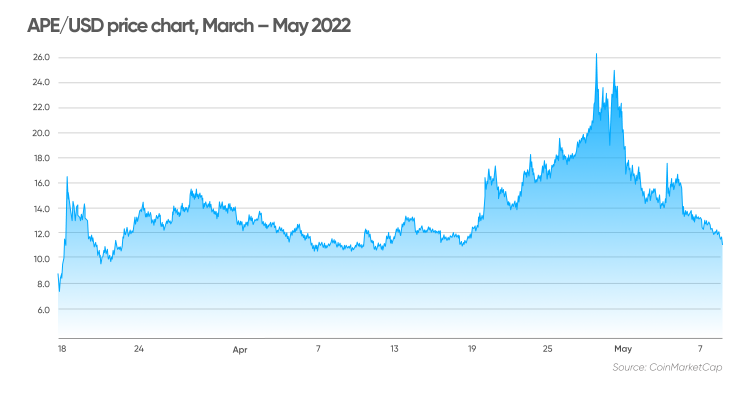
The APE NFT coin saw its value surge 126.8% on the first day of launch, reaching $16.47, up from $7.2604 in less than 24 hours, as seen on the price chart below. The coin retreated to $14. 03 by the end of the day and continued to move sideways throughout 19 March 2022 before falling to values just above $9 on 21 March 2022.

By 24 March, the APE token price climbed back to over $14 as anticipation grew ahead of the first ever ApeCoin DAO voting event, which was due to take place on the day. The cryptocurrency peaked at $15.43 on 28 March 2022 before embarking on a bearish journey into April 2022.

APE/USD price chart, March – May 2022

In April 2022, the APE token price peaked on three occasions:

  • On 10 April at $12.27 – the Bored & Hungry restaurant in California became the first ever catering establishment to accept payments in ether (ETH) and APE.
  •  On 21 April at $17.31–  following announcements that ApeCoin was cooperating with the OliveXFitness Metaverse to grant APE token holders special access to the metaverse’s move-to-earn Dustland games.
  • On 29 April at $26.19 – its all-time high value, as three new proposals were opened for ApeCoin DAO members to vote on.

On 30 April 2022, one of the largest NFT marketplaces, OpenSea, announced that it would start accepting the APE cryptocurrency for NFT purchases on its platform. This led to an over 30% one-day gain as the APE price rose to just below $25.

Following 102% April 2022 gains, the APE NFT coin chart started on a downwards trend, losing over 45% of its value by the time of writing (9 May). Today the coin is trading at $11.24.

In terms of APE token technical analysis, short-term sentiment for the token at the time of writing (9 May) was largely bearish.

Relative Strength Index (RSI) reading of 41.89 was pointing towards neutral territory. A reading of 30 or below would indicate that the asset is becoming undervalued. Meanwhile, the token was trading below its three, five and 10-day moving averages, indicating a bearish trend.

Will apecoin go back up? Future outlook

The debut success of the coin and its speedy price reversal leaves a question on investors’ lips: is apecoin a good investment? There are multiple factors at play.

Recent ApeCoin news saw ApeCoin DAO members approve two measures that would let them lock their tokens for a period of time in exchange for more apecoins in future. The finalisation of this decision on 5 May 2022 led to a mini surge in the APE price, which jumped by 23.9%, up from $14.13 on the previous day to $17.52.

In an announcement in a Twitter thread, ApeCoin noted that the new updates would be implemented “within the next week or two” following the end of the voting.

In addition to that, on 5 May, another proposal was going live for a community-wide vote to deal with security tools and education. The vote is set to end by 12 May 2022. If successful, the plan will be implemented in three phases.

Other ApeCoin news that could move the APE price in the future includes the launch of Otherside on 1 May 2022 – the largest expansion of the Bored Ape NFT universe, powered by apecoin.

Otherside is an online metaverse and role-playing game connected to the BAYC ecosystem where players can purchase lands and real estate. It was reported that 45 minutes after the metaverse’s launch BAYC sold over $100m worth of digital real estate.

Following the 1 May successes, crypto analyst and the founder of Eight Global, Michaël van de Poppe, said on Twitter that the APE price prediction had potential to embark on a bullish trend towards $19 and even $20.

One of the main reasons to why the APE cryptocurrency has managed to generate a lot of buzz was because it was built on the Ethereum blockchain, BigOne Exchange chair in Asia, Anndy Lian, told Capital.com.

“Looking at some of the volumes transacted on Whalealert and Whalestats, I can safely say that APE is one of the most purchased altcoins amongst the Ethereum whales. This is a very positive sign for the token and I must say APE is not just another ordinary meme coin,” he added.

However, the token could benefit from some more utility, Lian noted.

“The faith and comradeship within their community help keep the price and volume going, while doing so the other immediate thing they should really look at is to increase utility online and offline. APE is currently being used in Benji Bananas as an in-game currency and E11EVEN Residencies in Miami has also accepted APE as payment.”

Lian concluded that the proposal from APE owners to lock up and stake their coins are “very sound measures to keep the token sustainable, especially in bear markets”.

ApeCoin price prediction 2022-2025, 2030

Algorithm-based forecasting service Wallet Investor gave a bullish outlook on the future of the APE/USD forecast at the time of writing (9 May), calling apecoin “an awesome long-term investment”.

Based on its analysis of past price performance, Wallet Investor expected the APE target price to grow to $30.501 by 2023, $43.940 by 2024 and reach $87.357 by 2027.

DigitalCoinPrice echoed an upbeat apecoin crypto price prediction, projecting that the token’s value could steadily grow in the coming years. The site noted that APE could end this year at $16.23 and reach $25.30 by the end of 2025.

By the end of 2027, the site’s APE crypto price prediction suggested that the coin could trade at $35.25. Its long-term APE prediction showed that the cryptocurrency has the potential to reach $54.26 by 2030.

Note that predictions can be wrong. Forecasts and analysts’ expectations shouldn’t be used as a substitute for your own research. Always conduct your own due diligence. And never invest or trade money you cannot afford to lose.


Original Source: https://capital.com/apecoin-ape-price-prediction

Anndy Lian is an early blockchain adopter and experienced serial entrepreneur who is known for his work in the government sector. He is a best selling book author- “NFT: From Zero to Hero” and “Blockchain Revolution 2030”.

Currently, he is appointed as the Chief Digital Advisor at Mongolia Productivity Organization, championing national digitization. Prior to his current appointments, he was the Chairman of BigONE Exchange, a global top 30 ranked crypto spot exchange and was also the Advisory Board Member for Hyundai DAC, the blockchain arm of South Korea’s largest car manufacturer Hyundai Motor Group. Lian played a pivotal role as the Blockchain Advisor for Asian Productivity Organisation (APO), an intergovernmental organization committed to improving productivity in the Asia-Pacific region.

An avid supporter of incubating start-ups, Anndy has also been a private investor for the past eight years. With a growth investment mindset, Anndy strategically demonstrates this in the companies he chooses to be involved with. He believes that what he is doing through blockchain technology currently will revolutionise and redefine traditional businesses. He also believes that the blockchain industry has to be “redecentralised”.

j j j