Binance Team Rebuffs Any KYC Data Leaks On Dark Web

Binance Team Rebuffs Any KYC Data Leaks On Dark Web

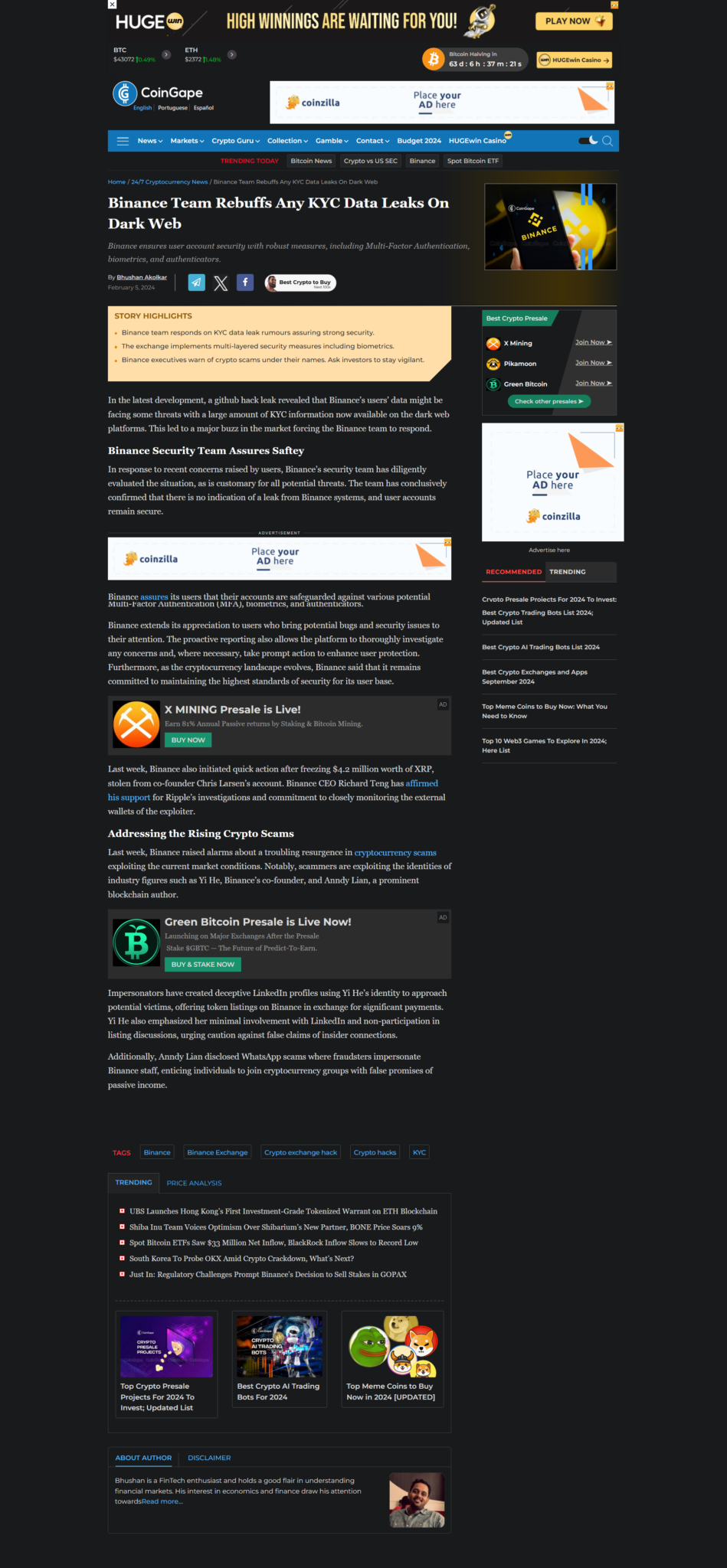
In the latest development, a github hack leak revealed that Binance’s users’ data might be facing some threats with a large amount of KYC information now available on the dark web platforms. This led to a major buzz in the market forcing the Binance team to respond.

Binance Security Team Assures Saftey

In response to recent concerns raised by users, Binance’s security team has diligently evaluated the situation, as is customary for all potential threats. The team has conclusively confirmed that there is no indication of a leak from Binance systems, and user accounts remain secure.

Binance assures its users that their accounts are safeguarded against various potential risks. The exchange has incorporated multi-layered security measures in place, including Multi-Factor Authentication (MFA), biometrics, and authenticators.

Binance extends its appreciation to users who bring potential bugs and security issues to their attention. The proactive reporting also allows the platform to thoroughly investigate any concerns and, where necessary, take prompt action to enhance user protection. Furthermore, as the cryptocurrency landscape evolves, Binance said that it remains committed to maintaining the highest standards of security for its user base.

Last week, Binance also initiated quick action after freezing $4.2 million worth of XRP, stolen from co-founder Chris Larsen’s account. Binance CEO Richard Teng has affirmed his support for Ripple’s investigations and commitment to closely monitoring the external wallets of the exploiter.

Addressing the Rising Crypto Scams

Last week, Binance raised alarms about a troubling resurgence in cryptocurrency scams exploiting the current market conditions. Notably, scammers are exploiting the identities of industry figures such as Yi He, Binance’s co-founder, and Anndy Lian, a prominent blockchain author.

Impersonators have created deceptive LinkedIn profiles using Yi He’s identity to approach potential victims, offering token listings on Binance in exchange for significant payments. Yi He also emphasized her minimal involvement with LinkedIn and non-participation in listing discussions, urging caution against false claims of insider connections.

Additionally, Anndy Lian disclosed WhatsApp scams where fraudsters impersonate Binance staff, enticing individuals to join cryptocurrency groups with false promises of passive income.


Source: https://coingape.com/binance-team-rebuffs-any-kyc-data-leaks-on-dark-web/?utm_source=sidebartabnews

Anndy Lian is an early blockchain adopter and experienced serial entrepreneur who is known for his work in the government sector. He is a best selling book author- “NFT: From Zero to Hero” and “Blockchain Revolution 2030”.

Currently, he is appointed as the Chief Digital Advisor at Mongolia Productivity Organization, championing national digitization. Prior to his current appointments, he was the Chairman of BigONE Exchange, a global top 30 ranked crypto spot exchange and was also the Advisory Board Member for Hyundai DAC, the blockchain arm of South Korea’s largest car manufacturer Hyundai Motor Group. Lian played a pivotal role as the Blockchain Advisor for Asian Productivity Organisation (APO), an intergovernmental organization committed to improving productivity in the Asia-Pacific region.

An avid supporter of incubating start-ups, Anndy has also been a private investor for the past eight years. With a growth investment mindset, Anndy strategically demonstrates this in the companies he chooses to be involved with. He believes that what he is doing through blockchain technology currently will revolutionise and redefine traditional businesses. He also believes that the blockchain industry has to be “redecentralised”.

j j j

Web3: A New Frontier or a False Dawn?

Web3: A New Frontier or a False Dawn?

Web3 is a term that describes the next evolution of the internet, which is based on decentralization and often uses blockchain technologies, such as different cryptocurrencies and non-fungible tokens (NFTs). The goal is to create a more open, fair, and democratic web, where users have more say over their own data, identity, and assets, and where middlemen and gatekeepers are replaced by peer-to-peer networks and protocols.

Web3 is different from Web2, the current version of the internet, which depends on centralized platforms and services that offer user-generated content, social media, and e-commerce. Web2 has brought a lot of innovation, connectivity, and convenience, but it has also caused problems such as data leaks, privacy violations, censorship, misinformation, and monopolization. Web3 tries to solve these problems by using the power of blockchain, a technology that records transactions in a secure, transparent, and unchangeable way. Blockchain allows the creation of digital assets that are rare, verifiable, and customizable, such as cryptocurrencies and NFTs. Cryptocurrencies are digital money that can be used for various purposes, such as payment, saving, or accounting, without the need for a central authority or intermediary.

NFTs are unique digital codes that can prove ownership and authenticity of any digital or physical item, such as art, music, or collectibles. Web3 also depends on the concept of smart contracts, which are agreements that are programmed on the blockchain and can do various things, such as sending money, checking conditions, or triggering events.

Smart contracts enable the creation of decentralized applications (DApps), which are applications that run on a network of computers, rather than on a single server or company. DApps can offer various services, such as decentralized finance (DeFi), gaming, social media, and more.

What is the main driver for Web3 in 2024?

In my opinion, Web3 is still in its early stages of development, and there are many challenges and uncertainties that need to be overcome before it can reach mass adoption. Some of these challenges include scalability, interoperability, usability, regulation, and security. However, there are also many factors that are driving the growth and innovation of Web3 in 2024, such as:

• The growing demand for digital sovereignty, privacy, and security, as users become more aware and concerned about the risks and drawbacks of Web2, such as data misuse, surveillance, manipulation, and censorship. Web3 gives users more control and ownership over their own data, identity, and assets, as well as more transparency and accountability over the platforms and services they use.

• The increasing popularity and value of cryptocurrencies and NFTs, as more people, brands and institutions recognize their potential as alternative forms of money, investment, and expression. Cryptocurrencies and NFTs enable new ways of creating, exchanging, and storing value, as well as new forms of art, culture, and community.

• The emergence and development of new technologies and standards that enable faster, cheaper, and more efficient transactions and interactions on the blockchain, such as layer-2 solutions, cross-chain bridges, decentralized identifiers, and verifiable credentials. These technologies and standards aim to improve the scalability, interoperability, and usability of Web3, making it more accessible and attractive to a wider audience.

• The support and involvement of various stakeholders, such as developers, entrepreneurs, investors, regulators, and users, who are contributing to the innovation and adoption of Web3. Developers are creating new and improved DApps and protocols that provide various solutions and opportunities for Web3 users. Entrepreneurs are launching new and exciting projects and platforms that leverage the power of Web3. Investors are funding and supporting the growth and development of Web3 projects and platforms. Regulators are providing guidance and clarity on the legal and regulatory aspects of Web3. And users are exploring and experimenting with the various possibilities and benefits of Web3.

Do you think NFTs will have a big comeback?

NFTs are one of the most prominent and controversial aspects of Web3. NFTs have been used to create and trade digital art, music, collectibles, and other forms of creative expression, generating billions of dollars in sales and attracting mainstream attention and participation.

However, NFTs have also faced criticism and skepticism, due to their environmental impact, legal ambiguity, and speculative nature.

According to Cryptoslam, NFTs experienced a huge boom in 2022, reaching a peak of over $23 billion in sales. As we all know, they also suffered a sharp decline in the following months, dropping to less than $8 billion in sales in the 2023. This was due to various factors, such as market saturation, regulatory uncertainty, technical issues, and fraud. Despite the past slump, NFTs have shown signs of recovery and resilience in 2024, thanks to several developments and trends, such as:

• The improvement and adoption of more energy-efficient and eco-friendly blockchain technologies, such as proof-of-stake, layer-2 solutions, and carbon offsetting. These technologies aim to reduce the environmental impact and carbon footprint of NFTs, which have been a major source of criticism and concern.

• The emergence and popularity of new and diverse forms and genres of NFTs, such as gaming, metaverse, music, sports, and social media. These forms and genres of NFTs offer more utility, functionality, and interactivity to users, as well as more opportunities for creators, artists, and celebrities.

• The integration and collaboration of NFTs with other Web3 platforms and services, such as DeFi, DAOs, and DEXs. These platforms and services enable new and innovative ways of creating, financing, governing, and exchanging NFTs, as well as enhancing their value and liquidity.

• The recognition and acceptance of NFTs by various institutions, organizations, and individuals, such as museums, galleries, brands, celebrities, and influencers. These entities are using NFTs to showcase, promote, and monetize their work, as well as to engage and reward their fans and followers.

Therefore, I think that NFTs will have a big comeback in 2024, as they continue to evolve and expand their scope and impact. It will not only be a form of digital art, but also a form of digital identity, culture, and economy. It will not only be a niche and novelty, but also a norm and necessity.

In my opinion, NFTs will not only be a part of Web3, but also a driver of Web3.

Conclusion

Web3 is a vision for a new and improved internet, where users have more freedom, power, and value. Web3 is driven by various factors, such as the demand for digital sovereignty, the popularity of cryptocurrencies and NFTs, the innovation of new technologies and standards, and the support of various stakeholders. It is also challenged by various obstacles, such as scalability, interoperability, usability, regulation, and security.

Other visionaries such as Anndy Lian who talks about Web4, Jack Dorsey on Web5 and Justin Sun on Web6, I still believe Web3 is still in its infancy, and its future is uncertain and unpredictable. It is full of potential and promise, and its future is exciting and inspiring. NFTs are one of the most prominent and controversial aspects of Web3. NFTs have been used to create and trade digital assets, generating billions of dollars in sales and attracting mainstream attention and participation.

NFTs have also faced criticism and skepticism, due to their environmental impact, legal ambiguity, and speculative nature. NFTs experienced a huge boom and a sharp decline, but they have shown signs of recovery and resilience in 2024, thanks to several developments and trends, such as the improvement and adoption of more eco-friendly blockchain technologies, the emergence and popularity of new and diverse forms and genres of NFTs, the integration and collaboration of NFTs with other Web3 platforms and services, and the recognition and acceptance of NFTs by various institutions, organizations, and individuals.

Web3 and NFTs are not just technologies, but also movements and cultures. They represent a new way of thinking and living in the digital age, where users are empowered, connected, and creative.
 

Source: https://hackernoon.com/web3-a-new-frontier-or-a-false-dawn

FAQ

What is Web3, and how does it differ from Web2?

Web3 is the next evolution of the internet, focusing on decentralization and utilizing blockchain technologies like cryptocurrencies and NFTs. In contrast, Web2 relies on centralized platforms, leading to issues like data leaks, privacy violations, and monopolization.

What are the main drivers for Web3 in 2024?

The growth of Web3 in 2024 is fueled by factors such as the increasing demand for digital sovereignty, privacy, and security, the popularity and value of cryptocurrencies and NFTs, advancements in technologies improving scalability and interoperability, and the support from various stakeholders contributing to Web3's innovation.

Do you think NFTs will experience a significant comeback in 2024?

Yes, despite a previous decline in 2023, NFTs are expected to make a comeback in 2024. This resurgence is attributed to improvements in eco-friendly blockchain technologies, the emergence of new NFT forms and genres, integration with other Web3 platforms, and increased acceptance by institutions and individuals.

What challenges does Web3 face in its development?

Web3 encounters challenges such as scalability, interoperability, usability, regulation, and security. Overcoming these obstacles is crucial for its mass adoption and successful implementation.

Are we stopping at Web3?

It will not stop. Other visionaries such as Anndy Lian who talks about Web4, Jack Dorsey on Web5 and Justin Sun on Web6, I still believe Web3 is still in its infancy, and its future is uncertain and unpredictable. It is full of potential and promise, and its future is exciting and inspiring.

Anndy Lian is an early blockchain adopter and experienced serial entrepreneur who is known for his work in the government sector. He is a best selling book author- “NFT: From Zero to Hero” and “Blockchain Revolution 2030”.

Currently, he is appointed as the Chief Digital Advisor at Mongolia Productivity Organization, championing national digitization. Prior to his current appointments, he was the Chairman of BigONE Exchange, a global top 30 ranked crypto spot exchange and was also the Advisory Board Member for Hyundai DAC, the blockchain arm of South Korea’s largest car manufacturer Hyundai Motor Group. Lian played a pivotal role as the Blockchain Advisor for Asian Productivity Organisation (APO), an intergovernmental organization committed to improving productivity in the Asia-Pacific region.

An avid supporter of incubating start-ups, Anndy has also been a private investor for the past eight years. With a growth investment mindset, Anndy strategically demonstrates this in the companies he chooses to be involved with. He believes that what he is doing through blockchain technology currently will revolutionise and redefine traditional businesses. He also believes that the blockchain industry has to be “redecentralised”.

j j j

Crypto and Web 3 Predictions in 2024 (Part 2)

Crypto and Web 3 Predictions in 2024 (Part 2)

Insights

How does AI contribute to game development in the crypto and Web 3 space in 2024?

Anndy Lian said AI in 2024 is playing a pivotal role as a game maker in crypto and Web 3. It accelerates game development by automating coding, testing, and debugging processes, producing diverse game elements, and adapting difficulty and content based on player preferences.

What factors will contribute to the improvement of formal verification in 2024, specifically in the crypto and Web 3 community?

In 2024, the improvement of formal verification in the crypto and Web 3 community will be driven by factors such as easier access, involving education and frameworks, automated verification using AI to streamline processes, and interactive verification leveraging Web 3 platforms like DAOs and DApps for collaboration.

How are brands using NFTs as digital assets in 2024, and what impact do they have on brand differentiation and recognition?

Anndy Lian mentioned that brands like Nike and Oracle Red Bull Racing are utilizing NFTs as digital assets in 2024 to enhance brand differentiation, recognition, and loyalty. Examples include Nike's CryptoKicks platform for digital sneakers and Oracle Red Bull Racing's Velocity Series, showcasing a unique blend of art, technology, and racing excitement.

What overarching impact do blockchain, AI, and Web3 technologies have on the transformation of digital assets, games, and brands in 2024?

Anndy Lian commented that blockchain, AI, and Web3 technologies are not only transforming digital assets, games, and brands but also empowering users, creators, and brands to create, own, and monetize digital works in a decentralized, transparent, and incentivized manner. These technologies pose exciting yet challenging questions that need addressing within the crypto and Web 3 community.

The trend that will shape the crypto and Web 3 space in 2024 is the role of AI as a game maker, which is the concept of using AI to generate, design, and develop games. It can provide various advantages for game-making, such as speed, scale, and diversity. In this second part of my predictions for crypto and Web 3 in 2024, I will delve into an in-depth analysis of crypto and Web 3.

AI Becomes a Game Maker

AI can also create games faster than human developers, as it can automate the processes of coding, testing, and debugging. This allows games at a larger scale than human developers, as it can produce infinite variations, combinations, and permutations of game elements, such as rules, mechanics, levels, or genres. Thus bringing in more diversity than human developers, as it can generate novel, original, and surprising game elements, such as themes, stories, characters, or aesthetics.

Just a few months back, I was exploring different AI game generators from G3D.ai, GPTGame.app to Scenario.com. Honest speaking, some of these work very well. Games can be created with more adaptability than human developers, as it can adjust the game difficulty, content, and feedback based on the player’s preferences, skills, and behaviors.

Therefore, in 2024, I predict that we will see a significant improvement in formal verification thanks to several factors:

  • Easier access: The first factor that will improve the formal verification is easier access, which is the concept of making the formal verification more available and accessible for the crypto and Web3 community, by lowering the barriers of entry, such as skills, tools, and languages. Easier access involves various methods, such as education, documentation, and tutorials, that can teach and train the developers, users, and auditors on the basics, principles, and practices of formal verification.

    Easier access also involves various solutions, such as frameworks, libraries, and templates, that can provide and support the developers, users, and auditors, with the necessary tools, languages, and resources, to perform formal verification. Easier access also involves various incentives, such as grants, bounties, and competitions, that can motivate and reward the developers, users, and auditors for participating and contributing to the formal verification.

  • Automated verification: The second factor that will improve formal verification is the automated verification, which is the concept of using AI to automate and optimize the formal verification process by reducing the human intervention, effort, and error in the process. Automated verification involves various techniques, such as machine learning, natural language processing, or computer vision, that can enable the AI to learn, understand, and analyze the system, such as the software, hardware, or protocol, and its properties, such as the specification, model, or behavior, and generate, execute, and verify the proofs, such as the theorems, lemmas, or corollaries, that can demonstrate the correctness, security, and reliability of the system. Automated verification also involves various benefits, such as speed, scale, and diversity, that can enhance the performance, coverage, and quality of the formal verification process.

  • Interactive verification: The third factor that will improve the formal verification is interactive verification, which is the concept of using Web 3 to enable and facilitate the collaboration and communication among the crypto and Web 3 community, in the formal verification process, by leveraging the decentralized, transparent, and incentivized nature of Web 3.

    Interactive verification involves various platforms, such as DAOs, DApps, or NFTs, that can empower and connect the developers, users, and auditors to create, share, and verify the system, and its properties and proofs in a peer-to-peer, trustless, and permissionless way. Interactive verification also involves various mechanisms, such as tokens, governance, or reputation, that can align and reward the interests, actions, and outcomes, of the developers, users, and auditors, in the formal verification process.

NFTs Become Brand Assets

The other trend that will impact the crypto and Web3 space in 2024 is the NFTs, which are non-fungible tokens that can represent unique and scarce digital assets, such as art, music, games, or collectibles, and can be owned, traded, or monetized by the users, on blockchains. They are popular for users, as they can provide authenticity, provenance, and ownership, of their digital assets, as well as creativity, expression, and identity of their digital selves.

They are also popular for creators, as they can provide new ways of creating, distributing, and NFTs are also popular for creators, as they can provide new ways of creating, distributing, and monetizing their digital works, as well as connecting, engaging, and rewarding their fans and communities.

However, in 2024, I predict that we will see a new wave of NFTs that will become brand assets, which are digital assets that can represent the identity, value, and reputation of a brand, such as a company, organization, or influencer, and can be owned, traded, or monetized by the brand, on blockchains. Brand assets are important for brands, as they can provide differentiation, recognition, and loyalty of their brand, as well as innovation, expression, and impact, of their brand.

Some examples of NFTs as brand assets that will emerge or expand in 2024 are:

  • Nike is a global sports brand that produces and sells footwear, apparel, equipment, and accessories for various sports and fitness activities. Nike is also a pioneer in using NFTs as brand assets, as it has launched its own NFT platform, called CryptoKicks, which allows users to buy, sell, and trade digital sneakers, that are NFTs that have different designs, features, and values. Users can also customize, personalize, and animate their CryptoKicks using the platform’s tools, such as NikeID, which allows users to design and create their own NFTs, or NikeAR, which allows users to view and interact with their NFTs, using augmented reality. I hope to see more developments in 2024.
  • Oracle Red Bull Racing is another sports brand that I would mention. They have launched a series of NFTs called The Velocity Series with Bybit. They have involved leading artists: Rik Oostenbroek, Per Kristian Stoveland, Erick Snowfro and Jack Butcher. They have done extremely well in the bear market, where basically no one is talking about NFT. This series has been the most high-end and successful Web 3 digital art membership and artist drop in the last two years. The series has not only showcased artistic brilliance but also created a unique blend of art, technology, and racing excitement. Its global reach and innovative activations have made a lasting impact, setting new standards in the Web3 art community. With full disclosure, I am part of this drop, and I am delighted to see it from the start to the end. Although I will not be part of the team in 2024, I am still very excited to see what they will do in 2024.

In a Nutshell

Crypto and Web3 are not only technologies, but also movements, that are transforming the world of digital assets, games, and brands, in unprecedented ways.

By using blockchain, AI, and Web3 technologies, users, creators, and brands can create, own, and monetize their digital works, as well as connect, collaborate, and govern their digital communities, in a decentralized, transparent, and incentivized manner. These trends are not only exciting but also challenging, as they pose various technical, social, and ethical questions, that need to be addressed and resolved by the crypto and Web 3 community and beyond.

I believe that crypto and Web 3 have the potential to unleash the creativity, expression, and innovation, of the human spirit and to empower the individual, collective, and global well-being, of human society. I also believe that crypto and Web3 have the responsibility to uphold the values, principles, and standards of human dignity and to respect the rights, freedoms, and diversity, of the human culture.

Source: https://www.financemagnates.com/cryptocurrency/crypto-and-web3-outlook-2024-innovations-in-user-experience-driving-adoption/

Anndy Lian is an early blockchain adopter and experienced serial entrepreneur who is known for his work in the government sector. He is a best selling book author- “NFT: From Zero to Hero” and “Blockchain Revolution 2030”.

Currently, he is appointed as the Chief Digital Advisor at Mongolia Productivity Organization, championing national digitization. Prior to his current appointments, he was the Chairman of BigONE Exchange, a global top 30 ranked crypto spot exchange and was also the Advisory Board Member for Hyundai DAC, the blockchain arm of South Korea’s largest car manufacturer Hyundai Motor Group. Lian played a pivotal role as the Blockchain Advisor for Asian Productivity Organisation (APO), an intergovernmental organization committed to improving productivity in the Asia-Pacific region.

An avid supporter of incubating start-ups, Anndy has also been a private investor for the past eight years. With a growth investment mindset, Anndy strategically demonstrates this in the companies he chooses to be involved with. He believes that what he is doing through blockchain technology currently will revolutionise and redefine traditional businesses. He also believes that the blockchain industry has to be “redecentralised”.

j j j
