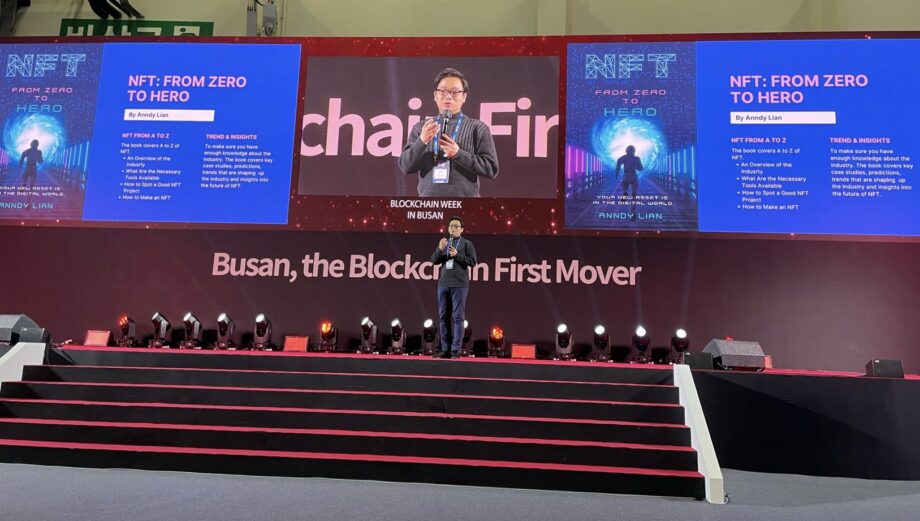
Anndy Lian Talks about “Trends Shaping the Future of NFT” at Busan Blockchain Week

Anndy Lian Talks about “Trends Shaping the Future of NFT” at Busan Blockchain Week

Busan Blockchain Week (BWB) 2022, hosted by Busan Metropolitan City held at BEXCO for 3 days from Oct. 27th (Thu.) to the 29th (Sat).

With the theme of “Blockchain, City and Life”, as an extension of last year’s NFT Busan 2021, BWB 2022 will feature conferences for the advancement of the blockchain industry and provide a space to obtain insight as well as to share information.

Anndy Lian’s speech is on “Trends Shaping the Future of NFT”.

Anndy Lian is an all-rounded business strategist in Asia. He has provided advisory across a variety of industries for local, international, public listed companies and governments. He is an early blockchain adopter and experienced serial entrepreneur, book author, investor, board member and keynote speaker.

NFT: From Zero to Hero is his latest book. Zero to Hero is a call to anyone and everyone excited about the prospect of the world of NFT. Bound by imagination only, the NFT space is still in its early days and early adopters can be a “hero” in their search for new possibilities. The book is available on Amazon and Bybit. More than 8,000 copies were sold.

NFTs took 2021 by storm. With billions traded over NFTs and a strong community behind the technology, we’re seeing NFTs being adopted by industries as diverse as gaming, finance, art, and medicine.

NFT Gaming and GameFi: This trend is obvious. At present, many successful game manufacturers in the traditional game industry want to get involved in NFTs.

NFT Ticketing: NFT ticketing goes beyond this. The future of NFTs in ticketing offers opportunities for lifetime value, exclusive access, and extra incentives for buyers.

NFT Fragments: Fractionalization essentially breaks up an NFT into smaller pieces, so people can purchase small parts of an expensive NFT.

Digital Twin NFTs: Imagine this same type of record existing for physical items. It would completely change resale markets.

AI NFTs: Alongside blockchain, artificial intelligence (AI) is the next major disruptor in tech. So it should be no surprise the two are being combined.

NFTs and Health: With issues surrounding counterfeit vaccination passports and concerns about the vulnerabilities of centralized data storage of sensitive medical information, NFTs and the blockchain may well be integrated more and more into medicine and health in the years to come.

Growth Amidst Doubt

Although the popularity of NFTs is indeed declining, all walks of life are still accelerating their integration with NFTs.

Starting in the second half of 2021, many well-known brands have also begun to try NFTs, matching them with real objects and even designing their own metaverse. Obviously, the utility has become the first test for big brands in the metaverse field through NFTs.

NFT essentially provides brands with a new way to launch limited-edition products, and the resulting community and word-of-mouth communication will raise their share of voice compared to rival brands.

The Future of NFTs

A number of countries are now actively working on regulatory frameworks for NFT assets, strengthening anti-fraud and anti-manipulation audits of projects, determining the business core of each platform, and solving financial security issues such as illegal fundraising and false fraud.

At the same time, major public chains are actively upgrading, expanding, and building their own ecological frameworks to provide underlying support for the production, confirmation, pricing, circulation, and traceability of NFT assets. Nowadays, NFT financial tools are becoming more and more abundant, and the scale of financial derivatives is steadily increasing. The NFT industry is gradually exploring a development path suitable for blockchain assets.

“The future these NFT trends depict is an interesting one. While many people are concerned about the implications of the metaverse and the rise of AI, it’s a future full of possibilities. We are still early. Let’s build the ecosystem together.” Anndy Lian added.

Anndy Lian is an early blockchain adopter and experienced serial entrepreneur who is known for his work in the government sector. He is a best selling book author- “NFT: From Zero to Hero” and “Blockchain Revolution 2030”.

Currently, he is appointed as the Chief Digital Advisor at Mongolia Productivity Organization, championing national digitization. Prior to his current appointments, he was the Chairman of BigONE Exchange, a global top 30 ranked crypto spot exchange and was also the Advisory Board Member for Hyundai DAC, the blockchain arm of South Korea’s largest car manufacturer Hyundai Motor Group. Lian played a pivotal role as the Blockchain Advisor for Asian Productivity Organisation (APO), an intergovernmental organization committed to improving productivity in the Asia-Pacific region.

An avid supporter of incubating start-ups, Anndy has also been a private investor for the past eight years. With a growth investment mindset, Anndy strategically demonstrates this in the companies he chooses to be involved with. He believes that what he is doing through blockchain technology currently will revolutionise and redefine traditional businesses. He also believes that the blockchain industry has to be “redecentralised”.

j j j

Anndy Lian Speaks at American Digital Week: ‘Decentralized Finance – What are the Opportunities?’

Anndy Lian Speaks at American Digital Week: ‘Decentralized Finance – What are the Opportunities?’

Anndy Lian, Chairman of BigONE Exchange gave a speech at the American Digital Week event on 19 October 2021, 13:00 – GMT. His topic is about ‘Decentralized Finance – What are the Opportunities?’

The following is the summary of his speech.

This is a fantastic time to be in DeFi, driven by short and long term drivers from the explosive growth of the NFT market overtaking DeFi, the new breed of play-to-earn games or GameFi, to rise of the ‘metaverse’ as the next big thing, there’s also a lot to unpick which is exciting an a little daunting if you are new to it.

But let’s start with some basics for those of you new to DeFi. A decentralized finance (DeFi) system allows people to create financial products or “smart contracts” that execute actions automatically on the blockchain – without any bank, brokerage, exchange, or corporation acting as an intermediary.

At the end of July 2021, the market capital for DeFi products was hovering near $80 billion. While that was down from its May peak of more than $89 billion, pundits believe growth will continue in the coming year as DeFi projects mature. Key to that maturity process is innovation DeFi – creating opportunities to profitably shape a decentralized future you’ll be sure to want to be a part of.

Let’s start with non-fungible tokens or more commonly known as NFTs. The NFT industry has exploded in popularity this year. There was more than $2.5 billion in sales volume during the first half of 2021 and it has only accelerated since then. OpenSea, the most popular NFT marketplace, saw more than $3 billion in NFT sales volume just during the month of August.

So what’s driving this demand in NFTs? The fact is that digital natives would rather own digital goods than physical goods, which means that we are watching the digitization of the collectibles industry. These digital natives want to use the NFTs as a way to play games, transact with each other, and generally recreate the collectibles industry. Another perspective, as outlined recently by popular crypto podcaster Pomp, is that we are watching the birth of a new type of status:

“Each individual that would normally drop $50,000 to $1,000,000 to purchase a car, watch, house, boat, etc is now realizing that you can spend the same money on a digital good and flex in front of more people on the internet. Only so many friends can check out your house and be impressed. But millions of people a month will see your Twitter avatar. These NFTs are a great example of where I would expect billions, if not trillions, of dollars to be made in the coming years.”

As Pomp says, just as every business had to figure out an internet strategy in the 1990s, every business is going to have to figure out their bitcoin strategy and every business is going to have to figure out their NFT strategy as well.

Speaking at the recent Paris ETH event EthCC Ben Lakoff, co-founder of NFT-protocol Charged Particles highlighted NFTs as in-game items and in the metaverse as examples: “There’s actually a new publicly traded exchange-traded fund, META. In your brokerage account, you can now get exposure to the metaverse plays that are publicly traded.”

Talking of the metaverse just a few weeks ago Facebook CEO Mark Zuckerberg said within five years Facebook would be a “metaverse company” while Satya Nadella, Microsoft’s CEO, said they were investing in the “enterprise metaverse.” Simply put, whoever can integrate NFTs and payment with the metaverse may well lead the biggest change in online culture and economy since the birth of the web in the 1990s. A view supported by David Raszucki, head of the $50 billion Roblox Corporation, who sees the emergence of the metaverse as profound a shift as the invention of the internet and the world wide web.

In a close fit with the vision of an open metaverse, play to earn crypto games are built on the fundamental need for a place that is available to everyone and owned by no one in particular. An amalgam of gaming and decentralized finance (DeFi), ‘GameFi’ refers to the intersection between blockchain-based gaming and decentralized financial instruments in all their guises: yield farming, lending/borrowing, algorithmic stablecoins, token minting instruments, etc.

“Crypto has been looking for a mass market use case,” Andrew Tu, an executive at quantitative trading firm Efficient Frontier, told CoinDesk. “Gaming is a sector that people have been hyping up for a long time. It’s the first area of crypto where the average Joe without a huge understanding of crypto or blockchain can participate.”
This rise in popularity of GameFi and associated tokens has captured the attention of the wider crypto market, especially in the longer-term trend of NFTs and the metaverse. The fund’s goal is to support developers and create GameFi projects by building decentralized finance (DeFi) content, the foundation said in a press release.

“GameFi is going to be the next big thing that makes the DeFi, NFT and the larger crypto space easy to understand and be involved in,” said Sun.

A striking example of how the rise of GameFi is driving the value of tokens came in early August with Axie Infinity, the popular crypto gaming platform on Ethereum, which raked in more than $220 million in revenue in 30 days to early August, making it the top revenue generator among all DeFi protocols and blockchains, Ethereum included, according to data from Token Terminal.

Not surprisingly this phenomenal price growth has caught traders and crypto market watchers’ attention. News BTC said, “Axie Infinity has been on an absolute tear lately. The play-to-earn platform has become the face of a new integration of crypto and gaming that holds unbelievable potential. Axie Infinity has surpassed 1M daily active users and is generating more revenue than any protocol or platform with the lone exception of Ethereum. Yes, Axie Infinity is yielding more fee revenue than major platforms such as OpenSea, Uniswap, Bitcoin, or the Binance Smart Chain.”

One of the key problems associated with such rapid growth in the DeFi ecosystem is the increasing transaction costs, particularly the rapidly increasing Ethereum gas fees. To address this issue, many projects in the crypto space are starting to offer cross-chain functionality. One of the most successful innovators in this space has been Polkadot. The price of the Polkadot governance coin (DOT) has risen to over $30 from under $10 in August. This puts DOT’s market cap at over $30 billion, about the same size as Ethereum a year ago. Also worth noting is the rise of Solana, recently listed on BigOne exchange, another ‘Ethereum-killer’ with lightning fast transactions at a fraction of the price. The rapid increase in value is largely a result of crypto gaming and successful NFT launches. Amid a huge NFTs sales, resulted in a bull rally of the Solana and the price of its token SOL which, trading at $1.60 during the start of January, smashed its all-time high (ATH) $194.82 on September 7th, 2021.

The full video can be obtained at:

Anndy Lian is an early blockchain adopter and experienced serial entrepreneur who is known for his work in the government sector. He is a best selling book author- “NFT: From Zero to Hero” and “Blockchain Revolution 2030”.

Currently, he is appointed as the Chief Digital Advisor at Mongolia Productivity Organization, championing national digitization. Prior to his current appointments, he was the Chairman of BigONE Exchange, a global top 30 ranked crypto spot exchange and was also the Advisory Board Member for Hyundai DAC, the blockchain arm of South Korea’s largest car manufacturer Hyundai Motor Group. Lian played a pivotal role as the Blockchain Advisor for Asian Productivity Organisation (APO), an intergovernmental organization committed to improving productivity in the Asia-Pacific region.

An avid supporter of incubating start-ups, Anndy has also been a private investor for the past eight years. With a growth investment mindset, Anndy strategically demonstrates this in the companies he chooses to be involved with. He believes that what he is doing through blockchain technology currently will revolutionise and redefine traditional businesses. He also believes that the blockchain industry has to be “redecentralised”.

j j j

Asian Digital Week 2021 “Special Edition” Interviews Anndy Lian- Evolving fintech landscape in Asia

Asian Digital Week 2021 “Special Edition” Interviews Anndy Lian- Evolving fintech landscape in Asia

Can you tell me a bit about your background and your current role?

My name is Anndy Lian. I am an early blockchain adopter and experienced serial blockchain entrepreneur. I am known for my work in the government sector for the blockchain space.

Currently, I am appointed as the Advisory Board Member for Hyundai DAC, the blockchain arm of South Korea’s largest car manufacturer Hyundai Motor Group where he looks after the governance and compliance aspects of the business.

I am also part of the Gyeongsangbuk-do Blockchain Special Committee, Government of Republic Korea, together with industry experts such as Brock Pierce (Chairman, Bitcoin Foundation) and Alexis Sirkia (Founder of Yellow.com), helping the province to grow using blockchain technologies.

Concurrently, I also act as the Chairman (Singapore) for Korea eSports Industry Association (KeIA) where I am actively promoting eSports to go mainstream and adopt cryptocurrencies.

I have also played a pivotal role as the Blockchain Advisor for Asian Productivity Organisation (APO), an intergovernmental organization committed to improving productivity in the Asia-Pacific region. I advise the Secretariat on the latest concepts and applications of blockchain technologies in cybersecurity and IoT network data integrity across smart factories and upskills the Secretariat staff in blockchain technologies as applicable to productivity. APO members include Bangladesh, Cambodia, Republic of China, Fiji, Hong Kong, India, Indonesia, Islamic Republic of Iran, Japan, Republic of Korea, Lao PDR, Malaysia, Mongolia, Nepal, Pakistan, Philippines, Singapore, Sri Lanka, Thailand, and Vietnam.

I have played a leadership role in not-for-profit and quasi-government linked organizations such as Singapore Business Federation (SBF) and Singapore Institute of International Affairs (SIIA) where I worked alongside policymakers, private sector decision-makers, and experts to create business value propositions for different industries.

I have also written a book titled “Blockchain Revolution 2030” and is published by Kyobo, the largest bookstore chain in South Korea. Together with co-authors, Park Young Sook and Shawn Hamnison, they share insights on how blockchain technology plays an important foundation for the Fourth Industrial Revolution.

An avid supporter of incubating start-ups, I have investments in several companies such as worldairfare.com. I have also been a private investor for the past eight years. With a growth investment mindset, I strategically demonstrate this in the companies I choose to be involved with.


 Can you tell us more about Fintech and its importance today?

Fintech stands for financial technology. It is an integration of technology that helps consumers or financial institutions deliver financial services in newer, faster ways than was traditionally available.

It is important to many as it extends financial inclusion, improves our daily lives, creates economic growth, empowering users & businesses. In today’s context, Fintech should be already part of our daily lives. This digital age has made Fintech more accessible, reach a whole new level of finance, and is changing the face of modern banking.


What’s gone wrong with traditional SMB Banking?

From a technology standpoint, actually, there is nothing wrong with traditional SMB banking. In the past, SMBs think that their banking needs are not fully met but this is not true entirely. Most SMB Banks are already harnessing the power of technology, they have adopted technology to enable digital banking abilities. They have also converted themselves from purely over the counter services to fully digitalised banking services.

For the very traditional banks who fail to keep up with the current times, they will fall behind. Traditional methods mean no harm. Innovation will push them to embrace changes and such will add in more revenue to the banks and bring customers closer to them.


What is the future of digital banking?

The future of digital banking will understand the users’ needs better. With the help of AI and machine learning, it can provide customized services and reduce fraud and loss.

Blockchain technology will also come into place to assist banks with automated services through the usage of smart contracts. It will be an added layer of security, convenience and reliability. Blockchain will form a trusted and controlled environment to streamline the banking performance and making financial transactions convenient and safe for users.

Cryptocurrency will be part of digital banking for sure. It will disrupt and replace how currency is being used.


Will banks eventually migrate to a cloud and what hardware they will keep?

The majority of the banks and financial institutions have or are developing a cloud strategy and the more forward-looking ones are also using cloud for years. The reduced in cost and speed to market have moved them into the cloud model. In my opinion, most hardware should be kept as migrating into cloud does not mean closing down the physical counters or closing down their current servers.


What do you think is the future of the Fintech industry in Asia?

The Fintech industry in Asia will continue to grow. Blockchain and cryptocurrencies will redefine the future of finance.


Or you can read the whole magazine at https://ditech.media/magazine/asian-digital-week-2021-special-edition/.

Anndy Lian is an early blockchain adopter and experienced serial entrepreneur who is known for his work in the government sector. He is a best selling book author- “NFT: From Zero to Hero” and “Blockchain Revolution 2030”.

Currently, he is appointed as the Chief Digital Advisor at Mongolia Productivity Organization, championing national digitization. Prior to his current appointments, he was the Chairman of BigONE Exchange, a global top 30 ranked crypto spot exchange and was also the Advisory Board Member for Hyundai DAC, the blockchain arm of South Korea’s largest car manufacturer Hyundai Motor Group. Lian played a pivotal role as the Blockchain Advisor for Asian Productivity Organisation (APO), an intergovernmental organization committed to improving productivity in the Asia-Pacific region.

An avid supporter of incubating start-ups, Anndy has also been a private investor for the past eight years. With a growth investment mindset, Anndy strategically demonstrates this in the companies he chooses to be involved with. He believes that what he is doing through blockchain technology currently will revolutionise and redefine traditional businesses. He also believes that the blockchain industry has to be “redecentralised”.

j j j