While you were sleeping: Iran closed a critical oil route and crypto exploits

While you were sleeping: Iran closed a critical oil route and crypto exploits

Over the past 24 hours, the total crypto market capitalisation has contracted by 1.74 per cent to settle at US$2.51T, a decline that reveals deeper structural concerns within the digital asset ecosystem. This selloff arrives at a particularly ironic moment, given that traditional equity markets closed at record highs just days prior on April 17, with the S&P 500 reaching 7,126.06, the Nasdaq Composite climbing to 24,468.48, and the Dow Jones Industrial Average touching 49,447.43. The stark divergence between these two worlds tells a story of a crypto market still struggling to mature beyond its inherent vulnerabilities.

The primary catalyst for this latest downturn stems from a devastating US$292M exploit targeting Kelp DAO’s rsETH bridge on April 19. This incident did not occur in isolation; it triggered immediate systemic risk across the decentralised finance landscape. Major protocols, including Aave and Treehouse, found themselves scrambling to review their exposures, sparking a wave of panic withdrawals that rippled through Ethereum-based DeFi platforms.

The impact on Ethereum itself proved severe, with the asset declining 3.18 per cent as investors fled leveraged positions and liquidity evaporated from key trading pairs. This episode underscores a persistent and uncomfortable truth about the crypto ecosystem. Smart-contract vulnerabilities remain a critical weakness that can undermine market confidence in a matter of hours.

What makes this situation particularly concerning is the timing. The exploit coincided with escalating geopolitical tensions as Iran moved to close the Strait of Hormuz, one of the world’s most critical oil transit routes. This development sent shockwaves through global markets, with Brent crude oil surging approximately six to seven per cent to exceed US$95 per barrel. The reintroduction of such significant risk premiums has forced traders to reassess their exposure to speculative assets across the board.

Crypto markets, despite their narrative of decentralisation and independence from traditional finance, have demonstrated remarkable sensitivity to these macro shocks. The 7-day correlation between crypto and Gold has reached 81 per cent, indicating that during periods of uncertainty, digital assets increasingly move in tandem with traditional safe-haven instruments rather than maintaining their promised role as an uncorrelated alternative investment.

The International Monetary Fund recently cut its 2026 global growth forecast to 3.1 per cent, warning that continued energy supply disruptions could push the economy toward a more adverse 2.5 per cent scenario. This backdrop of economic uncertainty heightens pressure on risk assets, and crypto is particularly exposed given its relatively short track record of navigating genuine geopolitical crises. The market now faces a critical test as it attempts to determine whether the rsETH exploit represents an isolated incident or the beginning of a broader contagion that could cascade through interconnected DeFi protocols.

The market has established US$2.44T as a crucial Fibonacci support level that must hold to prevent further deterioration. Should the market consolidate between this US$2.44T floor and the US$2.53T resistance level, it would suggest that the worst of the selling pressure has been absorbed. A sustained break below US$2.44T would open the door to testing the US$2.35T level, which would represent a much more severe correction.

Bitcoin’s dominance currently sits at 59.3 per cent, and this metric will prove essential in determining whether the market can stabilise. If Bitcoin maintains its defensive anchor role while altcoins continue to weaken, it would indicate a flight to quality within the crypto ecosystem itself. Conversely, if Bitcoin’s dominance begins to erode, it would signal broader market distress.

The path forward depends on several critical factors that will unfold over the coming days.

  • First, the crypto community needs clarity on the total losses stemming from the Kelp DAO exploit and assurance that no additional vulnerabilities exist in related protocols.
  • Second, markets require some resolution or de-escalation of the Strait of Hormuz situation, as continued geopolitical tension will keep risk premiums elevated across all asset classes.
  • Third, investors await S&P Global flash PMIs later this week to gauge how the US economy navigates elevated oil prices and geopolitical uncertainty, as any signs of economic deterioration would further pressure risk assets.

The divergence between traditional equity markets hitting record highs and crypto markets under siege reveals the immature nature of digital assets as an investment class. While the S&P 500, Nasdaq, and Dow Jones posted gains of 1.20 per cent, 1.52 per cent, and 1.79 per cent, respectively, on April 17, crypto markets have proven unable to insulate themselves from either technical exploits or macroeconomic shocks. This reality challenges the narrative that cryptocurrencies are a mature alternative investment vehicle and instead positions them as highly speculative assets vulnerable to both internal technical failures and external geopolitical pressures.

The week of April 20, 2026, will prove pivotal in determining whether the crypto market can demonstrate resilience amid compound crises or succumb to a more severe correction that could take months to recover from. Investors would be wise to monitor both the technical support levels and the broader geopolitical landscape with equal attention, as the convergence of these factors will likely dictate market direction in the critical days ahead.


 

Source: https://e27.co/while-you-were-sleeping-iran-closed-a-critical-oil-route-and-crypto-exploits-20260420/

Anndy Lian is an early blockchain adopter and experienced serial entrepreneur who is known for his work in the government sector. He is a best selling book author- “NFT: From Zero to Hero” and “Blockchain Revolution 2030”.

Currently, he is appointed as the Chief Digital Advisor at Mongolia Productivity Organization, championing national digitization. Prior to his current appointments, he was the Chairman of BigONE Exchange, a global top 30 ranked crypto spot exchange and was also the Advisory Board Member for Hyundai DAC, the blockchain arm of South Korea’s largest car manufacturer Hyundai Motor Group. Lian played a pivotal role as the Blockchain Advisor for Asian Productivity Organisation (APO), an intergovernmental organization committed to improving productivity in the Asia-Pacific region.

An avid supporter of incubating start-ups, Anndy has also been a private investor for the past eight years. With a growth investment mindset, Anndy strategically demonstrates this in the companies he chooses to be involved with. He believes that what he is doing through blockchain technology currently will revolutionise and redefine traditional businesses. He also believes that the blockchain industry has to be “redecentralised”.

j j j

Roughly 48% of Ethereum NFT trades in October were fake

Roughly 48% of Ethereum NFT trades in October were fake

Traders seeking to artificially inflate the price of collections or earn marketplace trading rewards generated $389 million in wash trades during October.

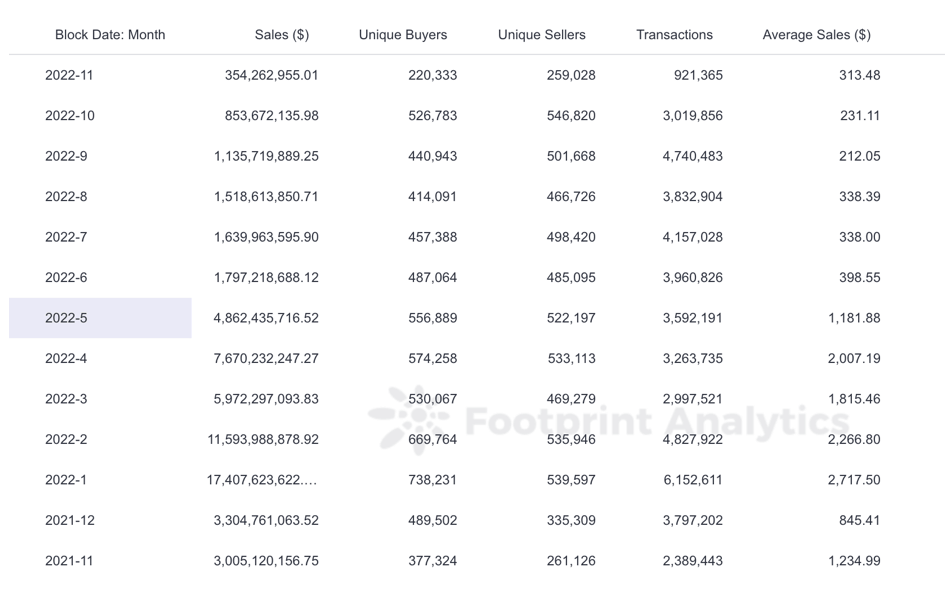
Global NFT sales in October clocked in at more than $850 million over roughly 3 million total transactions. I looked into NFT wash trades last month and that research got me to look at the numbers more closely.

Footprint Analytics – NFT Monthly Sales

The trigger points for me to say that transactions are becoming more fake are as follows:

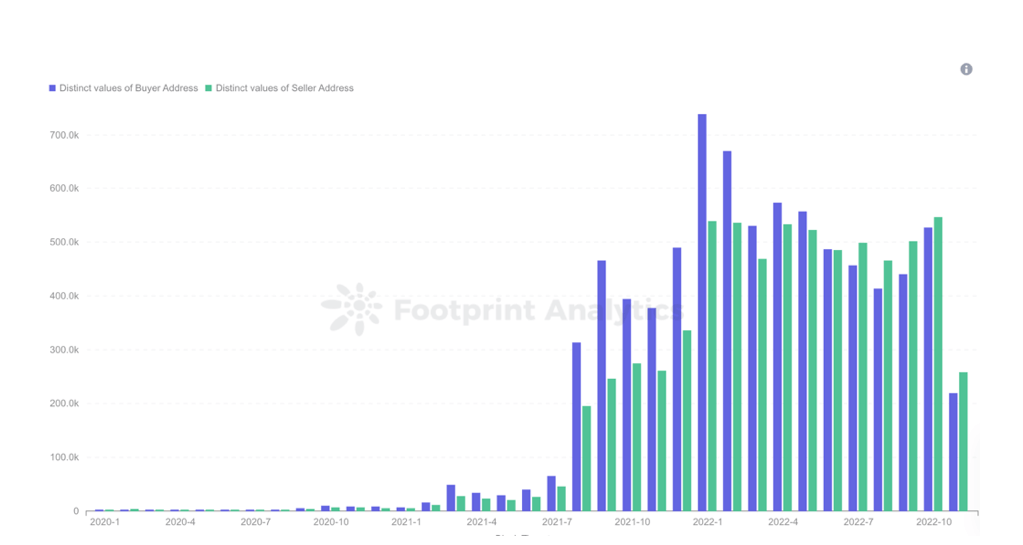
  1. Despite bad market conditions, we continue to see a high number of unique buyers and sellers. In October, we had over 1 million unique buyers and sellers. Both buyers and sellers have increased compared to September.
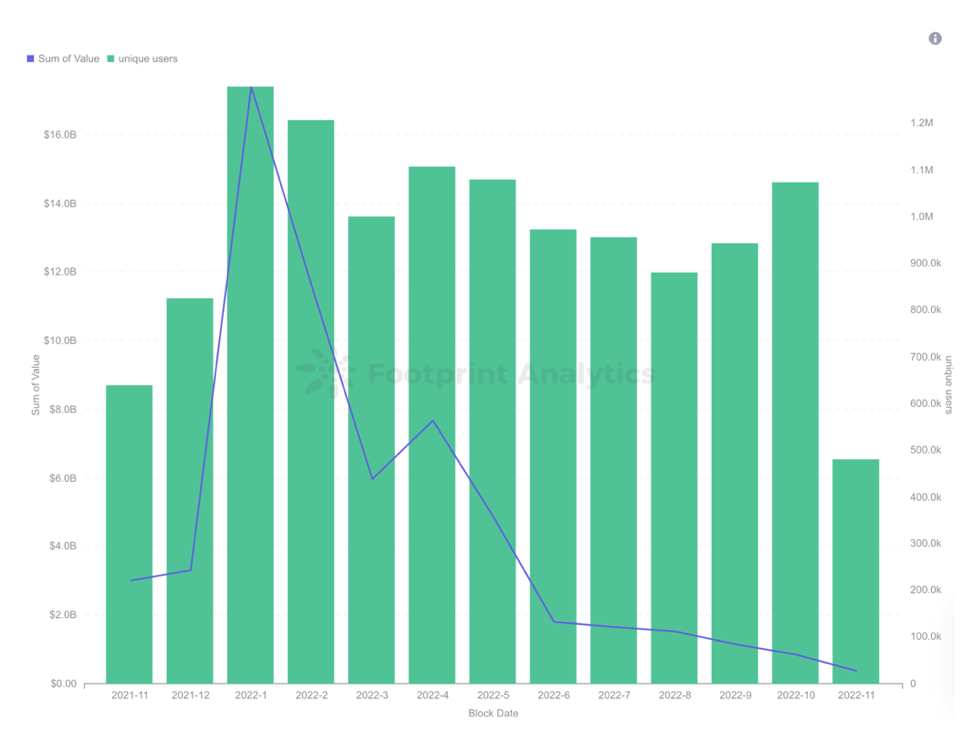
  2. The number of unique buyers and sellers seems to be inconsistent with the growth of sales value and transactions. Around 1 million users contributed more than 4 million sales value in May versus less than 250,000 in October. To me, it seems unlikely to have a growing market demand with less sales value traded.
Footprint Analytics – Sales value vs. Unique users

To look into this further, I spoke with two centralized exchanges that operate NFT marketplaces. The exchanges said that around 80% of new buyers are keeping NFTs in their wallets, rather than selling them. With the market so unfavorable, holding these assets seems to be the sensible move.

So where are all these unique buyers and sellers coming from? I had a word with Footprint Analytics and brought up my points. I realized that the statistics I am looking at are way too big. It involved multiple chains and it is hard to track everything. We agreed to work on only Ethereum-based marketplaces as an example to dive deep into since it is the most popular.

Here are the findings:

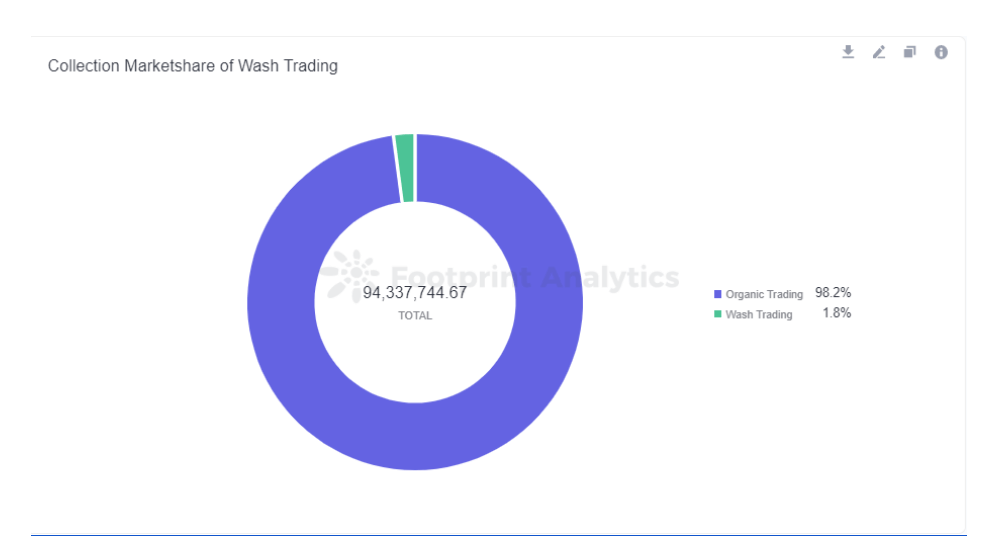
According to Footprint Analytics’ filters, wash trading makes up nearly half of all NFT trading volume.

Footprint Analytics – ETH NFT Market Overview (With Wash Trading Filtered)

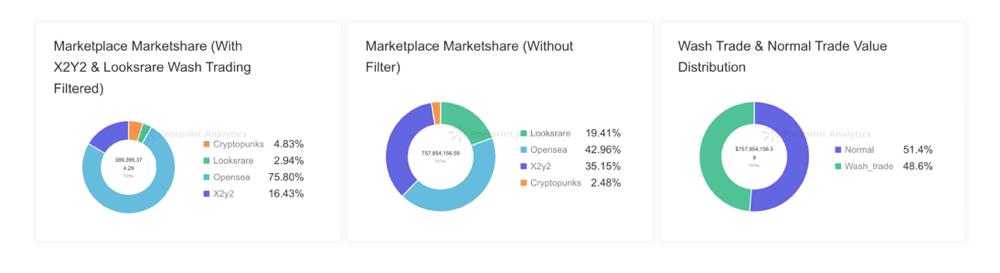
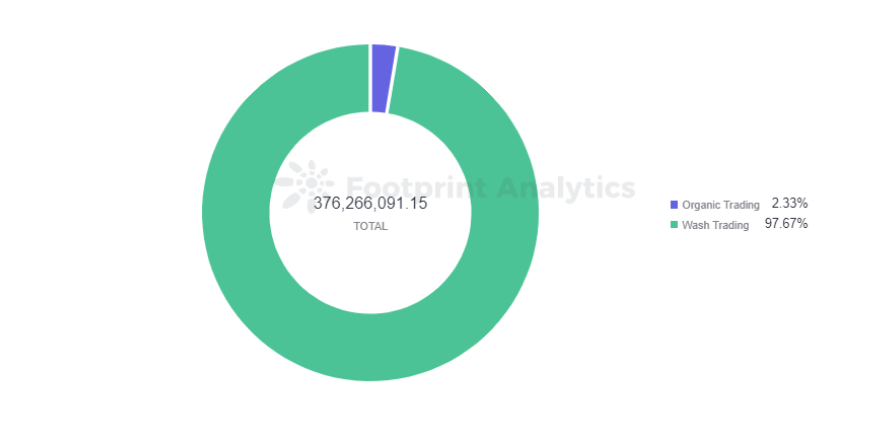
Traders seeking to artificially inflate the price of collections or earn marketplace trading rewards generated $389 million in wash trades out of October’s total of $758 million in NFT trading volume — bringing the amount of wash trading in the NFT market close to half that of organic trading.  The number of wash trading users accounts for nearly 46% of total users.

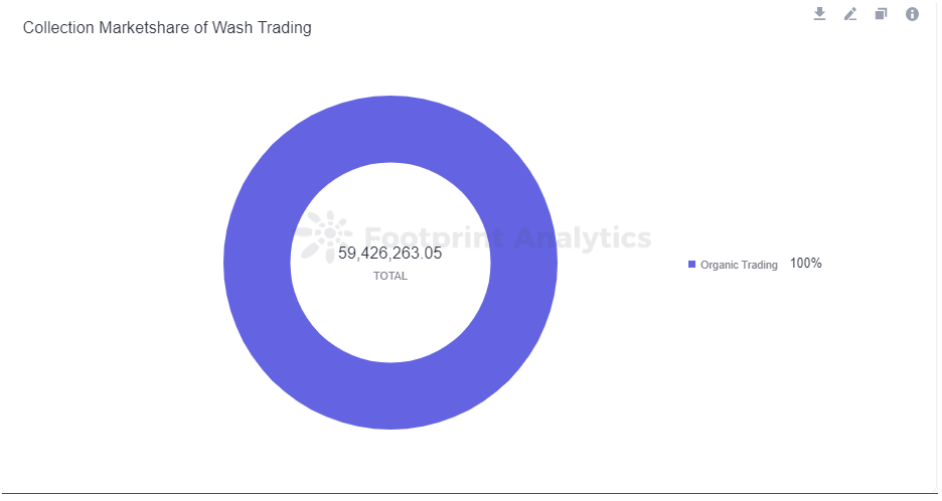
Footprint Analytics – Marketplace Market Share Wash Trading Filtered & Without Filtered
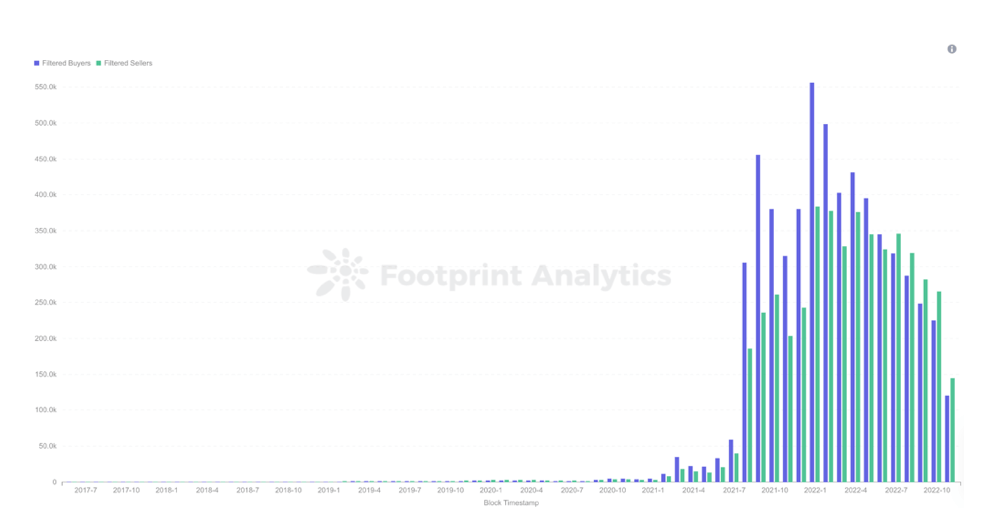
Footprint Analytics – NFT Sellers & Buyers Without Wash Trade
Footprint Analytics – NFT Sellers & Buyers

Wash trading is a form of market manipulation where an investor simultaneously sells and buys the same financial instruments to create misleading, artificial activity in the marketplaceIt creates enormous dissonance in the NFT industry between what most people imagine NFT trading is i.e., someone buying an NFT for speculation, and the behavior which actually underlies the market — hundreds of insiders transferring NFTs between their own wallets.

There are several indicators to identify suspicious trading activity.

Signals and indicators include:

  1. Overpriced NFT trades with 0% creators fees
  2. Specific NFT IDs that are bought more than a normal amount of times in a day
  3. NFTs bought by the same buyer address in a short period of time

The incentives for wash trading are to earn platform rewards and to create an appearance of value or liquidity for assets. Because there is no way to prevent or discourage wash trading in the NFT market today, people have a hugely misguided picture of the amount of organic, genuine trading activity in the industry.

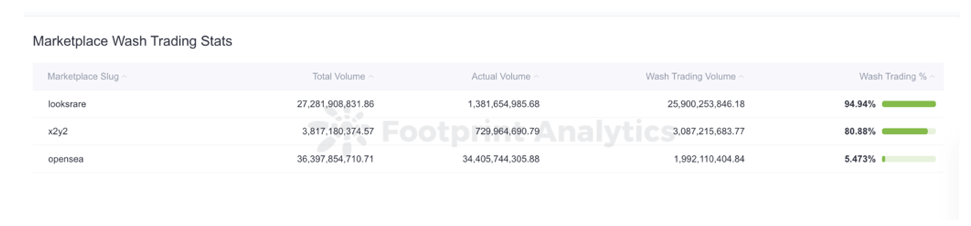
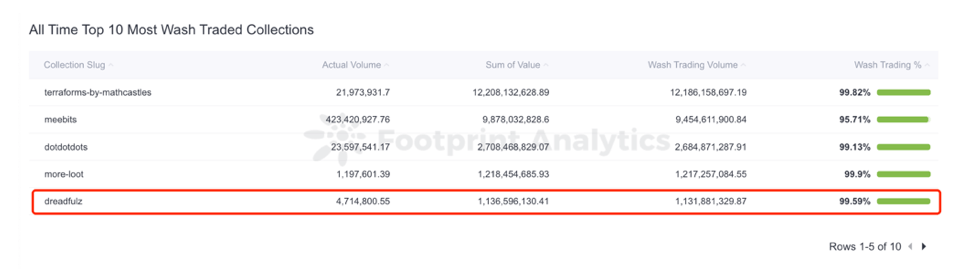
For example, 81% percent of all trades on X2Y2, one of the top 3 NFT marketplaces, were wash trades according to the filters applied. The main reason for X2Y2 wash trading is volume-based daily trading rewards. The larger the percentage of volume a user contributes to X2Y2, the larger the share of daily trading rewards the user will earn. A similar breakdown can be observed when looking at individual collections. For example, of Dreadfulz’ $1.1 billion in total volume, $1.131 billion was flagged as wash trading.

Footprint Analytics – Marketplace Wash Trading Stats
Footprint Analytics – All Time Top 10 Most Wash Traded Collections

An analyst or writer who does not understand this wash trading dynamic risks grossly misunderstanding the current market. For example, here’s what Business2Community wrote on Oct. 12 about Terraforms by Mathcastles:

“Non-fungible token collections continue showing strong resilience amid the current general crypto market downturn so far this year. Here are some of the top-selling NFT collections this week: 1. Terraforms Reclaim The Top Spot. Terraforms, a non-fungible token (NFT) collection from Mathcastles, has reclaimed the top spot after flipping below our ten top-selling lists last week. Terraforms has a 24-hour sales volume of 1,814 ETH.”

The next collections the article listed were BAYC and CryptoPunks, which have nearly no wash trading. This would give a reader the impression that Terraforms more of a popular collection than those blue chip collections when in reality there were almost no organic trades.

Footprint Analytics – Bored Ape Yacht Club Trading Stats
Footprint Analytics – Cryptopunks Wash Trading Stats
Footprint Analytics – Terraforms-by-mathcastels Wash Trading Stats

By filtering trades for wash trading, traders, analysts and investors can more accurately evaluate NFT assets and the industry. Having accurate datasets and using them are two separate things. My role here is not to whistleblow or break the NFT myths, I am here to share my knowledge and tell my side of the story to everyone.

Using this article, I would like to make a request to analyze CEX NFT marketplaces’ data. Binance or Bybit NFT Marketplace would be ideal.


Source: https://cryptoslate.com/roughly-48-of-ethereum-nft-trades-in-october-were-fake/

Anndy Lian is an early blockchain adopter and experienced serial entrepreneur who is known for his work in the government sector. He is a best selling book author- “NFT: From Zero to Hero” and “Blockchain Revolution 2030”.

Currently, he is appointed as the Chief Digital Advisor at Mongolia Productivity Organization, championing national digitization. Prior to his current appointments, he was the Chairman of BigONE Exchange, a global top 30 ranked crypto spot exchange and was also the Advisory Board Member for Hyundai DAC, the blockchain arm of South Korea’s largest car manufacturer Hyundai Motor Group. Lian played a pivotal role as the Blockchain Advisor for Asian Productivity Organisation (APO), an intergovernmental organization committed to improving productivity in the Asia-Pacific region.

An avid supporter of incubating start-ups, Anndy has also been a private investor for the past eight years. With a growth investment mindset, Anndy strategically demonstrates this in the companies he chooses to be involved with. He believes that what he is doing through blockchain technology currently will revolutionise and redefine traditional businesses. He also believes that the blockchain industry has to be “redecentralised”.

j j j