What Is Web4? Is It Centralized or Decentralized?

What Is Web4? Is It Centralized or Decentralized?

Web4 is a term that is used to refer to the next generation of the internet. It is also known as the “more” decentralized web. Web4 aims to create a more decentralized and distributed internet that is controlled by its users rather than centralized organizations or corporations.

Web4 is characterized by its decentralized nature, which aims to distribute power and control among users, rather than concentrating it in a small group of companies or organizations. This is achieved through the use of technologies such as blockchain and peer-to-peer networks.

Web4 aims to provide increased security and privacy for users, censorship resistance, interoperability, new business models and economic opportunities, increased scalability, and improved accessibility.

Web4 is also associated with the growing field of AI, which has the potential to complement the decentralized nature of Web4 in various ways such as decentralized AI, Federated Learning, Privacy-Preserving AI, Blockchain-based AI, and AI-driven scalability.


Why Is Web3 Less Decentralized?

It is worth noting that Web3 is still in its early stages of development, and it is not yet fully decentralized. There are still challenges and limitations that need to be overcome before Web3 can truly be considered a decentralized version of the internet.

Some of the reasons why Web3 is not fully decentralized include:

  1. Centralized infrastructure: While blockchain networks are decentralized, the infrastructure that supports them, such as servers, data centers, and internet service providers, are still centralized.

  2. Limited scalability: Blockchain networks currently face scalability issues, which limits the number of transactions that can be processed on the network.

  3. Limited user adoption: The majority of internet users are still not using decentralized applications, which means that the network is not yet fully decentralized.

  4. Limited Interoperability: Current Web3 platforms and applications are not yet fully interoperable, which limits their ability to communicate with each other and with the existing web.

  5. Limited privacy and security: Some of the current Web3 applications and platforms do not yet provide the same level of security and privacy as centralized platforms.


Why Is Web4 More Decentralized?

Web4 is more decentralized because it aims to distribute power and control among users, rather than concentrating it on a small group of companies or organizations. This is achieved through the use of technologies such as blockchain and peer-to-peer networks.

Blockchain technology, which is a decentralized and distributed digital ledger, can be used to create decentralized platforms and applications that are controlled by their users rather than centralized organizations.

This allows for more transparency and security in the handling of data, and can also enable new business models such as decentralized marketplaces.

Peer-to-peer networks, which allow for direct connections between users rather than relying on centralized servers, can also contribute to the decentralization of the internet.

This can enable new forms of content sharing, collaboration, and communication that are not controlled by a centralized organization.

Additionally, Web4 aims to provide increased security and privacy for users, censorship resistance, interoperability, new business models and economic opportunities, increased scalability, and improved accessibility, which all contribute to a more decentralized web.


Web4 Is More Decentralized Than WEB3 in Several Ways:

  1. Decentralized infrastructure: Web4 aims to use decentralized technologies such as blockchain, peer-to-peer networks, and other decentralized infrastructures to create a more distributed and resilient internet. This allows for more control and ownership of data by the users and less dependence on centralized servers and organizations.

  2. Decentralized applications: Web4 also aims to create decentralized applications (dApps) that run on decentralized infrastructure, which eliminates the need for intermediaries and centralized organizations to control and manage the applications.

  3. Decentralized governance: Web4 is more focused on decentralized governance models where the users have more control over the decision-making process of the network, rather than relying on centralized organizations to govern the network.

  4. Decentralized economy: Web4 aims to create a decentralized economy where the users can own and control their data, and participate in decentralized marketplaces and other economic activities.

  5. Interoperability: Web4 aims to create a more interoperable internet, where different systems and applications can easily communicate with each other without the need for centralized intermediaries.

Web3 refers to the development of decentralized applications (dApps) that run on blockchain networks, which allows for more control and ownership of data by the users.

However, Web4 builds upon the foundation of Web3 and aims to create a more decentralized and distributed internet that is controlled by its users, and not just limited to decentralized applications.


Source: https://hackernoon.com/what-is-web4-is-it-centralized-or-decentralized
Anndy Lian is an early blockchain adopter and experienced serial entrepreneur who is known for his work in the government sector. He is a best selling book author- “NFT: From Zero to Hero” and “Blockchain Revolution 2030”.

Currently, he is appointed as the Chief Digital Advisor at Mongolia Productivity Organization, championing national digitization. Prior to his current appointments, he was the Chairman of BigONE Exchange, a global top 30 ranked crypto spot exchange and was also the Advisory Board Member for Hyundai DAC, the blockchain arm of South Korea’s largest car manufacturer Hyundai Motor Group. Lian played a pivotal role as the Blockchain Advisor for Asian Productivity Organisation (APO), an intergovernmental organization committed to improving productivity in the Asia-Pacific region.

An avid supporter of incubating start-ups, Anndy has also been a private investor for the past eight years. With a growth investment mindset, Anndy strategically demonstrates this in the companies he chooses to be involved with. He believes that what he is doing through blockchain technology currently will revolutionise and redefine traditional businesses. He also believes that the blockchain industry has to be “redecentralised”.


j j j

What Are Crypto Venture Capitalists (VCs) Investing in This Bearish Market?

What Are Crypto Venture Capitalists (VCs) Investing in This Bearish Market?

(Image credits: A Golden Bear Market by Anndy Lian)


The value of a cryptocurrency can be influenced by various factors, including news about the cryptocurrency and its underlying technology, government regulations, and overall market conditions.

The market can also be influenced by investor sentiment, which can be affected by a wide range of events.

There are many different types of investments in the cryptocurrency space, and the popular specific investments can vary over time. In general, some of the most popular types of cryptocurrency investments include:

Bitcoin: Bitcoin is a decentralized cryptocurrency that was the first of its kind. It is often considered a store of value and is widely recognized and accepted as a form of payment.

Ethereum: Ethereum is a decentralized platform that runs smart contracts, which are applications that execute automatically when certain conditions are met. It is also used as a platform for building decentralized applications (dApps).

Decentralized finance (DeFi) tokens: DeFi refers to financial applications built on the blockchain and decentralized, meaning that they are not controlled by a single entity. DeFi tokens are often used to access or participate in these applications.

Security tokens: Security tokens are digital assets representing ownership in an asset, such as a company or real estate. They are subject to federal securities laws and are often issued through initial coin offerings (ICOs).

Stablecoins: Stablecoins are cryptocurrencies that are pegged to a stable asset, such as the US dollar, to reduce price volatility.

There are many different investment theses for cryptocurrencies. Some people believe that cryptocurrencies have the potential to replace traditional fiat currencies. In contrast, others think they will be used primarily as a store of value or a means of exchange.

Still, others believe that the underlying blockchain technology has the potential to revolutionize a wide range of industries, from supply chain management to identity verification.

These Are Some Specific Investment Theses for Cryptocurrencies:

The use of cryptocurrency as a means of exchange: Some people believe that cryptocurrencies will eventually be used as a primary means of exchange, replacing traditional fiat currencies.

The store of value thesis: Some people believe that cryptocurrencies will eventually be used as a store of value, similar to gold.

The blockchain revolution thesis: Some people believe that the underlying blockchain technology has the potential to revolutionize a wide range of industries and that investing in cryptocurrencies is a way to get in on the ground floor of this technological revolution.

The “greater fool” theory: Some people believe that the price of a cryptocurrency will continue to go up as long as someone is willing to buy it at a higher price, even if there is no intrinsic value to the cryptocurrency. This is sometimes referred to as the “greater fool” theory of investing.

Venture capitalists (VCs) are investors who provide capital to early-stage companies in exchange for equity ownership. In the cryptocurrency space and especially after witnessing the fall of FTX, many VCs have started to be interested in investing in companies that are working on infrastructure and applications for the blockchain, rather than investing directly in cryptocurrencies themselves.

Some Specific Areas of Interest for VCs in the Cryptocurrency Space.

Blockchain infrastructure: VCs have invested in companies working on building out the infrastructure for the blockchain, such as companies that are developing new consensus algorithms or building out decentralized storage solutions.

New blockchains get good support too. Shardeum is the world’s first EVM (Ethereum Virtual Machine)-based sharded blockchain mainnet.

With dynamic state sharding technology, the blockchain can linearly scale and increase TPS (transaction per second) with every node added to the network.

The network can maintain low gas fees indefinitely. It was co-founded by Nischal Shetty, a co-founder of WazirX, India’s largest crypto exchange by trading volume.

They have raised $18.2 million in a seed funding round from more than 50 investors, including Jane Street and The Spartan Group joined this seed round along with Wemade and others.

Web3 solutions: Web3, also known as Web 3.0, is the next iteration of the World Wide Web, and it is built on blockchain technology. It is designed to be more decentralized, secure, and open than the current Web.

VCs are looking for projects that align with the core principles of Web3 and have the potential to drive its adoption and growth. This is another rising trend.

The Venom Foundation, a Layer-1 blockchain licensed and regulated by the Abu Dhabi Global Market (ADGM), and Iceberg Capital, an ADGM-regulated investment manager, have announced a partnership to launch the Venom Ventures Fund (VVF), a $1 billion venture fund.

The fund aims to invest in innovative protocols and Web3 dApps, focusing on long-term trends such as payments, asset management, DeFi, banking services, and GameFi.

The VVF will be blockchain-agnostic, meaning it will not be limited to any specific blockchain and will invest in projects based on their potential regardless of the underlying blockchain. The fund aims to become the leading supporter of next-generation digital technologies and entrepreneurs.

I noted that the VCs in my network are also looking at blockchain applications.

VCs have also invested in companies that are using the blockchain to build new applications, such as supply chain management platforms, decentralized finance (DeFi) platforms, and decentralized identity solutions.

Interoperability and cross-chain solutions, for example, aim to enable different blockchain networks to communicate and interact with each other and are also one of the top investment choices.

When I showed this article to some of my friends before publishing, they asked me why didn’t VCs consider investing in crypto exchanges.

The truth is that most of the VCs who understand how the crypto market works would know that exchanges are facing tremendous stress from the regulators. Having a license does not necessarily mean good, honestly. There are new travel rules that will tighten how crypto moves.

The new rules may even force DEXs to new unknown territories where the realization of profits can be deemed a nuisance for many investors. The older existing exchanges usually have very high operating costs, overspending habits on marketing, sponsorships, and staffing.

Moreover, the valuation is way too high for a good entry point, in my humble opinion.

Therefore, I believe investing in blockchain infrastructure and applications will support the development and growth of the cryptocurrency ecosystem and potentially generate more sustainable returns for its investors in this bear run.

It is also important to note that VC investment in the cryptocurrency space is just one aspect of the broader cryptocurrency ecosystem.

There are many other types of investors, such as hedge funds, family offices, and individual investors, who may have different investment theses and strategies.

Having said this, there are still many opportunities in this volatile market. I commented in the South China Morning Post yesterday, “Gold may be a safe haven”, but there were many other [crypto] opportunities elsewhere for investors “to profit from price fluctuations.”

Take a recent market movement, for example. A fellow investor in Singapore reacted quickly to short bitcoin after the US report of 6.5% CPI inflation. He made money. During the same week, he noted that the resistance level had hit its low and would bounce upward soon.

He injected another $10m to long it. Bitcoin went over $21,000. He made money again. And when he heard rumors that PBOC might start to print more money as a stimulus, he sold his crypto holdings into Chinese A-shares as he saw a higher upside in the longer run.

As a licensed fund manager and a VC myself for over a decade, this is my humble note to all.

“Believe in the underlying technology, aim for community growth and ride on the right waves for the best crypto returns.”- Anndy Lian.

Not financial advice, of course.


Source: https://hackernoon.com/what-are-crypto-venture-capitalists-vcs-investing-in-this-bearish-market

Anndy Lian is an early blockchain adopter and experienced serial entrepreneur who is known for his work in the government sector. He is a best selling book author- “NFT: From Zero to Hero” and “Blockchain Revolution 2030”.

Currently, he is appointed as the Chief Digital Advisor at Mongolia Productivity Organization, championing national digitization. Prior to his current appointments, he was the Chairman of BigONE Exchange, a global top 30 ranked crypto spot exchange and was also the Advisory Board Member for Hyundai DAC, the blockchain arm of South Korea’s largest car manufacturer Hyundai Motor Group. Lian played a pivotal role as the Blockchain Advisor for Asian Productivity Organisation (APO), an intergovernmental organization committed to improving productivity in the Asia-Pacific region.

An avid supporter of incubating start-ups, Anndy has also been a private investor for the past eight years. With a growth investment mindset, Anndy strategically demonstrates this in the companies he chooses to be involved with. He believes that what he is doing through blockchain technology currently will revolutionise and redefine traditional businesses. He also believes that the blockchain industry has to be “redecentralised”.

j j j

Hooked Protocol price prediction: What is HOOK?

Hooked Protocol price prediction: What is HOOK?

We’ve heard of earn-to-play tokens but what does a learn-to-earn cryptocurrency exist?

Now it does!

The Hooked Protocol (Hook) is one of the first platforms to incorporate GameFi technologies with learning and cryptocurrencies by teaching new and experienced crypto investors about the world of Web3 through playing games.

Even though its native token, HOOK, was launched on 1 December 2022, the token is already making headlines with a surge of more than 40% on its second day of existence.

What does the Hooked Protocol price prediction suggest?

What is Hooked Protocol (HOOK)?

Hooked Protocol is the “on-ramp layer for massive Web3 adoption to form the future of community-owned economies”.

The application was created with the aim of helping everyone, whether they have had previous crypto experience or not, enter, own and earn a share of crypto through a gamified experience. In addition, the platform is providing crypto investors with a number of learning and earning tools, via gamified learning, that will help them enter and adapt to the world of Web3 through playing games.

Its most prominent game is Wild Cash, “the all-in-one Learn-to-Earn dApp [decentralised application]” that rewards users in GOLD tokens for their participation in “delicately tailored quiz challenges”.

According to the Hooked Protocol website, Wild Cash is the first and only Web3 application to dominate a Google Play ranking ever having achieved more than 2.5 million monthly active users, over 50,000 new users and 90% of user participation in three months after its launch (the DApp was launched in the third quarter of 2022).

The platform is targeting “billions of Web2 internet users who can be onboarded to Web3” through its learn-to-earn initiative in order to solve one of the biggest unresolved challenges of the crypto industry – the lack of new users.

“Potentials for intrinsically dynamic modern virtual economy after covid are recognized and scaled up, leading to upsurging demands for trusted cooperation and sustainable economic model in Web3,” Hooked Protocol said in its whitepaper.

The platform has a dual token system:

  • HOOK: its governance token that reflects the value of the Hooked protocol ecosystem
  • Hooked Gold Token (HGT): an in-ecosystem only utility token through which the community is incentivised.

Apart from governance, HOOK is also used to pay for gas fees in on-chain activities and staking incentives as holding rewards. In addition, by holding HOOK tokens, community members may gain access to exclusive events and grants to buy limited editions of in-platform non-fungible tokens (NFTs).

“HOOK will be put into innovation practices which overall benefit the ecosystem of both individual participants and businesses, ensuring considerable liquidity and token value will grow in direct proportion for the success of the whole community,” the coin’s whitepaper noted.

A bullish start in a bear market

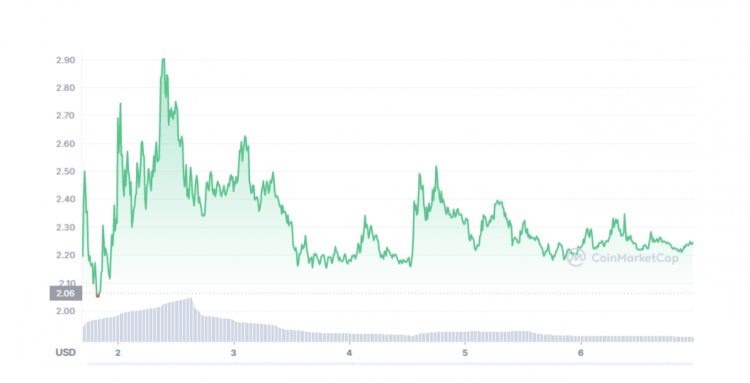
HOOK launched on CoinMarketCap on 1 December 2022 and within a day had gained over 40%, up from $2.0626 to $2.9016, its all-time high. In general, HOOK has had a pretty bullish start, a significantly positive aspect in an overall bear market.

The bull run in the coin’s price, however, did not last long as it lost over 20% of its gains on 2 December 2022, dropping to around $2.30 as the platform warned investors on Twitter that all HOOK tokens for sale on PancakeSwap were fake.

HOOK to USD price chart, December 2022

HOOK to USD price chart, December 2022

Source: CoinMarketCap

By the following day, the cryptocurrency managed to regain some of its losses, rising 13.8% to $2.617, but soon fell back down to $2.15.

Between 3 and 4 December 2022, HOOK fluctuated between $2.10 and $2.30 before surging twice, first by 15.8% to $2.4904 from $2.15 and then by an additional 1% to $2.517, possibly hiked by the platform’s whitelist giveaway.

Since surging to $2.517 on 4 December 2022, HOOK’s value has been dipping, down by 9.8% to $2.27 as of 7 December 2022.

According to data published on CoinMarketCap, as of 7 December 2022 the total number of HOOK coins in circulation is capped at 500 million. The cryptocurrency does not have a maximum supply, meaning that an unlimited amount of tokens can be mined. HOOK’s circulating supply stands at 50 million.

Latest news driving HOOK

Perhaps, some of the biggest news, news driving HOOK in recent days is the token’s listings on major exchanges.

On 2 December 2022, PancakeSwap announced that “the HOOK fam is now live on” the platform, meaning the token was available for purchase on the crypto exchange.

In addition, the HOOK cryptocurrency has been highly driven by the completion of the Hooked Protocol subscription launchpad and its listing on Binance, one of the most popular crypto exchanges worldwide.

According to a press release published by Binance, over 114,000 investors committed more than 9 million BNB during the subscription period, showing high interest for the HOOK cryptocurrency.

In other news, on 5 December 2022 the Hooked Protocol platform announced the end of its very first Hooked Web3 Quiz Maker Contest, which saw the winner scoring $100 equivalent of HOOK, with the platform promising more “fun” to come soon.

In a blog post published on Medium on 5 December 2022, the Hooked Protocol noted that the platform is working on bettering its user acquisition methodology in order to further expand the platform on a more global level.

In addition, the Hooked Protocol will focus on user engagement by “adding more content and developing new features to keep users engaged”.

Finally, “on the user rewards and commitment side” the platform is planning to launch an incentive mechanism in the following weeks.

HOOK is also planning to launch a product roadmap and airdrop plan.

So, what is the overall sentiment on the future Hooked Protocol price prediction?

Hooked Protocol price prediction

According to data provided by BitNation, as of 7 December 2022 the Hooked Protocol Price prediction for 2023 sees the token surging to $6.29 and reaching $9.44 by 2025. The website’s long-term Hooked Protocol coin price prediction saw the coin rising to $15.52 by 2028 and $22.02 by 2030.

DigitalCoinPrice also supported the bullish Hooked Protocol crypto price prediction, seeing the token averaging $5.73 in 2023. The website’s Hooked Protocol price prediction for 2025 saw the coin surging past an average of $9 and exceeding $11 in 2027.

The website’s Hooked Protocol price prediction for 2030 saw the token passing an average $32.

Anndy Lian, chief digital advisor at the Mongolian Productivity Organisation and author of NFT: From Zero to Hero, told Capital.com that the recent HOOK price surge was due to the cryptocurrency’s listing on Binance:

“Based on past track records for Binance Launchpad projects, users highly value such projects. Hence hitting numbers like this are not uncommon.”

He also added that, at the time of launch, only 10% of the tokens were in circulation, which, according to Lian, is an easier amount of currencies to manage.

“I would like to see how Hooked Protocol fairs in the bear market and how ‘quiz-to-earn’ rewards can be sustained over a more extended period. A similar comparison with GMT would be fair too. I remember them jumping to $3.80, and then their price plummeted 90% shortly. If they can manage the rewards, continue to build on its community and use base. They could be a considerable force to reckon with.”

To conclude, Lian noted that in the long run, only time will tell on where the Hooked Protocol price prediction will head.

The Hooked Protocol whitepaper also shared an outlook on what could potentially affect the future HOOK price predictions noting that the coin’s “long-term value is tied with the confidence people hold for the project but as opposed to HGT, supply of HOOK is fixed and designed to be deflationary”.

Note that HOOK/USD predictions can be wrong and shouldn’t be used as a substitute for your own research. Always conduct your own due diligence looking at fundamental and technical analysis, a wide range of commentary and latest news. Remember that past performance does not guarantee future returns. And never trade money that you cannot afford to lose.


Source: https://capital.com/hooked-protocol-hook-price-prediction

Anndy Lian is an early blockchain adopter and experienced serial entrepreneur who is known for his work in the government sector. He is a best selling book author- “NFT: From Zero to Hero” and “Blockchain Revolution 2030”.

Currently, he is appointed as the Chief Digital Advisor at Mongolia Productivity Organization, championing national digitization. Prior to his current appointments, he was the Chairman of BigONE Exchange, a global top 30 ranked crypto spot exchange and was also the Advisory Board Member for Hyundai DAC, the blockchain arm of South Korea’s largest car manufacturer Hyundai Motor Group. Lian played a pivotal role as the Blockchain Advisor for Asian Productivity Organisation (APO), an intergovernmental organization committed to improving productivity in the Asia-Pacific region.

An avid supporter of incubating start-ups, Anndy has also been a private investor for the past eight years. With a growth investment mindset, Anndy strategically demonstrates this in the companies he chooses to be involved with. He believes that what he is doing through blockchain technology currently will revolutionise and redefine traditional businesses. He also believes that the blockchain industry has to be “redecentralised”.
j j j