Navigating the uncharted legal territory of NFT: What to avoid?

Navigating the uncharted legal territory of NFT: What to avoid?

According to the NFT aggregator platform- CryptoSlam, the market for Non-Fungible Tokens (NFTs) plummeted from its peak of $17 billion in early 2022 to $460 million in October 2022, a staggering decline of 97.3%. While the decrease in NFT transaction volume may be partially attributed to dropping cryptocurrency prices, NFT developers continue to create NFT. In fact, creators are confident that the NFT industry will recover. We see new projects popping up every day on Twitter. We see different projects challenging the Number 1 spot on sales volume. At the point of publishing, Art Globblers are topping the charts. I see centralized marketplaces like Bybit are still selling out their Mystery Boxes. Everyone is building harder than before.

Taking the sentiments from the ground and as per the requests from various communities asking about NFT regulations, I have decided to share some insights on legal implications and the regulatory side of things so that you will be aware and up to speed on the state of the NFT sector.

Around 105 nations have legalized NFTs either expressly or as part of a larger recognition of cryptocurrencies and virtual currencies. However, as the aforementioned list illustrates, legislation regarding NFTs is frequently general and not designed mainly for NFTs.

The U.S., Canada, Australia, and most of the European Union are notable examples of markets that are integrated and moderately regulated. In each of these jurisdictions, the predominant legal strategy is to view NFTs as either a type of capital gains taxable asset or a component of an individual’s income tax portfolio. However, there are still a lot of nations where NFTs and cryptocurrencies are either implicitly or expressly banned. This is largely because those governments view NFTs and other digital assets as threats to the current financial system and sources of illicit and/or terrorist financing. China, Vietnam, Algeria, Egypt, Qatar and Nepal are notable instances.

I will go through a few markets.

U.S.A

Although there are no particular NFT legislation in the US, similar to the UK, some NFT crypto-asset kinds may be covered by already-existing federal statutes. For instance, the Securities and Exchange Commission (SEC) may treat specific types of NFT as securities under US securities law.

India

Since there is no official legal framework for NFTs and no classification of NFTs under the SCRA, it is unclear if dealing in NFTs is forbidden under the Securities Contract Regulation Act, 1956 (“SCRA”). If NFTs are deemed to constitute derivatives, trading in them would be prohibited in India.

Singapore

Singapore’s central bank has recently announced that it will not regulate the NFT market. Recently, under Singapore law, it will be subject to MAS’ regulatory requirements if an NFT has the characteristics of a capital markets product under the Securities and Futures Act (SFA). Similarly, should an NFT have the features of a digital payment token under the Payment Services Act (PSA).

U.K.

NFTs are not subject to any special NFT rules in the U.K., but they are recognized as a kind of crypto asset. To be more precise, it can be classified as a security token, an e-money token, or an unregulated token. However, most NFTs are not regulated since they do not meet the first two prerequisites. Even if it does, it can still result in broad regulations, such as an anti-laundering rule for art sales over €10,000 and capital gains tax if purchased or sold at a profit. Strict laws require consumers to be adequately informed and warned about the risk of loss or price volatility if public advertisements promote NFTs.

China

NFTs can currently be purchased or sold by individuals in Mainland China. NFTs are not presently subject to any specific laws or regulations. The National Internet Finance Association of China, the Securities Association of China, and the China Banking Association jointly released an initiative regarding the prevention of financial risks associated with NFTs. Because the three associations are under the supervision of the central bank, the banking regulatory authority, and the security regulatory authority, respectively, and because the Initiative is not a regulation under PRC law, it reflects the attitudes and policy orientation of regulators in Mainland China. For some time, the word “NFT” was also deemed a sensitive word and temporarily blocked by some official media sites.

Japan

While there are presently no particular regulations in Japan that govern NFTs, the government said in January 2022 that it was creating an NFT task force, which suggests that regulation is soon to come. Currently, an NFT may meet the definition of a security under the Financial Instruments and Exchange Act if its holder receives cash or other assets that represent a sharing of profits. It should be carefully considered whether NFTs violate gambling laws, which are especially important for NFTs employed in games.

Now that you have read briefly how the regulators around the world look at NFTs in general. If you are an entrepreneur, your DNA could be telling you to be a creator or start an NFT Marketplace. So what are some legal considerations if you want to create a business like an NFT marketplace? What do you need to do?

  • Creation of a legal entity: A corporate body must first be established before a marketplace can be introduced. Your company will benefit from the most robust liability protection, increased capability, and credibility while looking for outside financing.
  • Formation of smart contracts: The digital work must be individually recognizable and have transferrable ownership within the smart contract. The economics of trading should be included in the creation process, including how much to charge for a primary sale, how much to charge for a secondary sale, royalties, transaction costs, and other characteristics of the aftermarket to facilitate trade with money naturally flowing to the right parties.
  • Terms of service: It regulates the interactions between users and the NFT marketplace operator, as well as between buyers and sellers of the NFTs displayed on the platform, which is a necessary component of NFT marketplaces. A carefully drafted term of service agreement will typically include clauses that limit the company’s overall responsibility and can aid in defending your firm from several legal problems.
  • Terms of sale: If the platform’s terms of service do not adequately address risks to the seller or creator, sellers or creators listing their NFTs on an NFT marketplace may choose to impose additional terms of sale on buyers of their NFT.
  • Securities law compliance: It’s critical to develop features that show the difference between your newly minted token and what governments seek to regulate to ensure it doesn’t have the characteristics of a security.
  • Intellectual property: It is crucial to confirm the validity of each participant’s intellectual property rights at every stage of every NFT transaction. Copyright ownership, which belongs to the original work’s creator, governs the original work. Make careful to divide up intellectual property ownership among the authors, artists, buyers, collectors, and other parties.
  • Consumer protection: Most jurisdictions have consumer protection laws. Consider a scenario where an NFT marketplace fails to appropriately notify its clients about the products they are buying and the hazards involved. Cybercriminals will probably attack NFTs in order to profit financially. To protect against these attacks, your platforms will need reliable controls. Other regulatory standards, including KYC and anti-money laundering, might also need to be implemented.

The fast-changing NFT space, where digital assets prevail, was not considered when developing the current regulatory and legal framework. However, some crucial challenges have surfaced as investors, financial institutions, and fintech firms investigate this market. Is there a gateway to your platform that guards against money launderers and other undesirable parties subject to government sanctions?

NFTs are indeed not treated as cryptocurrencies right now. Regulators are trying to clamp down on grey NFT projects and have warned the general public about buying NFT. So far, I have been talking about how governments look at us and what entrepreneurs need to understand when they start their NFT business as a marketplace. I have come out with a few quick reminders for consumers when buying NFT.

3 Quick Reminders on NFT Buying

  • Do not buy NFTs that include securities, insurance or other financial assets as the underlying value of NFTs. An NFT may become a regulated financial product if it grants its owner the right to income streams or a stake in an underlying portfolio of investment assets. There are many grey examples to be named.
  • Do check on the copyright behind the NFTs. Some of the creators are plagiarizing artists’ original work. Playboy Enterprises filed a lawsuit against the owners of a website that was constructed to seem like the one Playboy used to market their “Rabbitar” NFTs. Playboy claims that the scam was successful because more than a thousand customers fell for it and collectively paid more than a million dollars for Rabbitars they never received.
  • Do remember that trading NFTs for profit is subjected to capital gain tax. It is good to consider all tax implications before making the trade. Take India, for example. All virtual digital assets, including NFTs, are subject to the government’s 30% tax levied.

NFT is a beautiful term and has excellent potential. As crypto community members, we should try our best to keep it clean and proper. Hiding financial products or securities behind an NFT is not an excellent way to support innovation. It will give the regulators a chance to kill the innovation. You need to understand regulations to grow in the right manner. #anndylian


Source: https://www.securities.io/navigating-the-legal-territory-of-nft-what-to-look-out-for/


Anndy Lian is an early blockchain adopter and experienced serial entrepreneur who is known for his work in the government sector. He is a best selling book author- “NFT: From Zero to Hero” and “Blockchain Revolution 2030”.

Currently, he is appointed as the Chief Digital Advisor at Mongolia Productivity Organization, championing national digitization. Prior to his current appointments, he was the Chairman of BigONE Exchange, a global top 30 ranked crypto spot exchange and was also the Advisory Board Member for Hyundai DAC, the blockchain arm of South Korea’s largest car manufacturer Hyundai Motor Group. Lian played a pivotal role as the Blockchain Advisor for Asian Productivity Organisation (APO), an intergovernmental organization committed to improving productivity in the Asia-Pacific region.

An avid supporter of incubating start-ups, Anndy has also been a private investor for the past eight years. With a growth investment mindset, Anndy strategically demonstrates this in the companies he chooses to be involved with. He believes that what he is doing through blockchain technology currently will revolutionise and redefine traditional businesses. He also believes that the blockchain industry has to be “redecentralised”.

j j j

Cardano (ADA) Price Prediction 2025-2030: What are the LAMBO chances on holding ADA?

Cardano (ADA) Price Prediction 2025-2030: What are the LAMBO chances on holding ADA?

In recent days, Cardano and other cryptocurrencies have performed strongly. The timing of this rebound coincided with the success of American markets. The explanation, according to analysts, was the United States’ dismal consumer confidence and housing data.

Cardano’s price has risen as a result of the Non-Fungible Token (NFT) market’s strong performance. According to statistics acquired by OpencNFT, the volume of NFTs has been trending significantly bullish over the past few months. As shown in the graph below, this week saw a surge in the daily volume of NFTs in the ecosystem.

After multiple delays, Cardano’s Vasil mainnet upgrade, which promised to raise the network’s capacity and enhance the scalability of the blockchain, was released on 22 September. The same was first announced via a tweet by the Cardano Foundation.

On 27 September, Vasil’s full capabilities became available. Additionally, the Plutus V2 cost model was enabled by the Cardano blockchain, resulting in lower transaction costs for smart contracts.

It is anticipated that these modifications would increase ADA’s value. As of press time, however, this hasn’t happened. This, is mostly because of the financial unpredictability around the world, according to Andy Lian, Chief Digital Advisor at the Mongolian Productivity Organization.

Interestingly, ADA has outperformed Bitcoin and Ethereum in terms of performance, having appreciated by 1100%. Cardano (ADA) is a relatively new coin. It is still a network with a lot of potential though. Due to its modifications, the money transfer system is expanding without any problems in 2022, despite the crypto world crisis.

Cardano’s ADA reached its peak in the bull market in 2021. ADA’s price rose to a value of above $3 in September 2021. The price was forced to take losses once more as a result. Before the significant bear market began, these losses occurred between September and November of 2021.

The past few months have seen enormous losses for Cardano. Starting in September 2021, ADA lost a lot of its value. Prior to the same, the price had greatly increased as a result of the creation of smart contracts on the Cardano blockchain at the time. As a result, ADA’s price was able to rise significantly to $3.

Long favoured by long-term investors, ADA has suffered during much of 2022 and is down more than 80% from the year’s beginning when it traded at $2.28.

Even though ADA, along with the majority of the other crypto markets, had a gloomy September, important updates and strong token fundamentals suggest that it may be poised for a breakthrough in October. Historically, this has been a typically positive month for cryptocurrencies.

However, considering that important technical indicators like the RSI and MACD continue to be below 50, suggesting a bearish trend, it seems difficult for Cardano to hit $1 in the upcoming four weeks. Popular analyst Peter Brandt even asserted that ADA could decline to less than $0.25 in the near future.

There has been buzz surrounding contemporary blockchains like Solana and Avalanche. These pose a direct threat to Cardano and can be distinguished by extremely fast transaction speeds. Owing to the same, one can argue that Cardano needs to look over its shoulder.

Despite losses in recent months, Cardano’s price prediction should be fairly optimistic. Cardano should eventually become one of the most technologically advanced blockchains on the market thanks to its long-term, scientifically directed development. In the near future, Cardano might outperform Ethereum and other blockchains in every respect. What is the outlook for Cardano going forward?

Given everything, purchasing ADA must ultimately be prudent, right? The majority of analysts have optimistic forecasts for ADA. Furthermore, the majority of long-term ADA price forecasts are confident.

The Cardano community specifically anticipates a potential increase in the token’s value, particularly following the Vasil hard fork. This line predicts that ADA will trade at $2.26 by August 31, 2022, according to NeuralProphet’s PyTorch-based price prediction algorithm that uses an open-source machine learning framework.

Cardano’s Charles Hoskinson was recently in the news too, with the exec taking a shot at his favorite target – BTC maximalists.


Bitcoin [BTC] maximalist Bryan (@btc_bryan_21) took to Twitter to claim that Hoskinson could alter the number of ADA tokens as a result of purported centralization. Cardano’s maximum supply is set at 45 million ADA tokens.

However, the Twitter user claimed that since blockchain’s monetary policy is relatively changeable, nothing would stop the crypto-tycoon from modifying it.

Hoskinson outright denied the credibility of these allegations. He further called the Twitter user “stupid”. This is not the first time the Cardano founder has commented on BTC maximalists. In July 2022, he stated that BTC maximalists are “toxic” and “useless” people to engage with.

The aforementioned statement was made in response to the MicroStrategy CEO’s claims that ADA is unregistered security.

Since all ADA tokens now exist in the possession of their rightful owners, Cardano has consistently resisted the idea of destroying them. Hoskinson claims that this would be equivalent to stealing from the neighbourhood.

Eight of the biggest cryptocurrency exchanges have modified their infrastructure, according to IOHK. Furthermore, the Cardano network’s development team is now prepared for the much-anticipated Vasil hard fork.

Furthermore, three of the top twelve exchanges for Cardano liquidity are ready for the upgrade. Several exchanges, including Gate.io, MEXC, Bitrue, OKx, Whitebit, BtcTurk, AscendEX, and Revuto, have improved their platforms.

Given everything, purchasing ADA must ultimately be prudent, right? The majority of analysts have optimistic forecasts for ADA. Furthermore, the majority of long-term ADA price forecasts are confident.

Why do these projections matter?

Cardano saw a substantial decline in 2022, falling from a high of $3.10 in September 2021 to a little over $0.47 in July 2022. However, only 75% of the total number of coins are now in use, thus there is still room for investors to amass coins.

Also, it seems like the conflict between Ethereum and Cardano may come down to an upgrade war. With the Goguen “Mary” update behind the latter and Vasil done too, it will be interesting to see what the impact of the same will be on the network and on ADA.

Over the past year, Cardano has established itself as one of the most active crypto-assets. As expected, it appears that cryptocurrency investors are optimistic as there has been an increase in the number of Cardano wallets. According to AdaStar, 121 new wallets have been created on average every hour since ADA’s record-breaking price run – A 98% hike.

Also, addresses holding between 10,000 and 10,000,000 ADAs have built on their accumulation tendencies, according to Santiment.

Since 27 July, these addresses have increased their portfolios by a total of 0.46% of ADA’s current supply. In just over 10 days, this amounts to an accumulation of ADA worth approximately $138 million.

3,105 Plutus-based smart contracts were implemented on the network, according to Cardano Blockchain Insights. Indeed, there has been an increase. In fact, in July, this number was 2,900. This demonstrates Cardano’s capability of enabling customers to create blockchain-related applications.

The bullish forecasts are in line with the generally bullish outlook on ADA that comes from network initiatives intended to make the asset more beneficial. The much-awaited Vasil hard fork is finally prepared for launch, according to Cardano’s Charles Hoskinson.

Supporters of the token are obsessed with price movement as it starts to recover, despite slight gains, ADA is yet to meaningfully react to the upgrade. The coin has, however, profited from the recent two-month surge in the wider cryptocurrency market.

In this article, we’ll quickly review the current activity of the cryptocurrency with a focus on market cap and volume. In conclusion, predictions from the most well-known analysts and platforms will be summarized together.

ADA’s price, volume, and everything in between

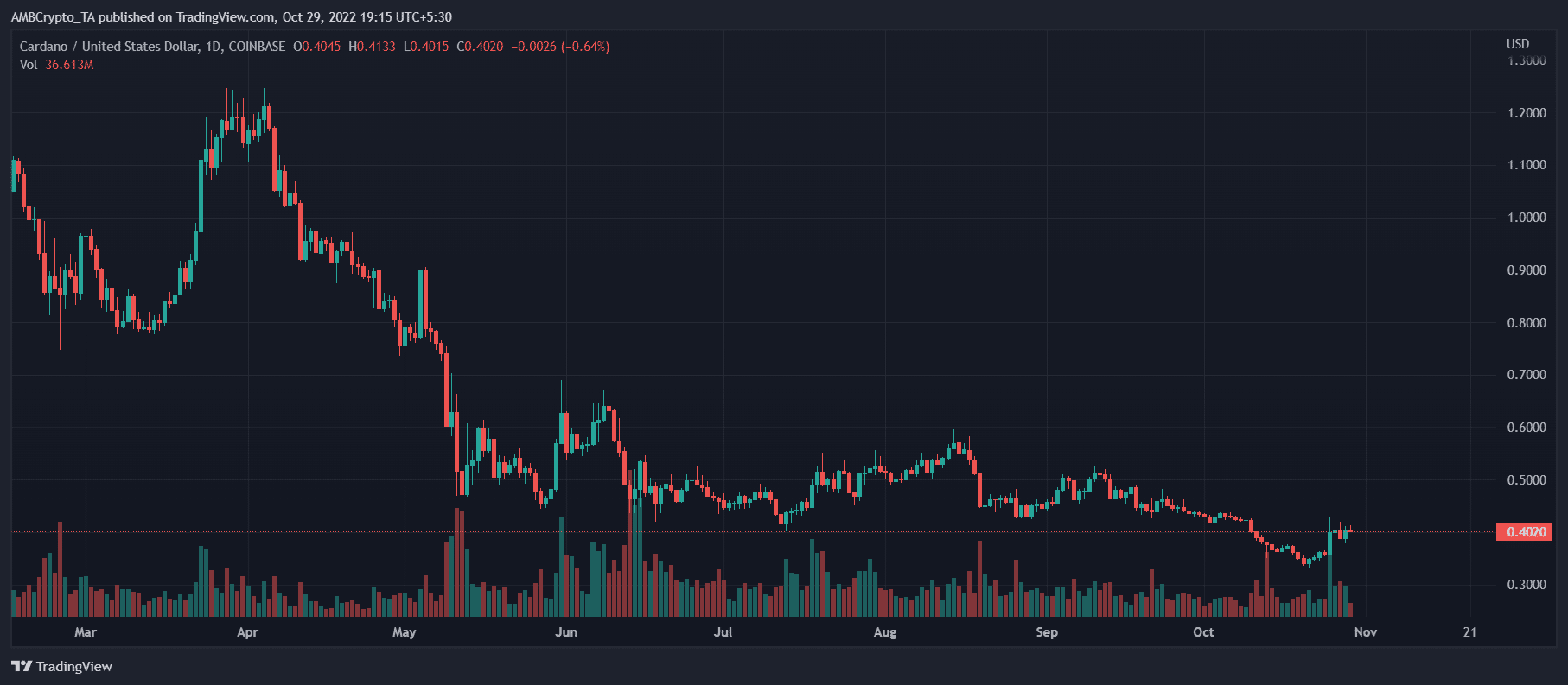
At press time, Cardano was trading at $0.40. Its market capitalization was  $13 billion and the price decreased by more than 2.73% on the 24-hour chart. In fact, it increased by 14.84% over the last 7 days.

The overall number of ADA wallets was estimated to be 3,577,849 on 28 September, according to Cardano Blockchain Insights. Cardano was also able to add over 500,000 new holdings in the last six months. Even the upgrade’s delay was unable to convince ADA fans to change their minds.

Source: TradingView

On the DeFi front, Cardano’s TVL on DeFiLama depreciated. The total amount locked was $56.52 million, at the time of writing. The same was down by over 7% in 24 hours.

The growth rate of FluidTokens, a DeFi lending platform that enables users to lend or borrow using CNFTs as collateral, was 54,000% over the previous month. However, the network did experience a considerable decline from its all-time high TVL of $326 million on 24 March.

By the end of the year, according to PLAYN creator Matt Lobel, ADA is likely to hike to $1.50. The management team’s quality-first philosophy, he claimed, will enable ADA “continue to develop and not encounter some of the quality challenges that other projects have,” although the rate at which it is expanding may be discouraging.

Martin Froehler, CEO of Morpher, concurs with this statement. He predicts that the value of ADA will reach $1 by the end of 2022 and states simply that “slow and steady wins the race.” The CEO and Xo-founder of Router Protocol, Ramani Ramachandran, is not as convinced about the future applications of ADA and believes the coin will only be worth $0.20 in 2022.

The estimate for September was set by the community at $0.5891. A curious prediction made by the algorithm was that by the end of September, ADA will trade at $1.77.

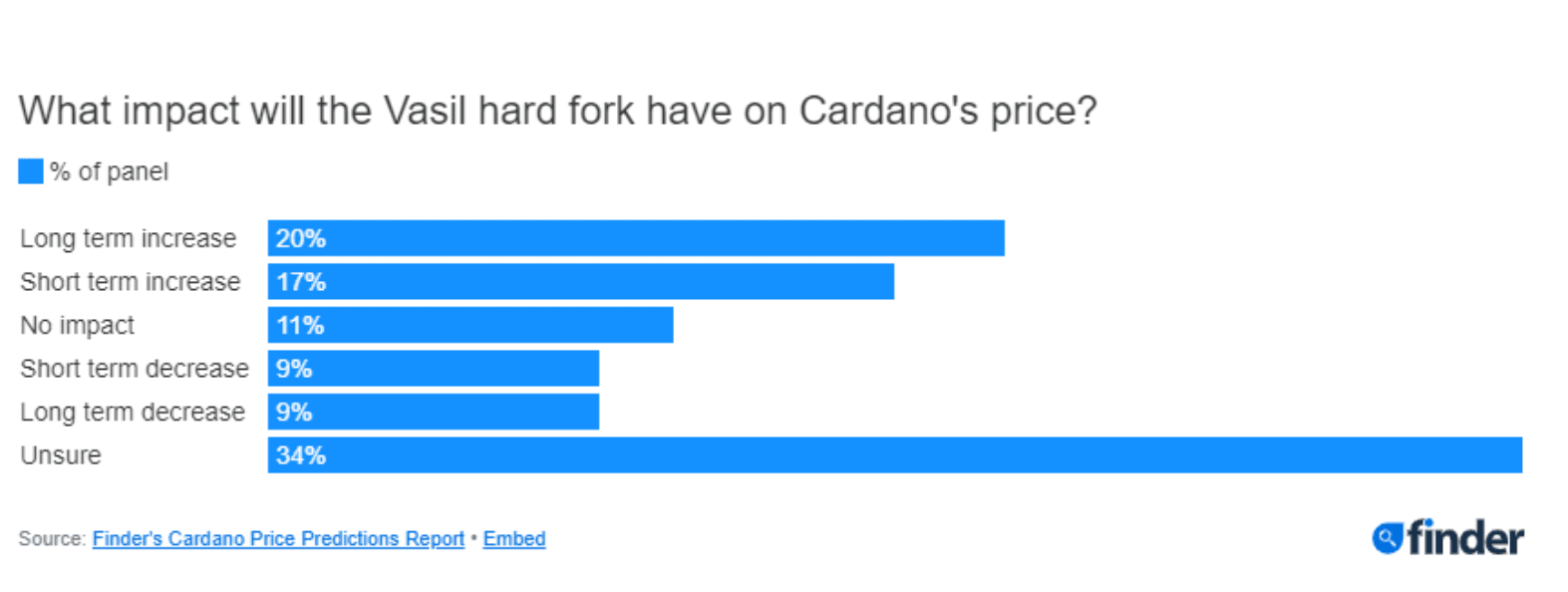
And, if these predictions seem too much to you, then you must know that there are reasons why the sentiments are so bullish. According to the same Finder research stated earlier, one in five (20%) panelists believes that the Cardano hard fork, which aims to further decentralize the network and boost throughput, will have a favorable long-term effect on the altcoin’s price. Another 17% believe it will at least have a favorable effect shortly.

Source: Finder

The real value of the blockchain will increase as it becomes faster and more effective, and ADA’s value should increase along with it. Cardano may once again reach $1, according to the Motley Fool’s analysts, making it a solid investment at the moment.

The most cautious Cardano price forecasts anticipate roughly linear growth for ADA over the next five years. According to the Cardano projection, ADA will conclude 2022 at $2.74.

There’s good reason for the optimism behind Vasil too. In fact, according to developers,

“Vasil is the most significant Cardano update to date, bringing increased network capacity and lower cost transactions.”

Let’s now look at what well-known platforms and analysts have to say about where they believe ADA will be in 2025 and 2030.

Cardano ADA Price Prediction 2025

Now, even though most predictions are positive, some reasons force us to believe otherwise. Even though the much-awaited update of the blockchain is expected to take the price high, what if the update does not reach its promises and becomes a failure?

According to Changelly, the minimum ADA price is predicted to fall to $1.87 in 2025, while its maximum price will be $2.19. The cost of trading will typically be $1.93.

Cardano is forecasted by Finder’s team of fintech experts to soar to $2.93 by 2025.

A cryptocurrency’s price typically reacts favorably to upgrades, as it did when Ethereum’s EIP-1559 was pushed and the asset’s value once again soared beyond the $ 3,000 mark. However, in the instance of Cardano, the asset’s value fell dramatically, by nearly 50% within one month of the launch of Alonzo.

However, even in a down market, Cardano strives to consistently improve its products. Investors should feel confident as a result because the project’s utility keeps growing. This distinguishes Cardano from several other “meme currencies.”

This seems to support a bullish Cardano prediction, which is why many analysts believe that ADA will be valuable in the long run. Building the utility now might serve as a launchpad for when the cryptocurrency markets heat up again, which would cause the price of ADA to soar dramatically that it would even top its all-time high.

And, you have reasons to believe that. Until 2026, the Cardano blockchain project hopes to sign up as many as 50 banks and 10 Fortune 500 businesses, according to Frederik Gregaard, CEO of the Cardano Foundation.

Gregaard also discussed how he hopes to make it possible for banking institutions to use Cardano’s utility token in a formal presentation.

Cardano ADA Price Prediction 2030

Experts frequently advise educating the public about cryptocurrencies before broad adoption takes place. And, the recent frenzy has probably done just that for many. As a result, many believe that ADA has a strong possibility of continuing to rise through 2030 and beyond.

It’s not “out of reach” for Cardano to surpass the “double-digit threshold,” according to Josh Enomoto, a former senior business analyst for Sony Electronics who has experience working with Fortune 500 businesses, who wrote about it in Nasdaq.com.

He first presented that argument in May 2021 and even forecast that the ADA price would reach $22 by the end of 2022 and perhaps $100 by the end of 2027. Both up and negative trends in altcoin prices are fairly powerful.

Finder’s panel has considered Cardano’s future, placing it in a good position. It believes ADA will hit $6.53 by 2030.

Furthermore, according to cryptocurrency exchange Kraken, the debut of the Minswap decentralized exchange (DEX) and growth in the SundaeSwap and MuesliSwap DEXs allowed Cardano’s total locked value (TVL) in decentralized finance (DeFi) apps to increase by more than 130% in March this year.

Eight years, though, are not without their ups and downs and rough patches. Inflation, recession, conflict, and the fear of an economic collapse are just a few of the hiccups.

Many in the cryptocurrency community are still optimistic about the chances of Cardano’s acceptance in the future.

In January, Ethereum’s Vitalik Buterin asked the community on Twitter which crypto, outside of ETH, they would prefer to see dominate transactions in 2035. ADA received 42% of the more than 600,000 votes, while Bitcoin received 38.4%.


Of course, investing in cryptocurrencies is risky because of their tremendous volatility. However, investing in Cardano may allow you to “set it and forget it” and watch your money increase, at least through 2030.

Conclusion

After a significant decline in 2022, analysts predict that ADA might eventually provide value and a strong return on investment. The volatility of cryptocurrencies, though, makes everything possible. Never put more money at risk than you can afford.

Remember, that within three months of its release, ADA surged to over $1 during the 2017 crypto bull run, which saw retail investor FOMO (fear of missing out) drive the price of Bitcoin to $20,000. The entire advance was subsequently totally retraced down to $0.02 during the 2018 bear market.

The amount of purchasers on the one-day chart has increased as a result of the altcoin’s demand showing significant appreciation.

To reduce the likelihood of price volatility, the Cardano price must continue to rise. However, it is emphasized that there is always a potential for a price decline following a surge.

The price of Cardano is currently 87% lower than the record high it reached in September 2021. For the altcoin, a rise above its immediate resistance point will open a clean route.

Fundamental analysis (FA), such as a growth in network addresses and TVL, which indicate the growing mainstream adoption of a crypto-project, should be of greater concern to long-term investors.

In addition, MuesliSwap, the first Cardano-based decentralized exchange, announced the successful integration of Plutus V2, making it more effective and less expensive to operate. Another upgrade to Cardano is expected to be issued shortly, according to a cryptic tweet earlier this week from the project’s founder Charles Hoskinson.

Moreover, network activity increased to 97,959 as a result of the rush to purchase Cardano NFTs, a 75% month-over-month rise. Despite the fact that interest in the project has decreased by about 90% from its peak in 2021, the founder, Charles Hoskinson, has portrayed an unconcerned picture. By the time dApps created on the blockchain create their own value, he said, “2023, 2024,” billions in venture money will enter the economy.

As crypto markets flourish, Cardano will follow. With an $18 billion market valuation, it will be very responsive to changes in price. The crypto market will probably expand as the world transitions to a decentralized future, which is good news for Cardano in the long run.


Source: https://ambcrypto.com/cardano-ada-price-prediction-5/

Anndy Lian is an early blockchain adopter and experienced serial entrepreneur who is known for his work in the government sector. He is a best selling book author- “NFT: From Zero to Hero” and “Blockchain Revolution 2030”.

Currently, he is appointed as the Chief Digital Advisor at Mongolia Productivity Organization, championing national digitization. Prior to his current appointments, he was the Chairman of BigONE Exchange, a global top 30 ranked crypto spot exchange and was also the Advisory Board Member for Hyundai DAC, the blockchain arm of South Korea’s largest car manufacturer Hyundai Motor Group. Lian played a pivotal role as the Blockchain Advisor for Asian Productivity Organisation (APO), an intergovernmental organization committed to improving productivity in the Asia-Pacific region.

An avid supporter of incubating start-ups, Anndy has also been a private investor for the past eight years. With a growth investment mindset, Anndy strategically demonstrates this in the companies he chooses to be involved with. He believes that what he is doing through blockchain technology currently will revolutionise and redefine traditional businesses. He also believes that the blockchain industry has to be “redecentralised”.
j j j

Are NFT Regulated? What Are The Concerns?

Are NFT Regulated? What Are The Concerns?

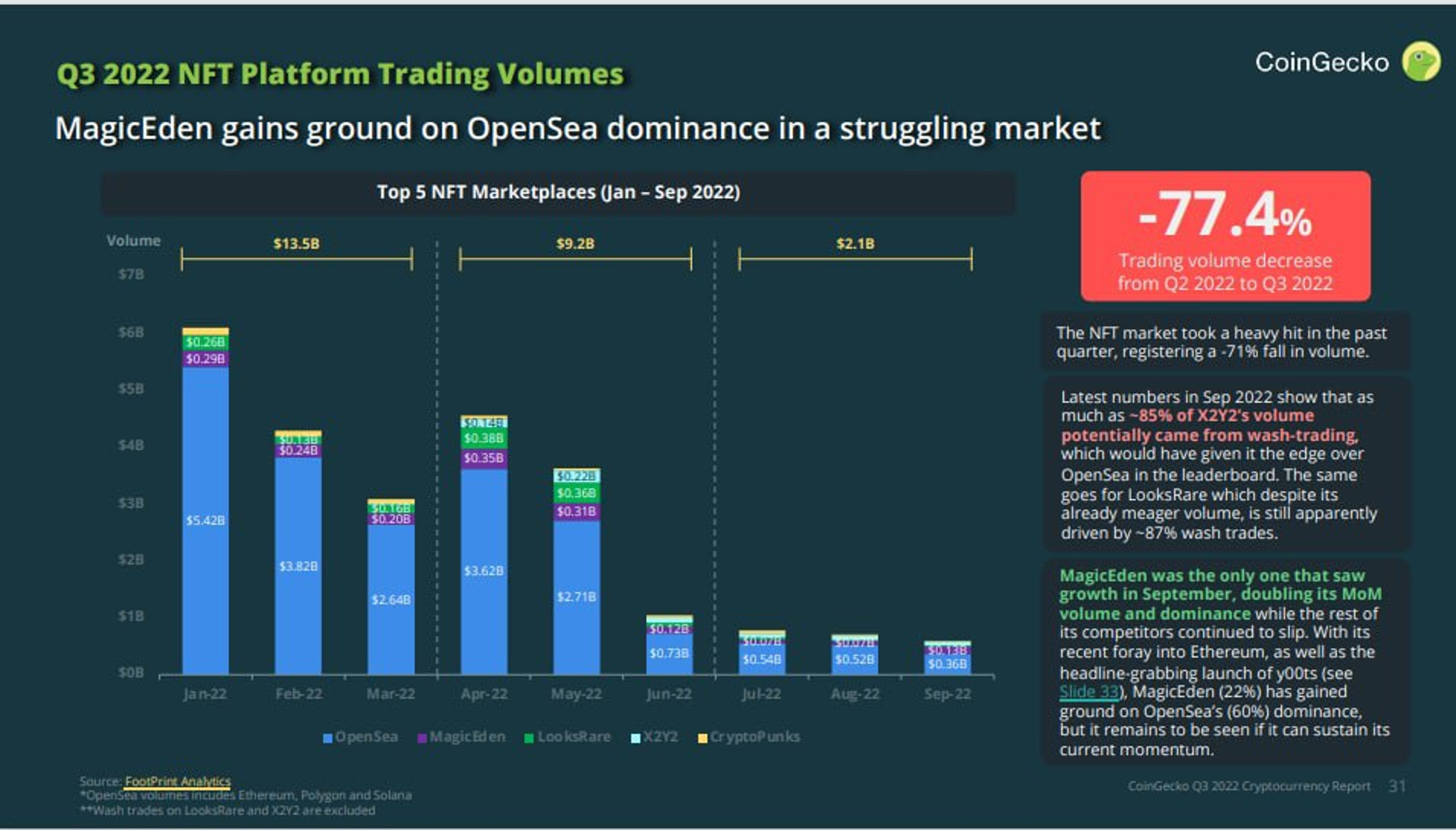
The hype around NFT has slowed down. It seemed like NFT was slated for explosive growth in 2022, being named “word of the year” and coming off a record-high volume in January this year. But as it turns out, that was the peak. Looking at Q3 2022 NFT trading volume around the top 8 chains. There is a 76.4% trading volume decrease from Q2 2022 to Q3 2022.

Since then, the trading volume has tumbled 83% from the start of the year, according to Footprint Analytics’s data on CoinGeco. Recent months have logged numbers lower than July 2021, right before NFT summer. Most notably, Ronin and Avalanche have fallen out of the Top 8, replaced by ImmutableX and Panini. Recent sports mania has spilt over to the NFT space, propelling Flow into the Top 3. Solana’s NFT ecosystem doubled its September volume while all its competitors faltered.

During this period of time, where the market is bearish, you will see changes. For example, in Q3 Magic Eden gains grounds on OpenSea dominance. Magic Eden was the only one that saw growth in September, doublings its month-on-month volume and dominance, while the rest of its competitors continued to slip further. Magic Eden (22%) has gained ground on OpenSea’s (60%) dominance, but it remains to be seen if it can sustain its current momentum.

Another factor in sustaining the current momentum is aligning with the regulatory norms. There is still disagreement over how to handle NFTs, which makes it difficult to set clear regulatory norms. NFTs can now be seen in one of three ways: as commodities, securities, or intellectual property. Let’s explore each interpretation in more detail.

Commodities

Commodities are defined by US law as reasonably interchangeable services, goods, and rights, including money and interest rates, that are traded as commercial articles. The Commodity Futures Trading Commission (CFTC) asserts that cryptocurrencies like Bitcoin and Ethereum, as well as renewable energy credits and other intangible assets, are included in the definition of commodity.

If we take NFTs, they resemble cryptocurrencies in several ways. They may be bought and sold and are based on blockchain technology. In addition, the CFTC emphasises price manipulation and commodities exchanges more than it does on underlying assets and issuers. The Commodity Exchange Act (CEA) may be implemented if it is decided that NFTs should be classified as commodities. The CEA’s rules on manipulative trading may be applicable in this situation.

Securities

Most NFTs with a single owner and only one unique asset are unlikely to be securities. However, under certain situations, they might. If an NFT possesses security-like characteristics or otherwise satisfies the Howey test, such as when money or another kind of compensation is invested with a reasonable expectation that gains will result from others’ efforts, then the NFT may be subject to US securities legislation. A case-by-case Howey analysis is essential to ascertain if a specific NFT is a security. NFTs may, however, violate securities laws in the following situations, depending on the specifics:

  • NFTs are pre-sales of digital assets intended to be used on a platform that has not yet been developed, with the sale’s proceeds going toward developing the platform;
  • Digital assets can be “pooled” or “fractionalised” (for instance, in the case of art, when creators pool resources and divide profits, or where several NFTs reflect different investors’ fractional ownership of a single asset);
  • NFTs are a license to a digital asset (like a song) and a portion of its earnings (e.g., a percentage of sales).

Intellectual Property

NFTs might be covered by intellectual property rights such as copyright, design patents, and trademark protections. As a result, buyers of NFTs should be aware of any associated intellectual property rights. In fact, the license that comes with many or even most NFTs merely allows the NFT buyer to use, copy, and display the NFT.

A clip of renowned basketball star LeBron James’ slam dunk is an excellent illustration. The video was made available as a limited-edition NBA highlight video collector. The NBA collectables are available for purchase and sale on the Top Shot NFTs market. The NBA owns the copyright, nevertheless, and the rules of its licensing agreement continue to apply to any purchased item’s replication.

However, while most NFT producers place limitations on commercial use, other authors grant NFT owners broader rights. Members of the Bored Ape Yacht Club (BAYC) have the right to use their “apes” for commercial purposes, which allows them to produce and market hats, T-shirts, mugs, and other items.

Brand owners should consider how current or upcoming design patents can protect against imitations or infringement in addition to trademark and copyright protection. Because they grant owners full ownership of an infringer’s profits rather than just the fraction related to the use of the design, design patents are important intellectual property protections compared to other IP rights.

Fraud Schemes

Despite being a relatively new idea, NFTs are already being utilised to commit numerous forms of fraud. Here, we go over some of the most prominent NFT-related fraud schemes that have occurred:

  • Tokenisation– The process of producing digital tokens that reflect ownership of physical assets is known as tokenisation. This happens when someone steals an artist’s creation without their consent and “mints” it to create an NFT.
  • Wash trading– This is the practice of users manipulating transactions by trading with themselves or others to feign large demand for an NFT, manipulate its price, or enhance its visibility.
  • Insider trading– The practice of using information that is not generally known to benefit personally from it. In recent high-profile situations, employees and executives of NFT companies and markets have engaged in behaviour that may be viewed as unfair or illegal. Various events generate negative press for these organisations. NFT insider trading regulations frequently forbid buying NFTs based on secret information. Similarly, multiple forms of trading in business NFTs that aim to inappropriately manipulate the perceived price or trading volume of such NFTs are prohibited.
  • Anti-Money Laundering– NFTs, especially those with large value, may occasionally be utilised to aid in money laundering. A study on how the art market aids in the financing of terrorism and money laundering was released by the US Department of Treasury. The study covered a variety of topics, including the dangers of financial crimes in relation to digital art and NFTs. The study discovered that the high-value art market has several intrinsic characteristics that could make it susceptible to various financial crimes.

To Conclude

As we can see, the market for NFTs is still growing, and it will take some time until an appropriate regulatory framework for NFTs is put in place. Having said that, governments all over the world have already begun the process of developing NFT norms and standards, proving that they are seriously interested in these digital assets.

Additionally, you should be aware that the phenomenal success of NFTs will undoubtedly result in fraudulent activities. For this reason, it is becoming more and more crucial to conduct your research before purchasing or investing in NFT collections or projects.


Source: https://www.msn.com/en-us/money/markets/are-non-fungible-tokens-nft-regulated-what-are-the-concerns/ar-AA13ijBk

Anndy Lian is an early blockchain adopter and experienced serial entrepreneur who is known for his work in the government sector. He is a best selling book author- “NFT: From Zero to Hero” and “Blockchain Revolution 2030”.

Currently, he is appointed as the Chief Digital Advisor at Mongolia Productivity Organization, championing national digitization. Prior to his current appointments, he was the Chairman of BigONE Exchange, a global top 30 ranked crypto spot exchange and was also the Advisory Board Member for Hyundai DAC, the blockchain arm of South Korea’s largest car manufacturer Hyundai Motor Group. Lian played a pivotal role as the Blockchain Advisor for Asian Productivity Organisation (APO), an intergovernmental organization committed to improving productivity in the Asia-Pacific region.

An avid supporter of incubating start-ups, Anndy has also been a private investor for the past eight years. With a growth investment mindset, Anndy strategically demonstrates this in the companies he chooses to be involved with. He believes that what he is doing through blockchain technology currently will revolutionise and redefine traditional businesses. He also believes that the blockchain industry has to be “redecentralised”.

j j j