What’s the solution to Terra’s UST and LUNA crisis?

What’s the solution to Terra’s UST and LUNA crisis?

Terra’s LUNA and UST stablecoin implosions are roiling the crypto world and beyond. Picking up the pieces won’t be easy — nor finding a good path forward.

The “road to hell is paved with good intentions,” but that’s no comfort to the many people who have lost all their money as a result of the estimated US$50 billion Terra UST/Luna crash, a crash that took place in just three short days. A decentralized stablecoin designed as the ultimate payments system “combining the price stability and wide adoption of fiat currencies with the censorship-resistance of Bitcoin”  that didn’t require any financial collateral seemed fine in principle, but when it stopped working, human collateral damage was the end result, both in terms of loss of savings and devastation of lives.

The repercussions are just starting to be felt, from talk of government regulation from U.S. Treasury Secretary Janet Yellen, to Tether temporarily losing its 1:1 peg to the dollar to as low as US$0.95, and the impact on the price of Bitcoin thanks to Terra selling off its collateral reserves in a vain attempt to shore up the value of its UST stablecoin.

To confirm the basic point driving one of the biggest collapses in crypto’s short history, last Thursday Terra’s pegged Luna token dropped in price from its high in April of US$118 to US$0.09, while TerraUSD (UST) hit US$0.04. And despite all that, plenty of self-styled #LUNAtics — the project’s fans, including developers and Terra itself — refused to admit the party was over. In a Twitter thread on Wednesday, May 11, the ever-confident Terra co-founder Do Kwon tried to sound reassuring, telling the Terra community: “I understand the last 72 hours have been extremely tough on all of you — know that I am resolved to work with every one of you to weather this crisis, and we will build our way out of this. Together.” That didn’t work.

“You can’t mint your way out of bankruptcy all the time,” tweeted Binance CEO Changpeng Zhao, also known as CZ, after Terra announced that their blockchain had resumed block production as if there’d just been a technical hitch.

Taking a step back from this mess, what caused the collapse of the UST/Luna system? And what happened to the US$3.5 billion Bitcoin that Terra had bought to steady the ship? Rumors that either the hedge fund Citadel, the asset manager BlackRock or crypto exchange Gemini created the crash have been rejected by the companies, and persuasively shot down by B2C2 founder Max Boonen.

Any discussion of the cause of the crash cannot ignore that as an algorithmic stablecoin not pegged to any collateral, it used a two-token system, allowing users to swap Luna to Terra’s UST and vice versa for a guaranteed price of US$1, with the difference that it was based on its own layer-1 blockchain. And Terra’s UST was itself propelled by a key dApp on that blockchain called Anchor, which was offering yields of 20%. Anchor’s total value locked (TVL) grew from US$8.65 billion on Jan. 1 to US$17.05 billion at its peak on May 6. And as UST began to show signs of strain in late March, a team in the form of the Luna Foundation Guard (LFG) started to buy Bitcoin, amounting in total to US$3.5 billion between January and May this year.

It should also be noted that as an algorithmic stablecoin, UST is not a decentralized stablecoin. Terra used a consensus mechanism called “delegated proof of stake” (DPoS) that meant control was in fact concentrated in the hands of “a few validators” — no doubt the same hands that controlled the Bitcoin collateral. On May 9, LFG announced that it would “Loan $750M worth of BTC to OTC trading firms to help protect the UST peg,” which, according to Elliptic, was followed by a further US$930 million, to the same address, and the 52,189 BTC was sent together to a Gemini address. CZ tweeted on Sunday May 15, “I would like to see more transparency from them. Much more! Including specific on-chain transactions (txids) of all the funds. Relying on 3rd party analysis is not sufficient or accurate. This is the first thing that should have happened.” This was eventually confirmed by the LFG on May 16 in a tweet: “Transferred 52,189 $BTC to trade with a counterparty, net of an excess of 5,313 $BTC that they have returned, for an aggregate 1,515,689,462 $UST.” With just 313 BTC remaining (approximately $9 million, plus other assets) as highlighted by Laura Shin on May 16.

For the sake of transparency and for the crypto community as whole, not just for UST/Luna users who have lost so much, Do Kwon needs to come clean about a few things. He needs to own up to his troubles with the U.S. Securities and Exchange Commission and his involvement in Basis Cash, a previous failed stablecoin project. He needs to give a frank disclosure as to what has happened with the US$3.5 billion Bitcoin collateral, to show where it is now. He needs to talk in terms of these specifics and not provide warm words and simply talk of re-launching Terra in some form or another. If he cannot learn from his past mistakes then he’s doomed to repeat them in some form or another, and the rest of the industry will suffer the consequences.

Certainly, in the interim, we should welcome the positive attitude of SEC Commissioner Hester Peirce, who recognizes that the market does need room to allow for trial and error, but also adds that due to the variation in types of stablecoins, it’s also “difficult to craft a regulatory framework.” I’m less optimistic about Terra’s plans to resurrect the platform by forking, as CZ tweeted “forking does not give the new fork any value. That’s wishful thinking.”

In the latest twist on May 16, CZ confirmed Binance had received 15,000,000 LUNA (at a peak worth US$1.6 billion) plus had US$12,000,000 in UST from staking. “To lead by example on PROTECTING USERS, Binance will let this go and ask the Terra project team to compensate the retails users first.”

For the sake of both Terra users and the wider crypto community, things need to be sorted out as soon as possible. Practically speaking, the devil is in the detail, and that’s what we need to grapple with now, for the sake of everyone involved.

Original Source: https://forkast.news/whats-best-solution-terras-ust-luna-crisis/

Anndy Lian is an early blockchain adopter and experienced serial entrepreneur who is known for his work in the government sector. He is a best selling book author- “NFT: From Zero to Hero” and “Blockchain Revolution 2030”.

Currently, he is appointed as the Chief Digital Advisor at Mongolia Productivity Organization, championing national digitization. Prior to his current appointments, he was the Chairman of BigONE Exchange, a global top 30 ranked crypto spot exchange and was also the Advisory Board Member for Hyundai DAC, the blockchain arm of South Korea’s largest car manufacturer Hyundai Motor Group. Lian played a pivotal role as the Blockchain Advisor for Asian Productivity Organisation (APO), an intergovernmental organization committed to improving productivity in the Asia-Pacific region.

An avid supporter of incubating start-ups, Anndy has also been a private investor for the past eight years. With a growth investment mindset, Anndy strategically demonstrates this in the companies he chooses to be involved with. He believes that what he is doing through blockchain technology currently will revolutionise and redefine traditional businesses. He also believes that the blockchain industry has to be “redecentralised”.

j j j

What Are The Best Metaverse Tokens To Invest In?

What Are The Best Metaverse Tokens To Invest In?

With Facebook changing its name to Meta and top investor Cathie Wood CEO of Ask Invest predicting that the future market value of metaverse would be in trillions of dollars, is it worth ‘getting in on the ground floor’ and investing in metaverse tokens? It’s worth having an investor approach, of course, not just being swept along by these headline announcements, but in such an innovative technology how do you decide what’s worth investing in? We’ve therefore compiled a watchlist of metaverse tokens that we believe will play a significant role in realizing the metaverse’s potential to become a trillion-dollar industry.

But just as importantly we’ve set our stall out by asking investors to consider metaverse tokens in terms of the wider thesis about what adds value from a web3 perspective. Apart from having a clear purpose or problem they are trying to solve, not just a white paper and a cute explainer video, they need to have a strong community foundation. Of course, every crypto startup talks the talk when it comes to community. But having a Discord server busy with airdrops and users waiting for the next price pump isn’t going to make it in the longer term. What is worth looking for when assessing which metaverse project to invest in is the degree to which they are actually community-owned, and how well they share the revenue and the control with their users.


Zilliqa (ZIL)

Flying somewhat under the radar has been Layer 1 blockchain Zilliqa, notable as the first Layer 1 to use sharding to solve the blockchain scaling problem that Ethereum has faced. What’s interesting is that with a recent change in leadership, and a new CEO with Ben Livshits who comes from the Brave browser, Zilliqa has already announced that is launching its own metaverse, ‘Metapolis’.

The obvious challenge for Metapolis will be its competitors Decentraland and Sandbox that currently have captured the majority of the blockchain metaverse users. Despite the current depressed value of the ZIL in 2022, the plans for a landmark event at the start of April, built around Zilliqa’s “position as the first layer-1 to build multiple commercial avenues of Web3” look exciting. The Q2 landmark event, which is built around Zilliqa’s “position as the first layer-1 to build multiple commercial avenues of Web3” is also a great opportunity for the Zilliqa team to organize PR and messaging – getting the consistency in messaging and confidence in its delivery should be a significant driver in the value of the ZIL token. The price of the token has been on a downward decline from a price on CMC of $0.2376 in mid-April 2021 to $0.0456 on 22 March 2022. But by the same token, this could be an ideal time to buy the dip in light of the Metapolis launch, the succession of new hires being announced, and the publicity surrounding the event itself.

It’s instructive that Ethereum’s co-founder Joseph Lubin recently criticized Zilliqa rival Solana for over-generous rewards to users validating transactions on the network. Solana Labs responded that “simply looking at protocol revenue doesn’t tell the full story of the long-term performance” of a blockchain’s economic model. That also begs the question as to whether in the longer term Zilliqa sufficiently incentivizes its mining community. After all the key to web3 isn’t merely community-engaged, but community ‘ownership’ in terms of the token structure and for governance.


Axie Infinity (AXS)

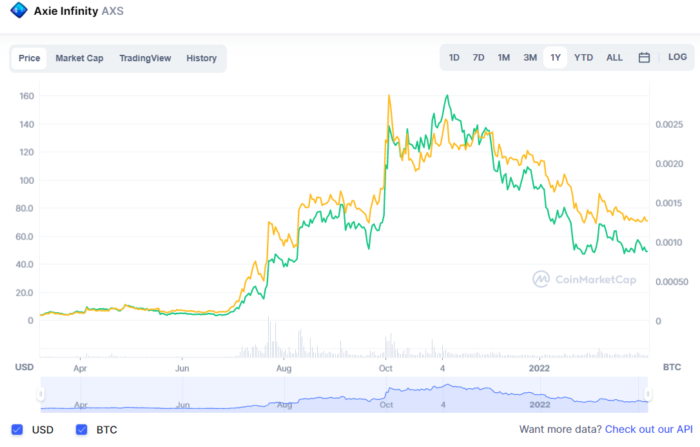
The growth of play-to-earn gaming, led by Axie Infinity, where engagement with a younger generation of gamers in countries like the Philippines shows how this can make a real financial difference to people’s lives. This is also why the role of DeFi in the metaverse, can be so important in providing people with a low-cost way to earn, save and send money from person to person. Back in October last year it hit a $3 billion equity valuation. Token Terminal estimates AXS is driving about $28.9 million in weekly revenue. Annualized, this equates to $1.5 billion in revenue, which is comparable to blockbuster games in the traditional gaming sector. Last month, Axie reduced production of its main in-game rewards to avoid what its blog post describes as “total and permanent economic collapse.” These changes should make a positive difference. However, as the chart from CoinMarketCap shows, the value appears to correlate heavily to the price of Bitcoin.

Tracking the price of AXS vs BTC (AXS: see green trend line; BTC orange trend line)


Decentraland (MANA)

Decentraland is an Ethereum-based blockchain-powered virtual-reality pioneer. Decentraland has the largest market capitalization in the metaverse space, and as one of the early adopters, the company is well-positioned to maintain its dominance in this space. Decentraland is divided into LAND parcels that are NFTs, and LAND ownership gives users complete control over what they build. In total there are 90,601 land parcels, and the LAND NFTs can be purchased using Decentraland’s native token MANA.

Users in Decentraland can use MANA tokens to buy and develop land, as well as some of the game’s tools to create spaces and works of art. Users are free to create whatever they want. Decentraland also holds various entertainment activities regularly, with users able to attend parties, play games, and visit digital art exhibitions. Decentraland recently hosted the world’s first multi-day music festival, with many well-known artists performing. Adding to the utility, as reported by Motley Fool, this month it will host Metaverse Fashion Week from March 24–27, featuring global brands, including Tommy Hilfiger, and Dolce & Gabbana.


The Sandbox (SAND)

Sandbox is similar to Decentraland in that users can use SAND tokens to purchase land, build houses, and share games on the purchased land. Sandbox has announced several collaborations in recent months, including top NFT marketplace OpenSea, Snoop Dogg, and The Walking Dead. At the same time, it recently completed a US$93 million round of financing led by Softbank, a leading investor in the blockchain space. There are three billion SAND tokens, and a third of its total supply is circulating at $3.06. Compared to MANA, SAND has been hit harder by the market downturn, with a drop in the last month alone from $4.20 in early Feb to $2.90 on March 7, a 30% decrease. However, recent price aside the fundamentals suggests SAND is a good bet for the future, based on a successful implementation of their project roadmap to date.

Coming back to the guiding thesis about the importance of community ownership for the longer-term viability of metaverse tokens one of the key benefits of Sandbox is that it’s decentralized both in name and in terms of its community governance. Indeed, the play-to-earn approach type revenue is shared throughout the gaming ecosystem via tokens, while Sandbox users can earn a passive income by charging other users to access their land. With both rewards and fees paid in SAND underline how this core web3 approach to community ownership supports the value of the SAND token to investors.


Somnium Space (CUBE)

Somnium Space is another metaverse ecosystem BigONE believes is worth investigating. Somnium space’s goal is to create an immersive metaverse. Users can buy lands, customize their avatars, and invest in real estate in Somnium, which was founded in 2017. Gemini supports the Somnium space, and the FTX exchange recently built a metaverse headquarters on the Somnium space.

In the last month, its native token $CUBE’s price movement has been very similar to SAND’s. The market capitalization of CUBE is $59 million, with 12.5 million circulating supply out of a total supply of 100 million. Somnium Space is ideal for users to build their real estate using their builder tools and create custom avatars using the Unity SDK. In addition, in 2019 they partnered with Sony to allow users to create full embodiment avatars of themselves in minutes alongside any 3D models for Somnium Store. Sony’s VR store in Somnium Space was among the world’s first.


Investing in the future of the metaverse

By providing more incentives and giving back to users, the metaverse will constantly flip the script and change how things will be done. BigONE anticipates a more transparent, open, and fully decentralized experience from the vibrant creative landscapes and avatars. The landscape itself will be visually stunning, a virtual place where the imagination is no longer constrained. Clearly, the development of a fully functional metaverse has the potential to fundamentally alter how people interact with the digital world. A collective virtual experience would reimagine the creative industry and open new doors for creators, gamers, and artists. BigONE Chairman Anndy Lian said: “The metaverse is here to stay, it’s clear the success already of Sandbox and Decentraland shows it has tremendous potential to bring people together. That potential in terms of GameFi we can see with Axie Infinity’s play-to-earn gaming which is making a real difference to people’s lives. However, there remain obstacles to its growth. Countries like China and South Korea have had laws about converting in-game tokens into fiat currency for nearly 15 years, for instance.

“However, I believe like any disruptive paradigm-shifting technology, which is attracting the attention of global players such as Facebook and governments keen to keep control of the internet, there are risks involved. But I’m optimistic that the decentralized community-owned development of an interoperable metaverse will deliver lasting value to both users and investors,” Lian added.


Any references to projects in this article are purely for information and should not be deemed financial advice, or promotional.


Original Source: https://metaverseinsider.tech/2022/04/25/what-are-the-best-metaverse-tokens-to-invest-in/

Anndy Lian is an early blockchain adopter and experienced serial entrepreneur who is known for his work in the government sector. He is a best selling book author- “NFT: From Zero to Hero” and “Blockchain Revolution 2030”.

Currently, he is appointed as the Chief Digital Advisor at Mongolia Productivity Organization, championing national digitization. Prior to his current appointments, he was the Chairman of BigONE Exchange, a global top 30 ranked crypto spot exchange and was also the Advisory Board Member for Hyundai DAC, the blockchain arm of South Korea’s largest car manufacturer Hyundai Motor Group. Lian played a pivotal role as the Blockchain Advisor for Asian Productivity Organisation (APO), an intergovernmental organization committed to improving productivity in the Asia-Pacific region.

An avid supporter of incubating start-ups, Anndy has also been a private investor for the past eight years. With a growth investment mindset, Anndy strategically demonstrates this in the companies he chooses to be involved with. He believes that what he is doing through blockchain technology currently will revolutionise and redefine traditional businesses. He also believes that the blockchain industry has to be “redecentralised”.

j j j

Sandbox (SAND) coin price prediction: What’s next for the token?

Sandbox (SAND) coin price prediction: What’s next for the token?

SAND, the coin of blockchain-based play-to-earn metaverse Sandbox, has a had a good week rising 15% to reach $2.93 today (21 April).

However this comes after a disappointing first half to the month when it was at $3.79 but slid down as low as $2.6.

The latest boost comes after reports that majority owner, the blockchain gaming developer Animoca Brands, was trying to raise $400m from new and existing investors. Last November it raised $93 million in a round led by SoftBank Vision Fund 2.

What is the outlook for the coin? What is a realistic future price target? What factors could shape any Sandbox coin price prediction for 2022, 2025 and 2030?

In this article we look at the latest analyst Sandbox price predictions, news and analysis to help you decide if you shoud make SAND part of your portfolio.

What is a Sandbox coin?

Sandbox is a play-to-earn game that combines blockchain technology and non-fungible tokens (NFTs) in a three-dimensional (3D) metaverse. It focuses on user-generated content which helps further develop the platform.

The game was initially known as two separate mobile hits: The Sandbox, which was launched in 2011, and The Sandbox Evolution, which was launched in 2016. Together, the two games generated around 40 million downloads across the Android and iOS platforms.

In 2018, the games’ developer, Pixowl, was acquired by Hong Kong-based game software company Animoca Brands which integrated the popular games into the blockchain ecosystem.

Sandbox is hosted on the Ethereum network and is powered by SAND, an ERC-20-based token.

Inspired by major game-creation systems such as Minecraft and Roblox, Sandbox allows players not just to create their own worlds and games, but also to have true ownership of their creations as NFTs. In exchange for participating and playing, players earn SAND tokens.

According to the metaverse’s whitepaper, the current game market limits creator rights and ownership, an issue which Sandbox aims to overcome “while accelerating blockchain adoption to grow the blockchain gaming market”.

The game itself is split into three parts:

  • VoxEdit, where players can create and animate 3D objects such as people, animals, tools and foliage. These are then exported into The Sandbox marketplace, where they become game ASSETS and are sold as NFTs.
  • The Sandbox marketplace where users can upload, publish and sell their ASSETS as ERC-721 and ERC-1155 tokens. The Marketplace launched on 30 March 2021.
  • GAMEMAKER, where players who own ASSETS can use them to play the game itself. Players can place their ASSETS within a piece of LAND (an ERC-721 token) that they own within the Sandbox metaverse. This LAND can be decorated with a number of ASSETS which can be given predefined behaviours through visual scripting nodes. Thus, players are able to turn their LAND into a potential full game experience. Several LANDS can be combined by players to form an ESTATE.

The SAND token fuels the platform and can be earned by selling ASSETS, by owning LAND which can be rented or populated with content to increase its value, and/or by building and monetising games through the GAME MAKER function on the LANDS that are owned by players.

The token also:

  • Gives players access to the platform. Players use SAND tokens to play games, make in-game purchases and customise their avatars. SAND is also charged to upload ASSETS on the marketplace and purchase Gems that define an ASSET’s rarity and scarcity.
  • SAND holders are granted governance and can exercise voting rights on key features within the project’s roadmap.
  • Players can stake their SAND tokens in order to earn more. This is also the only way that players can earn the Gems and Catalysts that are needed for ASSET creation.

Players get to keep 95% of their SAND revenue.

The total supply of SAND coins stands at three billion, with 1.16 billion in circulation. The token reached over $3.39bn in market capitalisation and is ranked the 41st largest cryptocurrency by CoinMarketCap as of 21 April 2022.

SAND price driven by partnership & investor news

The Sandbox token’s outlook started to look much more positive at the start of February 2021, following Sandbox’s partnership with cryptocurrency price-tracking website CoinMarketCap for the latter to release an NFT collection on the metaverse.

In the following months, the token’s price kept moving sideways before it reached $3.22 on 3 November 2021, after the metaverse announced on 2 November that it had gained $93m from Softbank Vision Fund 2 investors, which would help the platform scale up its growth strategy, operations and player acquisition.

By then, Sandbox already had over 165 partners, including popular US rapper Snoop Dogg, and famous TV series The Walking Dead and the Smurfs. The project had also partnered up with Liberty City Ventures, Galaxy Interactive and Adidas Originals.

On 25 November 2021, the token had reached its all-time high of $8.4 – a 16,387% surge since its launch at $0.051 on 15 August 2020.

On 1 December 2021 Sandbox announced that players could purchase plots next to the one where Snoop Dogg was building his mansion, Snoopverse. This led the SAND token to grow by just 2.% from $6.58 on 1 December to $6.71 the following day.

Following an overall drop in bitcoin and ether prices at the start of December, SAND also fell by 29% to $4.78 by mid-month, despite having secured partnerships with 10 exchanges, as well as a MAUER NFT collection memorialising the Berlin wall.

On 21 December 2021, the metaverse’s partner, Canadian electronic music producer deadmau5, announced the launch of his NFT collection on the Sandbox marketplace which pushed the SAND token’s price up to $6.73 on 26 December, an increase of by 41% from its 14 December low.

Bank of America strategist Haim Israel said on 1 December that the metaverse will make cryptocurrencies even more popular than they already were, thus boosting price targets for many metaverse-based crypto tokens including SAND. On 18 January 2022, investment firm JP Morgan Chase agreed with BoA’s bullish predicament by publishing a report saying that the metaverse industry could possibly reach over $1t in yearly revenues. The firm’s report mentioned Sandbox as one of the “main metaverse platforms”.

However, the token’s value line on the chart started to decline once again, amid a general dip in the crypto market at the start of 2022 due to the possibility of tightening monetary policy and geopolitical tensions.

What’s next for the metaverse?

One silver lining for the SAND token price was Snoop Dogg’s announcement on 27 January 2022 that he would be launching a series of Snoop Dogg metaverse avatars on the platform. The news pushed the token’s price by 61.28% from $2.99 on 22 January to $4.81 on 8 February 2022. The NFTs were minted on 22 February and have the potential to hike the token’s price once again.

In more recent SAND coin news, partnerships with Gucci and Ubisoft  were unable to offset the overall bearish forecast in the markets, with the token reaching $3.11 on 22 February – a 35.4% drop since 8 February.

The platform also partnered with Warner Music Group which will create a music-themed world in the metaverse as the platform plans to launch its first virtual concerts in the third quarter of 2022.

A mobile version of the metaverse is anticipated for some time in the fourth quarter of 2022.

BigOne Exchange chair Anndy Lian told Capita.com that Sandbox heavily relies on Ethereum’s performance, making the token quite volatile.

“Personally, I do like the developments of the project. But I do want to point out some angles for improvement. Firstly, the project relies heavily on Ethereum’s performance. I do think that, given the right situation, they should look at building on another blockchain or even their own chain.

“Secondly, their game needs to be attractive enough to draw in more users while retaining the old ones. I hope to see more game enhancement and token utility that comes along with it.”

Sandbox coin price prediction 2022-2030

Algorithm-based forecasting service WalletInvestor gave a bullish SAND price prediction at the time of writing (21 April), calling it an “awesome long-term investment”.

Based on its analysis of the cryptocurrency’s past performance, the forecasting service’s SAND crypto price prediction was it could trade at $6.4 by April 2023 and reach $21.2 in five years.

DigitalCoinPrice supported the bullish Sandbox crypto price prediction but at a much slower pace, seeing the coin reach $3.77 in 2022 and $5.57 by 2025.

The site’s SAND prediction was that the token was expected to hit $6.53 in 2027 and by 2030, the token’s price could reach $13.34

Please note that Sandbox predictions can be wrong. SAND coin price predictions shouldn’t be used as a substitute for your own research. Always conduct your own due diligence before investing. And never invest or trade money you cannot afford to lose.

Analyst views on SAND

Bitbank crypto market analyst Yuya Hasegawa told Capital.com that upbeat comments on the Sandbox metaverse from financial institutions like Bank of America and JP Morgan, as well as sales of collaborative items with celebrities and popular brands, are attracting investors to the platform.

Hasegawa was interviewed before Russia invaded Ukraine on 24 February 2022.

“However, although SAND and some other metaverse-related tokens have outperformed bitcoin in the last quarter, the current market environment – not limiting to the crypto market – is heavily affected by the situation at the Russia-Ukraine border and investors are being quite defensive,” he noted.

“So, even though SAND has a lot of growth potential in the long run, as the industry itself is still in a sort of ‘experimental’ or ‘developmental’ phase, the financial market as a whole has to wait and see how the situation at the Russia-Ukraine border rolls out.”

Invezz data analyst Dan Ashmore added that the token managed to piggyback off the wider boom in the metaverse caused by Facebook rebranding to Meta in October.

“Further fuel was provided via high-profile partnerships, including Gucci, Warner Music Group and Snoop Dogg (offering shopping experiences, virtual concerts and playable avatars respectively). Particularly exciting going forward is the focus on user-generated content.

“Objects and interactive games can be created and sold on the marketplace. With the internet increasingly focused on content creation (YouTube, TikTok etc), ATH above $8 could be achievable in the next year or two, although that will depend on the wider crypto market,” he concluded.


Original Source: https://capital.com/sandbox-sand-coin-price-prediction

Anndy Lian is an early blockchain adopter and experienced serial entrepreneur who is known for his work in the government sector. He is a best selling book author- “NFT: From Zero to Hero” and “Blockchain Revolution 2030”.

Currently, he is appointed as the Chief Digital Advisor at Mongolia Productivity Organization, championing national digitization. Prior to his current appointments, he was the Chairman of BigONE Exchange, a global top 30 ranked crypto spot exchange and was also the Advisory Board Member for Hyundai DAC, the blockchain arm of South Korea’s largest car manufacturer Hyundai Motor Group. Lian played a pivotal role as the Blockchain Advisor for Asian Productivity Organisation (APO), an intergovernmental organization committed to improving productivity in the Asia-Pacific region.

An avid supporter of incubating start-ups, Anndy has also been a private investor for the past eight years. With a growth investment mindset, Anndy strategically demonstrates this in the companies he chooses to be involved with. He believes that what he is doing through blockchain technology currently will revolutionise and redefine traditional businesses. He also believes that the blockchain industry has to be “redecentralised”.

j j j