Where Can You Find the Best Crypto ETFs?

Where Can You Find the Best Crypto ETFs?

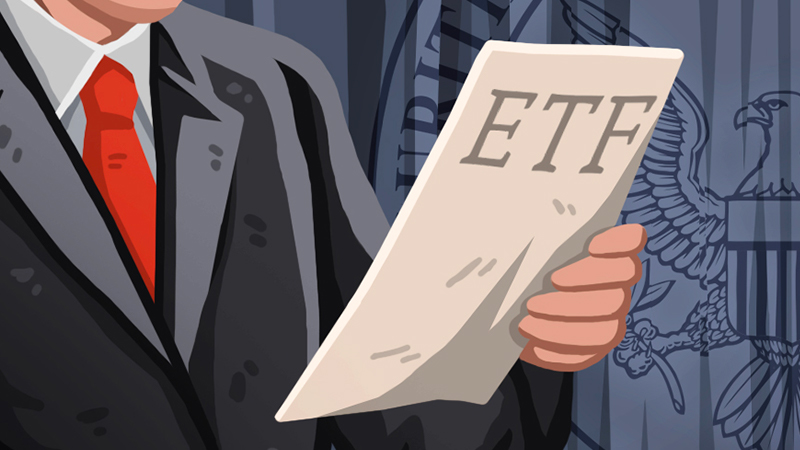
Crypto ETFs captured the attention of the crypto investors late last year when the first Bitcoin ETF in the US, the ProShares Bitcoin Strategy ETF (BITO) was listed on the New York Stock exchange.  It also made crypto investing accessible to the wider investment world, after years of attempts to launch one. The ETF was designed to appeal to investors comfortable with the traditional investment world of stocks and ETFs, but who perhaps didn’t fancy the learning curve of creating their own crypto account and wallet. Nevertheless, the launch was welcomed by many as a radical step forward allowing crypto and NFTs as an alternative investment, to diversify portfolios to withstand future economic changes, as well as widening public understanding of the value of crypto.

ETF, which stands for Exchange Traded Fund, traditionally a mutual fund that is traded on a stock exchange, is typically consists of three components: an index, a stock type, and a fund. In other words, an ETF is essentially a fund that tracks an index while also being bought and sold in the stock market. To put it simply, “An exchange traded fund (ETF) is a basket of securities that trade on an exchange just like a stock does,” according to Investopedia. As a result of their makeup, the key advantage of ETFs is their ability to diversify risks. For example, if there are 100 different stocks in an ETF then they all cannot drop in price together. As a result, the investment portfolio established by this ETF will not suffer a significant drop either.

As well as ProShare’s BITO, there are several similar products which all have one thing in common, they are in the main issued by traditional financial institutions. The practical implication for interested crypto investors is that their categories are however fairly limited to include BTC, ETH and a few ETH products. Despite these drawbacks the struggle to launch further ETFs has continued, despite a reluctant SEC. At the end of January Fidelity tried to get a Bitcoin ETF passed (the so-called “Wise Origin Bitcoin Trust”) only to see it rejected, only to follow up the next day with the Fidelity Crypto Industry and Digital Payments ETF and the Fidelity Metaverse ETF. A key difference that inspired the SEC ban was that the Fidelity Bitcoin ETF was designed to directly hold the cryptocurrency, unlike other BTC ETFs approved by the SEC which solely deal with Bitcoin futures. In other words, buying the BITO ETF doesn’t mean you own BTC, rather that ProShares invests in Bitcoin futures contracts on the Chicago Mercantile Exchange (CME). As confirmed in a report in Fortune: “Rejecting Fidelity’s proposal is just the latest disappointment for investors that had hoped 2022 could be the year where an ETF directly tied to the price of Bitcoin would make it to market in the U.S.”

Outside the US comes more promising news of crypto-related ETFs with the launch this month in Brazil of the world’s first fund dedicated to DeFi, called the Hashdex DeFi Index (DEFI11). “We are confident that DeFi, through its innovative and disruptive technology, will exponentially grow and play a vital role in the financial sector of the future. By offering the first DeFi ETF in the world, we are providing our global investors with the ability to play a part in the next evolution of the crypto ecosystem,” said Marcelo Sampaio, CEO of Hashdex. According to a FT report the ETF will invest in eight DApps, including Uniswap; lender Aave; Polygon, a service designed to speed up transactions on blockchains which recently raised $450 million in a new venture financing round; and oracle innovator Chainlink. It’s also worth noting that as these DApps have smaller market capitalizations than BTC and ETH the tokens may be even more volatile. Cryptocurrency advisor Michele Zilocchi explained: “ETFs are not cryptocurrencies and so they do not give you the ownership, but they allow you to replicate trends. BITO and Hashdex represent a great innovation and a helping hand to institutional investors that were afraid of actual cryptocurrencies ownership. I think that these ETFs represent the doorway for institutional investors to the crypto-space.”

On the regulatory front the launch highlights a divide between global financial centers that have thus far permitted little innovation in the growing field of digital assets, and relatively more laissez-faire financial hubs. “While Canada, Sweden, Germany, Switzerland, Jersey and Liechtenstein all boast spot cryptocurrency ETPs (exchange-traded products), and Australia and India are poised to join them, US regulators have only approved futures-based versions, while those in the UK, Hong Kong and Singapore have not even permitted these vehicles,” the FT report pointed out. Barrister Brian Sanya Mondoh and The Cake advisor, said that when rejecting ETFs, the SEC applies Section 6(b)(5) of the Exchange Act, which requires, in part, that the rules of a national securities exchange be “designed to prevent fraudulent and manipulative acts and practices [and] to protect investors and the public interest.” However, Mondoh agreed that the lack of uniformity in applying this legal test has resulted in impeding investor choice and stifles innovation. “With an increased appetite for Bitcoin and other cryptocurrencies, investors often bypass the law to access crypto markets. Rather than expose investors to bad actors, ETFs should be allowed to ensure more robust protections for investors and more effective surveillance for market manipulation and other fraudulent activity.”

What hasn’t been reported widely is the comparative success of leveraged ETFs launched by cryptocurrency exchanges themselves including BigONE. What they lack in trading volume enjoyed by traditional financial institutions they more than make up for in the advantages offered to the savvy investor. For starters, users do not need to pay the collateral assets to achieve the effect of leveraged trading on the target asset. The product has no expiration date, no risk of liquidation, but it contains the risk that the net value might close to zero. In addition, the ETF products available on cryptocurrency exchanges cover a far wider range of cryptos categories within the ETFs than traditional financial institutions offer. And because their market cap is lower, compared to the likes of BTC and ETH, the impact of the smaller crypto ETF’s upward price movements results in bigger gains.

A leveraged ETF typically uses financial derivatives and debt to scale up the returns of an underlying index. While a traditional ETF typically tracks the securities in its underlying index on a one-to-one basis, a leveraged ETF may aim for a 2:1 or 3:1 ratio, according to Investopedia. For example, for every 1% increase in BTC, BTC3L (three times long BTC) increases 3%, and BTC3S (three times short BTC) decreases 3%. In other words, compared with spot trading, the same asset leveraged ETF will generate three times the profit. On BigONE Exchange this means if you purchase one asset of BTC3L and achieve three times profitability in a unilateral rise, all of this is also managed by platform fund managers, which crucially means users can easily build their own leveraged investment portfolio without knowing the specific mechanism. Plus, he/she does not need to borrow money or pay for the secured assets to achieve their goal.

Thanks to the unique rebalancing mechanism of BigONE’s leveraged ETF product, when the ETF is profitable, it will automatically increase the position after the adjustment. While in the event of a loss, the position will be automatically reduced after the adjustment to avoid the risk of being liquidated. The mechanism is designed to automatically adjust the position of the contract behind each product, and the number of currency holdings will not change. Which in simple terms means while the ETF price remains stable, the level of profitability is also greater.

“What we are seeing is the maturation of the crypto ETF market with the launch of the Hashdex DeFi Index, the world’s first fund dedicated to DeFi. While the US is lagging with the SEC looking for further regulation before committing to a spot crypto ETF, I see the real innovation coming from crypto exchanges like BigONE,” said BigONE Chairman Anndy Lian. “But clearly following the BITO ETF and news of Australia’s corporate regulator giving the green light to a range of cryptocurrency-related ETFs, which could see Bitcoin and Ethereum-backed investment funds trading on the ASX in the coming months, the potential for the global crypto ETF market is huge,” he added.


Original Source: https://www.timebulletin.com/where-can-you-find-the-best-crypto-etfs/

Anndy Lian is an early blockchain adopter and experienced serial entrepreneur who is known for his work in the government sector. He is a best selling book author- “NFT: From Zero to Hero” and “Blockchain Revolution 2030”.

Currently, he is appointed as the Chief Digital Advisor at Mongolia Productivity Organization, championing national digitization. Prior to his current appointments, he was the Chairman of BigONE Exchange, a global top 30 ranked crypto spot exchange and was also the Advisory Board Member for Hyundai DAC, the blockchain arm of South Korea’s largest car manufacturer Hyundai Motor Group. Lian played a pivotal role as the Blockchain Advisor for Asian Productivity Organisation (APO), an intergovernmental organization committed to improving productivity in the Asia-Pacific region.

An avid supporter of incubating start-ups, Anndy has also been a private investor for the past eight years. With a growth investment mindset, Anndy strategically demonstrates this in the companies he chooses to be involved with. He believes that what he is doing through blockchain technology currently will revolutionise and redefine traditional businesses. He also believes that the blockchain industry has to be “redecentralised”.

j j j

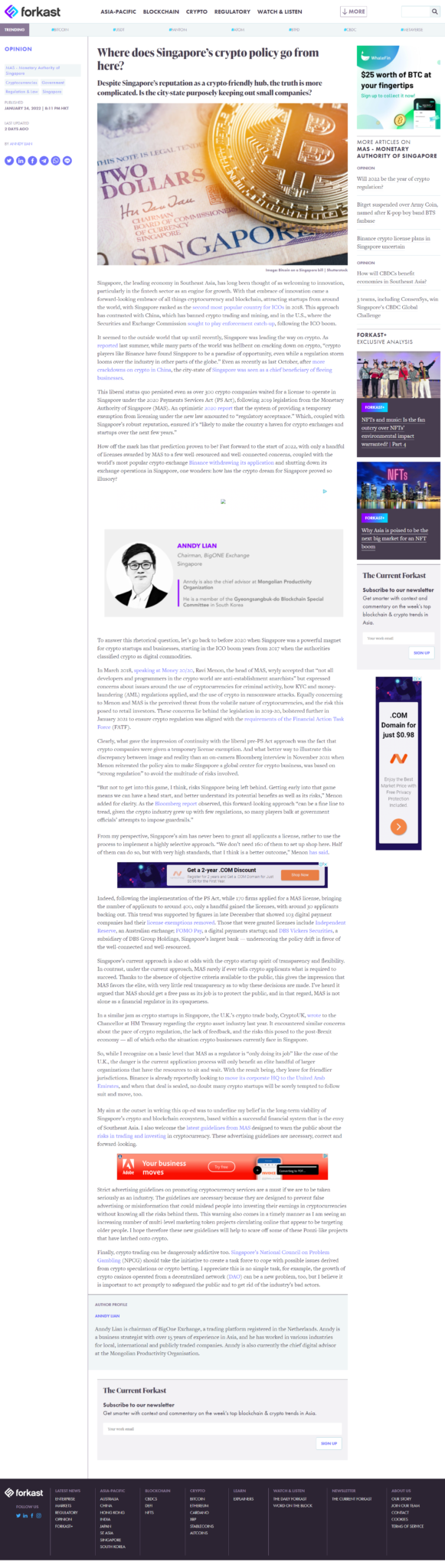
Where does Singapore’s crypto policy go from here?

Where does Singapore’s crypto policy go from here?

Singapore, the leading economy in Southeast Asia, has long been thought of as welcoming to innovation, particularly in the fintech sector as an engine for growth. With that embrace of innovation came a forward-looking embrace of all things cryptocurrency and blockchain, attracting startups from around the world, with Singapore ranked as the second most popular country for ICOs in 2018. This approach has contrasted with China, which has banned crypto trading and mining, and in the U.S., where the Securities and Exchange Commission sought to play enforcement catch-up, following the ICO boom.

It seemed to the outside world that up until recently, Singapore was leading the way on crypto. As reported last summer, while many parts of the world was hellbent on cracking down on crypto, “crypto players like Binance have found Singapore to be a paradise of opportunity, even while a regulation storm looms over the industry in other parts of the globe.” Even as recently as last October, after more crackdowns on crypto in China, the city-state of Singapore was seen as a chief beneficiary of fleeing businesses.

This liberal status quo persisted even as over 300 crypto companies waited for a license to operate in Singapore under the 2020 Payments Services Act (PS Act), following 2019 legislation from the Monetary Authority of Singapore (MAS). An optimistic 2020 report that the system of providing a temporary exemption from licensing under the new law amounted to “regulatory acceptance.” Which, coupled with Singapore’s robust reputation, ensured it’s “likely to make the country a haven for crypto exchanges and startups over the next few years.”

How off the mark has that prediction proven to be? Fast forward to the start of 2022, with only a handful of licenses awarded by MAS to a few well-resourced and well-connected concerns, coupled with the world’s most popular crypto exchange Binance withdrawing its application and shutting down its exchange operations in Singapore, one wonders: how has the crypto dream for Singapore proved so illusory?

To answer this rhetorical question, let’s go back to before 2020 when Singapore was a powerful magnet for crypto startups and businesses, starting in the ICO boom years from 2017 when the authorities classified crypto as digital commodities.

In March 2018, speaking at Money 20/20, Ravi Menon, the head of MAS, wryly accepted that “not all developers and programmers in the crypto world are anti-establishment anarchists” but expressed concerns about issues around the use of cryptocurrencies for criminal activity, how KYC and money-laundering (AML) regulations applied, and the use of crypto in ransomware attacks. Equally concerning to Menon and MAS is the perceived threat from the volatile nature of cryptocurrencies, and the risk this posed to retail investors. These concerns lie behind the legislation in 2019-20, bolstered further in January 2021 to ensure crypto regulation was aligned with the requirements of the Financial Action Task Force (FATF).

Clearly, what gave the impression of continuity with the liberal pre-PS Act approach was the fact that crypto companies were given a temporary license exemption. And what better way to illustrate this discrepancy between image and reality than an on-camera Bloomberg interview in November 2021 when Menon reiterated the policy aim to make Singapore a global center for crypto business, was based on “strong regulation” to avoid the multitude of risks involved.

“But not to get into this game, I think, risks Singapore being left behind. Getting early into that game means we can have a head start, and better understand its potential benefits as well as its risks,” Menon added for clarity. As the Bloomberg report observed, this forward-looking approach “can be a fine line to tread, given the crypto industry grew up with few regulations, so many players balk at government officials’ attempts to impose guardrails.”

From my perspective, Singapore’s aim has never been to grant all applicants a license, rather to use the process to implement a highly selective approach. “We don’t need 160 of them to set up shop here. Half of them can do so, but with very high standards, that I think is a better outcome,” Menon has said.

Singapore’s current approach is also at odds with the crypto startup spirit of transparency and flexibility. In contrast, under the current approach, MAS rarely if ever tells crypto applicants what is required to succeed. Thanks to the absence of objective criteria available to the public, this gives the impression that MAS favors the elite, with very little real transparency as to why these decisions are made. I’ve heard it argued that MAS should get a free pass as its job is to protect the public, and in that regard, MAS is not alone as a financial regulator in its opaqueness.

In a similar jam as crypto startups in Singapore, the U.K.’s crypto trade body, CryptoUK, wrote to the Chancellor at HM Treasury regarding the crypto asset industry last year. It encountered similar concerns about the pace of crypto regulation, the lack of feedback, and the risks this posed to the post-Brexit economy — all of which echo the situation crypto businesses currently face in Singapore.

So, while I recognize on a basic level that MAS as a regulator is “only doing its job” like the case of the U.K., the danger is the current application process will only benefit an elite handful of larger organizations that have the resources to sit and wait. With the result being, they leave for friendlier jurisdictions. Binance is already reportedly looking to move its corporate HQ to the United Arab Emirates, and when that deal is sealed, no doubt many crypto startups will be sorely tempted to follow suit and move, too.

My aim at the outset in writing this op-ed was to underline my belief in the long-term viability of Singapore’s crypto and blockchain ecosystem, based within a successful financial system that is the envy of Southeast Asia. I also welcome the latest guidelines from MAS designed to warn the public about the risks in trading and investing in cryptocurrency. These advertising guidelines are necessary, correct and forward-looking.

Finally, crypto trading can be dangerously addictive too. Singapore’s National Council on Problem Gambling (NPCG) should take the initiative to create a task force to cope with possible issues derived from crypto speculations or crypto betting. I appreciate this is no simple task, for example, the growth of crypto casinos operated from a decentralized network (DAO) can be a new problem, too, but I believe it is important to act promptly to safeguard the public and to get rid of the industry’s bad actors.


Original Source: https://forkast.news/where-does-singapores-crypto-policy-go-from-here/

Anndy Lian is an early blockchain adopter and experienced serial entrepreneur who is known for his work in the government sector. He is a best selling book author- “NFT: From Zero to Hero” and “Blockchain Revolution 2030”.

Currently, he is appointed as the Chief Digital Advisor at Mongolia Productivity Organization, championing national digitization. Prior to his current appointments, he was the Chairman of BigONE Exchange, a global top 30 ranked crypto spot exchange and was also the Advisory Board Member for Hyundai DAC, the blockchain arm of South Korea’s largest car manufacturer Hyundai Motor Group. Lian played a pivotal role as the Blockchain Advisor for Asian Productivity Organisation (APO), an intergovernmental organization committed to improving productivity in the Asia-Pacific region.

An avid supporter of incubating start-ups, Anndy has also been a private investor for the past eight years. With a growth investment mindset, Anndy strategically demonstrates this in the companies he chooses to be involved with. He believes that what he is doing through blockchain technology currently will revolutionise and redefine traditional businesses. He also believes that the blockchain industry has to be “redecentralised”.

j j j

Anndy Lian’s Comments Quoted “DeFI as an open financial ecosystem where you can build various small financial tools and services in a decentralized manner.”- Associated Press

Anndy Lian’s Comments Quoted “DeFI as an open financial ecosystem where you can build various small financial tools and services in a decentralized manner.”- Associated Press

Thanks for taking my comments BitBerry. I got to know about this wallet from UpBit in their early days. Glad to see that they are moving along with the times and working with new partners to expand their business.

Anndy Lian, a DeFI expert and also a Member of Gyeongsangbuk-do Blockchain Special Committee, Government of the Republic of Korea added:

“I am a user of BitBerry and I do see the importance for their wallet to move with the times and embrace DeFI. DeFI as an open financial ecosystem where you can build various small financial tools and services in a decentralized manner. Thanks to their existing framework, BitBerry’s non-custodial nature can let users safely store their own funds without having to rely on third-party institutions to hold their assets. And by partnering with OKEx and listing OKB to their wallet, this has opened up new opportunities for the current users.”


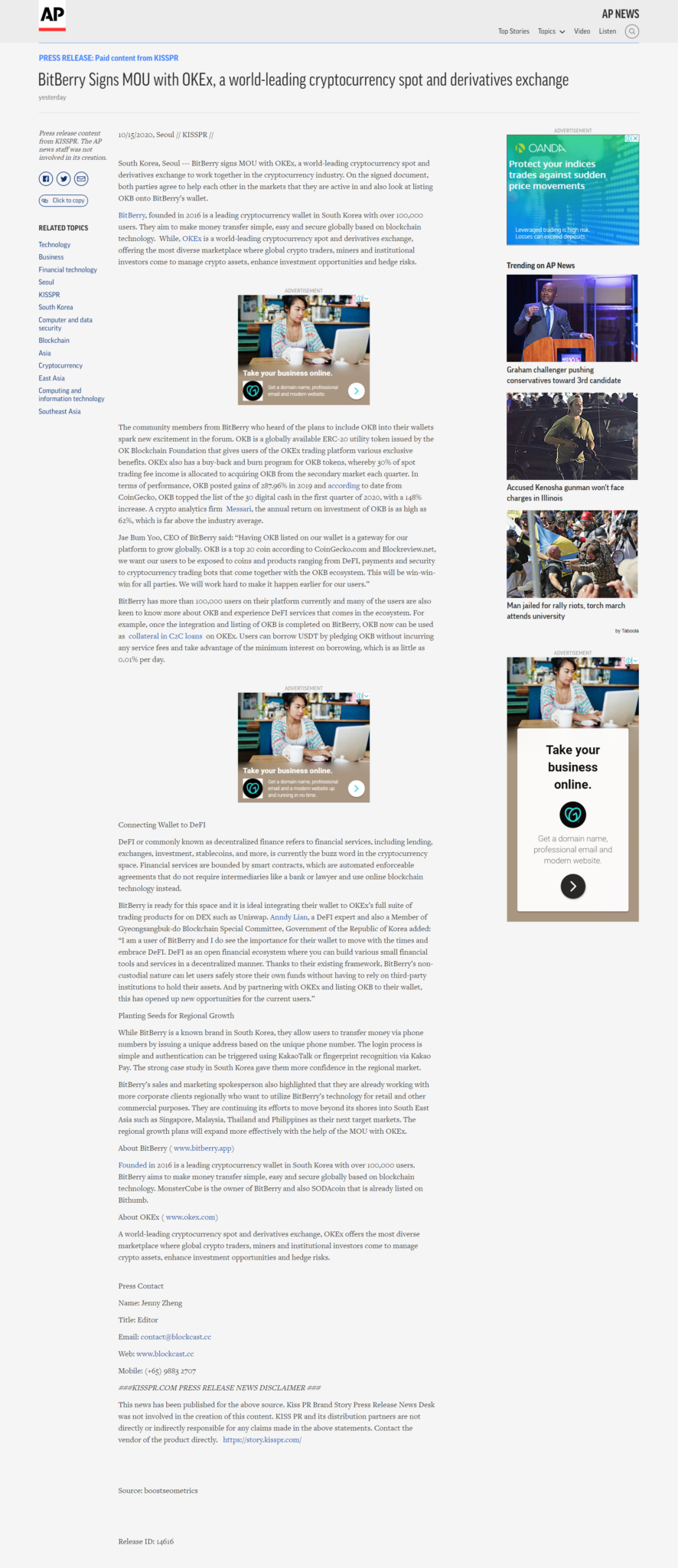
BitBerry Signs MOU with OKEx, a world-leading cryptocurrency spot and derivatives exchange


South Korea, Seoul — BitBerry signs MOU with OKEx, a world-leading cryptocurrency spot and derivatives exchange to work together in the cryptocurrency industry. On the signed document, both parties agree to help each other in the markets that they are active in and also look at listing OKB onto BitBerry’s wallet.

BitBerry, founded in 2016 is a leading cryptocurrency wallet in South Korea with over 100,000 users. They aim to make money transfer simple, easy and secure globally based on blockchain technology.  While, OKEx is a world-leading cryptocurrency spot and derivatives exchange, offering the most diverse marketplace where global crypto traders, miners and institutional investors come to manage crypto assets, enhance investment opportunities and hedge risks.

The community members from BitBerry who heard of the plans to include OKB into their wallets spark new excitement in the forum. OKB is a globally available ERC-20 utility token issued by the OK Blockchain Foundation that gives users of the OKEx trading platform various exclusive benefits. OKEx also has a buy-back and burn program for OKB tokens, whereby 30% of spot trading fee income is allocated to acquiring OKB from the secondary market each quarter. In terms of performance, OKB posted gains of 287.96% in 2019 and according to date from CoinGecko, OKB topped the list of the 30 digital cash in the first quarter of 2020, with a 148% increase. A crypto analytics firm  Messari, the annual return on investment of OKB is as high as 62%, which is far above the industry average.

Jae Bum Yoo, CEO of BitBerry said: “Having OKB listed on our wallet is a gateway for our platform to grow globally. OKB is a top 20 coin according to CoinGecko.com and Blockreview.net, we want our users to be exposed to coins and products ranging from DeFI, payments and security to cryptocurrency trading bots that come together with the OKB ecosystem. This will be win-win-win for all parties. We will work hard to make it happen earlier for our users.”

BitBerry has more than 100,000 users on their platform currently and many of the users are also keen to know more about OKB and experience DeFI services that comes in the ecosystem. For example, once the integration and listing of OKB is completed on BitBerry, OKB now can be used as  collateral in C2C loans  on OKEx. Users can borrow USDT by pledging OKB without incurring any service fees and take advantage of the minimum interest on borrowing, which is as little as 0.01% per day.

Connecting Wallet to DeFI

DeFI or commonly known as decentralized finance refers to financial services, including lending, exchanges, investment, stablecoins, and more, is currently the buzz word in the cryptocurrency space. Financial services are bounded by smart contracts, which are automated enforceable agreements that do not require intermediaries like a bank or lawyer and use online blockchain technology instead.

BitBerry is ready for this space and it is ideal integrating their wallet to OKEx’s full suite of trading products for on DEX such as Uniswap. Anndy Lian, a DeFI expert and also a Member of Gyeongsangbuk-do Blockchain Special Committee, Government of the Republic of Korea added: “I am a user of BitBerry and I do see the importance for their wallet to move with the times and embrace DeFI. DeFI as an open financial ecosystem where you can build various small financial tools and services in a decentralized manner. Thanks to their existing framework, BitBerry’s non-custodial nature can let users safely store their own funds without having to rely on third-party institutions to hold their assets. And by partnering with OKEx and listing OKB to their wallet, this has opened up new opportunities for the current users.”

Planting Seeds for Regional Growth

While BitBerry is a known brand in South Korea, they allow users to transfer money via phone numbers by issuing a unique address based on the unique phone number. The login process is simple and authentication can be triggered using KakaoTalk or fingerprint recognition via Kakao Pay. The strong case study in South Korea gave them more confidence in the regional market.

BitBerry’s sales and marketing spokesperson also highlighted that they are already working with more corporate clients regionally who want to utilize BitBerry’s technology for retail and other commercial purposes. They are continuing its efforts to move beyond its shores into South East Asia such as Singapore, Malaysia, Thailand and Philippines as their next target markets. The regional growth plans will expand more effectively with the help of the MOU with OKEx.


About BitBerry ( www.bitberry.app)

Founded in 2016 is a leading cryptocurrency wallet in South Korea with over 100,000 users. BitBerry aims to make money transfer simple, easy and secure globally based on blockchain technology. MonsterCube is the owner of BitBerry and also SODAcoin that is already listed on Bithumb.


About OKEx ( www.okex.com)

A world-leading cryptocurrency spot and derivatives exchange, OKEx offers the most diverse marketplace where global crypto traders, miners and institutional investors come to manage crypto assets, enhance investment opportunities and hedge risks.


Press Contact

Name: Jenny Zheng

Title: Editor

Email: contact@blockcast.cc

Web: www.blockcast.cc


Source: https://apnews.com/press-release/kisspr/technology-business-financial-technology-seoul-south-korea-61100ffaa3e727fc3827735d699af011

Anndy Lian is an early blockchain adopter and experienced serial entrepreneur who is known for his work in the government sector. He is a best selling book author- “NFT: From Zero to Hero” and “Blockchain Revolution 2030”.

Currently, he is appointed as the Chief Digital Advisor at Mongolia Productivity Organization, championing national digitization. Prior to his current appointments, he was the Chairman of BigONE Exchange, a global top 30 ranked crypto spot exchange and was also the Advisory Board Member for Hyundai DAC, the blockchain arm of South Korea’s largest car manufacturer Hyundai Motor Group. Lian played a pivotal role as the Blockchain Advisor for Asian Productivity Organisation (APO), an intergovernmental organization committed to improving productivity in the Asia-Pacific region.

An avid supporter of incubating start-ups, Anndy has also been a private investor for the past eight years. With a growth investment mindset, Anndy strategically demonstrates this in the companies he chooses to be involved with. He believes that what he is doing through blockchain technology currently will revolutionise and redefine traditional businesses. He also believes that the blockchain industry has to be “redecentralised”.

j j j