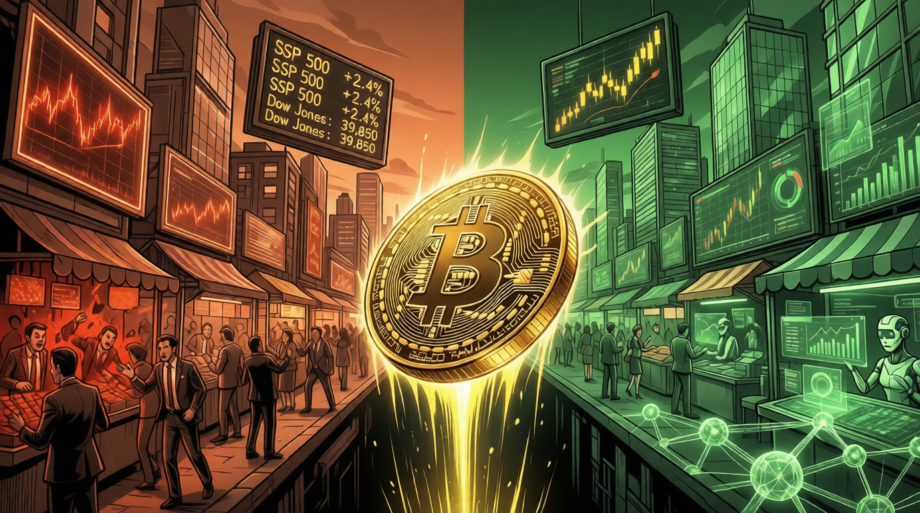
The real reason crypto fell while Wall Street celebrated — The quiet correction

The real reason crypto fell while Wall Street celebrated — The quiet correction

On one hand, encouraging signals from preliminary US-China trade talks have lifted risk assets, with Wall Street closing at record highs and Asian equities starting the week on a strong note. On the other hand, the crypto market has pulled back modestly, shedding 1.24 per cent over the past 24 hours after a solid seven-day rally of 2.86 per cent.

This divergence reflects not a collapse in sentiment but rather a recalibration driven by three interlocking forces: derivatives deleveraging, airdrop-driven sell pressure, and shifting macro policy dynamics. Together, they underscore a market in transition, one that remains fundamentally intact but temporarily adjusting to new layers of complexity.

The most immediate catalyst for the crypto dip lies in the derivatives market. Open interest in perpetual futures contracts fell by 4.25 per cent to US$834 billion, accompanied by a 35 per cent drop in funding rates. This decline follows a dramatic 100 per cent surge in derivatives volume, which spiked to US$1.48 trillion, a clear sign that speculative activity had reached overheated levels.

When funding rates turn excessively positive and open interest balloons without proportional spot market support, the setup becomes ripe for a deleveraging event. Traders, sensing vulnerability or simply taking profits, began unwinding positions, triggering cascading liquidations that totalled US$869 billion. While such corrections can feel abrupt, they serve a necessary function. They purge excess leverage from the system, reducing the risk of a disorderly unwind later.

The current spot-to-perpetuals ratio of 0.23 remains low, confirming that price action continues to be driven more by leveraged derivatives than by underlying spot demand. If open interest continues to bleed and falls below the US$800 billion threshold, further downside pressure could materialise. But for now, this appears to be a healthy reset rather than a structural breakdown.

Compounding this technical adjustment is a wave of airdrop-related selling. New token launches, specifically Enso (ENSO) and Anoma (XAN), plummeted by 12 per cent to 13 per cent as recipients of free allocations rushed to monetise their holdings.

In the case of Dego Finance (DEGO), the impact was even more severe, with a 43 per cent crash following US$650,000 in long liquidations and coordinated whale sell-offs. This pattern has become increasingly common in 2025, where projects launch with low circulating supply but extremely high fully diluted valuations (FDVs). The result is a fragile equilibrium. Early participants, often incentivised through airdrops rather than organic belief in the protocol, have little reason to hold.

When large percentages of a token’s initial supply, typically 10 per cent to 20 per cent , hit the market all at once, demand simply cannot absorb the shock. The sell-off is not a reflection of project quality per se but of misaligned tokenomics and distribution mechanics. Until the industry develops more sustainable models for initial distribution, perhaps through vesting, utility gating, or community staking commitments, this post-TGE volatility will remain a recurring feature of the crypto landscape.

Meanwhile, macro policy developments are introducing a new layer of uncertainty that is beginning to decouple crypto from traditional equities. For the past week, Bitcoin and the broader market had moved in near lockstep with the S&P 500, but that correlation has now turned negative, registering at -0.56. This shift coincides with two significant regulatory signals from Asia.

First, China’s central bank issued fresh warnings about the systemic risks posed by stablecoins, echoing its long-standing skepticism toward private digital currencies. Second, Japan approved its first yen-backed stablecoin, JPYC, signalling a more proactive but tightly controlled approach to digital money.

These contrasting stances highlight a growing bifurcation in global regulatory philosophy. While some jurisdictions seek to suppress decentralised finance, others aim to co-opt it within state-sanctioned frameworks. For crypto markets, this creates a dual-edged effect. On one side, regulatory clarity in Japan could foster institutional adoption and stablecoin innovation.

On the other, China’s warnings inject caution, particularly among Asian retail participants and miners who remain sensitive to Beijing’s policy shifts. The net result is a temporary decoupling from equities, as crypto prices now reflect not just macro liquidity conditions but also jurisdiction-specific regulatory risk.

Despite these headwinds, the broader context remains supportive. Global risk sentiment has improved markedly following US-China trade overtures, with President Trump expressing optimism ahead of his October 30 meeting with President Xi.

This diplomatic thaw has lifted equities worldwide. The S&P 500 rose 1.2 per cent , the Nasdaq surged 1.9 per cent , and Asian benchmarks like South Korea’s KOSPI jumped 2.57 per cent . Even the US dollar softened slightly, with the DXY index slipping 0.2 per cent to 98.78, ahead of the Federal Reserve’s October 31 policy decision.

Treasury yields reflect this mixed outlook. Two-year yields ticked up 2 basis points to 3.5 per cent , while the 10-year yield dipped one basis point to 3.99 per cent , suggesting markets are pricing in both near-term resilience and longer-term caution. In commodities, gold’s sharp three per cent drop to US$3,980.55 per ounce underscores the retreat from safe-haven assets, while Brent crude held steady near US$65.75 per barrel despite OPEC+ output concerns.

Within this environment, crypto’s modest pullback appears corrective rather than ominous. The Fear & Greed Index sits at a neutral 42 out of 100, indicating neither panic nor euphoria. Bitcoin dominance remains stable at 59 per cent , suggesting that capital is not fleeing the sector but rotating within it.

Technically, the total market cap has retested the US$3.85 trillion pivot level, with the 14-day RSI cooling to 49.86 from overbought territory. This provides room for consolidation without triggering deeper bearish momentum. The critical support to watch is the seven-day simple moving average at US$3.77 trillion. Holding above this level would preserve the short-term bullish structure.

To sum up, today’s crypto dip is best understood as a convergence of technical, microeconomic, and macro forces, not a reversal of trend. Derivatives markets are shedding unsustainable leverage, airdrop economics are punishing poorly structured launches, and regulatory developments are temporarily disrupting crypto’s correlation with equities. The underlying macro backdrop remains favourable, with improving US-China relations, strong corporate earnings, and a dovish-leaning Fed on the horizon.

For investors, this moment offers a reminder that crypto’s path to maturity will be nonlinear, marked by volatility born not of weakness but of growing pains. The market is not breaking. It is adapting. And in that adaptation lies opportunity for those who can distinguish noise from signal.

Anndy Lian is an early blockchain adopter and experienced serial entrepreneur who is known for his work in the government sector. He is a best selling book author- “NFT: From Zero to Hero” and “Blockchain Revolution 2030”.

Currently, he is appointed as the Chief Digital Advisor at Mongolia Productivity Organization, championing national digitization. Prior to his current appointments, he was the Chairman of BigONE Exchange, a global top 30 ranked crypto spot exchange and was also the Advisory Board Member for Hyundai DAC, the blockchain arm of South Korea’s largest car manufacturer Hyundai Motor Group. Lian played a pivotal role as the Blockchain Advisor for Asian Productivity Organisation (APO), an intergovernmental organization committed to improving productivity in the Asia-Pacific region.

An avid supporter of incubating start-ups, Anndy has also been a private investor for the past eight years. With a growth investment mindset, Anndy strategically demonstrates this in the companies he chooses to be involved with. He believes that what he is doing through blockchain technology currently will revolutionise and redefine traditional businesses. He also believes that the blockchain industry has to be “redecentralised”.

j j j

While stocks stay calm, Bitcoin rockets to US$105K after downgrade

While stocks stay calm, Bitcoin rockets to US$105K after downgrade

Last Friday, Moody’s decision to downgrade the US credit rating from its pristine Aaa status to Aa1 sent a jolt through global financial markets, stirring a wave of subdued risk sentiment that lingered into the new week. The downgrade, rooted in concerns over the United States’ mounting debt burden and the rising cost of servicing it, marked a rare moment of scrutiny for the world’s largest economy.

Moody’s pointed to a debt-to-GDP ratio spiralling toward 134 per cent by 2035 and persistent fiscal deficits as key drivers behind the move—a sobering assessment that echoed earlier downgrades by Fitch and S&P in recent years. For a nation long regarded as the bedrock of global financial stability, this shift might have been expected to unleash chaos across asset classes. Yet, as Monday’s trading session unfolded, the response was anything but panicked. US equities, after stumbling out of the gate, clawed back early losses to close modestly higher.

The S&P 500 eked out a 0.1 per cent gain, the Dow Jones rose 0.3 per cent, and the Nasdaq edged up by 0.1 per cent. This resilience hinted at a market more preoccupied with immediate economic signals than long-term fiscal warnings, a sentiment reinforced by Federal Reserve officials who doubled down on their patient, wait-and-see stance. With no policy shifts anticipated before September, the Fed’s measured tone seemed to steady investors’ nerves, suggesting that the downgrade, while noteworthy, wasn’t yet a tipping point for broader market upheaval.

The bond market, too, offered a nuanced reaction to Moody’s announcement. US Treasuries, often the first port of call in times of uncertainty, initially faltered as the downgrade sparked a brief sell-off.  Yields ticked higher, with the 30-year Treasury yield briefly piercing the five per cent mark—the highest since November 2023—before retreating to close at 4.903 per cent, down 4.1 basis points.

The 10-year yield followed a similar arc, slipping 3.0 basis points to settle at 4.447 per cent. This recovery signalled that, despite the downgrade, investors weren’t ready to abandon US debt as a safe haven. The enduring appeal of Treasuries likely stems from their unparalleled liquidity and the dollar’s status as the world’s reserve currency, factors that continue to outweigh concerns about America’s fiscal trajectory.

Meanwhile, the US Dollar Index took a modest hit, dipping 0.7 per cent to 100.43, a move that might reflect some unease about the downgrade but hardly a flight from the greenback. Gold, ever the barometer of uncertainty, rebounded with a 0.8 per cent gain to US$3,230 per ounce, reinforcing its role as a hedge against perceived cracks in the global financial edifice.

Across the commodity spectrum, Brent crude inched up 0.2 per cent to US$66 per barrel, buoyed not by the US downgrade but by geopolitical currents—namely, tentative truce talks between Russia and Ukraine and whispers of a nuclear deal with Iran. These movements painted a picture of a market absorbing the Moody’s news with a shrug, focusing instead on near-term catalysts and broader macro trends.

Elsewhere, Asian markets offered a contrast to the relative calm in the US. The MSCI Asia ex-Japan index slid 0.66 per cent on Monday, dragged lower by a faltering Chinese equity market. Concerns over weakening consumption in China, coupled with the much-anticipated debut of a major battery manufacturer, weighed heavily on sentiment. This divergence underscored a key dynamic: while the US downgrade rippled globally, regional factors often held greater sway over local markets.

Early trading in Asia on Tuesday showed a mixed picture, with no clear direction emerging, while US equity index futures pointed to a softer open stateside. The muted response across these asset classes suggested that, for now, the downgrade was being filed away as a long-term concern rather than an immediate threat. Investors seemed more attuned to the Federal Reserve’s next moves, inflationary pressures, and geopolitical developments than to Moody’s stern warning about America’s fiscal health.

Amid this complex tapestry of market reactions, Bitcoin emerged as a standout story, surging past the US$105,000 mark over the weekend and igniting a US$250 billion rally across the cryptocurrency universe. By Sunday, Bitcoin’s price had climbed to US$105,424.45, pushing its market capitalisation beyond US$2.05 trillion and lifting the broader crypto market’s total value past US$2.65 trillion in just five trading days.

This 37.5 per cent ascent from its April low of under US$75,000 was no fluke; it was fuelled by a potent mix of macroeconomic tailwinds and shifting investor psychology. Inflation data, which has kept markets on edge, bolstered Bitcoin’s appeal as an inflation hedge—a narrative that gained traction as confidence grew in potential interest rate cuts from the Federal Reserve.

Significant fund inflows from retail enthusiasts and institutional heavyweights poured fuel on the fire, driving Bitcoin’s dominance in the crypto space to 53.2 per cent, its highest level in over three years. Altcoins rode the wave, buoyed by Bitcoin’s momentum and a technical breakout that saw the cryptocurrency shatter key resistance levels. Open interest in Bitcoin futures soared to a record US$36 billion, a clear sign of growing trader conviction and speculative fervour.

What makes Bitcoin’s rally particularly striking is its timing alongside the Moody’s downgrade. While traditional markets digested the downgrade with relative composure, the crypto market’s exuberance suggested a deeper shift in investor behavior. For some, Bitcoin is increasingly seen as a counterweight to the uncertainties plaguing sovereign debt and fiat currencies, precisely the uncertainties Moody’s highlighted in its downgrade rationale.

The cryptocurrency’s rise wasn’t just a technical story; it was a macroeconomic one, amplified by positive conditions like regulatory clarity in major markets and a growing acceptance among traditional financial players. Take JPMorgan Chase, for instance. On Monday, CEO Jamie Dimon announced at the bank’s annual investor day that clients would now have access to Bitcoin, a surprising pivot for a man who once vowed to shut down the crypto industry if he could.

Dimon, a vocal skeptic who has long flagged concerns about money laundering and illicit activities tied to digital currencies, framed the move as a reluctant nod to client demand. “I don’t think you should smoke, but I defend your right to smoke,” he quipped, per CNBC’s report. “I defend your right to buy Bitcoin.” JPMorgan won’t custody or endorse the asset, but its decision to facilitate access marks a watershed moment, bridging the gap between Wall Street and the crypto frontier.

This juxtaposition—Moody’s downgrade on one hand, Bitcoin’s ascent on the other—offers a lens into the evolving financial landscape. The downgrade’s tepid impact on equities and Treasuries suggests that traditional markets remain anchored by faith in the US economy’s resilience, bolstered by the Fed’s steady hand. Yet Bitcoin’s surge hints at a parallel narrative: a growing cohort of investors, from retail traders to institutions, is seeking alternatives to the established order.

The crypto rally, underpinned by inflation fears and low-rate expectations, reflects a bet on a future where digital assets play a bigger role in hedging against fiscal and monetary instability. Gold’s rebound fits into this story too, though its gains pale beside Bitcoin’s meteoric rise. Meanwhile, the mixed performance in Asian markets and Brent crude’s modest uptick remind us that global markets are a mosaic, shaped as much by local dynamics as by headline events like a US credit downgrade.

In the end, the past few days have revealed a market at a crossroads. While significant, the Moody’s downgrade didn’t spark the turmoil one might expect, suggesting that investors are either desensitised to such warnings or too focused on shorter-term horizons to care. US equities and Treasuries held firm, the dollar dipped but didn’t collapse, and gold reclaimed some ground.

Bitcoin, however, stole the spotlight, and its surge is a testament to shifting tides in how value is perceived and stored. Whether this marks a fleeting speculative boom or a lasting realignment remains to be seen, but one thing is clear: the financial world is growing more complex, with traditional and alternative assets increasingly dancing to different tunes.

As the Fed holds its ground and geopolitical currents swirl, the interplay between these forces will shape markets for months to come. For now, the Moody’s downgrade is a footnote in a broader story—one where resilience, innovation, and uncertainty coexist in uneasy harmony.


Source: https://e27.co/while-stocks-stay-calm-bitcoin-rockets-to-us105k-after-downgrade-20250520/

Anndy Lian is an early blockchain adopter and experienced serial entrepreneur who is known for his work in the government sector. He is a best selling book author- “NFT: From Zero to Hero” and “Blockchain Revolution 2030”.

Currently, he is appointed as the Chief Digital Advisor at Mongolia Productivity Organization, championing national digitization. Prior to his current appointments, he was the Chairman of BigONE Exchange, a global top 30 ranked crypto spot exchange and was also the Advisory Board Member for Hyundai DAC, the blockchain arm of South Korea’s largest car manufacturer Hyundai Motor Group. Lian played a pivotal role as the Blockchain Advisor for Asian Productivity Organisation (APO), an intergovernmental organization committed to improving productivity in the Asia-Pacific region.

An avid supporter of incubating start-ups, Anndy has also been a private investor for the past eight years. With a growth investment mindset, Anndy strategically demonstrates this in the companies he chooses to be involved with. He believes that what he is doing through blockchain technology currently will revolutionise and redefine traditional businesses. He also believes that the blockchain industry has to be “redecentralised”.

j j j

Bitcoin Price Faces Consolidation While Altcoins See Resurgence

Bitcoin Price Faces Consolidation While Altcoins See Resurgence

Even as Bitcoin continues to grapple with the key level of $64,000, experts are pointing to Ethereum’s outperformance of Bitcoin since the Federal Reserve’s 50 basis point rate cut as a possible indicator of shifting market dynamics.

Despite the minor pullbacks, institutional interest in both assets persists. Bitcoin spot ETFs reported a net inflow of $106 million on September 25, extending a 5-day streak. BlackRock’s iShares Bitcoin Trust (IBIT) alone saw an inflow of $184 million. Meanwhile, Ethereum spot ETFs brought in $43.2 million, including $26.6 million into Grayscale’s (ETH) ETF, according to data from SoSo Value.

Meanwhile, interest in altcoins and meme coins has surged, according to Peter Chung, Head of Research at Presto Labs.

Speaking with Decrypt, he noted that the renewed enthusiasm extends beyond just Layer 1 (L1) blockchain assets. 

“The interest in alts is not just confined to L1s but also quite strong on meme coins, which have rebounded strongly today as European trading hours started,” said Chung. “DOGE, PEPE, and SHIB have all spiked noticeably, signaling that the altcoin rebound has quickly become broad-based.”

Nonetheless, attractive annual percentage yields (APYs) on major stablecoins are drawing attention. For instance, DAI through MakerDAO offers a 6.00% APY, while Morph Blue’s SPDAI (LTV 100%) provides a 9.81% APY, indicating that decentralized finance (DeFi) protocols continue to offer competitive yields.

According to senior market analyst Alex Kuptsikevich of FxPro, while stock indices are hitting multi-month or all-time highs, the cryptocurrency market is treading water at a one-month high.

Author and intergovernmental blockchain expert Anndy Lian highlighted that Bitcoin’s surge past $64,000 has shifted market sentiment into “greed” territory,” but added that excessive exuberance often precedes a market correction.

“The current undercurrent of fear on social media suggests that a sentiment shift may be underway, potentially foreshadowing a period of consolidation or even decline in the cryptocurrency market,” he added.

Speaking with Decrypt, Lian also noted that the expectation of easing U.S. monetary policy, with a projected 50 bp interest rate cut at the Fed’s November meeting, has already influenced recent market movements.


Source: https://decrypt.co/255130/bitcoin-consolidation-altcoins-resurgence


Anndy Lian is an early blockchain adopter and experienced serial entrepreneur who is known for his work in the government sector. He is a best selling book author- “NFT: From Zero to Hero” and “Blockchain Revolution 2030”.

Currently, he is appointed as the Chief Digital Advisor at Mongolia Productivity Organization, championing national digitization. Prior to his current appointments, he was the Chairman of BigONE Exchange, a global top 30 ranked crypto spot exchange and was also the Advisory Board Member for Hyundai DAC, the blockchain arm of South Korea’s largest car manufacturer Hyundai Motor Group. Lian played a pivotal role as the Blockchain Advisor for Asian Productivity Organisation (APO), an intergovernmental organization committed to improving productivity in the Asia-Pacific region.

An avid supporter of incubating start-ups, Anndy has also been a private investor for the past eight years. With a growth investment mindset, Anndy strategically demonstrates this in the companies he chooses to be involved with. He believes that what he is doing through blockchain technology currently will revolutionise and redefine traditional businesses. He also believes that the blockchain industry has to be “redecentralised”.

j j j