Central African Republic’s Bitcoin Adoption Will Be A Real Test Case: Here’s Why

Central African Republic’s Bitcoin Adoption Will Be A Real Test Case: Here’s Why

Among the poorest, the African country is likely to serve as a case study on bitcoin adoption in under-developed and politically unstable regions.

The Central African Republic has become the first country in Africa and second in the world after El Salvador to adopt bitcoin as a legal tender. Among the poorest in the world, the African country is likely to serve as a case study on bitcoin adoption in under-developed and politically unstable regions.

Central African Republic’s move towards bitcoin is surprising since it is not among the top African countries in crypto adoption and did not have any supporting infrastructure before the announcement.

A recent Chainalysis data showed Kenya, South Africa, and Nigeria among the top 10 countries in the world for cryptocurrency use.

Reports said that President Faustin Archange Touadera signed a law to make bitcoin an official currency alongside the CFA Franc and legalise cryptocurrencies.

“This move places the Central African Republic on the map of the world’s boldest and most visionary countries,” the Presidential office said.

Significantly, the civil war-infested country is currently under an IMF-monitored financial reform programme. The IMF has opposed the adoption of bitcoin or any cryptocurrency, calling them ‘significant financial risks’.

“In the last decade, many economically-handicapped countries switched over to the US dollar. Now, people – and governments in particular – are looking at cryptocurrencies as the problem solver,” crypto expert Anndy Lian told NDTV.

In the case of the Central African Republic, the oft-repeated charge of former colonial power France’s overreaching economic influence could have been one of the triggers for legalising bitcoin.

However, there is no official statement yet linking the move to the flaws in the France-supported CFA Franc ecosystem.

While Mr Lian believes bitcoin is a good hedge against country-specific risks, he cautioned that bitcoin could only be a mid-way solution for economic stabilisation.

“Bitcoin can help build the economy in the short run. In the long term, countries need to innovate with a localised, sustainable model,” he said.

The African nation’s troubles are poor internet penetration and a high unbanked population – two metrics detrimental to adopting a sophisticated technology like bitcoin.

According to a Datareportal report, internet penetration stood at a mere 11.4% in January 2021, while the IMF estimates that 99% of the population is unbanked.

A look at the situation in El Salvador, which on September 7 last year became the first country to adopt bitcoin as a legal tender, suggests that bitcoin as a currency has not yet gained wider acceptance among the general public.

As per a National Bureau of Economic Research survey, the “usage of bitcoin for everyday transactions is low and is concentrated among the banked, educated, young, and male population”.

About 70% of El Salvador is unbanked. Interestingly, the government had supported the adoption of bitcoin to enable greater financial inclusion.

Original Source: https://www.ndtv.com/business/central-african-republics-bitcoin-adoption-will-be-a-real-test-case-heres-why-2927618

Anndy Lian is an early blockchain adopter and experienced serial entrepreneur who is known for his work in the government sector. He is a best selling book author- “NFT: From Zero to Hero” and “Blockchain Revolution 2030”.

Currently, he is appointed as the Chief Digital Advisor at Mongolia Productivity Organization, championing national digitization. Prior to his current appointments, he was the Chairman of BigONE Exchange, a global top 30 ranked crypto spot exchange and was also the Advisory Board Member for Hyundai DAC, the blockchain arm of South Korea’s largest car manufacturer Hyundai Motor Group. Lian played a pivotal role as the Blockchain Advisor for Asian Productivity Organisation (APO), an intergovernmental organization committed to improving productivity in the Asia-Pacific region.

An avid supporter of incubating start-ups, Anndy has also been a private investor for the past eight years. With a growth investment mindset, Anndy strategically demonstrates this in the companies he chooses to be involved with. He believes that what he is doing through blockchain technology currently will revolutionise and redefine traditional businesses. He also believes that the blockchain industry has to be “redecentralised”.

j j j

MATIC price prediction: Will going green boost Polygon value?

MATIC price prediction: Will going green boost Polygon value?

On 12 April 2022, Polygon (MATIC) made headlines with the  release of  its “Green Manifesto”, pledging to make its blockchain universe more environmentally friendly.

Polygon’s future plans might seem bright, but its native cryptocurrency, MATIC, has been on a bearish trend since the start of 2022.

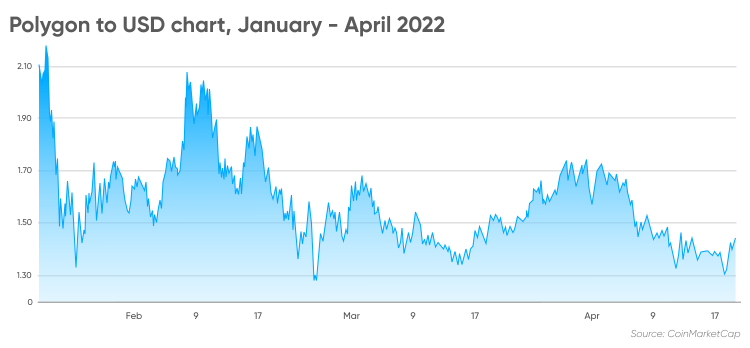
After reaching its all-time high on 26 December 2021 at $2.8768 the token has been on a downward trend, losing 50.9% of its value and dropping to $1.41 by 19 April 2022.

Amid plans to go green, can the token surpass its all time high, and what’s in stock for the Polygon crypto price prediction?

What is Polygon crypto?

In the last couple of years, ether (ETH) has become one of the most popular cryptocurrency tokens. It’s the second biggest cryptocurrency by market capitalisation and the leader in decentralised finance (DeFi) (as of 19 April) due to its compatibility with smart contracts, which make building decentralised applications (dApps) easy.

However, ETH’s growing popularity has also made the blockchain very hard to use amid rising gas fees and excessive traffic. That, in addition to low throughput and no sovereignty has pushed for the creation of Polygon.

Polygon, previously known as Matic Network, is the first easy-to-use platform for Ethereum scaling and infrastructure development. Founded by Jaynti Kanani, Sandeep Nailwal, Anurag Arjun and Mihailo Bjelic in 2017, it wants to make Ethereum a “full-fledged multi-chain system”.

Using the slogan “built by developers, for developers”, Polygon has managed to combine all existing Ethereum tools with faster and cheaper transactions.

Polygon’s key features include:

  • Fast, cheap and safe transactions on Polygon sidechains that are finalised on the Ethereum mainchain
  • High throughput and multi-chain transactions
  • Smooth user experience
  • Public sidechains that support a number of protocols

So far, Polygon has released three scaling solutions:

  • Polygon PoS – a Layer 2 scaling solution that achieves great transaction speed and cost savings
  • Polygon Hermez – a Layer 2 construction on top of Ethereum that solves its scalability issues
  • Polygon Edge – allows users to run their own blockchain network with customisable features

Three others are in development:

  • Polygon Avail – targets off-chain scaling solutions and standalone chains
  • Polygon Miden – a Layer 2 scaling solution for Ethereum and relies on zero-knowledge technology to merge thousands of Layer 2 transactions into one single ETH transaction, increasing throughput and decreasing transaction fees
  • Polygon Zero – a Layer 2 scaling solution for Ethereum that separates Polygon Zero from other zero-knowledge scaling solutions

Polygon Nightfall, a unique privacy-focused scalable transaction solution, is currently undergoing a testnet. The Enterprise chain is planned.

Since launching, Polygon has allowed users to develop over 10,000 dApps, attracted over 130 million unique users, experienced over 3 million daily transactions and hosted over 3.4 billion transactions.

Polygon’s native cryptocurrency is known as MATIC, an ERC-20 token running on the Ethereum network. The MATIC crypto is used to pay fees on the Polygon network, and for stacking and governance.

A maximum of 10bn MATIC tokens were released. Over 7.8bn tokens are currently in circulation, according to data provided by CoinMarketCap, as of 19 April. MATIC currently has a market capitalisation of over $11bn and is ranked as the 18th most popular token.

Will MATIC go up or down? Technical outlook

The MATIC token launched two years after Polygon was founded through an initial exchange offering (IEO) on the Binance crypto exchange platform.
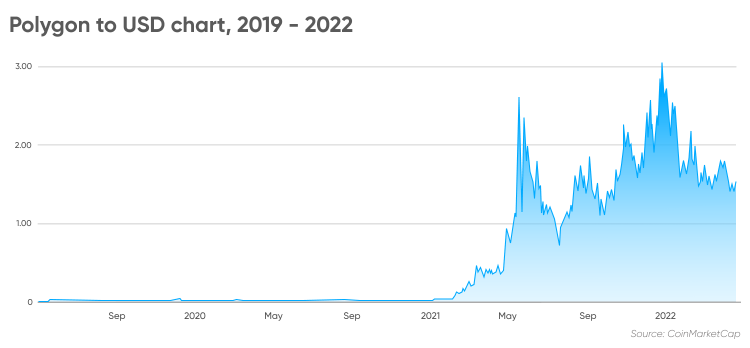
Since its launch in 2019, the token struggled to speed up, moving sideways and fluctuating between $0.01 and $0.03 for the next two years.

The Polygon cryptocurrency started to gain traction in early February 2021, soaring to new price levels by May that same year. In four weeks between 22 April 2021 and 18 May 2021, the Polygon coin price surged by 602.4%, up from $0.3494 to a then record high of $2.4544.
Polygon to USD chart, 2019 - 2022

Despite its momentary success, the coin dropped to $1.0867 but managed to rebound to $2.2102 by 26 May 2021.

Following May’s highs, the Polygon coin’s price has struggled through a volatile ride. it hit a new record-high of $2.8768 on 26 December 2021, following news that the number one Ethereum App, Uniswap, had launched on Polygon.

Since then, however, the token has been on a bearish trend, with its price losing over half of its value from the record high, dropping to the $1.4222 level, as of 19 April 2022. Between 15 February 2022 and 15 March 2022, the coin lost 25.9% of its value amid general negative market sentiment as tensions started to rise on the Russia-Ukraine border.
Polygon to USD chart, January - April 2022

What is your sentiment on MATIC/USD?

MATIC token technical analysis provided by CoinCodex showed that short-term sentiment for the coin was neutral at the time of writing (19 April), with 14 indicators pointing to ‘sell’ and 13 to ‘buy’.

relative strength index (RSI) of 35 was neutral, yet close to an oversold territory. A reading of 30 or below would indicate that the asset is becoming undervalued and a trend reversal is likely to occur. The token is trading above its five-and 10-day moving averages, yet close to its R1 resistance level of $1.47.

Is Polygon a good investment?

Some of the biggest Polygon (MATIC) news came as the platform announced that it would be going carbon-negative in 2022, revealing its “Green Manifesto” – a $20m pledge to tackle climate change.
The crypto industry has been heavily criticised for its high electricity consumption by climate change activist groups, including Greenpeace.
By joining the green movement, Polygon is not only aiding the battle against climate change, but has the potential to catch the attention of investors who value the environment, thus building the case for a bullish Polygon MATIC price prediction.

In addition, MATIC was recently listed on Robinhood, the leading retail investment and trading platform. According to Anndy Lian, the BigONE Exchange chair in Asia, that could be an endorsement for the MATIC token.

“With the Robinhood app adding Polygon to their crypto offerings, my guess is that they are also bullish on the token. In addition, the world’s most popular NFT Marketplace, OpenSea, has some of its functions run through Polygon,” Lian told Capital.com.

The expert added that Polygon’s low fees and fast speed are the two key points that are pushing more projects to mitigate the platform.

“On top of this, MATIC made good moves to deep dive into the NFT and gaming sectors. This allows them to scale and gain popularity a lot faster than their peers,” Lian said.

According to Lian, apart from the low fees and fast scalability, the platform is also easy to use and their community and developers are very supportive.

“They are building up their ecosystem by empowering projects to build dApps easily on top of their infrastructure. Their roadmap since 2017 is very clear and this has given them a lot of followers, especially in the South Asia region,” he said.

“Overall, MATIC is an exciting blockchain in the market. The demand of the token will continue to grow as long as ETH 2.0 is still not out.”

MATIC price prediction 2022 – 2025, 2030

Despite recent bearish MATIC token price action, algorithm-based forecasting service Wallet Investor gave a bullish MATIC coin price prediction at the time of writing (19 April).
The site noted that MATIC is “an awesome investment”, adding that it has a long-term earning potential.

Based on its analysis of past price performance, the website expected that the token could cost $2.439 in 2023 and jump to $6.701 by 2027.

DigitalCoinPrice supported the positive MATIC to USD forecast, but projected a much slower pace of growth in the following years, predicting that the token could rise to $1.98 by the end of 2022, $2.50 by the end of 2024 and $3.15 by the end of 2025, surpassing its December 2021 all-time high.

For the end of 2028, the site gave a $4.41 Polygon price target. Its long-term MATIC future price prediction suggested that the cryptocurrency could have the potential to reach $6.89 by 2030.

Note that price predictions can be wrong. Forecasts shouldn’t be used as a substitute for your own research. Always conduct your own due diligence. And never invest or trade money you cannot afford to lose.

Polygon (MATIC) price prediction: The bottom line

The green transition and Robinhood listing appear to be fuelling the bull case for the MATIC coin, in line with the upbeat predictions from algorithm-based forecasting sites.
There are many factors at play for the future of the coin, from the overall macroeconomic environment, acceptance of the crypto markets and the level of adoption. Always remember that your decision to trade should depend on your attitude to risk, your expertise in this market, the spread of your investment portfolio and how comfortable you feel about losing money. Crypto markets are  very volatile and involve high risk. Never invest money that you cannot afford to lose.

Anndy Lian is an early blockchain adopter and experienced serial entrepreneur who is known for his work in the government sector. He is a best selling book author- “NFT: From Zero to Hero” and “Blockchain Revolution 2030”.

Currently, he is appointed as the Chief Digital Advisor at Mongolia Productivity Organization, championing national digitization. Prior to his current appointments, he was the Chairman of BigONE Exchange, a global top 30 ranked crypto spot exchange and was also the Advisory Board Member for Hyundai DAC, the blockchain arm of South Korea’s largest car manufacturer Hyundai Motor Group. Lian played a pivotal role as the Blockchain Advisor for Asian Productivity Organisation (APO), an intergovernmental organization committed to improving productivity in the Asia-Pacific region.

An avid supporter of incubating start-ups, Anndy has also been a private investor for the past eight years. With a growth investment mindset, Anndy strategically demonstrates this in the companies he chooses to be involved with. He believes that what he is doing through blockchain technology currently will revolutionise and redefine traditional businesses. He also believes that the blockchain industry has to be “redecentralised”.

j j j

Will Institutional Adoption of Crypto Continue in 2022?

Will Institutional Adoption of Crypto Continue in 2022?

The principles and practice of web3 and decentralized protocols may be enabling the birth of a new digital world, but central to the ambition is the pivotal role of cryptocurrencies. From stablecoins to new meme coins it’s clear that cryptocurrencies have long held appeal to individual users wanting an exciting new asset which is completely decentralized. A recent report from American Banker found that only about 20% of banks in the world currently offer crypto asset consulting to their clients. However, it found nearly 40% of its banking industry respondents from around the world stated that they may begin providing crypto-asset services to their retail customers in 2022. It also makes sense that if the decentralized economy is to valuable and innovative, that the overall market value of the cryptocurrency sector must continue to rise. And institutional investment is particularly important during this current bear market phase, when the crypto market has shed more than $1 trillion in market cap since November’s high of $3.1 trillion.


It’s therefore timely to consider how the widespread adoption of cryptocurrency by institutional investors with substantial sums of money to invest could impact the ideals of decentralization in today’s crypto market. According to a 2021 Alternative Investment Management Association report, on global crypto hedge funds, nearly half of hedge fund managers with $180 billion in assets under management (AUM) were considering investing in Bitcoin. With in terms of the main obstacles to investing, regulatory uncertainty the greatest barrier (82%). So, it’s striking that the report found “64% of respondents said that if the main barriers were to be removed, they would either actively accelerate investment in digital assets.” Considering the report’s identification of regulatory impediments to greater institutional involvement in crypto, despite the risks it’s potentially good for the current bear market that the US Biden administration is due to launch a government-wide strategy for digital assets. This executive order will direct all relevant federal agencies to assess crypto’s opportunities and risks and submit their findings later in 2022.


Grayscale Bitcoin Trust had been bullish on institutional investment, having witnessed an influx of almost $2 billion since October 2020, compared to outflows of $7 billion for exchange-traded funds backed by gold. However, in the current downturn it appears one of the biggest causalities has been the trust, as the $27 billion fund (ticker GBTC) has plunged nearly 17% so far in 2022, outpacing Bitcoin’s nearly 9% decline, according to Bloomberg. And just a few days ago CoinDesk reported that crypto trader Tantra, which offered an interest-bearing investment product, planned to close due to the ‘GBTC Discount’ widening to a record level.


So, what are the prospects for the future for increase institutional investment with the significant loss of value in the cryptocurrency market currently? The entry of institutional investors into the crypto industry may have accelerated the adoption of digital currencies as mainstream assets. But will institutional investors’ increased adoption of cryptocurrencies continue, or will the combined headwinds of market forces and regulatory pressures provide an obstacle to growth in 2022?


What drives institutional investors’ adoption of cryptocurrency?

Investment diversification is a significant reason institutional investors have flocked to the cryptocurrency market in search of assets to balance out their portfolio. While many of cryptocurrency’s procedures and structures compared to ‘TradFi’ are relatively still in their infancy, investors can reap various financial benefits in the long term. In similar fashion, institutional investors see it as an opportunity to enter the sector early and reap the benefits of early adopters. Perhaps one of the most dramatic examples in 2021 was El Salvador’s decision to adopt Bitcoin as legal tender. This was given a fresh twist after the president, Nayib Bukele tweeted he’d taken advantage of the current drop in BTC price, thanks to the fact that “Some guys are selling really cheap.”


On the financial management side of the investment equation the news in 2021 that BlackRock, the big news was when the world’s largest asset manager with $9.5 trillion assets, was one of 16 mutual fund managers to gain access to the crypto market via its Global Allocation and Strategic Income Opportunities funds, which have a collective worth of over $40 billion. As Forbes reported in August 2021, “BlackRock is also indirectly exposed to bitcoin via a 14.56 percent stake in MicroStrategy, the cloud software firm with over $3.4 billion of BTC on its balance sheet. MicroStrategy’s outspoken founder Michael Saylor has been one of bitcoin’s biggest champions in recent years arguing that it will soon be on the balance sheets of cities, states, governments, companies, small and big investors as well as core to tech innovation at Apple, Amazon, and Facebook.”


Protecting institutional adoption of crypto in the future

As more institutional investors enter the crypto market, it aids in the broader acceptance of digital assets by bringing more excellent stability to the space. For example, we’ve heard various statements that the most popular cryptocurrency, Bitcoin, would increase in value by a factor of 25 over the next several years due to institutional support. While institutional support appears to help crypto stability and value, crypto innovation must avoid the same mistakes traditional financial services made and remain truly decentralized.


BigONE’s chairman Anndy Lian said: “As a recent IMF report showed crypto prices are increasing in sync with stocks, following the pandemic and the printing of currency by central banks; so it’s not surprising that when tech stocks declined recently, that crypto would follow suit.


“The IMF’s view is that this means less institutional use of crypto is required to diversify risk, and to avoid an increased risk of a larger market downturn as a result. While I disagree with this pessimistic attitude to crypto, I support the report’s conclusion that as regulation makes crypto safer for institutional investment, we also need a robust infrastructure to enable crypto assets to be become part of the mainstream financial system.”


Original Source: https://www.ustimesnow.com/will-institutional-adoption-of-crypto-continue-in-2022/

Anndy Lian is an early blockchain adopter and experienced serial entrepreneur who is known for his work in the government sector. He is a best selling book author- “NFT: From Zero to Hero” and “Blockchain Revolution 2030”.

Currently, he is appointed as the Chief Digital Advisor at Mongolia Productivity Organization, championing national digitization. Prior to his current appointments, he was the Chairman of BigONE Exchange, a global top 30 ranked crypto spot exchange and was also the Advisory Board Member for Hyundai DAC, the blockchain arm of South Korea’s largest car manufacturer Hyundai Motor Group. Lian played a pivotal role as the Blockchain Advisor for Asian Productivity Organisation (APO), an intergovernmental organization committed to improving productivity in the Asia-Pacific region.

An avid supporter of incubating start-ups, Anndy has also been a private investor for the past eight years. With a growth investment mindset, Anndy strategically demonstrates this in the companies he chooses to be involved with. He believes that what he is doing through blockchain technology currently will revolutionise and redefine traditional businesses. He also believes that the blockchain industry has to be “redecentralised”.

j j j