Beyond the US$70K level: Why Bitcoin’s real test isn’t price yet

Beyond the US$70K level: Why Bitcoin’s real test isn’t price yet

Bitcoin’s ability to hold above US$70K while ETF outflows cooled provided the essential foundation. The Fear and Greed Index resting at a neutral 45 signalled neither panic nor euphoria, conditions that often precede sharp reversals. This equilibrium allowed capital to rotate with confidence into broader crypto assets without the spectre of a Bitcoin-led collapse hanging over traders. I see this stability as evidence that the market now prices in institutional participation without becoming enslaved to it. Bitcoin steadies, and the ecosystem breathes.

Bitcoin’s resilience functioned as more than a price level. It served as a psychological anchor for a market still learning to decouple from traditional finance while remaining tethered to macroeconomic currents. When Bitcoin steadies above critical support, it creates space for experimentation and risk-taking elsewhere in the ecosystem. The fact that this stability occurred amid ongoing ETF flow volatility demonstrates that institutional participation, while influential, no longer dictates every intraday move.

Retail and sophisticated derivatives traders alike interpreted Bitcoin’s strength as a green light to explore opportunities beyond the largest-cap assets. This dynamic underscores a healthy evolution where Bitcoin serves as digital gold and market bellwether without stifling innovation in adjacent protocols and tokens.

The rally’s amplification came from two interconnected forces. First, speculative capital chased explosive moves in low-capitalisation tokens. Alaya Governance Token surged 94.5 per cent while RaveDAO climbed 235.4 per cent , gains fuelled by derivatives activity and social media momentum. These moves reflect a familiar pattern where risk appetite returns, capital seeks asymmetric opportunities, and narratives form around emerging projects.

Second, and equally important, crypto maintained a 92 per cent correlation with the Nasdaq-100 ETF, QQQ. This tight linkage means digital assets continue to ride the same macro waves as technology equities, particularly sensitivity to interest rate expectations and liquidity conditions.

On April 10, 2026, US markets extended gains with the S&P 500 rising 0.62 per cent to 6,824.66, the Nasdaq Composite advancing 0.83 per cent to 22,822.42, and the Dow Jones Industrial Average adding 0.58 per cent to close at 48,185.80. The VIX volatility index fell 7.37 per cent to 19.49, signalling reduced anxiety among equity traders. Crypto’s participation in this broader risk-on move was not coincidental but structural.

This correlation cuts both ways. When macro sentiment improves, as it did on hopes of geopolitical de-escalation in the Middle East and steady labour market data, crypto benefits from the same liquidity flows that lift technology stocks. This linkage also means crypto remains vulnerable to shifts in Federal Reserve policy or unexpected economic data. The projected advance in CPI inflation data looms as a potential catalyst for volatility.

Commodity markets reflected similar crosscurrents, with US crude settling near US$98 per barrel amid hopes of a de-escalation, while Brent crude held at US$96.71. Gold rose to US$4,790.90 per ounce as a hedge against uncertainty, and the US Dollar Index slipped 0.51 per cent to 99.13, providing modest tailwinds for risk assets, including crypto. For those of us who believe in the long-term promise of decentralised systems, this macro tether represents both a reality of the current transition period and a reminder that true independence for digital assets requires deeper structural decoupling.

The market faces a clear inflexion point. Technically, the total crypto market capitalisation confronts resistance at the 23.6 per cent Fibonacci retracement level of US$2.49T. The seven-day Relative Strength Index reading of 80.72 suggests short-term overbought conditions that often precede consolidation or pullbacks. Bitcoin’s ability to hold above US$70K remains the primary support for the broader complex. A sustained break above US$72K could reignite bullish momentum across altcoins. A failure to hold US$70K might trigger a retreat toward the US$2.39T support zone.

Beyond price levels, regulatory developments warrant close attention. The SEC’s CLARITY Act roundtable scheduled for April 16 could provide clarity or confusion depending on the tone and substance of discussions. From my perspective, having engaged with policymakers on blockchain frameworks, I view regulatory progress as essential for sustainable growth, but I remain sceptical of approaches that prioritise control over innovation.

The current market posture warrants cautious optimism. Bitcoin’s foundational strength, combined with speculative enthusiasm in altcoins, creates a constructive backdrop. The confluence of technical resistance, overbought signals, and macro uncertainty demands discipline. For investors and builders alike, this environment rewards selectivity.

Projects with genuine utility, transparent tokenomics, and active communities are better positioned to withstand volatility than those riding pure speculation. The 92 per cent correlation with tech equities reminds us that crypto does not operate in a vacuum. Liquidity conditions, rate expectations, and geopolitical developments will continue to influence price action in the near term. The longer arc points toward gradual decoupling as digital asset infrastructure matures and use cases expand beyond financial speculation.

Mainstream narratives often oversimplify crypto market moves as mere risk-on or risk-off plays. The reality proves more nuanced. Bitcoin’s resilience above US$70K despite ETF outflows suggests underlying demand that transcends short-term flow data. The explosive moves in tokens like RaveDAO reflect the enduring appeal of asymmetric opportunities in emerging ecosystems.

These gains occur within a macro framework that remains rate-sensitive. This duality defines the current moment. Traders must navigate technical levels and sentiment indicators while keeping one eye on Federal Reserve communications and geopolitical developments. Builders must focus on creating real value that can sustain projects beyond the next market cycle.

The path forward likely hinges on whether Bitcoin can convert its current stability into decisive upward momentum. A break above US$72K with conviction could propel the total market cap toward the US$2.49T resistance. Success at that level would signal a shift from cautious accumulation to broader participation.

Failure to clear these hurdles might see capital rotate back into Bitcoin as a relatively safe haven within crypto or into traditional assets if macro headwinds intensify. ETF flow data will remain a crucial gauge of institutional sentiment, particularly after a rally that has pushed short-term indicators into overbought territory. Like I said yesterday, the April 16 regulatory roundtable could serve as a catalyst if it produces constructive dialogue, or as a source of volatility if expectations diverge sharply from outcomes.


 

Anndy Lian is an early blockchain adopter and experienced serial entrepreneur who is known for his work in the government sector. He is a best selling book author- “NFT: From Zero to Hero” and “Blockchain Revolution 2030”.

Currently, he is appointed as the Chief Digital Advisor at Mongolia Productivity Organization, championing national digitization. Prior to his current appointments, he was the Chairman of BigONE Exchange, a global top 30 ranked crypto spot exchange and was also the Advisory Board Member for Hyundai DAC, the blockchain arm of South Korea’s largest car manufacturer Hyundai Motor Group. Lian played a pivotal role as the Blockchain Advisor for Asian Productivity Organisation (APO), an intergovernmental organization committed to improving productivity in the Asia-Pacific region.

An avid supporter of incubating start-ups, Anndy has also been a private investor for the past eight years. With a growth investment mindset, Anndy strategically demonstrates this in the companies he chooses to be involved with. He believes that what he is doing through blockchain technology currently will revolutionise and redefine traditional businesses. He also believes that the blockchain industry has to be “redecentralised”.

j j j

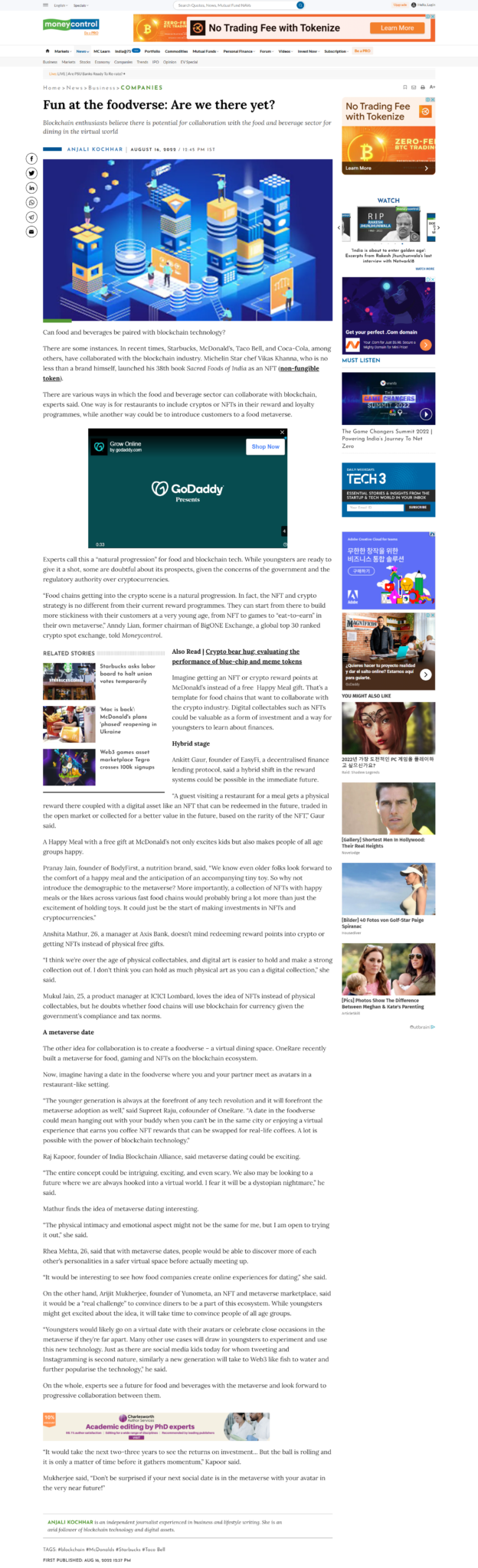
Fun at the foodverse: Are we there yet?

Fun at the foodverse: Are we there yet?

Can food and beverages be paired with blockchain technology?

There are some instances. In recent times, Starbucks, McDonald’s, Taco Bell, and Coca-Cola, among others, have collaborated with the blockchain industry. Michelin Star chef Vikas Khanna, who is no less than a brand himself, launched his 38th book Sacred Foods of India as an NFT (non-fungible token).

There are various ways in which the food and beverage sector can collaborate with blockchain, experts said. One way is for restaurants to include cryptos or NFTs in their reward and loyalty programmes, while another way could be to introduce customers to a food metaverse.
Experts call this a “natural progression” for food and blockchain tech. While youngsters are ready to give it a shot, some are doubtful about its prospects, given the concerns of the government and the regulatory authority over cryptocurrencies.

“Food chains getting into the crypto scene is a natural progression. In fact, the NFT and crypto strategy is no different from their current reward programmes. They can start from there to build more stickiness with their customers at a very young age, from NFT to games to “eat-to-earn” in their own metaverse,” Anndy Lian, former chairman of BigONE Exchange, a global top 30 ranked crypto spot exchange, told Moneycontrol.

Imagine getting an NFT or crypto reward points at McDonald’s instead of a free  Happy Meal gift. That’s a template for food chains that want to collaborate with the crypto industry. Digital collectables such as NFTs could be valuable as a form of investment and a way for youngsters to learn about finances.

Hybrid stage

Ankitt Gaur, founder of EasyFi, a decentralised finance lending protocol, said a hybrid shift in the reward systems could be possible in the immediate future.

“A guest visiting a restaurant for a meal gets a physical reward there coupled with a digital asset like an NFT that can be redeemed in the future, traded in the open market or collected for a better value in the future, based on the rarity of the NFT,” Gaur said.

A Happy Meal with a free gift at McDonald’s not only excites kids but also makes people of all age groups happy.

Pranay Jain, founder of BodyFirst, a nutrition brand, said, “We know even older folks look forward to the comfort of a happy meal and the anticipation of an accompanying tiny toy. So why not introduce the demographic to the metaverse? More importantly, a collection of NFTs with happy meals or the likes across various fast food chains would probably bring a lot more than just the excitement of holding toys. It could just be the start of making investments in NFTs and cryptocurrencies.”

Anshita Mathur, 26, a manager at Axis Bank, doesn’t mind redeeming reward points into crypto or getting NFTs instead of physical free gifts.

“I think we’re over the age of physical collectables, and digital art is easier to hold and make a strong collection out of. I don’t think you can hold as much physical art as you can a digital collection,” she said.

Mukul Jain, 25, a product manager at ICICI Lombard, loves the idea of NFTs instead of physical collectables, but he doubts whether food chains will use blockchain for currency given the government’s compliance and tax norms.

A metaverse date

The other idea for collaboration is to create a foodverse – a virtual dining space. OneRare recently built a metaverse for food, gaming and NFTs on the blockchain ecosystem.

Now, imagine having a date in the foodverse where you and your partner meet as avatars in a restaurant-like setting.

“The younger generation is always at the forefront of any tech revolution and it will forefront the metaverse adoption as well,” said Supreet Raju, cofounder of OneRare. “A date in the foodverse could mean hanging out with your buddy when you can’t be in the same city or enjoying a virtual experience that earns you coffee NFT rewards that can be swapped for real-life coffees. A lot is possible with the power of blockchain technology.”

Raj Kapoor, founder of India Blockchain Alliance, said metaverse dating could be exciting.

“The entire concept could be intriguing, exciting, and even scary. We also may be looking to a future where we are always hooked into a virtual world. I fear it will be a dystopian nightmare,” he said.

Mathur finds the idea of metaverse dating interesting.

“The physical intimacy and emotional aspect might not be the same for me, but I am open to trying it out,” she said.

Rhea Mehta, 26, said that with metaverse dates, people would be able to discover more of each other’s personalities in a safer virtual space before actually meeting up.

“It would be interesting to see how food companies create online experiences for dating,” she said.

On the other hand, Arijit Mukherjee, founder of Yunometa, an NFT and metaverse marketplace, said it would be a “real challenge” to convince diners to be a part of this ecosystem. While youngsters might get excited about the idea, it will take time to convince people of all age groups.

“Youngsters would likely go on a virtual date with their avatars or celebrate close occasions in the metaverse if they’re far apart. Many other use cases will draw in youngsters to experiment and use this new technology. Just as there are social media kids today for whom tweeting and Instagramming is second nature, similarly a new generation will take to Web3 like fish to water and further popularise the technology,” he said.

On the whole, experts see a future for food and beverages with the metaverse and look forward to progressive collaboration between them.

Mukherjee said, “Don’t be surprised if your next social date is in the metaverse with your avatar in the very near future!”


Original Source: https://www.moneycontrol.com/news/business/companies/fun-at-the-foodverse-are-we-there-yet-9034761.html

Anndy Lian is an early blockchain adopter and experienced serial entrepreneur who is known for his work in the government sector. He is a best selling book author- “NFT: From Zero to Hero” and “Blockchain Revolution 2030”.

Currently, he is appointed as the Chief Digital Advisor at Mongolia Productivity Organization, championing national digitization. Prior to his current appointments, he was the Chairman of BigONE Exchange, a global top 30 ranked crypto spot exchange and was also the Advisory Board Member for Hyundai DAC, the blockchain arm of South Korea’s largest car manufacturer Hyundai Motor Group. Lian played a pivotal role as the Blockchain Advisor for Asian Productivity Organisation (APO), an intergovernmental organization committed to improving productivity in the Asia-Pacific region.

An avid supporter of incubating start-ups, Anndy has also been a private investor for the past eight years. With a growth investment mindset, Anndy strategically demonstrates this in the companies he chooses to be involved with. He believes that what he is doing through blockchain technology currently will revolutionise and redefine traditional businesses. He also believes that the blockchain industry has to be “redecentralised”.

j j j

Anndy Lian Interviews Teng Theng Dar, Business Leader, Ambassador and tech evangelist “The best is yet to be.”

Anndy Lian Interviews Teng Theng Dar, Business Leader, Ambassador and tech evangelist “The best is yet to be.”

Anndy Lian: Good morning, everyone. I have invited Theng Dar for this interview. He is a business leader, and many know him as Singapore Non-Resident Ambassador to the Sultanate of Oman, and most importantly, he is my friend. It is my honour to have him in our segment.

Good morning Theng Dar. Can you tell the audience more about yourself? 

Theng Dar: My name is Teng Theng Dar. I spent about 30 years living and working outside of Singapore. Mainly in the Asia region; Ten years plus each in Japan and Indonesia, four and half years each in Malaysia and Australia, including project time in the ASEAN region countries, especially Vietnam and Myanmar.

After I graduated from Waseda University in April 1979, immediately I started my first job in Tokyo, Japan, with a Japan MNC Kao Corporation (Then known as Kao Soap Co., Ltd).

Out of the 75 new recruits for the year, I was the only non-Japanese, and I stayed with the company for 13 years.

Over the years, I worked in various sectors like FMCG manufacturing and marketing, F&B, commodity trading, ICT, IoT and telecommunication infrastructure and biotechnology etc.

Anndy Lian: Can you share some highlights in your career?

Theng Dar: Sure. The highlights of my career would have to be my time with the Singapore Business Federation (SBF) as CEO in 2008 – 2011 when the whole world was plunged into chaos because of the global financial crisis.

As the voice of the business community, SBF in partnership with members of the uniquely Singapore tripartite body successfully weathered the challenge, and together  Singapore achieved a V-shaped recovery in the following year 2010.

During the same period, I also served as Chair of APEC Business Advisory Council during the APEC Year Singapore in 2009 and collectively, with representatives from 21 economies raised issues against the rising protectionism then and continued to promote the possibility of TPP.

This is the two in one experience that I appreciate the most as it was so demanding that I had to put in my all, and it really stretched my capacity to the maximum.

Anndy Lian: Your career paths are exciting, navigating from business to government. It is very similar to what I am experiencing now. Much of my work is outside of Singapore. Is this what you have planned for?

Theng Dar: Not by design but through series of career path changes and events, as well as my active participation in various regional business forums and dialogues that somehow led to my appointment as Singapore Non-Resident Ambassador to the Sultanate of Oman, Adviser, South East Asia Affairs, Shizuoka, Global Business Adviser of Miyagi Prefecture Governments, and Adviser to the School Of Applied Science, Temasek Polytechnic.

With Temasek Polytechnic, my current focus is on using it as the trusted platform and gateway to promote food security & smart city collaborations between Singapore & Japan and then to the ASEAN region.

Interestingly, I am doing what I dreamt of doing when I was still a young undergraduate, and also to do the things I wrote in my graduate thesis.

Life has been very kind to me.

Anndy Lian: Food security, as defined by the United Nations’ Committee on World Food Security, means that all people, at all times, have physical, social, and economic access to sufficient, safe, and nutritious food that meets their food preferences and dietary needs for an active and healthy life. I understand that you have been a strong voice in food security matters. What are you working on right now? 

Theng Dar: In the past four years, I have been focusing on seeking collaboration opportunities linked to food security (I. e. aquaculture & urban farming)

By working with Temasek Polytechnic as the technical gateway and platform, my focus has been in the development of agri-business & R&D community to enable co-development and business collaborations to achieve Singapore Vision 30 by 30, and thereafter expand overseas to contribute to UN Sustainable Development Goal 1 – no poverty, Goal 2 – zero hunger, Goal 11 – Sustainable cities and communities, Goal 12 – responsible consumption and production, and Goal 17 – Partnerships for the goals.

Although delayed by Covid19, one exciting outcome is the inaugural Singapore Shizuoka Agrifood Forum held on Nov 17th, 2020.

Anndy Lian: Thanks for sharing, and do you think companies are ready to fork our extra cost to increase security from their productions? Do you also feel the governmental bodies and private companies have aligned goals on this?

Theng Dar: If we take food security as the specific example for consideration, then it is not just about cost but rather food loss/ food wastage and sustainable food supplies.

In agribusiness, we are still trying to measure food loss and food wastage and their impact on food cost and pricing. Either at pre-farmgate or post-farmgate, the “loss” or “waste” percentage can go as high as 30 – 50%. Next is the wastage at retail and consumption level where food waste is suggested to be between 10 – 30%.

All in all, with the current mode of operating the supply chain for foods, we are looking at a very alarming rate of losses/wastes.

Anndy Lian: Food sustainability is about generating food at a productivity level that is enough to maintain the human population. In years to come, we will face food scarcity. Future food like lab-grown beef has been much talked about; people are worried about its source, how it is produced etc. Do you think technology implementation, e.g. Blockchain + IoT connectivity helps in providing more trust for the consumers?

Theng Dar: By 2050, the world population is projected to reach more than 9 billion people but based on various studies and forecasts, food production capacity using traditional methods will not be able to meet the increase in demand.

We are looking at a severe food crisis in the making if farming practices do not adopt technology to grow more with less with assured quality.

With the above as a backdrop, combined with AI, big data, and analytics, I see blockchain technology as one enabling technology to help reduce “loss and waste”, create a supply chain of trust that can deliver speed in transactions involving multiple parties. In so doing,  time and cost of supply chain can be further compressed.

Anndy Lian: Having chatted on various aspects, can you share with us how you see blockchain technology? What is the future like?

Theng Dar: Assuming that the required hard infrastructure is already in place, blockchain technology has the potential to deliver great impact in the way businesses are done and also in the way we consume health services.

(1) How blockchain can help to remove the administration pains associated with KYC? This should be able to benefit the regulators, financial institutions, and users by reducing the time and manpower needed to complete the process.

(2) How can the adoption of blockchain help ensure product traceability? This is one tremendous contribution that blockchain technology can deliver to food security and food safety and thus enabling the concept of “farm to table” to support quality and safe foods assurance. By the way, this will also enable a food supply chain with speed and security in inspections etc., and thus potentially achieve less food spoilage in transit.

(3) How blockchain technology can be done to help speed up property transactions?

(4) In health services, how blockchain technology can be applied to secure medical records and enable the delivery of personalised health records for better and accurate healthcare services in preparation for the tsunami of aging population. And many more.

That’s the bright and better future for all of us if the blockchain technology can be better applied in the areas where better and higher economical values can be generated by creating new efficient ways of doing things and higher value and quality jobs are then done by humans.

Anndy Lian: Do you think this pandemic is a wake up for many who did not digitise themselves? Do you think a level of decentralised post-pandemic will safeguard us in the event of another crisis?

Theng Dar: I do not think this needs further discussion. The reality is before all of us. As we advance, both IR4 and the preference of the future workforce will give pressure for businesses to digitise. On top of that, I believe we need to adopt a new way of doing business – i. e.  How to operate our business on a permanent pandemic ready mode. If the answer is yes, then digitalising is the way to go.

Anndy Lian: Last but not least, please share an inspiring quote.

Theng Dar: It is my pleasure.

“The best is yet to be.”

Anndy Lian: Thanks for spending time with us today. I hope all of you like my moderation. Next week, Melody or Jenny will take interview another expert. Stay tune at www.blockcast.cc/interviews.


This interview is curated by www.blockcast.cc.

Original Source: https://anndy.com/interview/teng-theng-dar-business-leader-ambassador-and-a-technology-evangelist-the-best-is-yet-to-be/

Anndy Lian is an early blockchain adopter and experienced serial entrepreneur who is known for his work in the government sector. He is a best selling book author- “NFT: From Zero to Hero” and “Blockchain Revolution 2030”.

Currently, he is appointed as the Chief Digital Advisor at Mongolia Productivity Organization, championing national digitization. Prior to his current appointments, he was the Chairman of BigONE Exchange, a global top 30 ranked crypto spot exchange and was also the Advisory Board Member for Hyundai DAC, the blockchain arm of South Korea’s largest car manufacturer Hyundai Motor Group. Lian played a pivotal role as the Blockchain Advisor for Asian Productivity Organisation (APO), an intergovernmental organization committed to improving productivity in the Asia-Pacific region.

An avid supporter of incubating start-ups, Anndy has also been a private investor for the past eight years. With a growth investment mindset, Anndy strategically demonstrates this in the companies he chooses to be involved with. He believes that what he is doing through blockchain technology currently will revolutionise and redefine traditional businesses. He also believes that the blockchain industry has to be “redecentralised”.

j j j