Shaping the Future of DevPortals: A Think Tank on Decentralization, AI, and Beyond

Shaping the Future of DevPortals: A Think Tank on Decentralization, AI, and Beyond

The digital landscape is rapidly evolving, reshaping how we build, deploy, and interact with software. At the forefront of this revolution are DevPortals, the unsung heroes that empower developers to build the future.

But What Are Developer Portals?

Blockchain Developer Portals (DevPortals) are specialized platforms designed to provide developers with the necessary resources, documentation, and tools to interact with blockchain networks and build decentralized applications (dApps). These portals play a critical role in the blockchain ecosystem by enabling developers to integrate blockchain functionalities into their applications, deploy smart contracts, and interact with various blockchain networks.

Ethereum, Polkadot, Solana, Binance Smart Chain (BSC), and Cardano are just a few of the popular blockchain networks that had their own dedicated DevPortals. Ethereum, for example, had been a cornerstone for dApp developers, offering extensive resources on smart contract languages like Solidity and tools like Truffle. Solana, on the other hand, gained traction due to its emphasis on high-speed transactions and low fees, making it ideal for DeFi applications. Polkadot’s Developer Hub stood out for its focus on interoperability, providing guidance on building parachains and custom blockchains using Substrate.

And, very recently, Shiba Inu’s Layer 2 scalability solution Shibarium joined the ranks of these innovative platforms with the launch of the ShibDev portal.

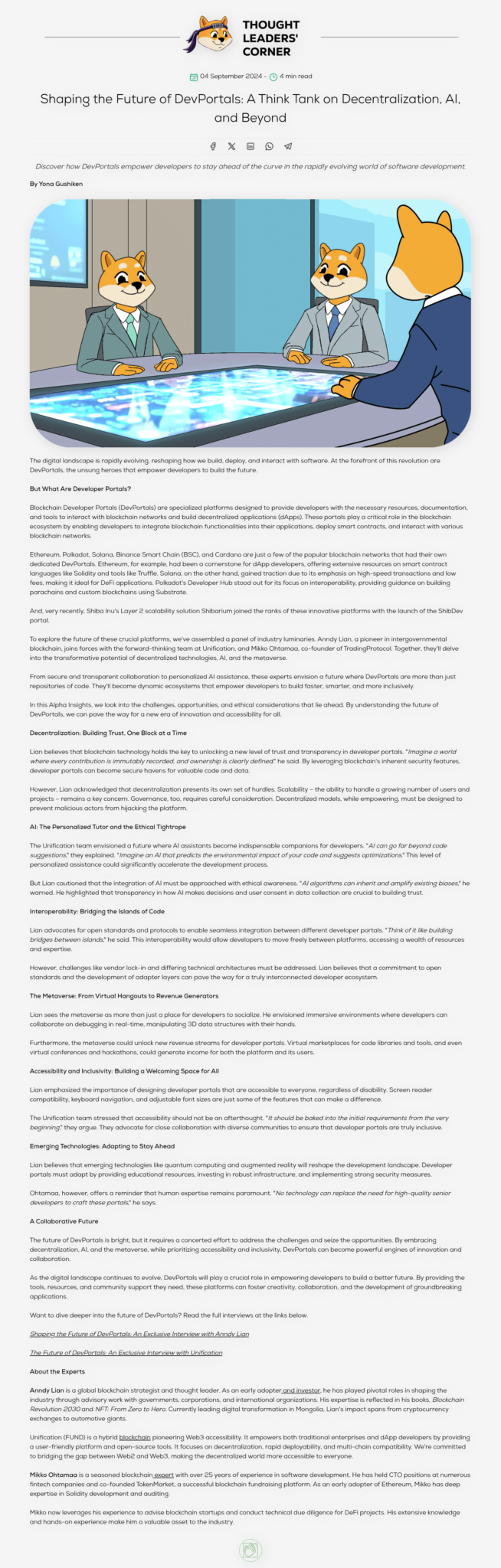
To explore the future of these crucial platforms, we’ve assembled a panel of industry luminaries. Anndy Lian, a pioneer in intergovernmental blockchain, joins forces with the forward-thinking team at Unification, and Mikko Ohtamaa, co-founder of TradingProtocol. Together, they’ll delve into the transformative potential of decentralized technologies, AI, and the metaverse.

From secure and transparent collaboration to personalized AI assistance, these experts envision a future where DevPortals are more than just repositories of code. They’ll become dynamic ecosystems that empower developers to build faster, smarter, and more inclusively.

In this Alpha Insights, we look into the challenges, opportunities, and ethical considerations that lie ahead. By understanding the future of DevPortals, we can pave the way for a new era of innovation and accessibility for all.

Decentralization: Building Trust, One Block at a Time

Lian believes that blockchain technology holds the key to unlocking a new level of trust and transparency in developer portals. “Imagine a world where every contribution is immutably recorded, and ownership is clearly defined,” he said. By leveraging blockchain’s inherent security features, developer portals can become secure havens for valuable code and data.

However, Lian acknowledged that decentralization presents its own set of hurdles. Scalability – the ability to handle a growing number of users and projects – remains a key concern. Governance, too, requires careful consideration. Decentralized models, while empowering, must be designed to prevent malicious actors from hijacking the platform.

AI: The Personalized Tutor and the Ethical Tightrope

The Unification team envisioned a future where AI assistants become indispensable companions for developers. “AI can go far beyond code suggestions,” they explained. “Imagine an AI that predicts the environmental impact of your code and suggests optimizations.” This level of personalized assistance could significantly accelerate the development process.

But Lian cautioned that the integration of AI must be approached with ethical awareness. “AI algorithms can inherit and amplify existing biases,” he warned. He highlighted that transparency in how AI makes decisions and user consent in data collection are crucial to building trust.

Interoperability: Bridging the Islands of Code

Lian advocates for open standards and protocols to enable seamless integration between different developer portals. “Think of it like building bridges between islands,” he said. This interoperability would allow developers to move freely between platforms, accessing a wealth of resources and expertise.

However, challenges like vendor lock-in and differing technical architectures must be addressed. Lian believes that a commitment to open standards and the development of adapter layers can pave the way for a truly interconnected developer ecosystem.

The Metaverse: From Virtual Hangouts to Revenue Generators

Lian sees the metaverse as more than just a place for developers to socialize. He envisioned immersive environments where developers can collaborate on debugging in real-time, manipulating 3D data structures with their hands.

Furthermore, the metaverse could unlock new revenue streams for developer portals. Virtual marketplaces for code libraries and tools, and even virtual conferences and hackathons, could generate income for both the platform and its users.

Accessibility and Inclusivity: Building a Welcoming Space for All

Lian emphasized the importance of designing developer portals that are accessible to everyone, regardless of disability. Screen reader compatibility, keyboard navigation, and adjustable font sizes are just some of the features that can make a difference.

The Unification team stressed that accessibility should not be an afterthought. “It should be baked into the initial requirements from the very beginning,” they argue. They advocate for close collaboration with diverse communities to ensure that developer portals are truly inclusive.

Emerging Technologies: Adapting to Stay Ahead

Lian believes that emerging technologies like quantum computing and augmented reality will reshape the development landscape. Developer portals must adapt by providing educational resources, investing in robust infrastructure, and implementing strong security measures.

Ohtamaa, however, offers a reminder that human expertise remains paramount. “No technology can replace the need for high-quality senior developers to craft these portals,” he says.

A Collaborative Future

The future of DevPortals is bright, but it requires a concerted effort to address the challenges and seize the opportunities. By embracing decentralization, AI, and the metaverse, while prioritizing accessibility and inclusivity, DevPortals can become powerful engines of innovation and collaboration.

As the digital landscape continues to evolve, DevPortals will play a crucial role in empowering developers to build a better future. By providing the tools, resources, and community support they need, these platforms can foster creativity, collaboration, and the development of groundbreaking applications.

Want to dive deeper into the future of DevPortals? Read the full interviews at the links below.

Shaping the Future of DevPortals: An Exclusive Interview with Anndy Lian

The Future of DevPortals: An Exclusive Interview with Unification

About the Experts

Anndy Lian is a global blockchain strategist and thought leader. As an early adopter and investor, he has played pivotal roles in shaping the industry through advisory work with governments, corporations, and international organizations. His expertise is reflected in his books, Blockchain Revolution 2030 and NFT: From Zero to Hero. Currently leading digital transformation in Mongolia, Lian’s impact spans from cryptocurrency exchanges to automotive giants.

Unification (FUND) is a hybrid blockchain pioneering Web3 accessibility. It empowers both traditional enterprises and dApp developers by providing a user-friendly platform and open-source tools. It focuses on decentralization, rapid deployability, and multi-chain compatibility. We’re committed to bridging the gap between Web2 and Web3, making the decentralized world more accessible to everyone.

Mikko Ohtamaa is a seasoned blockchain expert with over 25 years of experience in software development. He has held CTO positions at numerous fintech companies and co-founded TokenMarket, a successful blockchain fundraising platform. As an early adopter of Ethereum, Mikko has deep expertise in Solidity development and auditing.

Mikko now leverages his experience to advise blockchain startups and conduct technical due diligence for DeFi projects. His extensive knowledge and hands-on experience make him a valuable asset to the industry.


Source: https://magazine.shib.io/article/66d86a7287c4c100015d5d7f
j j j

Panel Discussion: VC vs KOLs Investment Strategy

Panel Discussion: VC vs KOLs Investment Strategy

The crypto world is at a crossroads. A recent panel discussion at a crypto event brought together a diverse group of experts – a venture capitalist, a representative from a major blockchain platform, and several angel investors – to dissect the changing dynamics of fundraising in this volatile space.

The moderator set the stage by pointing to a noticeable trend: a “crisis of narratives.” While fleeting trends and meme coins grab headlines, the industry seems to be lacking a cohesive long-term vision. This lack of direction, coupled with the aftermath of high-profile failures, has made venture capitalists wary, leading to a noticeable tightening of the purse strings.

This cautious approach from traditional funding sources has opened the door for a new breed of investors. Angel investors and smaller funds, less burdened by the need for massive returns, are stepping in to support promising projects. This shift is not just about available capital; it’s about a fundamental change in how projects are being evaluated and supported.

The panelists agreed that the old playbook of relying solely on big-name VCs is becoming outdated. Projects are realizing the importance of building strong communities and attracting a diverse range of investors who bring more than just money to the table. Strategic guidance, network access, and marketing expertise are now viewed as equally valuable, especially in a market saturated with projects vying for attention.

This new landscape demands adaptability and creativity from both sides of the table. Founders need to think beyond traditional fundraising rounds and explore alternative models, such as community-driven initiatives and tokenized equity. VCs, on the other hand, need to evolve from being just financiers to becoming active partners, offering tangible value beyond their initial investment.

The panel discussion served as a reminder that the crypto space while facing challenges, is also ripe for reinvention. The current climate, though turbulent, presents a unique opportunity to build a more sustainable and community-driven ecosystem where innovation thrives on shared vision and collaborative effort.

This event, held in Seoul on 2 September 2024, is a side event organized by ICP, NewTribe, and Cointelegraph in conjunction with the Korea Blockchain Week (KBW). Panelists include David from UFVentures, Shashi Shekhar from ICP, Red from PickelsDAO, Petr Martynov from Morningstar Ventures, and best-selling author Anndy Lian.


j j j

Blockchain & AI Change the Shape of Government in 2024

Blockchain & AI Change the Shape of Government in 2024

As we venture into the heart of 2024, information technology is undergoing a seismic shift. Government IT chiefs are grappling with a dual challenge: staying abreast of cutting-edge tech while harnessing its power to boost efficiency, security, and innovation.

This year’s standout trend? blockchain meeting artificial intelligence (AI) to reshape public sector IT strategies.

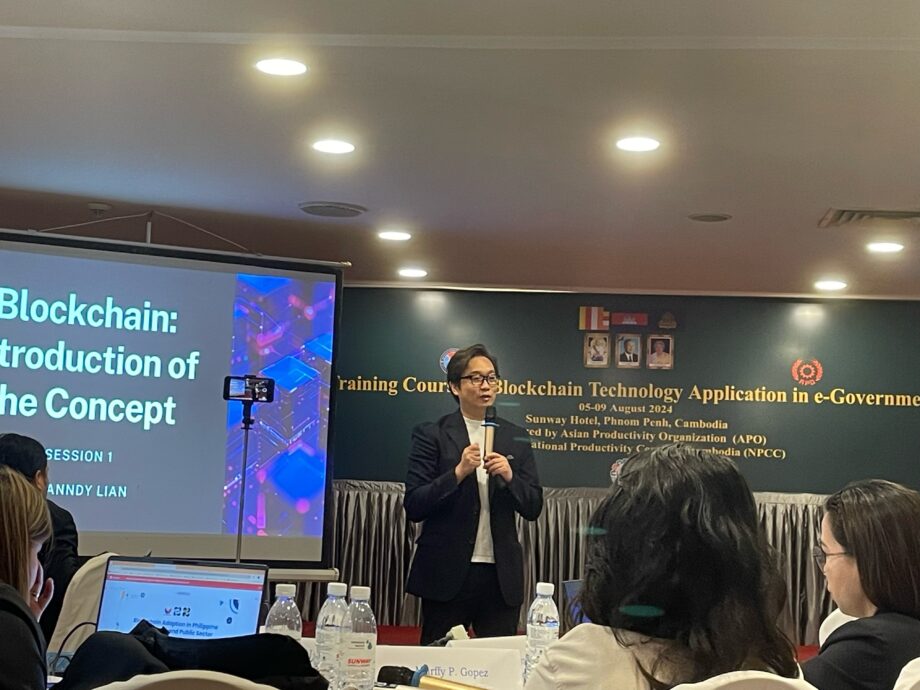
A recent workshop on Blockchain in e-Government, held in Cambodia’s bustling capital from August 5-9, 2024, highlighted the growing fascination with blockchain among state bodies.

The event drew delegates from nine nations and boasted the presence of dignitaries like H.E. Phork Sovanrith, a top official from MISTI and Cambodia’s APO Director, and highlighted blockchain’s pivotal role in molding tomorrow’s digital government services.

As the expert speaker, I witnessed firsthand the palpable excitement surrounding blockchain. The lively debates and probing questions revealed a keen appetite among public sector representatives for blockchain adoption. This shift isn’t fleeting; it marks a profound change in governmental attitudes toward technology.

Key Takeaways

  • Blockchain and AI are beginning to change how public sector IT works, offering security, efficiency, and innovation.
  • The Cambodia workshop in August highlighted global interest in blockchain’s role in transforming e-government services.
  • Blockchain’s transparency and AI’s analytical power can turbo-charge government operations and citizen engagement.
  • There are challenges in adopting these technologies — scalability, interoperability, and ensuring inclusive access among them.
  • Successful e-government transformation hinges on strategic planning, collaboration, and the ethical implementation of blockchain and AI.

Blockchain’s allure for the public sector is multifaceted. At its core, it offers a transparent, decentralized, and tamper-proof ledger system, significantly bolstering the security and integrity of government data and transactions. In our era of sophisticated cyberthreats, blockchain’s security features present an enticing shield for sensitive information.

Furthermore, blockchain’s capacity to streamline operations, slash red tape, and boost transparency aligns perfectly with e-government objectives. Its potential applications span from land registries and identity management to voting systems and public procurement.

Yet, blockchain’s true potential in e-government lies in its synergy with other emerging technologies, particularly AI. This powerful combination could spawn highly efficient, secure, and intelligent systems, revolutionizing public services.

Picture AI algorithms sifting through blockchain-stored data, uncovering patterns, forecasting trends, and making informed decisions. This could lead to more responsive and proactive government services. For instance, an AI-enhanced blockchain system could automatically flag and prevent fraud in public procurement, saving taxpayer money and ensuring fair competition.

Moreover, the AI-blockchain duo could supercharge citizen engagement in governance. Imagine smart contracts on a blockchain paired with AI-powered interfaces, creating intuitive, personalized e-government services. Citizens could interact using everyday language while AI ensures accurate processing and blockchain recording of their requests.

The enthusiasm for these technologies isn’t confined to one region. The diverse attendance at the Cambodia workshop, with participants from nine countries, signals global recognition of blockchain’s potential. This international collaboration is crucial for developing standards and best practices to facilitate widespread blockchain adoption in e-government.

However, the path to blockchain integration in the public sector isn’t without hurdles. Scalability, interoperability, and regulatory compliance are key challenges. There’s also an urgent need for capacity building and skill development within government agencies to implement and manage blockchain solutions effectively.

Looking ahead, it’s clear that blockchain and AI will remain focal points for IT leaders’ strategies. The public sector stands to gain significantly from these technologies. However, success hinges on a strategic approach that considers not just technical aspects but also organizational and cultural shifts needed to fully adopt these technologies.

For public sector IT leaders, key priorities should include developing clear blockchain strategies, investing in AI capabilities, fostering collaboration, prioritizing security, focusing on user experience, addressing ethical considerations, and maintaining agility in the face of rapid technological change.

It Won’t Be a Smooth Ride Though

The enthusiasm observed at the Cambodia workshop is encouraging, suggesting we’re on the brink of a major transformation in government operations and service delivery. However, it’s crucial to temper this excitement with a realistic understanding of the challenges ahead.

Implementing blockchain and AI solutions at a governmental level is a complex undertaking requiring careful planning, substantial resources, and, often, legislative changes. It’s not just about adopting new technologies; it’s about reimagining the delivery of government services and citizen-state interactions.

As governments rush to adopt these technologies, there’s a risk of creating a digital divide. Not all citizens may have equal access to or understanding of these new systems. IT leaders must ensure that blockchain and AI adoption doesn’t inadvertently exclude segments of the population.

Despite these challenges, the potential benefits of blockchain and AI in e-government are too significant to ignore. These technologies promise more efficient, transparent, and responsive government services. They can help rebuild trust in public institutions by providing verifiable records of government actions and decisions.

The interest shown by public sector representatives at the Cambodia workshop is a positive sign, indicating a willingness to learn and adapt. However, this enthusiasm must be channeled into concrete action plans and sustained efforts to realize the full potential of these technologies.

As we progress, it will be fascinating to see how different countries approach blockchain and AI adoption in their e-government initiatives. Will we witness a race to become blockchain-enabled smart nations? Or will the adoption be more measured and cautious?

What’s certain is that blockchain and AI are no longer just buzzwords or experimental technologies. They’re becoming integral to IT strategies, particularly in the public sector. The focus now should be on responsible and effective implementation that truly serves citizens’ needs.

The Bottom Line

In conclusion, as IT leaders map out their strategies for the coming years, blockchain and AI will undoubtedly be at the forefront. The convergence of these technologies presents an unprecedented opportunity to transform e-government services. However, success will depend on more than just technological prowess. It will require visionary leadership, collaborative efforts, and a commitment to ethical and inclusive implementation.

The journey towards blockchain and AI-enabled e-government has just begun. The enthusiasm witnessed at events like the Cambodia workshop is just the first step. The real test lies in translating this enthusiasm into tangible improvements in government services and citizen experiences. As we stand at this technological crossroads, one thing is certain: the future of e-government is exciting, and it’s powered by blockchain and AI.


Source: https://www.techopedia.com/blockchain-ai-in-government

j j j