New Crypto Trend: Trading Tokens Before Release

New Crypto Trend: Trading Tokens Before Release

A new trend is taking off in the cryptocurrency community — as investors start to purchase tokens before waiting for them to hit the markets.

In a fast-paced industry, being an early investor is a crucial step as it allows individuals to potentially capitalize on significant price appreciation as innovative projects gain traction and adoption.

And now, investors are finding ways to start buying before the firing pistol has signaled the start of the race.

Here’s everything you need to know.

Key Takeaways

  • Investing in tokens before their release allows investors to potentially benefit from significant price increases as projects gain traction.
  • Platforms like AEVO and Hyperliquid have introduced new opportunities to speculate or hedge against future token prices, marking a shift from traditional ICOs to more dynamic pre-token trading environments.
  • Pre-token and point market sales have seen $50 million in trades despite low liquidity.
  • The pre-token and point markets are heavily dominated by buyers, a sign of potential investor confidence.
  • Despite the enthusiasm and high trading volumes, these markets face challenges such as lower liquidity and higher volatility compared to post-TGE markets.

Pre-Token & Point Markets Take Off

Until recently, investors could purchase cryptocurrencies prior to their official launch through their initial coin offering (ICO), a fundraising mechanism used by new decentralized finance (DeFi) projects to raise capital by selling tokens to investors prior to a project’s full development.

This allows anyone to speculate on or hedge against the price of a token before its launch, creating a new era of crypto investing.

In short, pre-token and point markets are platforms that allow people to buy or sell the promise of receiving tokens or points at a future date, often before the official release of the token.

Such markets are divided into two main types: one where trades are settled with cash and another where the actual tokens or points are exchanged. Such a setup lets investors speculate on the future value of tokens or points, potentially profiting from changes in their price before they become available.

According to Anndy Lian, an inter-governmental blockchain adviser, by participating in pre-sales, investors get the opportunity to directly support the development and growth of new projects, as well as create a sense of community and alignment with the project’s goals.

He said:

“This community effect can drive demand as more people become involved and invested in the token’s success. Effective marketing campaigns can generate significant hype around a token before its release, leading to increased demand as investors don’t want to miss out on what is being promoted as a promising opportunity.”

A Keyrock report released on April 30 uncovered that the crypto community has seen a notable surge in interest and participation in these pre-tokens and point markets with $50 million already being traded.

This high level of activity reflects a growing enthusiasm among investors to engage with new crypto projects at an early stage.

The markets predominantly cater to buyers, with the majority of orders coming from users eager to purchase tokens or points ahead of their public release. This eagerness is driven by the potential for high returns on investments as token values can increase significantly upon official launch.

Pre-token & Point Markets See Higher Buyer Dominance

According to the Keyrock report, the markets showed a pronounced buyer dominance, with most tokens analysed displaying a higher buying than selling volume.

This trend suggested that investors were more interested in acquiring tokens rather than selling them, believing in the potential for token value appreciation after their Token Generation Event (TGE).

The report highlighted:

“Most tokens exhibit a buying volume significantly higher than the sell volume. Only 5 out of 57 tokens that have been traded on Whales Market show a selling volume that exceeds the buy volume. Participants in Whale Markets demonstrate a strong preference for buying tokens, points, and runes.”
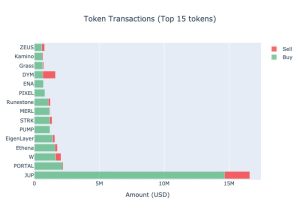
Data on buying vs selling tokens from Whales Market. Source: Keyrock Data Intelligence

Data on buying vs selling tokens from Whales Market. Source: Keyrock Data Intelligence

Liquidity Remains Low

Despite optimistic trading volumes, pre-token and point markets still face challenges related to liquidity.

The Keyrock report highlighted that compared to traditional post-TGE markets, pre-token and point markets are relatively less liquid, meaning they have relatively fewer buyers and sellers, which could lead to price volatility and make it harder to execute larger orders without affecting the market price.

Additionally, sometimes the demand for a pre-release token is driven more by hype and marketing than by the project’s fundamentals, which could lead to an inflated valuation that does not reflect the token’s true worth, Lian explained.

“Projects that prioritize transparency, communication, and community trust are more likely to succeed in pre-release trading. Investors will gravitate toward projects they believe in.”

Technical issues could also serve as a major potential risk in purchasing cryptocurrencies before they fully launch since the technology behind the asset is only just being developed.

The Bottom Line

As the landscape of pre-token and point markets continues to evolve, strategic considerations and forward-thinking approaches are essential for both investors and project developers.

The surge in trading volumes and the enthusiasm observed in these markets suggest a robust interest in early-stage investment opportunities.

According to Lian, this has been an ongoing trend since the beginning of the crypto ICO period, and the act of trading tokens before their official release is likely to continue into the future as well. However, investors should exercise caution when investing in new projects and never invest money they cannot afford to lose.


Source: https://www.techopedia.com/news/exploring-crypto-pre-token-and-point-markets

j j j

Karak has ‘good chance’ of becoming next EigenLayer after EIGEN airdrop disappointment

Karak has ‘good chance’ of becoming next EigenLayer after EIGEN airdrop disappointment

Emerging Ethereum restaking protocol Karak’s total value locked (TVL) rose over 25% in the past week to over $440 million, and industry experts believe it could start eating into EigenLayer’s market share.

Following the disappointment around the EigenLayer airdrop, Karak has a “good chance” of become the next big restaking protocol, according to Anndy Lian, intergovernmental blockchain expert and author of NFT: From Zero to Hero. He told Cointelegraph:

“Karak supports a broader range of assets for restaking, including Ether, liquid staking tokens, liquid restaking tokens, stablecoins, liquidity provider tokens and Wrapped Bitcoin. This diversity could attract a wider user base looking for more options beyond ETH.”

At the beginning of April, Karak closed a $48-million Series A funding round, giving it a valuation of over $1 billion, which means more upside potential. By comparison, EigenLayer has a $15.7-billion valuation, making it the largest restaking protocol on Ethereum.

Source: Karak

EigenLayer airdrop disappointment could lead to a drop in TVL

On April 29, EigenLayer released a white paper for its upcoming EIGEN token, which banned several jurisdictions from its upcoming airdrop, including the United States, Canada and several African and Asian countries.

The decision caused widespread criticism in the crypto community. Pseudonymous crypto trader Jay noted that it could be a significant opportunity for Karak in an April 29 X post:

“Think Eigen has handed Karak a golden opportunity.”

EigenLayer’s decision to ban airdrop participants from key crypto jurisdictions could lead to a fall in TVL as stakers look for more lucrative alternatives, according to Lian. He said:

“Farmers and stakers who were eagerly anticipating the EIGEN airdrop might now seek alternative platforms or protocols. Some may choose to reallocate their assets to other DeFi projects that offer more inclusive airdrop opportunities.”

According to crypto analyst and Crypto Banter podcast host Ran Neuner, EigenLayer is a venture capitalist (VC) scam aiming to attract liquidity from unsophisticated retail investors. He wrote in an April 30 X post:

“Early VCs get in early at small valuations — Retail will get in at $15bn+. Low circulation high [fully diluted valuation] at the start — let’s fleece more retail…”

Source: Ran Neuner

Neuner argued that the airdrop ban in key unbanked jurisdictions, along with the decision to keep airdropped EIGEN tokens locked until the team decides, are mainly in favor of early-stage VC investors:

“Any retail investor that buys this in the first 3 years will be punished.”

While Karak could become the next leading restaking protocol, multi-asset restaking could introduce more protocol risks compared to EigenLayer, according to Alon Muroch, CEO of SSV.Labs. Muroch told Cointelegraph:

“With more complexity comes more risk. EigenLayer has put its eggs in the Ethereum basket because Ethereum is the most secure and battle-tested proof-of-stake network and, therefore, a safer foundation for shared security.”


Source: https://cointelegraph.com/news/karak-good-chance-becoming-next-eigenlayer

j j j

Top 5 Decentralized Finance Trends to Expect in 2024: Analyst Insights

Top 5 Decentralized Finance Trends to Expect in 2024: Analyst Insights

The decentralized finance (DeFi) space is leaving the bear winter behind and entering a bull summer as industry interest continues to pick up and the market moves into incentive-driven growth that focuses on real utility and technological innovations.

Or at least, that is what experts in the DeFi space are saying.

A recent report published by Exponential found that the “latest indicators signal not just growth but a transformative shift” within the DeFi space with significant growth in interest in DeFi yields.

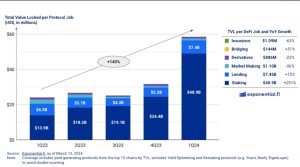
The total value locked (TVL) in yield-generating DeFi protocols has steadily increased from $26.5 billion in the third quarter of 2023 to $59.7 billion in the first quarter of 2024, according to the report.

Total Value Locked per Protocol Job.
Total Value Locked per Protocol Job. Source: Exponential.fi

This growth signifies a return of confidence and liquidity to the DeFi markets.

We spoke to experts to find out the latest DeFi trends for 2024.

Key Takeaways

  • The DeFi industry continues to evolve with $43 billion already locked in low-risk yield contracts, indicating a shift towards more stable and reliable investment avenues.
  • The merging of traditional financial systems with DeFi is a significant trend, with financial institutions expected to use DeFi innovations such as smart contracts and decentralized lending to improve their services.
  • The DeFi space faces potential regulatory hurdles, exemplified by the SEC’s actions against Uniswap.
  • The development of Layer-2 scaling solutions and crypto bridges are pivotal in enhancing transaction speeds and reducing costs, thus supporting the broader adoption of DeFi.
  • Increased international regulatory cooperation is likely to result in a unified global framework for digital assets, balancing innovation with financial stability and opening up new opportunities for the DeFi sector.

DeFi Industry Is Maturing

As central banks signal towards more rate cuts, the DeFi yields space is gaining significant popularity as an attractive investment form with DeFi markets maturing, Anndy Lian, an inter-governmental blockchain advisor, told Techopedia.

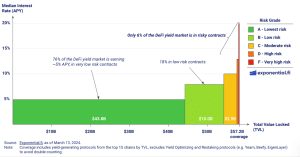
This was also backed by the Exponential report, which noted that over $43 billion were locked into very low-risk DeFi yield contracts.

75% of DeFi total value locked (TVL) is currently in pools offering 0-5% of annual percentage yield (APY).

Total Value Locked in DeFi Yield Markets.
Total Value Locked in DeFi Yield Markets. Source: Exponential.fi

Additionally, new trends in the market are pointing towards more mainstream adoption, with DeFi projects continuing to grow and integrate more and more with traditional finance.

Lian said:

“The focus [of the DeFi space in 2024] seems to be on sustainable growth, improved security, and real-world applications that could lead to wider acceptance and use of DeFi platforms.”

Igor Telyatnikov, CEO and co-founder of AlphaPoint, a digital asset and cryptocurrency trading and investing platform, added that with over $90 billion locked in DeFi protocols, the DeFi market could very much reach and even surpass previous heights of $150 billion locked as previously seen in 2021. He said:

“Despite the challenges faced, DeFi has continued to attract both developers and users, showcasing its ability to innovate and adapt. We are seeing a maturing ecosystem with more robust infrastructure, improved user experiences, and increasing collaboration among projects.”

Decentralized Finance Trends 2024

Over the last year, DeFi applications have undergone significant changes, with a number of new trends starting to show up in the industry, stemming from crypto bridges to a number of Layer-2 (L2) scaling solutions.

Here are some of the biggest DeFi trends experts are paying attention to in the second half of 2024.

1. Traditional Finance Integration

The traditional finance market entering the DeFi space is perhaps the biggest trend in the current DeFi landscape.

Lian noted that the integration of traditional markets into the DeFi space could become a “significant step towards a more inclusive and efficient financial ecosystem,” with traditional financial institutions expected to collaborate more closely with the DeFi space, utilizing features like smart contractstokenization, and decentralized lending to enhance their products and services.

Lian said:

“A growing number of financial institutions are projected to adopt DeFi solutions, with significant investments to streamline operations and offer innovative services. The 24/7 operational model of DeFi breaks down traditional barriers of time and geography, offering constant accessibility and borderless transaction capabilities.”

Telyatnikov added that as regulatory clarity improves, the DeFi space could see a lot of exploration of new use cases in collaboration with more traditional institutions.

“Furthermore, the lines between DeFi and centralized finance will blur, leading to hybrid solutions that combine the best of both worlds.”

2. Layer-2 Scaling Solutions

Layer-2 scaling solutions are a prominent tech DeFi example that is expected to play a crucial role in the second half of 2024, AlphaPoint’s Telyatnikov noted. These solutions will enable faster and cheaper transactions while also maintaining the security of the underlying blockchain.

Lian added that the ability of L2 solutions to enhance the scalability and efficiency of blockchain networks is also vital for the growth of DeFi technology.

3. Crypto Bridges

However, major DeFi platforms have seen other emerging trends in the past year, including the development of crypto bridges and Know Your Customer (KYC’d) DeFi, according to Lian. He said:

“The emergence of crypto bridges has facilitated asset transitions to faster layer 2 networks like Arbitrum and Polygon, enhancing ERC-20 token trading while maintaining exposure to Ethereum.”

4. Regulation

AlphaPoint’s Telyatnikov added that over the past year, one of the most significant changes in the DeFi landscape was the heightened regulatory scrutiny.

One example is recent enforcement actions by the U.S. Securities and Exchange Commission (SEC) aimed at Uniswap Labs, which noted that the commission was planning to recommend legal action against the company.

Telyatnikov said:

“The recent Wells notice issued to Uniswap, the largest decentralized exchange by volume, and the ongoing Tornado Cash case have sent shockwaves and warning signals through the DeFi community, particularly in the US. Uniswap, being a significant utility in the DeFi ecosystem, is now facing a direct attack from regulators, creating uncertainty that may take a long time to resolve, similar to the Coinbase lawsuit.”

5. KYC’d DeFi

Such lawsuit cases bring direct challenges to the legal status of DeFi products, their tokens and use cases, which is why there could also be a potential rise of KYC’d DeFi. Know Your Customer procedures are known to align with regulatory standards and reduce illegal activities, which could serve as a limelight for a number of DeFi platforms.

For example, Singularity, a startup developing a protocol to provide institutions with confidential access to DeFi, attracted $2.2 million to develop a KYC-compliant DeFi platform for institutions.

Miko Matsumura, the managing partner at Gumi Cryptos Capital, said in a press release on February 22, 2024:

“Singularity addresses a crucial need in the market, providing institutional users with both the compliance and the commercial confidentiality necessary to participate in DeFi.”

Additionally, the SEC’s new regulatory definitions have the potential to bring decentralized exchanges (DEXs) within the scope of regulations for US broker-dealers, affecting their operations, which could also play a significant impact on the future of the DeFi space in the coming year.

However, global regulatory cooperation and the balance between innovation and safeguarding against financial stability risks will be crucial for further development of the DeFi space.

“The [current] focus seems to be on creating a regulatory environment that supports innovation while ensuring the security and integrity of the financial system,” Lian said.

The Bottom Line

As DeFi transitions from its speculative phase into a more mature and stable environment, the integration with traditional finance and the adoption of advanced technologies like Layer-2 solutions signify a robust future.

Despite facing regulatory challenges, the sector’s innovative response showcases its resilience and potential for sustained growth.

The growing acceptance and implementation of KYC procedures in DeFi could further enhance its legitimacy and foster broader adoption.

Overall, the future of DeFi looks promising, poised to redefine financial landscapes globally as it bridges the gap between traditional and decentralized finance while navigating regulatory challenges.


Source: https://www.techopedia.com/decentralized-finance-trends

j j j