“NFTS ARE NOT DEAD”: EXPLORING BYBIT’S ANNDY LIAN’S TAKE

“NFTS ARE NOT DEAD”: EXPLORING BYBIT’S ANNDY LIAN’S TAKE

While NFTs have been the subject of both hype and skepticism, Head of Partnerships for ByBit, Anndy Lian, has taken a positive view of the current landscape. In a recent article, Lian dismantles the notion that the NFT market has reached its end. Contrary to popular belief, he argues that NFTs serve as a catalyst for a new era of creativity and financial accessibility.

Emerging Trends

To start with, Lian references the market’s rise to a $10.7 billion total market cap in 2021 and its subsequent fall. He points out that despite this downturn in the market, several promising trends are taking shape. For example, generative artwork allows users to mint unique digital art pieces through algorithms or computer programs. Projects like Art Blocks and Otherside have already made strides in this space.

He also highlights the idea of fractionalizing high-value collectibles. This involves breaking down a rare or expensive NFT into smaller, tradable portions. According to Lian, this approach expands access and investment opportunities in high-value NFTs for a broader audience.

Furthermore, established companies like Coca-Cola and Marvel are entering the NFT sphere by creating digital collectibles or collaborating with existing NFT communities. “This shows the growing mainstream recognition and adoption of NFTs as a new form of digital expression and engagement,” says Lian.

Lian’s latest project, the Velocity Pass, demonstrates how NFTs can evolve over time. Limited to 1,000 pieces, each new drop of this NFT series reflects the developments in Oracle Red Bull Racing’s RB19 race car and the Formula One World Championship. The project features artwork from collaborating artists such as Rik Oostenbroek, Per Kristian, and Erick “Snowfro” Calderon.

Beyond Art and Collectibles

According to Lian, the transformative power of NFTs extends well beyond the realm of art. They have the potential to revolutionize our understanding of ownership and property rights. He asks us to “Imagine a world where disputes over ownership are virtually nonexistent, where property rights are as secure as the blockchain itself.” In addition to artwork, these changes could affect various sectors like real estate and intellectual property.

Anndy Lian presents a compelling case for the ongoing relevance and transformative potential of NFTs. Despite market fluctuations, emerging trends and broader applications suggest that the NFT phenomenon is far from a short-lived craze. As blockchain technology continues to mature, NFTs have the potential to reshape our concepts of value, ownership, and creativity.

Lian concludes his article by dismissing claims that NFTs are a fading trend, saying, “The obituary for NFTs is premature at best and, at worst, a misunderstanding of the transformative power of these digital tokens.”


Source: https://nftnewstoday.com/2023/10/14/nfts-are-not-dead-exploring-bybits-anndy-lians-take/

j j j

Asian nations more cautious of crypto regulation after Hamas taps digital assets for Israel strike

Asian nations more cautious of crypto regulation after Hamas taps digital assets for Israel strike
  • The use of crypto by Hamas is a warning for Asian nations looking to regulate digital assets, and highlights the need for standardised laws, analysts say
  • In Asia, just Singapore and Hong Kong have regulated cryptocurrency markets but scandals and collapses of crypto exchanges continue to test investors’ faith

The use of cryptocurrency by Hamas to fund its strike on Israel is likely to raise red flags in Asian countries that are framing regulations to govern the digital currency, and underscores the need for harmonising standards, analysts have said.

According to a report in The Wall Street Journal, three militant groups – Hamas, Palestinian Islamic Jihad (PIJ), and their Lebanese ally Hezbollah – received large amounts of crypto funds in the year leading up to the October 7 attack.

“It is a kick on the backside for most governments. All regulatory bodies will take a closer look at crypto regulation. Governments will need to start implementing new rules and regulations,” said Raj Kapoor, founder of India Blockchain Alliance.

At the G20 summit in New Delhi last month, a joint declaration called for the regulation, supervision and oversight of crypto assets, among other things, with the bloc saying it would support “a coordinated and comprehensive policy and regulatory framework”.

Kapoor, who was a speaker at one of the G20 committee meetings on cryptocurrency assets, said the statement had not been translated into action. It was time to revisit the declaration and come up with solutions to back it, he said.

Digital-currency wallets that Israeli authorities linked to the PIJ received as much as US$93 million in cryptocurrency between August 2021 and June this year, the WSJ report said, citing analysis by crypto researcher Elliptic.

Wallets connected to Hamas received about US$41 million over a similar time period, the report added, citing research by crypto analytics and software firm BitOK that is based in Tel Aviv.

“Some countries may bring up the narrative that banning cryptocurrencies is the way forward,” said Anndy Lian, Singapore-based author of the book NFT: From Zero to Hero.

“I would argue that banning cryptocurrencies would not stop terrorist financing, but rather drive it underground and make it harder to trace and stop,” he added. “Cryptocurrencies can be traced and tracked, while fiat (currency) such as US dollars cannot.”

Singapore and Hong Kong have regulated cryptocurrency markets, but most of the governments in the region are just beginning to understand the power of cryptocurrencies that could open up new financing opportunities.

However, investors’ faith has been time and again been tested by scandals and collapses of digital exchanges.

Hong Kong’s cryptocurrency sector was recently hit by a JPEX scandal in which more than HK$1.5 billion (US$192 million) went missing, prompting complaints against an ostensibly Hong Kong-based exchange, run by people who have still not been identified.

The revelation about Hamas funding could add to public discomfort, analysts said.

“The disclosure about Hamas could potentially lead to stricter regulations and enhanced scrutiny of crypto transactions in Singapore. It may prompt the MAS to enhance its oversight and enforcement of the crypto sector, as well as to collaborate more closely with other countries to prevent and disrupt terrorist financing through digital assets,” Lian said, referring to Singapore’s central bank.
The Monetary Authority of Singapore (MAS) has been taking measures to regulate the cryptocurrency industry, and has been one of the first to regulate the sector in Asia. Hong Kong has been following Singapore’s lead.

“While the government recognises the economic and social potential of cryptocurrency, it is also cautious about identifying and managing risks involved, such as consumer protection and anti-money-laundering/counter-financing of terrorism,” Lian added.

But cryptocurrencies could easily be tracked down “so this may not be the best way for terrorist organisations”, said Singapore-based Branson Lee, who runs custody solution provider Custodize.com.

“Finally, there are many tools to track and trace these funds. Overall, the crypto industry remains aware of these risks and has done well since to conform to many regulations from FATF (Financial Action Task Force) to jurisdictional compliance,” he said.

Southeast Asia, with nearly 700 million residents, has one of the world’s fastest-growing populations, with some 480 million of them as active internet users.

Consumers in countries like Vietnam and India have been among the fastest worldwide to adapt to cryptocurrencies, but authorities in many other places have not yet found a path to govern the ecosystem effectively.

India does not have any specific cryptocurrency regulations in place, but has been working on introducing legislation.

Earlier this month, local media reported that a probe by Indian police brought to light a case where 3 million rupees (US$36,000) in cryptocurrency was stolen from the digital wallets of a Delhi-based businessman and transferred to the accounts of Hamas.

Manhar Garegret, India head at digital wallet Liminal, highlighted that Hamas had launched campaigns on social media to raise funds through cryptocurrency, but Israel used its technical know-how to block the crypto accounts.

The case of digital theft in Delhi together with the report on Hamas funding showed why each country needed to have standards for cryptocurrency regulation and use technical know-how to integrate into a global standard, Kapoor said.

“Criminals are always one step ahead, but if you reverse-engineer processes, then you can have some solutions,” he said. “Every country is vulnerable to some extent or the other.”

Source: https://www.scmp.com/week-asia/economics/article/3238397/asian-nations-more-cautious-crypto-regulation-after-hamas-taps-digital-assets-israel-strike

j j j

Enhancing Web3.0 security through on-chain data analysis: Insights from industry leaders

Enhancing Web3.0 security through on-chain data analysis: Insights from industry leaders

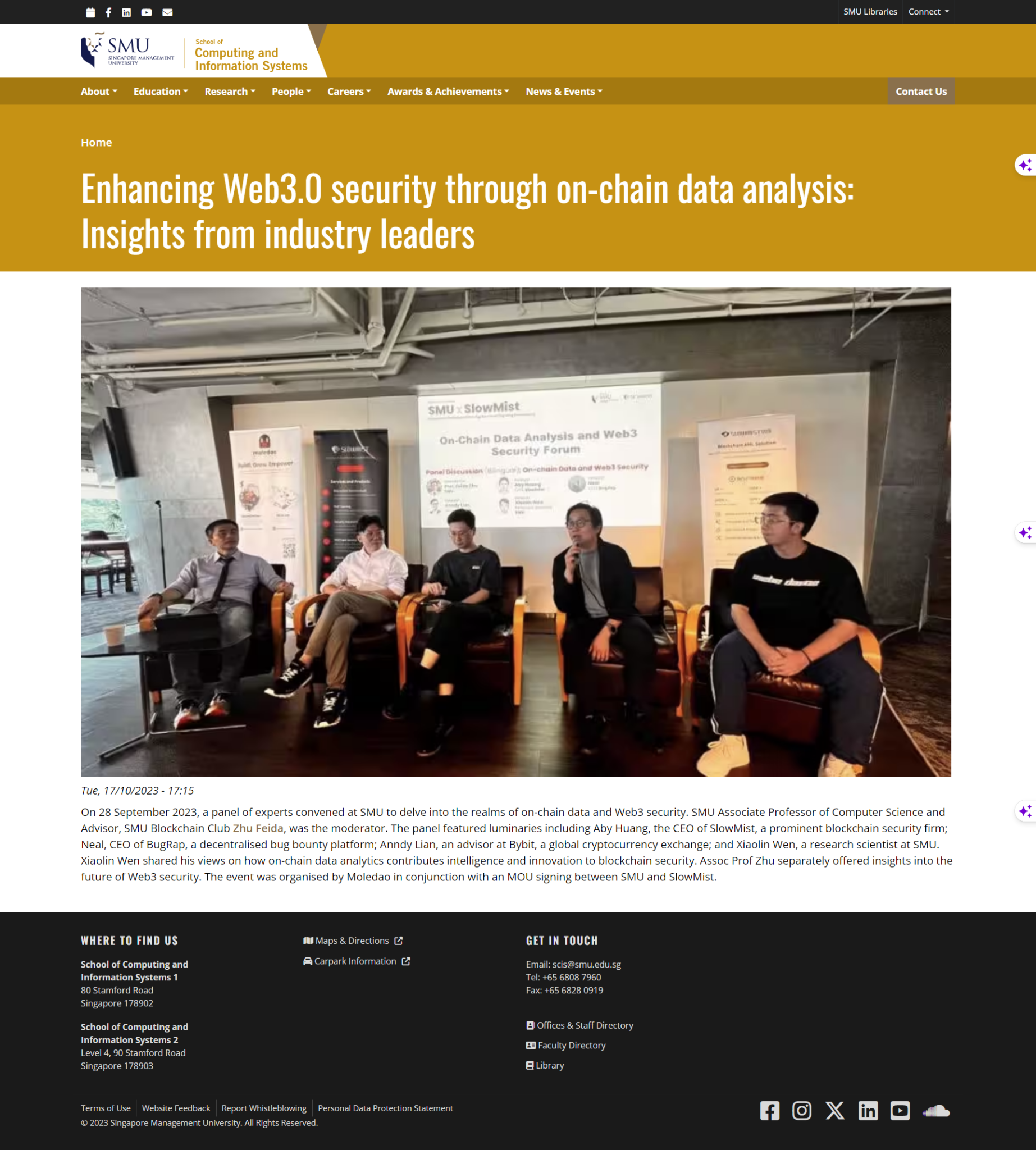
On 28 September 2023, a panel of experts convened at SMU to delve into the realms of on-chain data and Web3 security. SMU Associate Professor of Computer Science and Advisor, SMU Blockchain Club Zhu Feida, was the moderator. The panel featured luminaries including Aby Huang, the CEO of SlowMist, a prominent blockchain security firm; Neal, CEO of BugRap, a decentralised bug bounty platform; Anndy Lian, an advisor at Bybit, a global cryptocurrency exchange; and Xiaolin Wen, a research scientist at SMU. Xiaolin Wen shared his views on how on-chain data analytics contributes intelligence and innovation to blockchain security. Assoc Prof Zhu separately offered insights into the future of Web3 security. The event was organised by Moledao in conjunction with an MOU signing between SMU and SlowMist.

Source: https://scis.smu.edu.sg/news/2023/oct/17/enhancing-web30-security-through-chain-data-analysis-insights-industry-leaders

j j j