Unveiling the Potential of LSD-fi: Liquid Staking and Yield Generation Explored

Unveiling the Potential of LSD-fi: Liquid Staking and Yield Generation Explored

Introduction

Innovative platforms and strategies have emerged within the dynamic world of decentralized finance (DeFi), empowering cryptocurrency holders to maximize their earnings. One particularly captivating concept is LSD-fi, an abbreviation for Liquid Staking and Yield Generation. LSD-fi encompasses a diverse range of DeFi platforms and strategies that enable users to stake their tokens and earn liquid staking tokens (LSTs) while optimizing their potential for generating yield.

DeFi Liquid Staking Providers: Staking Tokens for Security and Rewards

At the core of the LSD-fi ecosystem, DeFi platforms serve as the fundamental infrastructure that facilitates user token staking. Token staking involves securely locking tokens in smart contracts and actively contributing to the consensus mechanism of the blockchain network. This active contribution plays a crucial role in ensuring network security by validating transactions and maintaining the integrity of the blockchain.

When users stake their tokens, they assume the roles of validators or delegators, depending on the specific staking mechanism employed by the blockchain. Validators propose and validate new blocks, while delegators choose validators to stake their tokens on their behalf. Both validators and delegators play vital roles in ensuring the smooth operation and security of the network.

As a reward for their active participation in staking, users receive LSTs. These tokens represent the assets staked by users and hold various applications within the DeFi ecosystem. It possesses intrinsic value and can be traded, sold, or held by users. They serve as a form of proof of stake (PoS), providing evidence of ownership and contribution within the network.

Participating in governance decisions is a significant advantage of holding LSTs. Many PoS-based blockchain networks allow token holders to engage in voting and decision-making processes that shape the network’s future development and governance. By possessing the tokens, users gain a voice and the opportunity to influence the direction and policies of the underlying blockchain project.

It grants users access to additional services within the DeFi ecosystem. Certain platforms exclusively offer extra functionalities, such as decentralized exchanges, lending protocols, or liquidity pools, to LST holders. These services broaden users’ opportunities to generate more yield or participate in specific DeFi activities.

Additionally, holding LSTs presents the potential for future value appreciation. As the adoption and utility of the underlying blockchain network grow, the demand may increase, leading to a rise in their market value. Users who retain can benefit from capital appreciation if the value of these tokens increases over time. This potential for value appreciation provides users with an added incentive to engage in staking activities and hold onto their LSTs.

Centralized Exchange Staking Providers: Broadening Accessibility with Centralized Exchanges

Centralized exchanges (CEXs) have played a pivotal role in making liquid staking more accessible to a broader audience. Renowned for their user-friendly interfaces and established reputation, these exchanges recognize the potential of staking and integrate staking services into their platforms.

By offering staking services, they simplify the staking process for users, eliminating the need for complex technical knowledge or navigating multiple decentralized platforms. The familiar interface and user experience attract experienced cryptocurrency traders and newcomers to the world of DeFi.

The convenience provided by staking through CEXs is a significant advantage. Users can stake their tokens directly from their exchange wallets, eliminating the need to transfer tokens to external wallets or interact with smart contracts. This streamlined process reduces the risks of managing private keys or unfamiliar interfaces.

It also offers additional benefits to stakers, such as enhanced security measures and customer support. These exchanges have well-established security protocols to safeguard user funds and prevent potential hacks or security breaches. Additionally, their dedicated customer support teams are readily available to assist users with issues or concerns related to staking activities.

Another notable advantage of staking is the increased liquidity and tradability it provides. By staking tokens on these exchanges, users receive staking rewards in the form of LSTs. They can often be traded directly on the exchange, enabling users to manage their staked assets while still earning rewards. This liquidity empowers users to seize opportunities, such as buying or selling other cryptocurrencies or taking advantage of market fluctuations, without the need to unstake their tokens and wait for the unstaking period to complete.

Likewise, the integration of staking services allows users to diversify their investment strategies. Users can allocate their tokens to the exchange’s different staking options, spreading their risk across various projects or protocols. This diversification helps mitigate the impact of potential adverse outcomes on a single staking endeavor and allows users to optimize their yield generation.

Collateralized Debt Position (CDP) Staking: Unlocking Liquidity with CDP Staking

In DeFi, specific protocols have introduced an innovative mechanism known as CDP staking. This mechanism allows users to utilize their LSDs as collateral, unlocking the potential to generate stablecoins. By leveraging their LSD holdings, users can mint stablecoins, cryptocurrencies with a stable value pegged to an underlying asset or currency.

CDP staking involves users locking their LSDs as collateral within the DeFi protocol. This trustless and transparent mechanism ensures that the locked LSDs guarantee the stability of the generated stablecoins. The locked assets act as a guarantee, assuring the protocol that the staked assets fully back the stablecoins minted.

Generating stablecoins through CDP staking offers users several advantages. Firstly, stablecoins provide stability in the otherwise volatile cryptocurrency market. Their value is typically pegged to a stable asset, such as a fiat currency or a basket of assets, ensuring a relatively constant value. This stability enables users to utilize stablecoins for various purposes, including conducting transactions, hedging against market fluctuations, or accessing other DeFi protocols and investment opportunities.

Also, the availability of stablecoins enhances the overall liquidity of users’ portfolios. Users can employ these stablecoins as a medium of exchange or collateral in other DeFi protocols, opening up possibilities for borrowing, lending, or participating in liquidity pools. This expanded liquidity allows users to seize opportunities and explore different avenues within the DeFi landscape without compromising their staked assets.

CDP staking serves as an effective tool for users to access the value of their staked assets intelligently. By minting stablecoins and retaining their staked assets as collateral, users strike a balance between liquidity and participation in the staking ecosystem. This feature allows users to capitalize on market opportunities, manage their financial needs, and explore diverse DeFi applications while maintaining exposure to the potential benefits and rewards of staking.

Index LSD Staking Strategies: Amplifying Returns with Index LSD Staking

Index LSD staking strategies form an integral part of the LSD-fi ecosystem, too, empowering users to amplify their earnings by staking tokens and earning specific LSDs tied to a particular project or protocol.

This kind of staking allows users to increase their LSD holdings, potentially amplifying the returns on their staked assets. Such staking involves diversifying staked tokens across multiple projects or protocols rather than focusing solely on a single endeavor. This diversification strategy serves two important purposes: optimizing yield generation and reducing risks associated with individual projects.

Users increase their exposure to broader opportunities within the LSD-fi ecosystem by staking tokens across multiple projects. Each project or protocol within the index represents a unique avenue for potential growth and earnings. This diversification allows users to benefit from the success of multiple projects simultaneously, increasing the likelihood of capturing lucrative returns.

Adding on to my above points, I want to say that diversification mitigates the risks associated with individual projects. In the volatile and rapidly evolving landscape of DeFi, not all projects or protocols may achieve the same level of success or provide consistent returns. By staking tokens across multiple projects, users spread their risk exposure and reduce the impact of potential underperformance or failures of any single project. This risk mitigation strategy helps safeguard users’ investments and provides a more balanced and resilient approach to earning returns.

The strategies often rely on predefined indices curated by experts or governed by decentralized autonomous organizations (DAOs). These indices typically comprise projects or protocols that meet specific criteria or adhere to a common theme, such as a particular industry sector or technological focus. The selection and composition of the index are designed to optimize yield generation by including projects with strong growth potential and promising prospects.

By participating, users align their investments with the collective intelligence and expertise behind the curated index. This approach leverages the knowledge and research of index creators to identify and include projects with favorable prospects. Users can benefit from the expertise of index curators and tap into the potential of diverse projects, increasing their chances of earning attractive yields.

Money Markets and Borrowing with LSD Tokens: Accessing Liquidity and Investment Opportunities

Money markets are also known to be a key component. These money markets operate as lending protocols within the LSD-fi ecosystem, allowing users to use their LSD tokens as collateral to borrow other tokens. This feature offers users increased liquidity while allowing them to earn rewards from their staked tokens.

By leveraging their LSD holdings as collateral, users can unlock additional funds that can be used for various purposes within the DeFi space. For example, users can use these borrowed funds for further investments, exploring new projects or opportunities aligning with their investment strategies. The borrowed funds can be employed to participate in yield-generating activities, such as liquidity mining or yield farming, which can further enhance users’ overall earnings within the LSD-fi landscape.

Moreover, accessing additional funds through borrowing against staked LSD tokens gives users flexibility and agility in capitalizing on emerging opportunities within the dynamic DeFi space. The rapidly evolving nature of DeFi presents users with numerous possibilities, ranging from participating in new token launches to engaging in innovative yield strategies. Users can seize these opportunities and potentially generate higher returns by having access to borrowed funds.

Using borrowed funds from money markets can allow users to maintain their staked assets, ensuring they continue earning rewards and participating in the staking ecosystem. This means that users can benefit from the potential appreciation of their staked tokens and the rewards earned from staking while still having access to the value represented by their LSD holdings.

Closing

LSD-fi presents an exciting realm DeFi. Through DeFi platforms, users can stake their tokens, earn LSTs, and explore various strategies to generate yield. Whether through decentralized platforms, centralized exchanges, CDP staking, index strategies, or participation in money markets, users can unlock the untapped potential of their staked assets.

Token staking allows users to contribute to network security while earning rewards through LSTs actively. These tokens hold intrinsic value and offer users opportunities for trading, selling, and participating in governance decisions. Holding LSTs grants users access to additional services and potential value appreciation as the underlying blockchain network grows.

CEXs simplify the staking process, offering convenience, enhanced security, and increased liquidity and tradability of LSTs. CDP staking allows users to utilize their LSDs as collateral, unlocking liquidity by generating stablecoins. Index strategies enable users to diversify their staked assets, optimizing yield generation and reducing risks. Money markets and borrowing protocols provide opportunities for lending, borrowing, and earning interest on staked assets.

I think as the world of DeFi continues to evolve, the potential of LSD-fi remains to be fully explored. For example, new components like fusing it with NFTs could bring in new liquidity. NFTs represent unique digital assets and can be used as collateral or traded within decentralized lending and borrowing protocols. This opens up possibilities for leveraging the value of NFTs to access loans or earn interest. This will be for another time.

Overall, I hope users can understand that there are many opportunities. Take advantage of these innovative strategies and platforms to maximize their earnings, participate in the growth of decentralized networks, and embrace the exciting possibilities of DeFi.

The following is a guest post from web3 investor Anndy Lian.

 

Source: https://cryptoslate.com/unveiling-the-potential-of-lsd-fi-liquid-staking-and-yield-generation-explored/

j j j

Web3 Wave Summit: Pioneering the Future of Digital Empowerment

Web3 Wave Summit: Pioneering the Future of Digital Empowerment

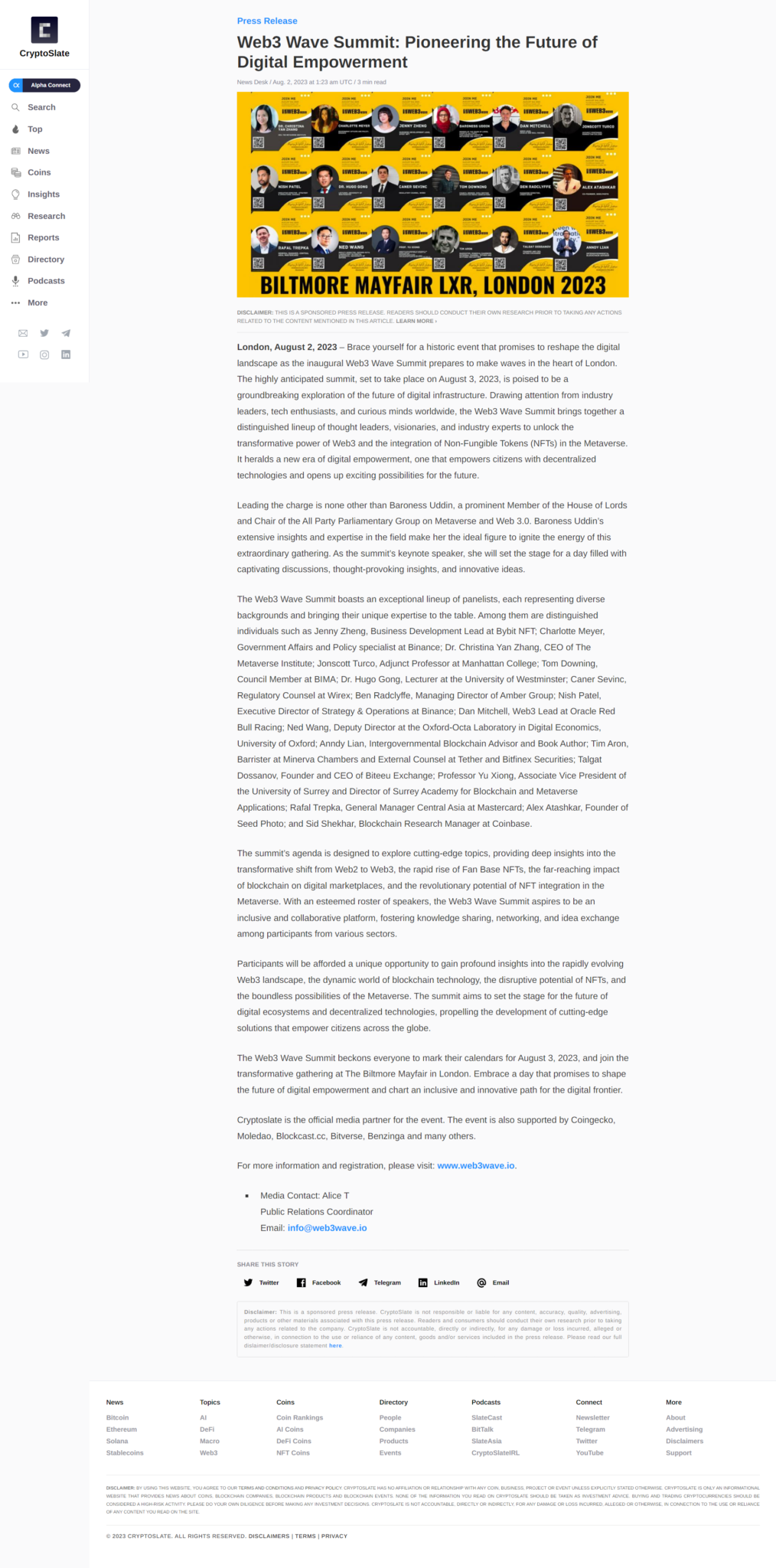
London, August 2, 2023 – Brace yourself for a historic event that promises to reshape the digital landscape as the inaugural Web3 Wave Summit prepares to make waves in the heart of London. The highly anticipated summit, set to take place on August 3, 2023, is poised to be a groundbreaking exploration of the future of digital infrastructure. Drawing attention from industry leaders, tech enthusiasts, and curious minds worldwide, the Web3 Wave Summit brings together a distinguished lineup of thought leaders, visionaries, and industry experts to unlock the transformative power of Web3 and the integration of Non-Fungible Tokens (NFTs) in the Metaverse. It heralds a new era of digital empowerment, one that empowers citizens with decentralized technologies and opens up exciting possibilities for the future.

Leading the charge is none other than Baroness Uddin, a prominent Member of the House of Lords and Chair of the All Party Parliamentary Group on Metaverse and Web 3.0. Baroness Uddin’s extensive insights and expertise in the field make her the ideal figure to ignite the energy of this extraordinary gathering. As the summit’s keynote speaker, she will set the stage for a day filled with captivating discussions, thought-provoking insights, and innovative ideas.

The Web3 Wave Summit boasts an exceptional lineup of panelists, each representing diverse backgrounds and bringing their unique expertise to the table. Among them are distinguished individuals such as Jenny Zheng, Business Development Lead at Bybit NFT; Charlotte Meyer, Government Affairs and Policy specialist at Binance; Dr. Christina Yan Zhang, CEO of The Metaverse Institute; Jonscott Turco, Adjunct Professor at Manhattan College; Tom Downing, Council Member at BIMA; Dr. Hugo Gong, Lecturer at the University of Westminster; Caner Sevinc, Regulatory Counsel at Wirex; Ben Radclyffe, Managing Director of Amber Group; Nish Patel, Executive Director of Strategy & Operations at Binance; Dan Mitchell, Web3 Lead at Oracle Red Bull Racing; Ned Wang, Deputy Director at the Oxford-Octa Laboratory in Digital Economics, University of Oxford; Anndy Lian, Intergovernmental Blockchain Advisor and Book Author; Tim Aron, Barrister at Minerva Chambers and External Counsel at Tether and Bitfinex Securities; Talgat Dossanov, Founder and CEO of Biteeu Exchange; Professor Yu Xiong, Associate Vice President of the University of Surrey and Director of Surrey Academy for Blockchain and Metaverse Applications; Rafal Trepka, General Manager Central Asia at Mastercard; Alex Atashkar, Founder of Seed Photo; and Sid Shekhar, Blockchain Research Manager at Coinbase.

The summit’s agenda is designed to explore cutting-edge topics, providing deep insights into the transformative shift from Web2 to Web3, the rapid rise of Fan Base NFTs, the far-reaching impact of blockchain on digital marketplaces, and the revolutionary potential of NFT integration in the Metaverse. With an esteemed roster of speakers, the Web3 Wave Summit aspires to be an inclusive and collaborative platform, fostering knowledge sharing, networking, and idea exchange among participants from various sectors.

Participants will be afforded a unique opportunity to gain profound insights into the rapidly evolving Web3 landscape, the dynamic world of blockchain technology, the disruptive potential of NFTs, and the boundless possibilities of the Metaverse. The summit aims to set the stage for the future of digital ecosystems and decentralized technologies, propelling the development of cutting-edge solutions that empower citizens across the globe.

The Web3 Wave Summit beckons everyone to mark their calendars for August 3, 2023, and join the transformative gathering at The Biltmore Mayfair in London. Embrace a day that promises to shape the future of digital empowerment and chart an inclusive and innovative path for the digital frontier.

Cryptoslate is the official media partner for the event. The event is also supported by Coingecko, Moledao, Blockcast.cc, Bitverse, Benzinga and many others.

For more information and registration, please visit: www.web3wave.io.


Source: https://cryptoslate.com/press-releases/web3-wave-summit-pioneering-the-future-of-digital-empowerment/

j j j

Web3 Wallets and Centralization: Can They Coexist?

Web3 Wallets and Centralization: Can They Coexist?

Web3 wallets have become a crucial tool in the new era of the Internet, where decentralization, blockchain, and cryptocurrencies are at the forefront of innovation. A Web3 wallet, also known as a crypto wallet, is a digital wallet that enables users to store, send, and receive cryptocurrencies, interact with smart contracts, transact NFTs, and access dApps on different blockchains.

As the use cases of Web3 wallets continue to expand, the question of whether centralization can play a role in managing these wallets arises. I will explore the concept of Web3 wallets managed by Centralized Exchange (CEX) and discuss whether it aligns with the principles of Web3.

What Is CEX + Web3 Wallet?

CEXs (centralized cryptocurrency exchanges) act as intermediaries for buying, selling, and trading cryptocurrencies in a centralized manner. They offer a user-friendly platform where users can conduct various cryptocurrency transactions. However, users must trust the exchange to manage their funds securely, as the exchange controls the wallets.

Web3 wallets provided by CEXs claim to integrate with decentralized ecosystems and allow interactions with dApps and blockchains. Despite this claim, the underlying nature of these wallets remains centralized, as the exchange retains control over users’ private keys and funds.

web3 app download

The centralization aspect of CEXs extends to their Web3 wallets in various ways:

  1. Users entrust the exchange with storing and managing their private keys, relying on the exchange’s security measures.
  2. The infrastructure supporting Web3 wallets, such as servers and network nodes, is owned and operated by the centralized exchange.
  3. Transactions from CEX’s Web3 wallets undergo internal approval and validation before being broadcasted to the blockchain, introducing a centralized control point.

For users seeking decentralization and full control over their funds, self-hosted software wallets or hardware wallets may be more suitable.

While Web3 wallets and centralization can coexist to some extent, the level of centralization varies depending on specific implementation and design choices by wallet providers. Understanding this relationship can shed light on how these elements interact.

Case Studies

Let me share some examples:

Case Study 1: OKX Wallet

OKX, a well-known player in the Web3 technology space and the second-largest cryptocurrency exchange in terms of trading volume, recently unveiled a significant upgrade to its OKX Wallet. This upgrade introduces groundbreaking features that position it as the first Web3 wallet to integrate advanced multi-party computation (MPC) technology.

Integrating MPC technology into the OKX Wallet eliminates the need for traditional key and seed phrase storage methods. Instead, the user’s private key is divided into three parts, significantly enhancing security and reducing the risks associated with a single point of failure. Leveraging MPC ensures that users retain complete control over their wallet assets while enjoying the highest level of security.

OKX Wallet operates as a fully decentralized and non-custodial solution, empowering users with full ownership and control over their funds. Unlike centralized exchanges, OKX does not hold users’ assets, creating a secure environment that allows individuals to have custody of their cryptocurrencies.

The wallet offers multi-blockchain support and automatically recognizes and connects to supported networks, providing a convenient solution for users engaged in decentralized finance (DeFi), non-fungible tokens (NFTs), and decentralized applications (DApps).

The upgraded OKX Wallet introduces an innovative asset recovery feature called “independent Emergency Escape,” revolutionizing the recovery process. In critical situations, users can regain access to their assets through using two out of three access credentials: a device, a cloud backup, or an OKX account login. This unique feature enhances user security and autonomy, allowing individuals to regain control of their assets without relying on OKX’s involvement.

In addition to its robust security features, the OKX Wallet provides complete control and ownership of funds, facilitating faster withdrawals without withdrawal approval. The wallet allows seamless management of multiple chains, eliminating the need for manual network switching.

Users can import multiple seed phrases and derive addresses within the wallet. Easy connectivity is ensured through the OKX Wallet web extension and dedicated iOS and Android mobile apps. Integration with the OKX DEX, an integrated decentralized exchange aggregator, enables multi-chain and cross-chain transactions.

Case Study 2: Bitverse

Introducing Bitverse, an innovative MPC + AA Wallet leading the way in building the “Credit Creates Wealth” Web3 ecosystem. Bitverse combines artificial intelligence, Oracle credit protocols, and advanced cryptographic techniques to create a secure, decentralized, and user-friendly environment for controlling and managing assets.

It aims to promote user engagement and loyalty with engaging features like lucky packets, event guessing, non-fungible tokens (NFTs), and airdrop tools. We will explore the key advantages and how it is shaping the landscape of Web3.

One of the primary advantages is its implementation of the Bitverse Credit Protocol (BCP) and Credit Oracle. BCP is a decentralized credit protocol that leverages AI and Oracle technology. It establishes a hybrid credit system (OCC + RWC) that operates on both the blockchain and off-chain.

Extending credit capabilities to both realms ensures that credit is accessible and convenient for all industry members and users. This innovative approach addresses common pain points in the industry, such as low fund utilization and limited benefits for high-credit users.

To achieve robust security, it employs MPC. It also prioritizes convenience for its users and incorporates a secret key partition management system with cryptography principles, zero-knowledge proofs, trusted execution environments (TEE), and robust authentication mechanisms.

In its development, it is actively working on an Account Abstraction (AA) wallet that supports non-main chain currencies. This AA wallet enables users to pay gas fees using alternative tokens. For compatibility, it supports single-signed wallets using traditional mnemonic phrases. This compatibility ensures a seamless transition for users already familiar with existing Web3 wallet practices while expanding the user base.

With its unique features and user-centric approach, it is shaping the future of decentralized finance and revolutionizing how users control and manage their assets in the digital world. It’s worth noting that Bitverse is integrated into the Bybit exchange, further expanding its reach and capabilities.

Can CEXs Manage Web3 Wallets?

The examples provided above serve to illustrate two distinct aspects. The first example showcases how a CEX can develop its own Web3 solution, while the second demonstrates the integration of a third-party solution. Both integrations have their merits and represent a positive step towards enabling users to experience the functionality of Web3.

In contrast, Web3 is founded on the principle of decentralization, ensuring that no single entity maintains control over the network. Decentralization enhances security, transparency, and resilience against attacks by eliminating a central point of failure.

So, can CEXs manage Web3 wallets? Technically, the answer is yes, but it contradicts the principles of Web3. When users entrust their assets to a CEX-managed Web3 wallet, they place their faith in the CEX, which undermines the concept of decentralization.

CEXs have a history of security breaches, and if it is hacked or goes bankrupt, users may permanently lose their funds. Moreover, they may impose restrictions on users’ funds, such as freezing or seizing them, which contradicts the financial sovereignty that Web3 aims to achieve.

Another concern with CEX-managed Web3 wallets is the risk of censorship. They may comply with government regulations and limit users’ access to specific decentralized applications (dApps) or blockchains, eroding the idea of an open and permissionless internet envisioned by Web3 further.

However, it is essential to note that not all CEXs are identical. Some have taken steps towards decentralization by adopting non-custodial features, enabling users to retain control over their private keys and assets while benefiting from the user-friendly interface of a centralized exchange.

Many also offer cross-chain interoperability, allowing users to access multiple blockchains from a single platform, which can be convenient for those who trade various cryptocurrencies. Nevertheless, despite these efforts, CEX-managed Web3 wallets still diverge from the core principles of Web3.

In Conclusion

Web3 wallets managed by CEXs may offer a user-friendly interface for cryptocurrency trading and accessing different blockchains, but they deviate from the fundamental principles of Web3. Decentralization is a pivotal aspect of Web3, distinguishing it from traditional Internet and financial systems.

While Web3 wallets and centralization can coexist, users should be cognizant of the degree of centralization involved and make informed decisions based on their priorities. For users seeking decentralization, the ideal scenario entails utilizing wallets prioritizing client-side control, locally stored private keys, and open-source code allowing independent verification.

The usual “Anndy Lian” quote to end the article: “Whether championed by a centralized or decentralized entity, this is the journey of Web3. We must respect this entire process.”

Source: https://www.financemagnates.com/cryptocurrency/web3-wallets-and-centralization-can-they-coexist/

j j j