Panel Discussion at Crypto Expo Asia 2023: The Institutionalisation of Blockchain Staking

Panel Discussion at Crypto Expo Asia 2023: The Institutionalisation of Blockchain Staking

In a panel discussion titled “The Institutionalization of Blockchain,” experts gathered to delve into the topics of blockchain decentralization, the future of Ethereum, and self-regulating technologies. Moderated by Anndy Lian, author of the book “NFT from Zero to Hero,” the panelists shared their insights on these critical subjects. Panelists included Anuj Shankar, CEO (Luganodes); Igneus Terrenus, Head of Communications and Business Development (Mantle Network by BitDAO); Ken Nizam, Founder & CEO (AsiaTokenFund Group); and Zhuling Chen, CEO (RockX).

The panel discussion commenced with a focus on how institutional investors can effectively manage risks when participating in blockchain staking. Ken emphasized the significance of conducting due diligence on the network’s security and governance. He stressed the importance of understanding the team behind the network and its track record in terms of security and resilience. Additionally, Ken highlighted the need for diversification, where institutions choose multiple staking providers to mitigate overall risk. Regulatory compliance was also deemed crucial, with staying updated on the latest regulations being a recommended practice.

Zhuling Chen added that institutional investors must comprehend the fundamental risks associated with crypto staking. These risks include crypto market volatility, network security, and platform safety. He mentioned the potential benefits of employing custodian services as an extra layer of protection, especially for those new to the crypto space. Insurance coverage was also suggested as a means to safeguard assets from hacks or loss.

Igneous Terraneans reiterated the notion that staking is an active contribution to the network’s security. It involves working to secure the network rather than merely earning passive income. Trust in the network’s robustness and team, as well as the proper management of rewards and counterparty risks, were highlighted as critical considerations. Diversification was mentioned as a prudent strategy, particularly for institutional investors with substantial assets.

The conversation then shifted towards zero trust and zero knowledge mechanisms and their applicability to institutional investors. Anndy Lian pointed out that staking is comparable to mining in the proof-of-work world, where physical machines secure the network. Staking, on the other hand, represents a virtual mining process, utilizing tokens and servers to safeguard the network. It was noted that institutions, especially those familiar with mining Bitcoin, may find it easier to understand staking as a form of fixed income derived from the network itself.

The panelists acknowledged that zero trust and zero knowledge principles lie at the core of blockchain technology, offering decentralized and trustless systems. While these mechanisms are not infallible, they are steadily improving, and teams are actively building on them. The power shift from centralized authorities to decentralized systems aligned with the ethos of blockchain. Institutions were encouraged to participate in these systems, contributing to a more distributed and secure network.

To facilitate broader institutional participation, the panelists stressed the need for simplicity in the staking process. Anuj from Luganotes highlighted the technical complexities involved in setting up and maintaining validators. While staking presents significant security considerations, it is crucial to streamline the process for institutional validators, especially newcomers to the space. Simplification would aid mass adoption and allow individuals without extensive technical knowledge to participate.

The panel discussion shed light on essential considerations for institutional investors. Risk management, due diligence, diversification, regulatory compliance, and custodian services were highlighted as crucial elements in managing risks effectively. The panelists emphasized the active role of staking in securing the network and discussed the importance of zero trust and zero knowledge mechanisms. Ultimately, the experts agreed that simplicity and security should be prioritized to encourage broader institutional participation in staking and contribute to the growth and decentralization of blockchain networks.

Crypto Expo Asia 2023 is a premier virtual asset and Blockchain Conference, organized by HQMena announced in Singapore 2023 with its large audience attending globally. Over 100+ Crypto companies are expected to participate in this event, with an estimated 3000+ attendees, Featured conference with 60+ Speakers, and many attendees from 30+ Countries.

Socials:

Facebook: http://www.facebook.com/anndylian
Twitter: http://www.twitter.com/anndylian
Instagram: http://www.instagram.com/liananndy
LinkedIn: https://www.linkedin.com/in/anndylian/
Homepage: http://www.anndy.com
YouTube: https://www.youtube.com/@AnndyLian

j j j

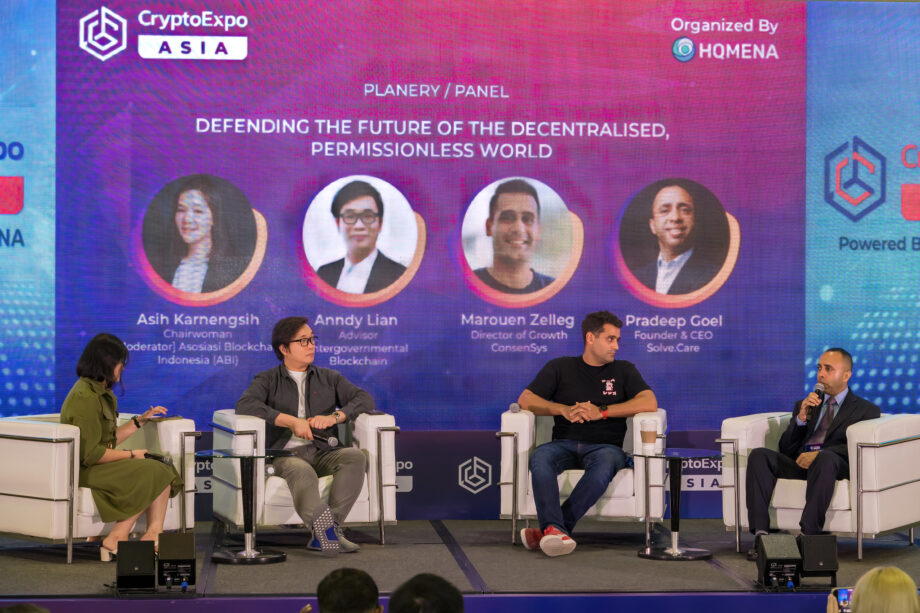
Crypto Expo Asia Panel Discussion: Defending the Future of the Decentralised, Permissionless World

Crypto Expo Asia Panel Discussion: Defending the Future of the Decentralised, Permissionless World

Topic- Defending the Future of the Decentralised, Permissionless World

Crypto Expo Asia, 7-8th June 2023, Singapore

Moderator- Asih Karnengsih, Chairwoman (Asosiasi Blockchain Indonesia)

Panelists:
– Anndy Lian (Intergovernmental Blockchain Advisor)
– Marouen Zelleg, Director of Growth (ConsenSys)
– Pradeep Goel, Founder & CEO (Solve.Care)

Crypto Expo Asia 2023 is a premier virtual asset and Blockchain Conference, organized by HQMena announced in Singapore 2023 with its large audience attending globally. Over 100+ Crypto companies are expected to participate in this event, with an estimated 3000+ attendees, Featured conference with 60+ Speakers, and many attendees from 30+ Countries.

One of the key discussions we have lined up is focused on “Defending the Future of the Decentralized Permissionless World.” This panel discussion brings together experts from different backgrounds to share their perspectives. The panelists include Asih Karnengsih, the moderator, Chairwoman of the Asosiasi Blockchain Indonesia; Anndy Lian, NFT from Zero to Hero book author; Marouen Zelleg, Director of Growth at ConsenSys, and Pradeep Goel, Founder and CEO of Solve Care.

Pradeep Goel emphasized the importance of user-centric security in the blockchain industry. He highlighted the challenges faced by users, especially in regulated industries such as healthcare. According to him, user-friendly solutions that protect identities, assets, and roles are crucial for driving adoption. Pradeep stressed the need for a holistic approach to security that combines nuanced identity management, asset protection, and role-based access.

Marouen Zelleg spoke about his commitment to decentralization. He shared his personal experiences from Tunisia, a country known for its centralized bureaucracy, and the limitations it imposes on individuals and businesses. Marwan expressed his passion for blockchain technology’s potential to transform economies and people’s lives. Consensus, through its software solutions, contributes to this mission by enabling developers to build on the blockchain.

Anndy Lian highlighted his role in advising companies and governments on blockchain adoption. He emphasized the importance of educating governments about the potential of blockchain technology and its benefits. Andy also mentioned his book, “NFT from Zero to Hero,” where he aims to educate people about decentralization and its implications.

The panelists further discussed the role of security in the decentralized world. Pradeep emphasized the significance of tying identity, assets, and roles together to provide a secure user experience. Marouen highlighted the need for a balance between security and decentralization. He drew parallels with the traditional taxi system, showcasing how decentralization can provide security and safety without relying on centralized entities. Anndy emphasized the role of artificial intelligence and blockchain analytics in enhancing security measures.

The conversation also touched upon the involvement of governments in the blockchain space. Anndy shared insights into the diverse perspectives of governments, ranging from concerns about regulation and taxation to promoting innovation and harnessing blockchain’s potential. He mentioned the increasing interest of governments in regulating aspects like wallets and monitoring crypto activities.

The panelists concluded that the implementation of blockchain technology in traditional institutions varies based on use cases and regulatory environments. While some institutions explore blockchain to revamp their infrastructure and benefit from quicker settlement times, others aim to cater to customer demands, such as providing crypto-related services within existing banking systems.

Socials:

Facebook: http://www.facebook.com/anndylian
Twitter: http://www.twitter.com/anndylian
Instagram: http://www.instagram.com/liananndy
LinkedIn: https://www.linkedin.com/in/anndylian/
Homepage: http://www.anndy.com
YouTube: https://www.youtube.com/@AnndyLian
 

j j j

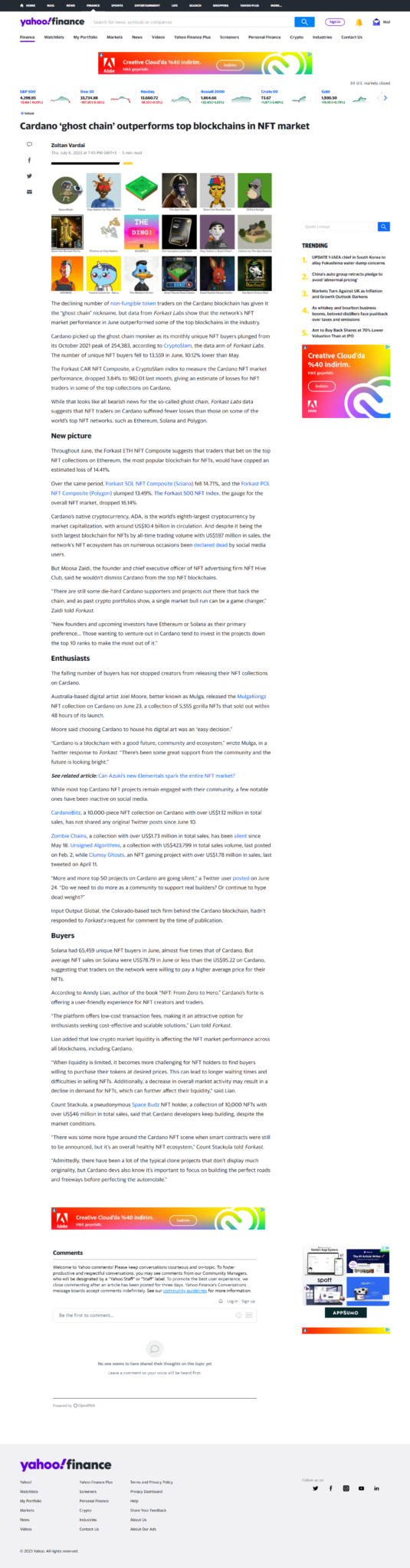
Cardano ‘ghost chain’ outperforms top blockchains in NFT market

Cardano ‘ghost chain’ outperforms top blockchains in NFT market

The declining number of non-fungible token traders on the Cardano blockchain has given it the “ghost chain” nickname, but data from Forkast Labs show that the network’s NFT market performance in June outperformed some of the top blockchains in the industry.

Cardano picked up the ghost chain moniker as its monthly unique NFT buyers plunged from its October 2021 peak of 254,383, according to CryptoSlam, the data arm of Forkast Labs. The number of unique NFT buyers fell to 13,559 in June, 10.12% lower than May.

The Forkast CAR NFT Composite, a CryptoSlam index to measure the Cardano NFT market performance, dropped 3.84% to 982.01 last month, giving an estimate of losses for NFT traders in some of the top collections on Cardano.

While that looks like all bearish news for the so-called ghost chain, Forkast Labs data suggests that NFT traders on Cardano suffered fewer losses than those on some of the world’s top NFT networks, such as Ethereum, Solana and Polygon.

New picture

Throughout June, the Forkast ETH NFT Composite suggests that traders that bet on the top NFT collections on Ethereum, the most popular blockchain for NFTs, would have copped an estimated loss of 14.41%.

Over the same period, Forkast SOL NFT Composite (Solana) fell 14.71%, and the Forkast POL NFT Composite (Polygon) slumped 13.49%. The Forkast 500 NFT Index, the gauge for the overall NFT market, dropped 16.14%.

Cardano’s native cryptocurrency, ADA, is the world’s eighth-largest cryptocurrency by market capitalization, with around US$10.4 billion in circulation. And despite it being the sixth largest blockchain for NFTs by all-time trading volume with US$597 million in sales, the network’s NFT ecosystem has on numerous occasions been declared dead by social media users.

But Moosa Zaidi, the founder and chief executive officer of NFT advertising firm NFT Hive Club, said he wouldn’t dismiss Cardano from the top NFT blockchains.

“There are still some die-hard Cardano supporters and projects out there that back the chain, and as past crypto portfolios show, a single market bull run can be a game changer,” Zaidi told Forkast.

“New founders and upcoming investors have Ethereum or Solana as their primary preference… Those wanting to venture out in Cardano tend to invest in the projects down the top 10 ranks to make the most out of it.”

Enthusiasts

The falling number of buyers has not stopped creators from releasing their NFT collections on Cardano.

Australia-based digital artist Joel Moore, better known as Mulga, released the MulgaKongz NFT collection on Cardano on June 23, a collection of 5,555 gorilla NFTs that sold out within 48 hours of its launch.

Moore said choosing Cardano to house his digital art was an “easy decision.”

“Cardano is a blockchain with a good future, community and ecosystem,” wrote Mulga, in a Twitter response to Forkast. “There’s been some great support from the community and the future is looking bright.”

See related article: Can Azuki’s new Elementals spark the entire NFT market?

While most top Cardano NFT projects remain engaged with their community, a few notable ones have been inactive on social media.

CardanoBitz, a 10,000-piece NFT collection on Cardano with over US$1.12 million in total sales, has not shared any original Twitter posts since June 10.

Zombie Chains, a collection with over US$1.73 million in total sales, has been silent since May 18. Unsigned Algorithms, a collection with US$423,799 in total sales volume, last posted on Feb. 2, while Clumsy Ghosts, an NFT gaming project with over US$1.78 million in sales, last tweeted on April 11.

“More and more top 50 projects on Cardano are going silent,” a Twitter user posted on June 24. “Do we need to do more as a community to support real builders? Or continue to hype dead weight?”

Input Output Global, the Colorado-based tech firm behind the Cardano blockchain, hadn’t responded to Forkasts request for comment by the time of publication.

Buyers

Solana had 65,459 unique NFT buyers in June, almost five times that of Cardano. But average NFT sales on Solana were US$78.79 in June or less than the US$95.22 on Cardano, suggesting that traders on the network were willing to pay a higher average price for their NFTs.

According to Anndy Lian, author of the book “NFT: From Zero to Hero,” Cardano’s forte is offering a user-friendly experience for NFT creators and traders.

“The platform offers low-cost transaction fees, making it an attractive option for enthusiasts seeking cost-effective and scalable solutions,” Lian told Forkast.

Lian added that low crypto market liquidity is affecting the NFT market performance across all blockchains, including Cardano.

“When liquidity is limited, it becomes more challenging for NFT holders to find buyers willing to purchase their tokens at desired prices. This can lead to longer waiting times and difficulties in selling NFTs. Additionally, a decrease in overall market activity may result in a decline in demand for NFTs, which can further affect their liquidity,” said Lian.

Count Stackula, a pseudonymous Space Budz NFT holder, a collection of 10,000 NFTs with over US$46 million in total sales, said that Cardano developers keep building, despite the market conditions.

“There was some more hype around the Cardano NFT scene when smart contracts were still to be announced, but it’s an overall healthy NFT ecosystem,” Count Stackula told Forkast.

“Admittedly, there have been a lot of the typical clone projects that don’t display much originality, but Cardano devs also know it’s important to focus on building the perfect roads and freeways before perfecting the automobile.”


Source: https://finance.yahoo.com/news/cardano-ghost-chain-outperforms-top-164500757.html


j j j