Why the USDC depeg is not a reason to panic

Why the USDC depeg is not a reason to panic

The crypto industry is currently experiencing anxiety due to concerns about the potential detachment of USDC, a stablecoin supported by US dollars. As an individual who closely monitors the market, I have been observing the situation and would like to share some of my personal views.

Firstly, It’s worth emphasizing that Silicon Valley Bank (SVB), responsible for holding the funds backing USDC, reportedly has enough assets to meet all withdrawal requests. According to the Federal Deposit Insurance Corporation (FDIC) reports as of December 31, 2022, SVB had approximately $209.0 billion in assets and about $175.4 billion in deposits. However, despite the impressive asset base, there are still concerns about the liquidity of SVB’s book and what percentage of a haircut would be expected if the bank were to experience significant losses.

This uncertainty stems from the fact that the bank’s underlying assets are not transparent, and there are no clear indications of how illiquid or risky these assets might be. As a result, there is a risk that if SVB’s assets experience significant losses or become illiquid, the bank may struggle to meet all of its obligations, potentially resulting in a depeg of USDC. This would significantly impact the broader crypto market, as USDC is widely used as a trading pair on various exchanges.

Secondly, another important aspect to consider regarding the stability of USDC is the financial backing provided by Circle, the company that issues the stablecoin. Circle holds 77% of their reserves in highly liquid instruments such as 1-4 month T-Bills, managed by Blackrock and held at BNY Mellon. This allocation of reserves provides significant security for USDC, as T-Bills are generally considered very safe and highly liquid investments.

The T-Bills held by Circle provide an absolute floor for USDC of around 0.77, meaning that even in the worst-case scenario, USDC should not depeg below this level. Furthermore, since T-Bills are highly liquid, they should be easily sold if Circle needs to raise funds quickly to meet unexpected obligations.

This provides additional protection for USDC and helps mitigate any potential risks associated with the stablecoin. It’s also worth noting that Circle’s retained earnings and interest income should theoretically be sufficient to cover any expected “losses” it may be exposed to from SVB. This means that even if SVB were to experience significant losses or become illiquid, Circle should be able to cover any potential losses without impacting the stability of USDC.

Thirdly, another point to consider when assessing the potential impact of a depeg of USDC is the maximum exposure of Circle. This company issues the stablecoin to Silicon Valley Bank (SVB), the bank that holds the funds backing USDC. Experts estimate that Circle’s maximum exposure to SVB will be around $198 million, which is a relatively small percentage of the total funds backing USDC, which is approximately $3.3 billion.

While this may seem like a large sum, it’s important to note that Circle has significant financial reserves and should be able to absorb any potential losses without significantly impacting the stability of USDC. The crypto market as a whole has grown significantly over the past few years, with a current market capitalization of close to $1 trillion. In this context, the potential loss of $198 million would represent a relatively small percentage of the overall market. It should not significantly impact investor confidence or the stability of the crypto market as a whole.

Fourthly, the relationship between Coinbase and Circle. Another factor that may reassure investors in USDC is the relationship between Coinbase and Circle. Coinbase, one of the largest crypto exchanges in the world, holds $4.4 billion on its balance sheet and is a 50-50 partner with Circle in the Centre Consortium, which oversees the technical aspects of USDC. Given its significant investment in USDC and its partnership with Circle, Coinbase has a vested interest in ensuring the stability of the stablecoin.

This may mean that Coinbase could provide additional support to Circle if needed, further strengthening the stability of USDC. Coinbase has a strong reputation in the crypto industry and has demonstrated a commitment to regulatory compliance and financial stability. As such, the involvement of Coinbase in the management of USDC may provide an additional layer of confidence for investors.

While there are concerns about the potential depeg of USDC, several possible scenarios could play out over the next week. One possibility is that Coinbase, as a partner in the Centre Consortium and a major investor in USDC, may provide additional support to Circle if needed. This could take the form of additional financial backing or other resources to help ensure the stability of USDC. Another possibility is that Circle may take on debt or credit facilities from BlackRock or other institutional lenders to help shore up its financial position.

This could provide additional liquidity and help to address any concerns about the stability of USDC. It’s also possible that the Federal Reserve may intervene to support Silicon Valley Bank (SVB), the bank that holds the funds backing USDC. While this may be seen as an unlikely scenario, it cannot be completely ruled out, given the potential impact of a destabilization of USDC on the broader financial system.

Several actions can be taken regarding risk management for investors who hold USDC. One option is to hedge USDC/USDT perpetual swaps by shorting USDC through centralized or decentralized exchanges (CeFi or DEX). This strategy can help offset potential losses if the value of USDC were to decline. Another strategy is to borrow USDC against USDT on lending protocols. However, this option may be limited due to the potential risks associated with USDC. Investors may also consider trading out of USDC and into USDT on CeFi exchanges at a rate of around 0.95 if they are concerned about the stability of USDC.

This can help to reduce exposure to any potential risks associated with USDC. It’s also important to note that investors should avoid sending USDC to Circle for redemption. While the risk of gated redemption is relatively low, there is still a potential risk of this occurring. As such, it’s recommended that investors hold USDC in a safe and secure wallet and take appropriate risk management measures to protect their investment.

In conclusion, investors must stay vigilant and informed during market volatility, such as the current unease in the crypto sector surrounding USDC. It’s important not to make impulsive decisions based on uncertainty or unpredictability but to remain composed and clear-headed. One way to stay informed is to follow updates and analyses from reliable sources, such as financial news outlets or industry experts.

It’s also important to understand one’s investment portfolio, including any potential risks or vulnerabilities. Taking a measured and calculated approach to investing can help mitigate potential losses and protect one’s assets. By remaining watchful and well-informed, investors can navigate market volatility and uncertainty with greater confidence and clarity.


Source: https://cryptoslate.com/op-ed-why-the-usdc-potential-depeg-is-not-a-reason-to-panic/


j j j

Bet on the Black? Take a punt on the Red? Or maybe put it all down on an NFT?

Bet on the Black? Take a punt on the Red? Or maybe put it all down on an NFT?

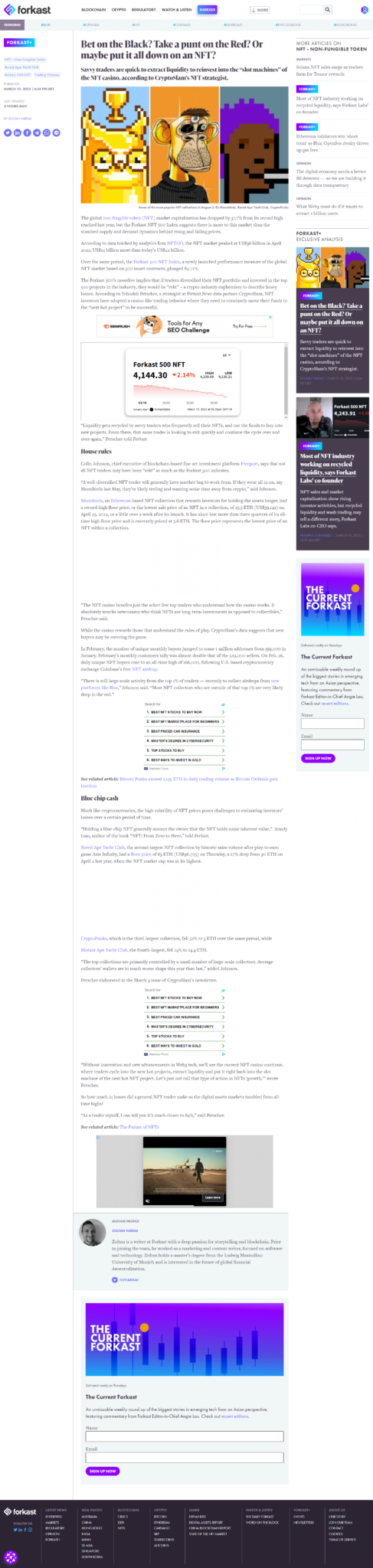
The global non-fungible token (NFT) market capitalization has dropped by 37.7% from its record high reached last year, but the Forkast NFT 500 Index suggests there is more to this market than the standard supply and demand dynamics behind rising and falling prices.

According to data tracked by analytics firm NFTGO, the NFT market peaked at US$36 billion in April 2022, US$14 billion more than today’s US$22 billion.

Over the same period, the Forkast 500 NFT Index, a newly launched performance measure of the global NFT market based on 500 smart contracts, plunged 84.71%.

The Forkast 500’s nosedive implies that if traders diversified their NFT portfolio and invested in the top 500 projects in the industry, they would be “rekt” – a crypto industry euphemism to describe heavy losses. According to Yehudah Petscher, a strategist at Forkast.News data partner CryptoSlam, NFT investors have adopted a casino-like trading behavior where they need to constantly move their funds to the “next hot project” to be successful.

“Liquidity gets recycled by savvy traders who frequently sell their NFTs, and use the funds to buy into new projects. From there, that same trader is looking to exit quickly and continue the cycle over and over again,” Petscher told Forkast.

House rules

Colin Johnson, chief executive of blockchain-based fine art investment platform Freeport, says that not all NFT traders may have been “rekt” as much as the Forkast 500 indicates.

“A well-diversified NFT trader will generally have another bag to work from. If they went all in on, say Moonbirds last May, they’re likely reeling and wanting some time away from crypto,” said Johnson.

Moonbirds, an Ethereum-based NFT collection that rewards investors for holding the assets longer, had a record-high floor price, or the lowest sale price of an NFT in a collection, of 25.5 ETH (US$39,142) on April 25, 2022, or a little over a week after its launch. It has since lost more than three quarters of its all-time high floor price and is currently priced at 5.6 ETH. The floor price represents the lowest price of an NFT within a collection.

While the casino rewards those that understand the rules of play, CryptoSlam’s data suggests that new buyers may be entering the game.

In February, the number of unique monthly buyers jumped to some 1 million addresses from 593,000 in January. February’s monthly customers tally was almost double that of the 529,000 sellers. On Feb. 26, daily unique NFT buyers rose to an all-time high of 166,000, following U.S.-based cryptocurrency exchange Coinbase’s free NFT airdrop.

“There is still large-scale activity from the top 1% of traders — recently to collect airdrops from new platforms like Blur,” Johnson said. “Most NFT collectors who are outside of that top 1% are very likely deep in the red.”

Blue chip cash

Much like cryptocurrencies, the high volatility of NFT prices poses challenges to estimating investors’ losses over a certain period of time.

“Holding a blue-chip NFT generally assures the owner that the NFT holds some inherent value,”  Anndy Lian, author of the book “NFT: From Zero to Hero,” told Forkast.

Bored Ape Yacht Club, the second-largest NFT collection by historic sales volume after play-to-earn game Axie Infinity, had a floor price of 63 ETH (US$96,705) on Thursday, a 27% drop from 90 ETH on April 2 last year, when the NFT market cap was at its highest.

Mutant Ape Yacht Club, the fourth-largest, fell 14% to 14.4 ETH.

“The top collections are primarily controlled by a small number of large-scale collectors. Average collectors’ wallets are in much worse shape this year than last,” added Johnson.

Petscher elaborated in the March 3 issue of CryptoSlam’s newsletter.

So how much in losses did a general NFT trader make as the digital assets markets tumbled from all-time highs?

“As a trader myself, I can tell you it’s much closer to 84%,” said Petscher.


Source: https://forkast.news/nft-casino-forkast-500-black-red/

j j j

Hong Kong’s New Crypto Licensing Regime: A Boon or Bane for Investors?

Hong Kong’s New Crypto Licensing Regime: A Boon or Bane for Investors?
  • The new regulations are expected to attract more foreign investment into Hong Kong.

  • Analysts remain unsure of how China will treat Hong Kong’s new crypto regime.

The new crypto regulations in Hong Kong have been a topic of discussion among investors and industry players alike. The announcement of the new licensing regime has brought hope for many who believe that it will make Hong Kong a major player in the crypto market. However, some remain cautious and have raised concerns about the potential risks that come with such a move. In this article, we will explore the opportunities and risks associated with the new Hong Kong crypto regulations, compare them with Singapore and South Korea, and discuss whether China is likely to back out.

New crypto exchanges

The new Hong Kong crypto regulations present several opportunities for the industry. Firstly, the licensing regime allows for the creation of new crypto exchanges, which will attract more investors and create more jobs. For example, a new exchange called Huobi Hong Kong is set to focus on institutional investors and high-net-worth individuals. This is good news for the industry as institutional investors are known to bring stability and liquidity to the market.

Secondly, the new regulations are expected to attract more foreign investment into Hong Kong. Hong Kong’s strong determination to regain the title of global crypto center is reflected in a series of policies and statements issued by the Hong Kong Monetary Authority. This is expected to create a favorable business environment that will attract foreign investors and companies to Hong Kong. This will benefit not only the crypto industry but also the overall economy of Hong Kong.

Thirdly, the new regulations are expected to enhance transparency and reduce the risk of money laundering and fraud. The Hong Kong Securities and Futures Commission has taken a regulatory approach to cryptocurrencies, which contrasts with recent actions in the US of regulation by enforcement. This approach will help build trust among investors and promote long-term growth in the industry.

However, while the new Hong Kong crypto regulations present several opportunities, they also come with risks. One of the biggest risks is the potential for increased market volatility. The crypto market is notoriously volatile, and the creation of new exchanges and the influx of more investors may exacerbate this. Moreover, there is the possibility of fraud and manipulation, which can further increase volatility and undermine investor confidence.

Lack of competition

Although the new Hong Kong crypto regulations present several opportunities, they also come with some risks. One of the biggest risks is the potential for increased market volatility. The crypto market is notoriously volatile, and the creation of new exchanges and the influx of more investors may exacerbate this. Moreover, there is the possibility of fraud and manipulation, which can further increase volatility and undermine investor confidence.

The new regulation may lead to a concentration of power in the hands of a few large exchanges. This can lead to a lack of competition, which can result in higher fees and a decrease in innovation. This is a problem that has been observed in other industries, such as banking and telecommunications, where a lack of competition has resulted in poorer service and higher prices.

Lastly, there is the risk of government interference. While the Hong Kong government has been supportive of the new regulations, there is always the possibility that it may change its stance. This could lead to a situation where the government restricts or bans crypto trading altogether. This would have a devastating impact on the industry and its investors.

Singapore as a major player

Hong Kong is not the only country in the region that is looking to regulate the crypto industry. Singapore and South Korea have also taken steps to regulate the industry. Singapore has been proactive in its approach, establishing a regulatory framework that encourages innovation while protecting investors. This has made Singapore a major player in the crypto market, with several major exchanges based in the country.

South Korea, on the other hand, has taken a more cautious approach. In 2017, the government banned initial coin offerings (ICOs), citing concerns about fraud and money laundering. However, the ban was lifted in 2018, and the government has since established a regulatory framework that requires exchanges to register with the Financial Services Commission. While this has led to a decrease in the number of exchanges in the country, it has improved investor protection and reduced the risk of fraud.

Compared to Singapore and South Korea, Hong Kong’s new crypto regulation is more similar to Singapore’s approach. Both countries have taken a proactive approach to regulation, with a focus on promoting innovation while protecting investors. However, Hong Kong’s new licensing regime is more focused on institutional investors, while Singapore’s regulatory framework is designed to cater to a broader range of investors.

Possible Backlash from China

Finally, there is the question of whether China is likely to back out of the new Hong Kong crypto regulation. China has been cracking down on the crypto industry, with a ban on ICOs and cryptocurrency exchanges in 2017. However, there are indications that China may be softening its stance. In 2019, President Xi Jinping stated that China should accelerate the development of blockchain technology. Moreover, in 2021, several Chinese companies announced plans to enter the crypto industry.

Despite these positive signs, there is still a risk that China may object to the new Hong Kong crypto regulations. China sees Hong Kong as part of its territory and may view the new regulations as a challenge to its authority. If this happens, it could lead to a deterioration of relations between Hong Kong and China, which would have far-reaching consequences for the industry and its investors.

Concentration of power

In conclusion, the new Hong Kong crypto regulations present both opportunities and risks. While they are expected to attract more investors and create a favorable business environment, there is also the potential for increased market volatility, concentration of power, and government interference. Compared to Singapore and South Korea, Hong Kong’s approach is more focused on institutional investors but shares a similar emphasis on promoting innovation and protecting investors. Whether China will back out of the new regulations remains to be seen, but there is a risk that it may object, leading to a deterioration of relations between Hong Kong and China.

Note: For new investors, be reminded that the crypto market is volatile. Please do your own proper research and do not get carried away by the hype. Today you can 10X, and tomorrow you may lose everything.

Source: https://www.financemagnates.com/cryptocurrency/hong-kongs-new-crypto-licensing-regime-a-boon-or-bane-for-investors/

j j j