What is Web4 and where are the opportunities?

What is Web4 and where are the opportunities?

Ideal decentralization refers to a system or network in which no single entity has control or the ability to make decisions for the entire system. Instead, power and decision-making are distributed among multiple participants, making it more difficult for any one person or group to manipulate or control the system. This ideal state could be Web4. 

Web4 is not a widely used term and it’s not a consensus definition, so it may refer to different things depending on the context. However, some people use the term “Web4” to refer to the next generation of the World Wide Web, which would be even more decentralized and more focused on artificial intelligence, semantic web, and the internet of things, among other things. It would be characterized by more dynamic, autonomous, and interconnected systems that can learn from data, communicate with each other and adapt to changing environments. This would allow for more dynamic and adaptable systems that can learn from data and improve over time.

It’s important to note that Web4 is not an official term and it’s not a widely accepted concept in the industry, so the extent to which it would be more decentralized than the current web (Web3) or previous versions of the web would depend on how it is defined.

New decentralization

The idea behind Web4 is to create a more decentralized and autonomous web that allows for more direct interactions between users and devices without the need for intermediaries. This could include the use of decentralized technologies, such as blockchain, peer-to-peer networks, and distributed systems, to enable new forms of online interactions and services that are not controlled by centralized entities. Additionally, Web4 could also have a greater focus on AI and machine learning, which would allow for more dynamic and adaptable systems that can learn from data and improve over time.

Some of the advantages of a more decentralized web include:

  • Greater security and privacy, as users have more control over their data and online interactions

  • More open and transparent systems, as there is no central point of control or failure

  • Greater resilience and robustness, as the network can continue to function even if parts of it fail

  • More innovation and competition, as there are fewer barriers to entry for new players

Web4 is seen as the next evolution of the World Wide Web, building upon the decentralized technologies of Web3. In Web4, the user experience is streamlined and frictionless, with the underlying technical details abstracted away. This means that users won’t need to worry about the specific blockchain being used, the intricacies of ZK-Rollups, or setting the right gas limit for transactions. The gas wars and transaction fees of the current web3 will be a thing of the past.

Moreover, Web4 has the potential to create a circular crypto-economy that transcends physical and digital boundaries, making the need for fiat on and off ramps obsolete. This would be a significant disruption in the current financial system.

There are other interpretations of what Web4 could be, such as the “symbiotic web,” which refers to a symbiotic relationship between humans and machines, possibly even utilizing direct brain-machine interfaces.

Overall, the transition from Web1 to Web2, and now from Web3 to Web4, is similar in that it is a gradual process that opens new doors and invites more people to participate. While Web3 is still in its early stages and considered experimental, Web4 is expected to be more accessible and user-friendly, making it more widely adopted by the general public.

Where are the opportunities?

Web 4.0 offers a wealth of possibilities for companies and individuals. The symbiotic web will enable the creation of more personalized experiences, allowing businesses to better understand their customers and provide tailored content.

AI-powered automation will improve efficiency, speed up time to market and lower costs, giving businesses a competitive edge and better customer service.

The combination of hardware, software and data will enable the development of new products and services, such as connected devices that interact with users and gather data for personalization.

Web 4.0 also opens up new revenue streams, like targeted advertising or subscription services, using data collected.

Additionally, VR and AR applications will allow for new ways for businesses to engage with customers, for example, creating an AR application that allows customers to interact with products in a 3D space.

In summary, what do we see in Web4?

1) Industry 4.0 full automation

2) Decentralized sustainable metaverse + AR + VR

3) AI making steps into the decentralized realm

4) Real decentralized app and economies

5) Real power back to the users

Web5 and Jack

In 2022, Jack Dorsey, the former CEO of Twitter, emerged as a leading figure in the development of Web5. He shared his vision for the next generation of the internet at the Consensus crypto and blockchain conference. Dorsey’s team at TBD, the Bitcoin-focused division of his fintech company Block (formerly known as Square), supports him in this endeavour.

According to Dorsey, Web5 is a solution to the issues he has with Web3, particularly his belief that it will never fully achieve decentralization.

“You don’t own ‘Web3.’ The [venture capitalists] and their [limited partners] do,” Dorsey said in a tweet, referring to the billions being poured into Web3. “It will never escape their incentives. It’s ultimately a centralized entity with a different label.”

“Know what you’re getting into,” he warned.

Ending note:

Yes, it’s important to note that true decentralization is a core principle of a decentralized economy. This means that there is no central authority or intermediary controlling or managing the network or its transactions. Instead, power and control is distributed among the network’s participants, and decisions are made through consensus mechanisms such as voting or proof of work. Decentralization ensures that the network is resistant to censorship, fraud, and other malicious activities and that the network’s users have full control over their own assets.

Perhaps, Web4 is a chance for us to redefine decentralization, reform and improve decentralization, and revalue the true meaning behind decentralisation.


Source: https://www.binance.com/en/feed/post/217984


j j j

TMRW Conference Completed Its Spectacular Debut in Dubai

TMRW Conference Completed Its Spectacular Debut in Dubai

The Biggest Global Tech Experts Graced the Stages of the Groundbreaking Event

Dubai, United Arab Emirates–(Newsfile Corp. – February 13, 2023) – TMRW conference powered by 2142, the largest emerging tech event, just delivered its groundbreaking debut edition in Dubai. More than 2,000 visitors and 10,000 online viewers from all over the world, were enjoying the conference’s outstanding program alongside networking events, VIP dinner and parties, from February 8th till 10th 2023 at Dubai Festival City. TMRW Dubai welcomed 80 internationally acclaimed tech masterminds such as Craig Sellars, Dr. Marwan Al Zarouni, Dr. Michael Gebert, Christopher Gleich, Davinci Jeremie, Dr. Christina Yan Zang, Christopher Quet, Khalifa Aljaziri Alshehhi, Abdulla Ziad Galadari, Dusan Zica, Stephanie Bretonniere, Caner Sevinc, Anndy Lian, Jenny Zheng and many more.

They were all presenting their keynotes, participating in panel discussions, interactive workshops and fireside chats, bringing the latest trends from the disruptive technologies such as blockchain development, NFT utilization, future of the Metaverse and Web3, artificial intelligence (AI) and many more. As always, TMRW brought mind blowing stage production while the opening ceremony was a trailblazing spectacle with the astronaut on stage, immersed in smoke, pyrotechnics and special effects.

The second Belgrade edition of the TMRW conference is announced, scheduled for May 12 – 14 2023. “I want to thank everyone who supported us at our Dubai debut; our amazing speakers, partners, media and audience. Our goal has always been to connect our visitors with the greatest global minds, to inspire the move forward and to bring the future closer. We are working hard to bring the highest quality programming alongside the incredible productions while providing the networking opportunities to everyone involved. And we’re happy to be able to do it around the world. We are proud to announce our second Belgrade edition from May 12th till 14th, which will be our biggest event so far, and I would like to invite everyone to join us!” said Mladjen Merdovic, Founder and CEO of TMRW conference.

Dr. Marwan Alzarouni, Strategic Advisor at Digital Dubai, welcomed the audience on the first day and emphasized Dubai’s role in being the hub of tech while Khalifa Al Jaziri Alshehhi, advisor of the Ministry of Economy, demonstrated the first Ministry having presence in the Metaverse.

They were followed by Michael Gebert, Chairman of the European Blockchain Association who was speaking about the future of blockchain and Christian Gleich, CEO of one Big Wave who talked about the future of Metaverse. Panel of the day gathered the Web3 Lady leaders Loretta Joseph, Ritu Marya, Aleksa Mil, Jenny Zheng and Anita Kalergis “KryptoGranny” to discuss the potential in Web3.

The day one ended with the exclusive launch of the VVerse project. Christopher Quet, CEO and co-founder of Vverse Technologies, said: “We wanted to bring real world use inside the Metaverse. We believe that Metaverse should be a land of opportunities bringing on abundance rather than scarcity. You can onboard and edit your own dimension with our builder and through our library of more than 100,000 assets. You can create events, concerts, you name it, you can do it.

Day two continued to bring great topics and speakers. Loretta Joseph, Director at AP Capital, spoke about the different regulatory frameworks for digital and virtual assets: “I don’t think there’s ever been a more important time to be talking about regulation. Regulation is coming. We all need to work with the policy makers to ensure that we have sensible regulation, and to harness the opportunities of technology and innovation“, she said.

Dr. Mark Van RijmenamThe Digital Speaker, talked about generative AI and the convergence with the Metaverse. “We have this technology, which is super powerful to create text, voice, audio, virtual worlds, assets, anything on the fly just with your voice. That will create Metaverse and bring it faster than through coding.” 

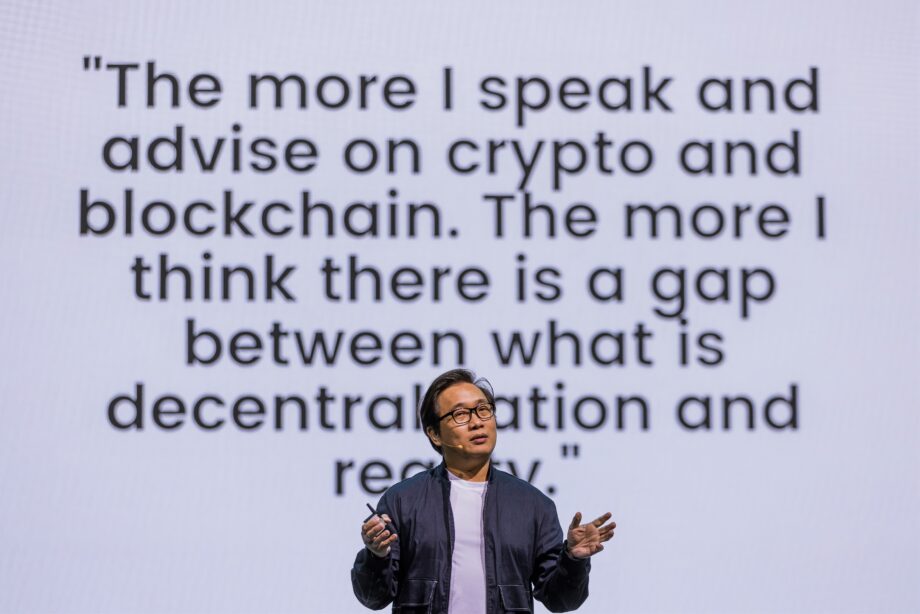
Anndy Lian, Best Selling Book Author – NFT: From Zero to Hero talked about Web4 as a new way to decentralize. “The Metaverse ecosystem and Web3 needs to be more decentralized. Web4 would be a totally different era, with machines and with full automation. If we want to really create a more sustainable, decentralized environment, we’ve got to make the change. And again, a Web4 could be the possible angle.” 

Dusan Zica, CEO & CTO of the NFT Comic Book 2142, brought the philosophical approach to building the world in his keynote From NFT Comic Book to video game: “The idea is to make comic books and video games presenting our view that technology should be in line with spirituality and humanity, and it should be observed strictly as a tool and not the driving force. Humanity’s humanity should be the driving force. Otherwise the technology can get instrumentalized instead of becoming decentralized,” he concluded.

Last day of the conference brought great global masterminds to the stageSharad Agarwal, Chief Metaverse Officer at cyber-gear.io, presented the topic Business and Metaverse: “I talked about how the Internet changed over the years. Metaverse as a technology is something new, and over the next 5 to 7 years, we will see its mass adoption. Metaverse will be used in different industries. Brands should start dabbling with the Metaverse, and get customers to experience it,” he added.

Jonscott Turco, Founder & CEO at COre3.io, spoke about reinventing business, exploring opportunities and challenges of the Metaverse and future technology. “In the heart of every successful business is the belief that something greater exists than simply the bottom line. It’s a belief in the power of people and connection and today, more than ever, the power of technology to bring us closer together and amplify community and collective intelligence towards purposeful outcomes.”

Davinci Jeremie, talked about the differences of using NFTs for just artwork and for utility purposes. “In return, you get access to someone or access to a concert; that’s an example of utility. I believe that it can also be useful in the community sense, where you bring a community of people together, sharing a common goal,” he explained.

Stephanie Bretonniere, CEO, POWR3 & WE IMPACT.WORLD explained how important it is to connect people. “Sustainability has to bring impact that will elaborate those technologies to convert every single individual into a changemaker.”


Source: https://finance.yahoo.com/news/tmrw-conference-completed-spectacular-debut-114700809.html

j j j

Binance Adds ZK-SNARKs to Improve Privacy of Proof of Reserves Report

Binance Adds ZK-SNARKs to Improve Privacy of Proof of Reserves Report
In Brief
  • Binance introduces zk-SNARKs into Proof of Reserves to prove changes to user asset balances with greater anonymity.
  • The exchange is also adding SHIB, DOT, CHZ, and SOL to the assets covered in future reports.
  • Crypto VC Nic Carter suggests the zk-SNARKs add significant privacy value to Proof of Reserves reports, but reports must be backed by other regulations related to an exchange’s fidcuiary duties.

Binance announced that it would introduce zero-knowledge proofs to improve the quality of its Proof of Reserves report.

Zk-SNARKs will allow Binance users to securely and privately confirm nonnegative balances and changes of balances using information from its proof of reserves Merkle tree.

Binance Makes Progress in PoR Roadmap, But Auditors Are Missing

As part of the announcement, Binance said it added SHIB, DOT, CHZ, and SOL to the assets covered by its proof of reserves report. Additionally, the exchange will open-source the zk-SNARKs code to improve transparency and to help other exchanges improve their reporting. Binance has yet to reveal the frequency of forthcoming reports.

Zk-SNARKs, an abbreviation of zero-knowledge succinct on-interactive arguments of knowledge, confirms a statement’s truth without revealing any information about the statement.

The zk-SNARK will verify that each user’s asset balance set is part of a global state of user funds Binance maintains. Additionally, it will anonymously ensure that the user’s net balance is not negative by including collateral posted for margin trading. Customers can use zk-SNARKs to verify that the Merkle root hash in Binance’s Merkle tree reflects asset balance changes. The Merkle root hash is essentially a cryptographic summary of all user balances. Changes to a user’s asset balances will prompt an update of the Merkle root hash, which the zk-SNARK will confirm.

Binance’s addition of zk-SNARKs is the last step in a transparency roadmap outlined at the end of November 2022. Part of its roadmap involved securing the services of a third-party auditor to audit its proof-of-reserves. This initiative has been jeopardized by the exit of accounting firm Mazars from the crypto space. Mazars was the accounting firm that conducted an agreed-upon procedure for the exchange’s first proof-of-reserves report.

Crypto VC Says Zero-Knowledge Proofs Only One Part of the Puzzle

While the technical implementations of PoRs vary, crypto VC Nic Carter expects zero-knowledge methods to supersede the technical limitations of traditional Merkle tree reports.

However, while zk-SNARKs represent an important step in the right direction for the world’s largest exchange, it is still only one part of a broader toolkit that can prevent collapses like FTX. Blockchain expert Anndy Lian agreed, saying that while not perfect, zk-SNARKs provide a “big enhancement.”

According to Carter, exchanges need additional rules to segregate corporate and user assets and protect customer assets from bankruptcy. Additionally, U.S. lawmakers must create a viable market for accounting firms to invest in tools to oversee PoR attestations. Doing so would also encourage offshore exchanges to conduct PoR reports.

Because audits are expensive and done quarterly, Carter suggests that they accompany, rather than replace, more frequent PoR reports, which provide updated customer reassurances.

Source: https://beincrypto.com/binance-adds-zk-snarks-proof-of-reserves-report/


j j j