Can the Metaverse Facilitate Sustainable Growth of Defi Systems?

Can the Metaverse Facilitate Sustainable Growth of Defi Systems?
  • Users could earn and spend virtual currency within the metaverse to buy and sell goods and services.
  • The metaverse could also support the creation and trade of unique digital assets.

The development of the metaverse, as a virtual world that combines elements of the real world with digital creations and experiences, has the potential to generate a new economy. The metaverse could offer users various activities and applications, including social interaction, entertainment, education, commerce, and more. These activities could generate value and economic opportunities for individuals, businesses, and other entities within the metaverse.

Users could earn and spend virtual currency within the metaverse to buy and sell goods and services or use decentralized finance (DeFi) tools and platforms to manage and trade their assets.

The metaverse could also support the creation and trade of unique digital assets, such as non-fungible tokens (NFTs), which could have value within and outside the metaverse. In addition, businesses and other organizations could use the metaverse for marketing, advertising, and other activities that generate revenue.

In my humble opinion, I think it is possible that the development of the metaverse could facilitate the growth of sustainable decentralized finance (DeFi) ecosystems. The metaverse is a virtual world that combines elements of the real world with digital creations and experiences, and it has the potential to support a wide range of activities and applications, including financial ones.

DeFi’s Future

These tools and platforms allow users to access and interact with financial services and assets more openly, transparent, and securely, potentially enabling greater financial inclusion and autonomy. DeFi is still a largely nascent and evolving field, and its potential impact and limitations are still being explored and debated. Since both metaverse and DeFi are new and debatable. It has potential upsides.

In a metaverse context, DeFi could potentially offer users a more immersive and interactive experience for managing and using their assets, as well as access to a wider range of financial services and opportunities. This could potentially lead to more sustainable DeFi ecosystems, as the increased accessibility and user engagement could drive adoption and growth.

Thoughts on How Decentralization Can Be Used in Metaverses:

1. Use decentralized exchanges to trade assets within the metaverse.

2. Use decentralized lending and borrowing platforms to access credit and earn interest on assets within the metaverse.

3. Use decentralized insurance platforms to protect against risks within the metaverse.

4. Use decentralized prediction markets to speculate on events within the metaverse.

5. Use decentralized governance mechanisms to make decisions and govern communities within the metaverse.

6. Use decentralized identity systems to securely manage and verify identities within the metaverse.

7. Use decentralized reputation systems to assess the trustworthiness of individuals and entities within the metaverse.

8. Use decentralized oracles to provide reliable data and information for use within the metaverse.

9. Use decentralized storage and data management systems to securely store and manage data within the metaverse.

10. Use decentralized automation and smart contract platforms to facilitate and automate transactions and interactions within the metaverse.

In theory, a metaverse could facilitate the growth of decentralized finance (DeFi) systems by providing a platform for people to access and interact with these systems in a more intuitive and user-friendly way.

One potential benefit of a metaverse is that it could make it easier for people to understand and use DeFi systems, which can sometimes be complex and difficult to navigate. By providing a visual representation of DeFi protocols and networks, a metaverse could help to demystify these systems and make them more accessible to a wider audience.

Another potential benefit of a metaverse is that it could provide a more engaging and immersive experience for users of DeFi systems. By allowing people to interact with each other and with digital assets in a virtual environment, a metaverse could make DeFi more fun and engaging, potentially increasing user adoption and participation in these systems.

Will Decentralization Work Better in the Metaverse?

Well, decentralization has the potential to offer several benefits in the context of the metaverse, a virtual world that combines elements of the real world with digital creations and experiences. Decentralization could enable users to have greater control and autonomy over their assets and activities within the metaverse, and it could provide a more resilient and secure infrastructure for the metaverse.

Decentralized finance (DeFi) tools and platforms could enable users to manage and trade their assets within the metaverse without relying on a central authority. Decentralized governance mechanisms could allow communities within the metaverse to make decisions and coordinate their activities in a decentralized manner. Decentralized identity systems could provide users with secure and verifiable identities within the metaverse.

It could provide a more resilient and secure infrastructure for the metaverse. Because decentralized systems are distributed across multiple nodes, they are less vulnerable to single points of failure and can continue to operate even if one or more nodes go offline. This could make the metaverse more resilient and less susceptible to attacks or other disruptions. Thus making the metaverse environment a good testing ground for decentralization.

DEXs on Metaverse: The Potential is Big

This could be a really crazy thought here. Centralized exchanges (CEXs) are already under the microscope of many regulators. Their first action is to go decentralized, forming new decentralized exchanges (DEXs). This is not a safe option too, the regulators are not blind, and they know that the operators behind the DEXs are from the same group of people.

Because a metaverse is a virtual shared space, DEXs could operate within it without being subject to the same regulatory constraints as they would in the real world. This could give DEXs greater freedom to innovate and experiment with new business models and technologies.

Operating within a metaverse could provide DEXs with access to a larger and more diverse user base. Because a metaverse is a virtual environment, it could potentially attract users from around the world, regardless of their physical location. This could give DEXs access to a larger and more diverse pool of users, potentially increasing their reach and user adoption.

Perhaps operating from a metaverse can give them a longer pathway.

Conclusion

The global metaverse market size was valued at USD 22.79 billion in 2021 and is expected to grow at a compound annual growth rate (CAGR) of 39.8% during 2022-2030. This is a big market. The potential is enormous.

However, I got to emphasize this again. The development and realization of the metaverse as an economic engine is still a largely untested and evolving concept. It will likely require significant advancements in technology and infrastructure, as well as the coordination and cooperation of various stakeholders, to fully realize the potential of this virtual world.

Summarizing my thoughts with a quote:

“The combination of metaverse and decentralized finance is an enormous potential for the future. Investors have put it in the spotlight as they consider it a great long-term investment opportunity. Many of us see this as one of the megatrends of the coming years. I believe it coming. Do you?” – Anndy Lian

Source: https://www.financemagnates.com/cryptocurrency/can-the-metaverse-facilitate-sustainable-growth-of-decentralized-finance-defi-systems/

j j j

6 NFT mistakes to avoid for newbies

6 NFT mistakes to avoid for newbies

We all know that the NFT is the next big thing and has many forward-looking potentials and utilities. As you find more NFTs trading in different marketplaces, you start to wonder what you should do next: “to buy or not buy”.

Here are six NFT trading mistakes to avoid for newbies.

Not promoting your NFT

After buying the NFT that you like, that NFT is yours. Most people have this mentality that the creator should be promoting, and as holders of the NFT, let’s sit back to watch the prices grow.

I’m afraid that’s not right. If you promote your copy of NFT, your unique NFT could be the one that gets sold the fastest. Always remember you control your assets. There is no need to wait for the creator.

Flipping it too fast

In the bull market, you have heard from NFT experts that they flipped their NFT 100X in an hour for millions of dollars.

Yes, this is possible back then. Right now, at this bearish market, you need to think long-term. You bought something that you feel has good value and potential. You bought a low price, and you do not mind keeping it. This kind of mentality will bring you far. “Good things take time”- remember this.

Buying it on the wrong marketplace

There are many NFT marketplaces in the space right now. Some of them are more controlled; They filter what can be listed and remove items that are unsuitable, not authentic or with copyright issues. While some are more open, adopting an “anyone can list” model, they have minimum supervision, and anyone can list almost anything on their platform.

If you choose the latter, you could be buying a fake and when you realise that, you are too late. There is no one attending to your complaints. And yes, there is no refund too. Hence choose wisely.

Buying an NFT that you do not like it

This is a real example. I have friends flexing their apes and punks as profile pictures to show they are well-to-do. But the fact is they do not like them. One guy told me he wants the tiger more, and it is his good luck animal, but there isn’t a big blue chip tiger NFT project. So he bought the monkey.

My sincere advice is to buy something you like, not just for the value. Last month, I purchased an NFT at US$0.01 from the Bybit NFT marketplace. It is affordable, has potential, and most importantly, I like the colours, and I am keeping it. This is how it should be. There is no stress about it.

Not using the right tools

There are many groups out there who are giving you tips on which one to buy. You can take their advice, but I suggest you research before agreeing and committing to your first NFT.

Many NFT tools in the market right now help you with your decision. For instance, some tools allow you to check on the rarity types. Some tools will enable you to analyse the volume and tell if any wash trading is involved. Stop guessing. Use the right tools!

Listening to the wrong consultants

NFT creators who listened to the wrong consultants are another common thing. They tend to hire the more expensive consultants thinking they know it all. Based on a survey I have conducted with corporations which have launched their NFT, they paid US$300,000 on average to the consultants to start the ball rolling.

I advise corporations and individuals to look online for resources before hiring consultants. I know of NFT studios who helped fellow creators by sharing their resources for free and helping them to list on platforms with zero cost.

One of the groups that I founded in 2006 is doing just that. They groom NFT rising stars, front the NFTs for them and do not ask a single cent from the creators. I think the spirit of sharing is essential, and they did it all correctly.

I am not here to put up any sale propositions. I want to see more people entering the NFT market with ease. And that is why I launched my book “NFT: From Zero to Hero by Anndy Lian” in August.

An NFT or non-fungible token is a unique digital identifier recorded in a blockchain and used to certify authenticity and ownership. Remember the above. It is not a profile picture or just another speculative product. The real value is in its utility. Do not make this mistake as well.


Source: https://e27.co/6-nft-mistakes-to-avoid-for-newbies-20221212/

j j j

Selecting a derivatives DEX: An overview & comparison

Selecting a derivatives DEX: An overview & comparison

For the purposes of this article, we’ll be looking broadly at these three measures: security and privacy, transaction and cost efficiency and lastly, token ecosystems and reward-generating offerings.

Trading volume on decentralized exchanges (DEXs) hit $32 billion within seven days in mid-November, recording another high since early June this year. This came after an explosive, tumultuous week in the crypto industry, which drove many investors — both seasoned and new alike — to take refuge in self-custodial, permissionless and decentralized trading platforms.

A variety of DEX models are available on the market at present; built on the principles of decentralization and financial freedom for all without restrictions, DEXs have been welcomed for the following reasons:

  • Removal of intermediaries supervising trades, where traders execute their trades based on immutable smart contracts
  • Greater security and privacy as only traders are privy to their data and such data cannot be shared/seen by others
  • Traders own their funds and assets, with multiple alternatives for fund recovery in the event of platform service suspensions or disruptions.
  • No access restrictions based on geographical locations or profiles, i.e., no KYC requirements
  • Community-focused, where stakeholders share in the platform’s revenue for providing liquidity, staking, and more.

DEXs such as Uniswap dominated the surge in November 2022, and traders are spoilt for choice when choosing a DEX to rely on, given the multiple options on the market. For seasoned traders searching for a derivatives alternative to capture trading opportunities and use every trading signal to the fullest, one could turn to derivatives DEXs — where margin trading and leverage options exist for customizable orders on various popular contracts.

Here’s a comparison of three derivatives DEXs that have shown up on traders’ radars recently, two of which are familiar to most traders — dYdX and GMX. The last DEX we’ll be looking at is the newly-launched ApeX Pro, which has increasingly gained attention after its beta launch back in August with recorded 6,000% growth in trading volume.

Let’s dive into the detail

dYdX is a leading decentralized exchange that supports spot, margin and perpetual trading. GMX is a decentralized spot and perpetual exchange that supports low swap fees and zero price impact trades and works on a multi-asset AMM model. And finally, ApeX Pro is a non-custodial derivative DEX that delivers limitless perpetual contract access with an order book model.

Comparison Criteria

For this article, we’ll be looking broadly at these three measures: (1) security and privacy, (2) transaction and cost efficiency, and lastly, (3) token ecosystems and reward-generating offerings.

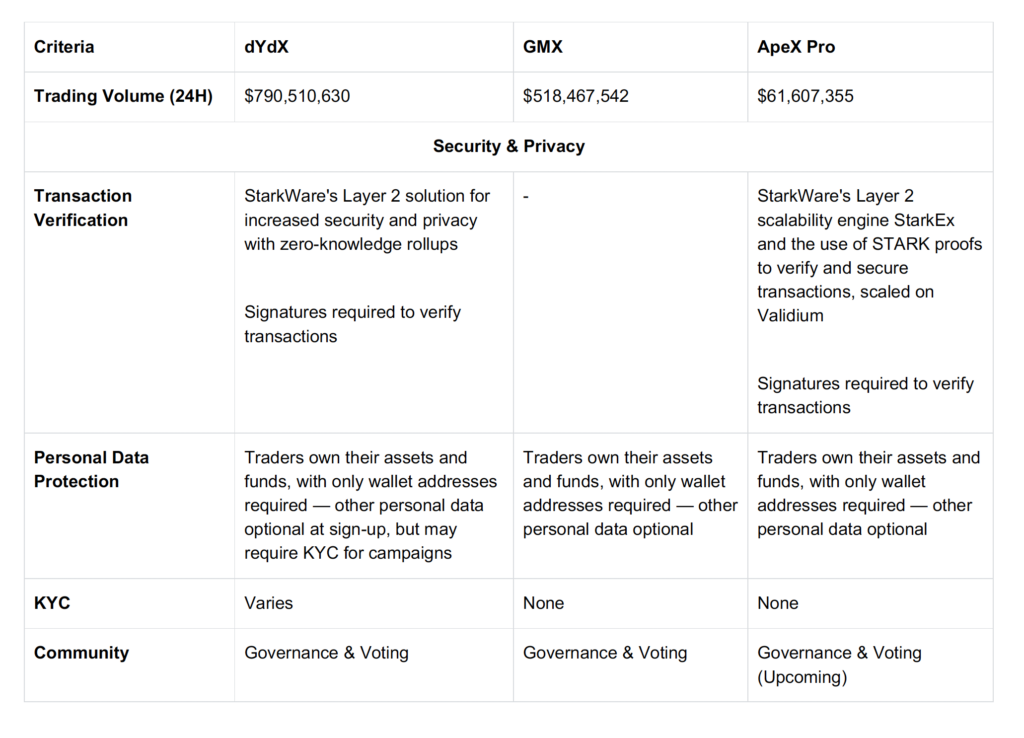
The above is a non-exhaustive list of notable highlights from the respective DEXs. dYdX and GMX are trader favorites for good reasons, so let’s see how the new ApeX Pro fares against the other two DEXs.

(1) Security & Privacy

All three DEXs are on relatively equal grounds regarding privacy-preserving measures, of which self-custody of funds is a common denominator across — the importance of a trading platform that is non-custodial is undeniable in light of recent events.

In particular, both dYdX and ApeX Pro have added safeguards with the integration of StarkWare’s Layer 2 scalability engine StarkEx, allowing the users of both DEXs to access forced requests to retrieve their funds even if the DEXs are not in service. Additionally, STARK proofs are used in both dYdX and ApeX Pro to facilitate the accurate verification of transactions, whereas GMX relies on the safety provisions of Arbitrum and Avalanche.

DEXs are known for their privacy-preserving measures, which is why GMX and ApeX Pro, in true decentralized fashion, are fully non-KYC. dYdX, on the other hand, has, on a previous occasion, implemented KYC to claim rewards for a selected campaign.

Another notable factor would be the provisions for governance and community discussions — on dYdX and GMX, pages to host votes and discussions are readily available. At present, however, ApeX Pro is still working towards creating their community-dedicated space for individuals to carry out activities such as voting and putting up suggestions.

(2) Transaction Cost & Efficiency

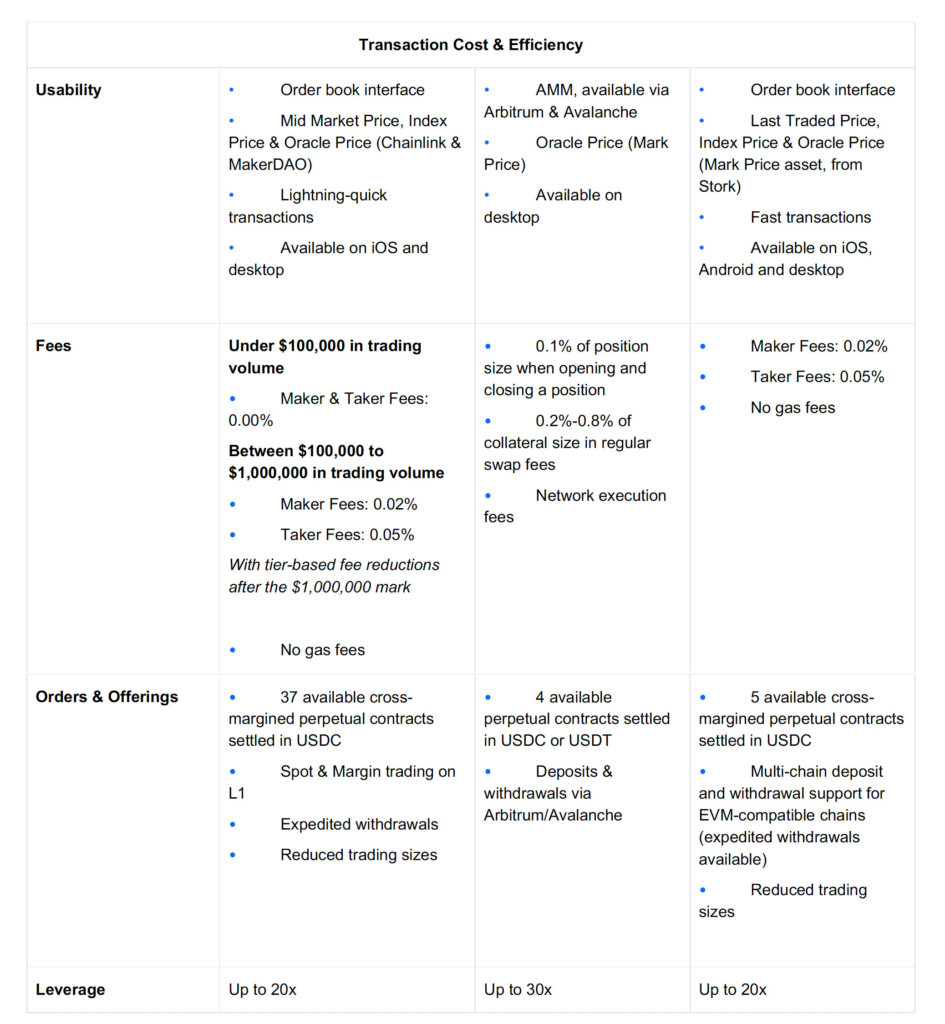
ApeX Pro has decided to go with the orderbook interface that is found most commonly in CEXs, and like dYdX, this trading model works because it removes the barrier to entry for traditional and aspiring crypto traders to step into DeFi. It also utilizes three price types which help to prevent market manipulation. However, it would be up to a trader’s preference to see Mid-Market Price (dYdX) or Last Traded Price (ApeX Pro) for more accurate trades.

With StarkWare’s integration, it is no surprise that ApeX Pro amped up on transaction speeds to process approximately ten trades and 1,000 order placements every second at no gas fees, together with the low maker and taker fees. dYdX’s tiered fees are incredibly comprehensive and cater to different trader’s different trading sizes; without any gas fees, it is unsurprising that derivatives DEX traders have looked primarily at dYdX.

These tiered fees are also familiar to derivatives traders on CEXs. GMX, on the other hand, does charge network execution fees, which means that gas fees paid by the trader for their trade may vary according to market factors.

ApeX Pro doesn’t have tiered fees just yet but considering that it just launched in November, differential fees are likely to drop soon with an upcoming VIP program, where the staked amount of APEX will determine the discount applied to maker-taker fees.

For traders looking for choices in trading pairs, dYdX remains the DEX with the greatest number of perpetual contracts while also providing access to spot and margin trading at the same time on Layer 1 Ethereum. ApeX Pro and GMX do not offer as many perpetual contracts as dYdX. Still, with new trading pairs being introduced frequently, it’s only a matter of time before traders get access to multitudes of assets and pairs on the remaining DEXs.

What might be notable for all is ApeX Pro’s support for multi-chain deposits and withdrawals on EVM-compatible chains; this is certainly a plus point for traders who engage in dynamic trades across multiple platforms, chains and asset categories in crypto.

(3) Tokens & Rewards

Of all factors, this is probably the one that most traders are interested in — how each DEX helps to multiple rewards and earnings while ensuring that these rewards remain valuable to the individual trader over time.

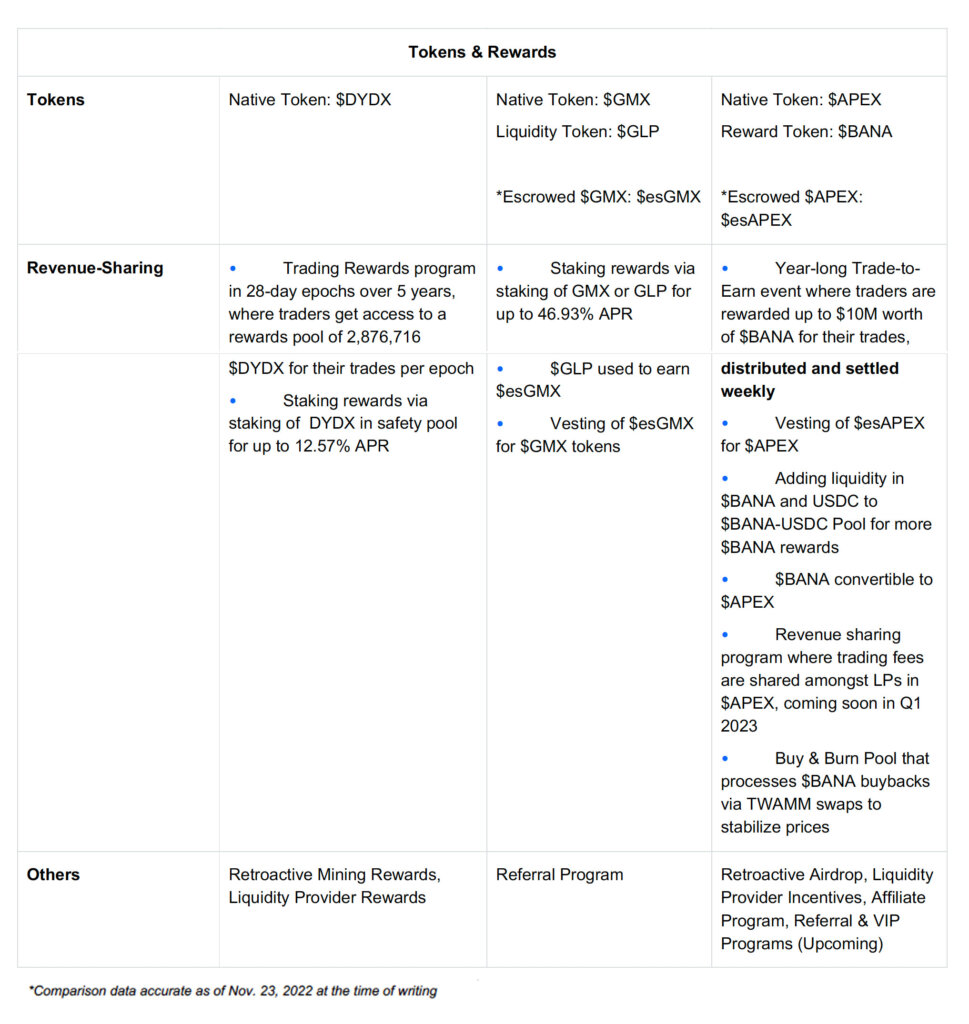
With dYdX and GMX, the success and popularity of trading events to earn rewards and staking incentives are apparent. It is paramount for DEXs to enable access to revenue-sharing programs for their community members and token holders, which commonly involve the distribution of trading fees accrued over a single period. Rewards and incentives are typically distributed in the platform’s native tokens.

dYdX’s offerings are straightforward, with a Trading Rewards program that distributes 2,876,716 $DYDX to traders based on their trading volume in 28-day epochs. On top of that, users can also stake $DYDX in a pool to receive additional staking rewards. This dual-earning track remains a success amongst traders. GMX, on the other hand, has taken community rewards forward by utilizing escrowed tokens in its staking program to stabilize further and sustain the value of the reward tokens that their traders receive.

ApeX Pro follows in GMX’s footsteps by enriching its token ecosystem with escrowed and liquidity tokens, which allows for more dynamism in maximizing token value and sustaining long-term token use cases for the community than using a single token for all DEX initiatives.

With a total supply of 1,000,000,000 $APEX, 25,000,000 $APEX has been minted to create $BANA. With ApeX Pro’s year-long Trade-to-Earn event and weekly reward distributions in $BANA, traders get to swap rewards for tangible incentives in USDC, and also redeem $APEX tokens after the event ends. Traders can also add liquidity to a $BANA-USDC Pool in exchange for LP Tokens, which they can then exchange for more $BANA.

Moreover, ApeX Pro maintains the stability of $BANA’s value with a Buy & Burn Pool, ensuring that its users’ holdings of either token are maximized at any time. $190,000 worth of $BANA will be distributed weekly for a year — a quick and easy settlement that every trader can certainly appreciate.

Conclusion

Innovations in DEX architecture in the nascent DeFi industry abound as DEXs find their footing in a world dominated by CEXs. It’s good news for traders because they can choose DEXs based on the provisions that suit them most or draw their preferred benefits across various platforms. With the growth, it has seen within its first week of mainnet launch and an ecosystem that combines the best of features on existing DEXs, ApeX Pro is one to watch out for in 2023.

Ending with a quote as usual.

“Blockchain-based projects should go back to their roots – decentralization. Decentralization is here to stay and it is the future.”
– Anndy Lian


Source: https://cryptoslate.com/selecting-a-derivatives-dex-an-overview-comparison/

j j j