Decrypting the Solana Wallet attack and how investors can safeguard their crypto holdings

Decrypting the Solana Wallet attack and how investors can safeguard their crypto holdings

Solana’s hack is one of the major events that happened this week. These are my additional comments.

According to a tweet on Solana account. “There is no evidence the Solana protocol or its cryptography was compromised.” I think we should not take this lightly. I would expect a full postmortem later this week to address to the attack.

The addresses that were affected by the attack were at one point created, imported or used in the Slope mobile applications. Private key information was also accidentally sent to an application monitoring service. I think a decentralized network should stay independent and operate purely by codes. This can help to reduce similar problems.

Whether it is a bridge exploit or supply chain attack, the root problem is still uncertain. I would suggest users to create a new wallet, move their funds over to the new wallet and delete the old ones. Users for the time being can also consider moving their funds to the more reputable centralized exchanges or hardware wallets too. Keeping assets secure amid the uncertain situation is the best way for now.

I think the rest on the network should check on their codes and increase their security to prevent any other possible exploits that could happen. Never be too sure and let your guard down.


Decrypting the Solana Wallet attack and how investors can safeguard their crypto holdings

With reports indicating around 8,000 ‘hot’ wallets were compromised in the attack, experts advise investors to switch to hardware wallets for better security.

Close on the heels of cross-chain messaging platform Nomad being the target of a $200-million crypto heist, investors using ‘hot’ or internet-connected crypto wallets on the popular blockchain Solana were under attack from an unknown bad actor.


Over $8 million stolen from 8,000 investors

With crypto holdings worth over $8 million stolen from approximately 8,000 investors, this latest attack has raised many questions about the security offered by both the Solana network and ‘hot’ wallets that are quite popular with the average crypto investor.
While Solana’s official Twitter account was quick to clarify that the attack was not the result of any compromise in the network’s software, it added that its team of engineers is fervently working with security researchers and ecosystem teams to identify the root cause of this wallet hack.

Create new wallets, delete old ones

“While it is my opinion that a decentralised network should stay independent and operate purely by codes, I think the team at Solana should re-check all their partner systems and increase their security to prevent any other possible exploits. Investors ought to remain vigilant and take necessary precautions at their end,” he said.

“I would suggest users create a new wallet, move their funds over to the new wallet and delete the old ones. They can also consider moving their funds to the more reputable centralised exchanges or hardware wallets too. Keeping assets secure amid the uncertain situation is the best way for now,” he added.

Preliminary investigations have revealed that this exploit was limited to just the Slope wallet on the Solana ecosystem, while hardware wallets used by Slope remained unscathed.

According to Solana, affected wallet addresses were at one point created, imported or used in Slope mobile wallet applications, and their private key information was transmitted to an application monitoring service.


Do not store private keys on computers

Commenting on the Solana network and the underlying sentiment, Lin, a senior analyst at Block Review, said according to his statistics, there were 10.5 percent negative sentiments for Solana in the last seven days, while Ethereum had around 6.2 percent and anything below 15 percent is still okay in his opinion.

“Coming back to the private keys that were compromised, I think any of this information should never be on any computer at any given time. This part should be taken care of and well audited by the wallet providers. Users, on the other hand, have to take extra care of their private keys and seed phrases,” Lin said.

Solana has already urged investors affected by the attack to abandon the affected wallets as they could still be compromised even after revoking wallet approvals.

While the exact modus operandi employed is still unknown, crypto industry leaders have highlighted that the suspect transactions were properly signed, further indicating that it could be a supply chain attack with a specific focus on Slope ‘hot’ wallet users.


Investors should opt for cold or hardware wallets   

Elaborating on how hackers can still steal from a compromised wallet, Raj Kapoor, founder of India Blockchain Alliance, said since private keys are stored in application and device wallets, hackers can access them and steal cryptocurrencies and that sums up the Solana hack.

“If your wallet has been compromised, it’s paramount that you transfer any existing funds from your compromised wallet to another wallet. Hackers will wipe your account of funds immediately, but if you’re lucky and they have not done this yet, it’s time for investors to take immediate action,” he added.

Since most hacks happen to hit “hot” wallets, investors should opt for cold or hardware wallets instead. While investors may need some of it online for transactions, they should keep what they need in the short term and store most of it offline.

A cold crypto wallet, which is similar in size to a USB device, holds a private key that can be used to access your funds. Investors can set their own private keys as well.


Use multi-factor authentication

Investors should also use multi-factor authentication (MFA) as this creates a layered defence on their account with independent credentials based on a password, security token, and/or biometrics.

Phishing is another danger and to prevent it, investors should never log in to their cryptocurrency exchange unless they are sure they are on the correct site.


Do not share information over texts, emails

Additionally, investors should not trust texts, emails or chats that ask for your personal information.

Avoiding public WiFi is also a great idea as is updating your software from time to time. Regularly changing the passwords is great as well. Change the password regularly and use a password manager like LastPass or 1Password.


‘Hot’ wallets are vulnerable

As Solana continues to work with Slope Finance in conjunction with their partners OtterSec and SlowMist to restore normalcy, this incident again serves to highlight the vulnerability of ‘hot’ wallets to cyberattacks, despite the faster transaction times offered by them.

Comprising the entire collection of web-based, mobile and desktop wallets available today, ‘hot’ wallets should be used in conjunction with ‘cold’ or hardware wallets to strike the perfect balance between speed, functionality and security.

For those actively trading in crypto tokens and other crypto assets, it is recommended to hold trading funds in a ‘hot’ wallet while the bulk of their crypto holdings remains secure in a ‘cold’ or hardware wallet.

Nearly impossible to hack hardware wallets

Since a user’s private keys never leave the device, stealing funds from a hardware wallet is an almost impossible task for malicious cyber entities. Ranging from 50 to a few hundred dollars, the security offered by these hardware wallets more than compensates for the one-time costs involved and is highly recommended for all crypto investors out there.

j j j

NFT market slumped by 25% between June and July

NFT market slumped by 25% between June and July

Along with the general crypto market, NFT sales have taken a massive hit in the face of the ongoing crypto winter.

According to data from NFT aggregation site CryptoSlam, July’s secondary NFT market sales fell to $650 million, a 25% drop from June figures. This is the second month in a row that NFT sales have been below $1 billion.

Anndy Lian, blockchain author and entrepreneur and founding member of NFT creator studio Influxo explained that “the current [crypto] market right now is in a bear market […] so [NFT] sales actually reflect very much on how the market is reacting.”

Meanwhile, NFT relations strategist for CryptoSlam, Yehudah Petscher said he thinks the market was yet to find the bottom.


I don’t know if we’ll find the bottom this year […] I believe this bear market we’re in could extend for multiple years.

However, Petscher is optimistic about the number of unique buyers currently in the market. The number of buyers fell just 7% month-on-month in July to 532,000, a higher figure than that of July last year. He said that while total sales in U.S. dollars are down, the number of transactions makes for a slightly more optimistic outlook.


NFTs are in a rough place right now, but I still think in a very healthy place as far as growth [or] as far as transactions [are concerned].

The upcoming “Merge” for Ethereum could give the NFT market a boost, as the leading blockchain for NFTs is due to move to a proof-of-stake (PoS) consensus in the coming months. The transition aims to reduce the energy used in the Ethereum network by up to 99%.

“I think [the Merge] will create another spur of hype among the Ethereum fan base,” Lian said, warning that transaction fees will likely remain high.

Meanwhile, Yuga Labs projects continue their dominance of the bestseller list in July, with the company’s Bored Ape Yacht Club (BAYC), Mutant Ape Yacht Club (MAYC), and CryptoPunks all in the top five.


Original Source: https://www.investing.com/news/cryptocurrency-news/nft-market-slumped-by-25-between-june-and-july-2860876

j j j

Who owns the most dogecoins? Biggest whales revealed

Who owns the most dogecoins? Biggest whales revealed

Dogecoin (DOGE) is a meme coin pioneer. So,  who owns the most dogecoins?

Here we take a look at the meme token’s circulating supply and dogecoin’s biggest holders.

What is dogecoin?

Dogecoin (DOGE) was created in 2013 by software engineers Billy Markus and Jackson Palmer, neither of whom are still affiliated with the project. The coin was inspired by the popular 2010 meme of a Shiba Inu dog called Doge, and was originally started as a joke. It was the first memecoin, and has inspired the creation of hundreds of others.

Dogecoin is an open-source, decentralised, peer-to-peer cryptocurrency, which “sets itself apart from other digital currencies with an amazing, vibrant community made up of friendly folks”.

According to its website: “Dogecoin is many things to many different people. At its heart, Dogecoin is the accidental crypto movement that makes people smile!

“It is also an open-source peer-to-peer cryptocurrency that utilises blockchain technology, a highly secure decentralised system of storing information as a public ledger that is maintained by a network of computers called nodes.”

The currency’s unofficial tagline is ‘Do Only Good Everyday’.  Its community cares about supporting each other, being kind, teaching people about cryptocurrency, fundraising, having fun, making memes and being absurd.

The coin’s protocol was based on the now-defunct Luckycoin, a spinoff of Litecoin (LTC) – an early altcoin. According to Palmer, this protocol was used as means to turn the potential miners away from the project with the aim of making it fail. However, that did not go as planned and Luckycoin was removed from DOGE’s protocol since it was causing a number of problems.

In 2014, the Dogecoin Foundation was established by the project’s creators. It aims to provide support, advocacy, trademark protection and governance for the DOGE cryptocurrency project.

Although started as a joke, the coin soon found utility as its low value  made it popular for small online transactions, such as tipping strangers anonymously on the internet.

Recently, Markus had even asked Twitter to add dogecoin to the Twitter tip jar, as “it just makes too much sense – the OG tipping cryptocurrency on the internet belongs there”.

As the token surged in popularity, it was spotted by Tesla (TSLA) founder Elon Musk, who tapped into the social media hype around DOGE, calling it “the people’s crypto” on Twitter.

Dogecoin supply

According to data provided by CoinMarketCap, DOGE does not have a maximum supply. This makes the digital asset an “inflationary coin”, while cryptocurrencies such as bitcoin are deflationary because they have a limit on how many tokens can be mined.

Every four years the number of bitcoin tokens released into circulation is halved.

“As with all commodities, cutting the supply in half will create a supply shock and a price spike — and that’s essentially what the halving cycle does,” Morgan Stanley’s Investing in Cryptocurrency report noted.

Up until 2014, dogecoin was also halved. The final dogecoin halving event took place in April 2014, when the payout was reduced from 250,000 to 125,000 coins a block. Later on, however, the cryptocurrency’s protocol was changed to provide an unlimited supply so the halving events were no longer necessary.

Dogecoin itself noted that the fact that it does not have a maximum supply does not make its total supply unlimited.

“Dogecoin’s supply is not unlimited, because it has an absolute limit of issuance per block, per day, per year – just like other coins do,” the project’s team said on dogecoin’s website.

“The only difference is that Dogecoin’s issuance does not have an end date. Therefore, Dogecoin is only “infinite” over ‘infinite time’. Over finite time, its issuance is, in fact, finite.”

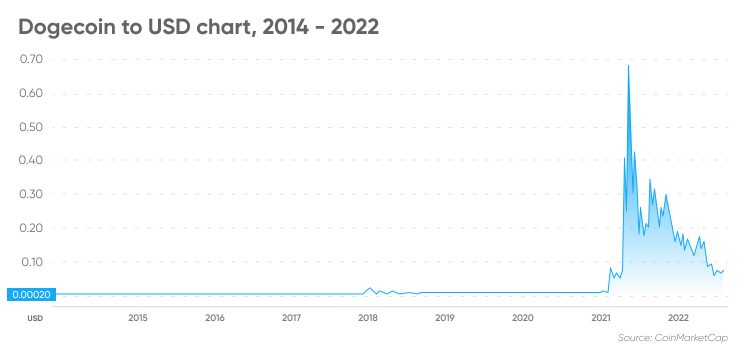
Dogecoin to USD chart, 2014 - 2022

As of 29 July, the total supply of dogecoins mined amounted to more than 132 billion. All tokens mined were in circulation.  The cryptocurrency had a market capitalisation surpassing $8bn and was ranked  the 10th biggest cryptocurrency, surpassing “dogecoin killer” Shiba Inu and “Ethereum killer” Polkadot.

Who owns the most dogecoins?

Over the years, there has been a lot of speculation about who has the most dogecoins or who are the biggest dogecoin whales. A crypto whale is an entity – be it an institution, individual or exchange – that owns a significant amount of a digital asset and therefore can influence the price.

What is your sentiment on DOGE/USD?

In 2021, news reports started referencing a “mysterious dogecoin whale” who owned $22bn of the asset at the time. Some alleged that that person was Elon Musk, as his support for the cryptocurrency was documented online in a series of twitter posts and during an appearance in an episode of Saturday Night Live (SNL). But there is no evidence to support the claim  that  it was him.

Other guesses included the US-based trading platform Robinhood (HOOD), however, the company’s CEO Vlad Tenev denied the rumours.

According to data provided by intotheblock, there are seven top holders of dogecoin, as of 29 July. The wallets are anonymous due to the decentralised nature of cryptocurrencies. Intotheblock noted that the biggest DOGE whale owns 30.16% of the total circulating supply of the cryptocurrency.

The top holder’s account’s balance surpassed 40.84 bn DOGE coins which amounted to $2.55bn at the time of writing. According to blockchair, the account’s address is DPDLBAe3RGQ2GiPxDzhgjcmpZCZD8cSBgZ.

The second biggest dogecoin whale owned just 5.35% of the total circulating supply of the cryptocurrency which amounted to 7.25bn DOGE tokens ($452.1m, as of the time of writing).

“You would be surprised at how many crypto currency token supplies that are owned by a handful of people. It is concerning but it is telling that crypto is no different than the financial industry in terms of  whales,” Mark Basa, the director at HOKK Finance, told Capital.com.

Anndy Lian, chairman of BigONE Exchange and the author of Blockchain Revolution 2030, told Capital.com that dogecoin concentration may be a real issue.

“The whales can single-handedly bring Dogecoin and its ecosystem down. This is a big flaw in the design and the similar outcomes can actually happen in many other top coins too. Personally, I think influencers like Elon Musk and Mark Cuban saw this issue and are the earliest to step in to instil confidence to avoid possible mass panic sell by regular holders,” he told Capital.com.

Lian also referenced the speculations that the biggest dogecoin holders were either Musk or Cuban but noted that who the owner is, is not as important.

“It is the behaviour and intention that matters most. If the top holder believes in the coin and is willing to build the ecosystem, I respect that. If they just want to sell their investment off, I hope they can offload it in batches. Offloading is also a good thing as the coin can become more decentralised.”

Dogecoin reveals the biggest whale wallet

Dogecoin has also addressed the speculations and rumours surrounding who the biggest dogecoin holders are.

Dogecoin said that “many of the top Dogecoin wallets are cold wallets or hot wallets controlled by exchanges and brokers, and they thus represent Dogecoin held in custody for thousands – or hundreds of thousands, even – of people.”

The meme coin’s team noted that many of the biggest holder wallets appear to be managed by trading platforms, as they exhibit patterns of activity and volume that are typical of crypto exchanges or brokerage services holding large amounts of collateral.

“In particular, the Dogecoin community has identified the exchanges and brokerage platforms behind some of the largest wallets, including the infamous ‘whale’ holding 30% of the supply… As it turned out, that infamous whale wallet, which was split across several addresses in October/November 2021, contains the holdings of hundreds of thousands of retail holders,” Dogecoin noted.

What does ownership concentration mean for the token?

CoinLoan’s digital assets analyst, Maxim Shilo, noted that knowing who owns the most dogecoins is as important as knowing how many shares Apple investors have.

“If you are already an investor or want to become one, then it is certainly necessary to understand what can become catalysts for growth or decline. Knowing who owns the most Dogecoin can give you an advantage in the marketplace,” he told Capital.com.

HOKK Finance’s Basa added that knowing who the top dogecoin holders are could expose their motives.

“Let’s say that an old rumour I read on the Doge reddit is true: that a foreign nation, or foreign investor, owned a huge supply of Doge and was using it to drain funds from the common retail investor.
“If so, Doge has a serious enemy and the world should know. If exposed, then there could be a huge sell-off, or a massive withdraw of Doge from centralised exchanges where investors would store their Doge on cold wallets in order to come together and show the community’s strength, similar to the Gamestop scenario, where the power of the community liquidated some serious hedge fund shorting the company’s stock.”

CoiLoan’s Shilo added that DOGE can be a great investment for novice traders since it is known for its “massive pumps,” however, highlighted that “owning it comes with risks… as it has a structure, in which most of the tokens are found in 1-2 wallets.

“This negatively affects the characteristics of the token. When there is such a concentration of coins, there is a chance that at any moment these wallets may be hacked, or the owner could be tempted to arrange dump and pump schemes.”

Note that analysts’ predictions and opinions can be wrong. Knowing and following the biggest cryptocurrency whales shouldn’t be used as a substitute for your own research. Always conduct your own due diligence before trading. And never invest or trade money you cannot afford to lose.


Original Source: https://capital.com/who-owns-the-most-dogecoins

j j j