China investors call it quits as Xi, ‘zero COVID’ sap confidence

China investors call it quits as Xi, ‘zero COVID’ sap confidence

Taipei, Taiwan – For months, Singaporean investor Anndy Lian has been selling off Chinese stocks to reduce his portfolio’s exposure to the world’s second-largest economy.

Once a regular investor in Chinese tech companies, Lian now views  China as an increasingly risky bet as the country’s autocratic turn under Xi Jinping and ongoing “zero COVID” lockdowns cast a cloud over the economy.

“I started gradually lowering my exposure since last year as that was when the downward trend became obvious, but I’ve increasingly sold off my holdings this year as things have gotten worse,” Lian told Al Jazeera,

“The instability is my biggest concern as an investor. The overall environment in China is uncertain right now, and it goes way beyond the financial sector.”

Lian is among a growing number of international investors who are pulling back from China after years of record inflows.

Overseas investors shed more than $150bn in China-based yuan-denominated assets in the first quarter of this year, the largest decline on record. Chinese bonds alone saw a $61bn sell-off between February and May. Roughly $300bn could exit the country this year, more than double last year’s outflow of $129bn, according to forecasts by the Washington-based Institute of International Finance.

Overseas investors shed more than $150bn in China-based yuan-denominated assets in the first quarter of this year, the largest decline on record [File: Qilai Shen/Bloomberg]

China’s economy barely avoided contraction in the second quarter, expanding just 0.4 percent, a dramatic decline from 4.8 percent growth during the first quarter.

Lian said the effects of last year’s crackdown on the tech sector, which decimated the stock prices of major players such as Alibaba, Tencent and Didi, are still being felt.

In one of the most prominent episodes of China’s “techlash”, ride-hailing app Didi lost 80 percent of its market cap – more than $60bn in value – within a year of going public after Chinese regulators accused the firm of violating data security rules. Facing mounting scrutiny at home, Didi delisted itself from the New York Stock Exchange last month.

“Chinese tech companies may be great performers, but they need to be in the best possible environment to achieve the best returns,” Lian said.

“If you look at the tech crackdown last year, and how the value of a whole company like Didi can be virtually wiped out, it makes you nervous.”

Ride-hailing app Didi lost 80 percent of its market cap after Chinese regulators accused the firm of violating data security rules

Other investors, though, see room to adapt to Beijing’s tightening grip on the economy.

“Investors understand what the goals of the tech crackdown were, taking aim at inequality and related social issues, so I think that makes the sector still very investible,” Ker Gibbs, former president of AmCham Shanghai and a veteran China investor, told Al Jazeera.

“There’s always policy risk in China, and regulation moves much faster than in the US. That is something people must be accustomed to.”

Nonetheless, Gibbs said the lingering uncertainty around the Chinese economy has been a significant concern.

“For me, it’s all about the uncertainty of the lockdowns and zero-COVID and not knowing when it will all end,” he said. “Investors just can’t see where it’s headed. People don’t know what environment they’re in now.”

Beijing has given mixed signals to investors about what to expect.

While Chinese officials have promised to tweak pandemic restrictions for the sake of the economy, Xi has repeatedly ruled out shifting from “zero COVID” to living with the virus.

China has opened up new offerings of asset classes to foreign investors but also stepped up supervision of institutional investors in the country.

This month, authorities announced the launch of Swap Connect, a mechanism to allow overseas investors to participate in mainland China’s financial derivatives market.

Meanwhile, more than 80 Shanghai- and Shenzen-listed exchange-traded funds will be made available to investors in Hong Kong. Beijing has also announced it will substantially raise its currency swap with the territory to new levels to provide extra liquidity for the offshore yuan.

“There is a dramatic opening of China’s securities, insurance broking, and wealth management markets going on,” Duncan Clark, founder of Beijing-based investment advisory firm BDA, told Al Jazeera.

“The transition isn’t going to be easy, though, from N-shares [shares of Chinese companies listed in New York] to onshore Chinese listings or even Hong Kong listings. Investor confidence is shaken and Chinese issuers can’t meet face to face,” Clark added.

Lian said Swap Connect is unlikely to turn the tide of investors exiting the Chinese market.

“On the one hand, it may help attract new investors to China, but I doubt it will do much to retain those who are already moving away, and that is a bigger issue,” he said.

“It will take time to turn the tide. There will probably be a two or three-year trial phase until they get the settings right. Another question investors will ask is ‘How do we exit?’ Can they be assured they can withdraw their stock when they wish? We will have to see what the final details are when it comes out.”

Even as Beijing courts more foreign investors, it is also seeking to monitor them more closely. Last month, the China Securities Regulatory Commission formally issued guidelines mandating the establishment of communist party cells within global hedge funds that operate in China.

“I think it will be problematic, but mostly because of the optics back at headquarters in the US,” Gibbs said, noting that many hedge fund managers specifically asked him about the measures at a recent conference he attended in San Francisco.

“Those of us who operate in China long term understand the role the party plays and the importance of aligning with their goals for society. Actually, the conversations they have with you are often about issues of social compliance, like labour standards or equality, which is not necessarily a bad thing,” Gibbs added, describing the scrutiny as comparable to “Chinese-style ESG [Environmental, social and governance]”.

“But in the US, we see the CCP [Chinese Communist Party] and think of the whole party apparatus, and so the idea of a party official in the boardroom sounds much scarier from an American perspective.”
China’s handling of the pandemic has widened the perception gap between the country and global markets, according to some observers [File: China Daily via Reuters]

Some observers say that the perception gap between China and global markets has only widened since the pandemic.

“Many in China don’t realise how dramatically perceptions have changed overseas about their country,” Clark said. “The wall of zero-COVID and the Great Firewall works both ways: they keep capital out and information skewed on both sides. China will have to hustle much more to raise funds going forward. The penny hasn’t dropped yet.”

Beijing may need to work harder at retaining local capital as well.

“We need to remember this is not just about foreign capital and foreigners leaving China. It impacts everyone,” Gibbs said. “Many Chinese investors are heading out, too, to places like Singapore.”

Lian said he has noticed an increasing number of Chinese tech entrepreneurs setting up in Singapore, especially those working on blockchain-based applications.

“It depends a lot on their business structure, but I believe those who can move will continue to do so,” he said.

“So you have these startups that were founded in China, the largest market of all, by Chinese entrepreneurs, and now they are here in Singapore, and now they are bringing their capital with them. To me, that says it all.”


Original Source: https://www.aljazeera.com/economy/2022/7/21/china-investors-call-it-quits-as-xi-zero-covid-rattle-markets

j j j

Green Satoshi Token price prediction: Will M2E crypto rebound?

Green Satoshi Token price prediction: Will M2E crypto rebound?

The green satoshi token (GST), the utility token of the STEPN project, started 2022 with a high, but soon burnt out amid a wider negative shift in investor sentiment. Being the pioneer of move-to-earn (M2E) projects, STEPN, a Web3 app powered by the GST token, inspired crypto enthusiasts to exercise while earning money.

However, as the wider crypto market collapsed, following the fall of the TerraUSD stablecoin and its sister cryptocurrency LUNA, so did GST. Its price action relies on the performance of the Solana (SOL) blockchain, where  it was built.

What do experts have to say, and what other factors will shape the green satoshi token price prediction?

What is the green satoshi token?

The green satoshi token (GST) is the native cryptocurrency of the Web3 lifestyles app STEPN, according to the project’s whitepaper.

STEPN combines SocialFi and GameFi elements and is built “around an essential daily activity for most people – moving around”.

When STEPN launched in December 2021, it was the first M2E mobile non-fungible token (NFT) game powered by the Solana network. The game was created by a fintech studio based in Australia named Find Satoshi lab.

In the game, users equip themselves with NFT Sneakers and can either jog, walk or run outdoors to earn GST tokens. Players can also choose whether they want to lease or sell their NFT Sneakers on the in-app Marketplace.

“With Game-Fi, STEPN aims to nudge millions toward a healthier lifestyle, combat climate change and connect the public to Web 3.0, all while simultaneously hinging on it’s Social-Fi aspect to build a long-lasting platform fostering user generated Web 3.0 content,” the platform’s whitepaper said in a statement.

STEPN is currently under a Public Beta Phase. The application makes profit from small taxes on in-app activities, like NFT trading, Shoe-minting and Shoe-rental.In addition, part of STEPN’s profit goes to buy Carbon Removal Credit on the blockchain to combat climate change.

STEPN has a dual token system:

  • GMT is the platform’s governance token
  • GST is the platform’s utility token.

The two tokens are utilised for different purposes within the platform. GST tokens can be used to level up or mint new NFT Sneakers or even cash out for profit, meanwhile GMT tokens can be used for customisation fees.

STEPN has a burn mechanism which means tokens are available in a limited supply. Both GMT and GST tokens are burned through a number of in-app activities.

In order to become part of the STEPN community, a person must first download the STEPN mobile app, register an account and open a wallet. Users deposit SOL tokens to the built-in STEPN wallet with which they can buy NFT Sneakers.

Activity rewards motivate users to use the app everyday for sports, thus pushing them to continue to exercise.

The total supply of GST tokens amounts to a little over 286m – over 276m tokens are currently in circulation, according to data provided by CoinMarketCapas of 20 July. GST has a market capitalisation surpassing $18m and is ranked as the 621st largest cryptocurrency.

In 2021, STEPN finished fourth out of over 500 projects at the Solana Ignition Hackathon.

GST price analysis

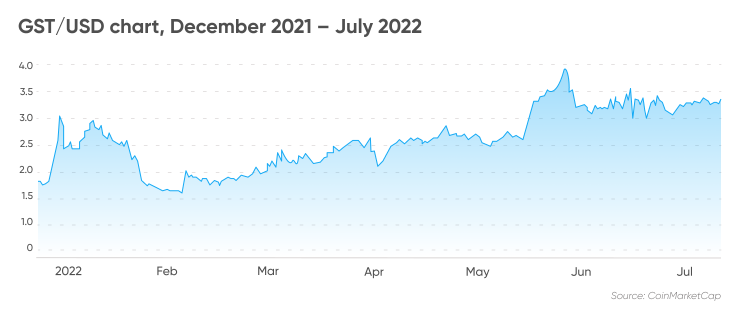
The GST token was arguably one of the most successful tokens of 2022 as it embarked on a bullish trend shortly after launch. Debuting at $1.8451 on 22 December 2021, the token gained nearly 70% in two weeks as it reached $3.1216 on 6 January 2022.

Even though it managed to lose some momentum between 16 and 20 January, GST started a steady climb to $2.9423 by 20 February, up from $1.6839 lows a month earlier.

GST/USD chart, December 2021 – July 2022 

Between 1 and 6 March, the GST token jumped by nearly 50%, reaching its then all-time high of $3.9838. A second jump followed in April, when the token first reached $4.7337 on 1 April, surging to $5.4805 six days later.

After some downward action and fluctuation between $4 and $5, the token skyrocketed to $7.8233 – a 42.7% surge since its 7 April value and a 324% jump since its launch in December 2021.

Following the massive surge, the token dipped on the following day and lost over 45% of its value as it fell back to the $4 levels. The token is trading at its record lows, as of 20 July.

As of 20 July, the coin was valued at $0.06673, a 96.4% decline since its launch in December and a 99.1% fall since its all-time high in April.

This comes amid a wider shift in market sentiment to risk-off due to the tightening cycle of monetary policy, soaring inflation, the war in Ukraine, and fears of recession, with cryptocurrency veterans bitcoin (BTC) and ether (ETH) down 48% and 56% respectively year-to-date.

Key GST news that are driving the token

The GST token seemed to have been performing fairly well at the start of May. However, the positive rally was short-lived as the token soon embarked on a bearish trend following the collapse of the TerraUSD (UST) stablecoin and its sister token LUNA that brought down a sea of other cryptocurrencies.

In addition, the token was affected by a Solana outage on 30 April. The outage happened in Solana’s Mainnet Beta cluster which ceased producing blocks as result of stalled consensus. Even though the system was quickly restored and the GST token ended up dipping by 48.7% in a day.

The biggest STEPN news, however, came on 22 April, Earth Day 2022, several days before the GST token reached its all-time high, as the coin announced its goal of carbon neutrality. As the company noted:

“STEPN, a Web3 lifestyle app, is kickstarting their mission toward combating climate change and achieving carbon neutrality with a purchase of $100,000 worth of Carbon Removal Tonnes, or 5,797.1 tonnes. STEPN will continue to power the movement to reverse climate change with a monthly commitment to pay for carbon removal.”

On 27 April Coinbase announced that it would be adding support for GMT and GST tokens. A day later, OpenSea said that STEPN NFTs were “now available” on the platform.

Following the news, the GST token surged by around 65% in April to its all-time high of $7.8233.

In addition, at the start of April, STEPN released its first quarterly GMT results, which saw a profit of 198,635.62 SOL ($26,815,807.35 at the time) from the platform’s NFT marketplace trading and royalty fees.

One week later, the platform announced that over the previous few months, the app was used by 200,000 daily active users. In the aftermath of positive news, the GST cryptocurrency grew by around 15%, from $4.7337 on 1 April to $5.4422 on 8 April.

On 28 February the company announced that it was looking into launching two updates: a merge spending account with Wallet and an NFT marketplace upgrade. On 1 March the platform announced a giveaway and the token was made available to buy on the Binance Launchpad.

GST price prediction: What should traders look out for?

In the third quarter of 2022, STEPN is planning to launch the spin-off of their NFT marketplace. In the fourth quarter it plans to implement a system where players can rent each other’s sneakers for running.

According to Mark Fidelman, the founder of SmartBlocks and host of the Cryptonized podcast, the GST token “is a speculation”.

“That’s what’s driving its price action. It’s a pretty cool concept, but I don’t think the token price is going to go anywhere in the future,” he told Capital.com.

Fidelman added that whilst STEPN’s main goal is to pay people to be healthy and move around, the token has no other value that could be driving it forward.

“I mean, yes, [people] have to buy NFT’s before they can start moving around on the app and there’s some money there, but the amount of money [people] are spending, or the token is spending, on people moving can’t be paid back because there’s no underlying value there.”

Anndy Lian, the chief digital advisor at Mongolian Productivity Organisation and the author of Blockchain Revolution 2030, added that in order for GST to pick up its pace again, STEPN must try to “find a place within the GameFi space”.

“GST has to scale up or find more users sustainably. Earning $1 daily by walking seems to be more sustainable compared to $30. The company should rethink its marketing strategy for it to scale up,” Lian added.
“When that is addressed, they can find real investors who are interested in their product and not just trying to make money off it. This will also help them to position themselves to attract more prominent institutions or sports brands to buy into their company too.”

Both Lian and Fidelman agreed that STEPN proposes a unique concept, however, the company must work on their marketing strategy and value in order to return to past highs.

“STEPN is the pioneer in the move-to-earn space. This will continue to give them a good head start. I wrote a lot about them in my new book titled NFT: From Zero to Hero. My friendly piece of advice for the team is to get them to sprint and not walk,” Lian concluded.
Fidelman added: “Maybe if they figure out an exercise model that works, maybe that would work. But this has been tried with startups and failed miserably.”

Green satoshi token price prediction

In line with recent action, algorithm-based forecasting service Wallet Investor gave a bearish green satoshi token price prediction.

As of 20 July, the site called GST is “a bad investment”. According to the website’s future GST coin price prediction, the token could fall to $0.0223 in 2023.

DigitalCoinPrice on the other hand, had a more bullish view on the GST crypto price prediction.

According to its green satoshi token price prediction for 2022, the cryptocurrency could average at $0.0998 by the end of the year.

The site’s  green satoshi token price prediction for 2025 suggested that the coin could average $0.13 and $0.22 by 2028. Meanwhile, DigitalCoinPrice’s long-term green satoshi token price prediction for 2030 indicated that the cryptocurrency could average at $0.31 during the year.

Note that price predictions can be wrong. Forecasts shouldn’t be used as a substitute for your own research. Always conduct your own due diligence, and never invest or trade money you cannot afford to lose.


Original Source: https://capital.com/green-satoshi-gst-price-prediction

j j j

Las criptomonedas superan la capitalización de mercado de 1B$

Las criptomonedas superan la capitalización de mercado de 1B$

Tras la drástica caída que sufrieron los precios durante las últimas semanas, el mercado de las criptomonedas ha conseguido cruzar la marca del billón de dólares en capitalización de mercado, lo cual brinda cierto alivio a los inversores y aumenta el optimismo sobre el comienzo de una tendencia alcista.

Se registra un fuerte interés de compra 

El fuerte interés de compra registrado en la moneda digital más grande del mundo, Bitcoin (CRYPTO: BTC), catapultó sus precios muy por encima de la marca de los 22.700 dólares, mientras que los precios de la segunda criptomoneda más valiosa, Ethereum (CRYPTO: ETH), cruzaron la marca de los 1.600 dólares, lo que ha hecho subir a todo el mercado de las criptomonedas aproximadamente un 5% en las últimas 24 horas.

La capitalización del mercado de las criptomonedas se sitúa en los 1,01 billones de dólares, un nivel que no se veía desde el 13 de junio.

Mientras que la capitalización de mercado de Bitcoin es de 420.000 millones de dólares, Ethereum tiene una capitalización de mercado total de 120.000 millones, de los que 20.000 millones de dólares se agregaron en las últimas 24 horas.

Ethereum se dispara un 54% en un mes

Según los datos de CoinGecko, Ethereum se ha disparado un impresionante 54% durante el último mes, gracias a su tan esperada fusión de su estado actual como blockchain de prueba de trabajo (PoW) a una red de prueba de participación (PoW) de eficiencia energética en septiembre de este año, también denominada “Ethereum 2.0”.

El activo había caído por debajo de los 1.000 dólares hace menos de una semana.

Según los expertos, aunque hay señales que apuntan a una recuperación del mercado de las criptomonedas en general, sería prematuro llamarlo una “bull run”.

Comienza lo que sería prematuro llamar una “bull run”

“Por un lado, no hay vientos en contra que apoyen el repunte y la mayoría de los factores que originaron el invierno de las criptomonedas siguen vigentes. Los inversores pueden agregar pequeñas cantidades de dinero en este momento y esperar a que el sentimiento general se vuelva positivo antes de unirse a la bull run cuando comience más adelante”, dijo a Benzinga Arijit Mukherjee,fundador de Yunometa, un mercado de NFT. “Ahora mismo, también es importante investigar y elegir los tokens correctos en lugar de unirse a la manada en busca de dinero rápido”.

Una tendencia bajista obvia

Jenny Zheng, líder de desarrollo comercial de NFTen Bybit, dijo que era muy obvio que actualmente se está produciendo una tendencia a la baja y que, históricamente, ha habido 200 semanas de negociación lateral antes de que el precio rompiera al alza.

“Lo que hemos visto esta semana es la ruptura al alza. Pero esto no significa que la tendencia al alza vaya a continuar. Tenemos que tener en cuenta que seguimos en un mercado bajista. Las grandes fluctuaciones de precios son parte integrante de las criptomonedas, y yo no voy a jugármelo todo solo por haber visto un pequeño repunte esta semana”, declara Zheng.

Los mineros abandonan rápidamente sus posiciones de BTC

En particular, un informe de la firma de análisis de blockchain CryptoQuant afirma que los mineros están abandonando rápidamente sus posiciones de Bitcoin, y asegura que, al final de la semana pasada, se habían transferido 14.000 Bitcoin valorados en más de 300 millones de dólares desde carteras pertenecientes a mineros en un solo periodo de 24 horas.

En las últimas semanas, los mineros se han deshecho la mayor cantidad de Bitcoin desde enero de 2021.

Un alza temporal

“Según los patrones de precios históricos, el mercado aún se encuentra en la trayectoria bajista que comenzó en mayo. El repunte de dos semanas es solo temporal. No estamos ni cerca de un mercado alcista”, dijo Philip Verrien,líder de proyectos en Pollen DeFi.

Según Anndy Lian, asesor digital jefe de la Mongolian Productivity Organization, no hay forma de detener un mercado bajista, ya que forma parte de un ciclo financiero.

“Durante la semana pasada, vimos un planteamiento de trading alcista y de pronto todo el mundo empezó a decir emocionado que los toros habían vuelto. No es nada realista y es una idea equivocada de los inversores más inexpertos”, explicó Lian.

El coautor de “Blockchain Revolution 2030” añadió que los mercados bajistas son sinónimo de subidas momentáneas de precios y que cuatro de los últimos seis meses han sido negativos para los mercados de criptomonedas, lo que indica que la tendencia bajista continúa.


Original Source: https://es.finance.yahoo.com/noticias/criptomonedas-superan-capitalizaci%C3%B3n-mercado-1b-123300624.html

j j j