The five most preferred digital assets by South Korean investors are Bitcoin (BTC), Ripple (XRP), Ether (ETH), Cardano (ADA), and Dogecoin (DOGE).
South Korean investors reportedly own over $5 billion worth of Bitcoin (BTC). Ripple (XRP) is the second most popular digital asset as locals hold nearly $4.8 billion in it.
BTC and XRP Lead the Way
South Korea’s leading crypto exchanges – Upbit, Bithumb, Coinone, and Korbit – conducted a study to determine which digital assets are the most attractive to local investors. The largest cryptocurrency by market capitalization – Bitcoin (BTC) – places first as South Koreans have invested more than $5 billion in it. The native token of Ripple – XRP – ranks second with around $4.8 billion distributed in it.
The third and fourth places belong to Ether (ETH) and Cardano (ADA), respectively. Investors own approximately $4.5 billion worth of the second-largest digital asset and nearly $1 billion in ADA.
Interestingly, the first-ever memecoin – Dogecoin (DOGE) – rounds up the top 5. South Koreans hold almost $900 million worth of it.
The report noted that local investors traded over $7 trillion in digital assets throughout 2021. The figure is more than the entire amount traded on the main Korea Composite Stock Price Index and the transactions on the junior Kosdaq.
South Korea Takes the Crypto Path
Last month, the East Asian country held its most contested presidential election. In the aftermath, the candidate of the Conservative party – Yoon Suk-yeol – collected only 263,000 votes more than his opponent and became South Korea’s next President. What’s more interesting is that he is a keen proponent of the cryptocurrency industry and vowed to turn his homeland into a digital asset hub.
During his campaign, he promised to allow initial coin offerings (ICOs) and increase the minimum threshold for paying capital gains tax on profits from crypto investments. He vowed to change the law and ensure that those who generate revenues of less than $40,000 annually should be exempt from paying taxes. Currently, such taxation is imposed on investors who make more than $2,000 per annum.
Korea Blockchain Association – a lobby group for crypto exchanges – envisioned that the new leader of South Korea will positively impact the local digital asset ecosystem. Secretary-General Yoon Seong-han said:
“We definitely welcome his stance as he is confident about boosting the industry. As ICOs are banned now, we have no choice but to issue coins in Singapore and other countries. Ventures and startups will be able to raise money easily from investors [if the ban is lifted].”
BigONE Exchange’s Chairman – Anndy Lian – also welcomed the new President of the country:
“He understands the importance of crypto. He understands the future, and it is unstoppable.”
With Facebook changing its name to Meta and top investor Cathie Wood CEO of Ask Invest predicting that the future market value of metaverse would be in trillions of dollars, is it worth ‘getting in on the ground floor’ and investing in metaverse tokens? It’s worth having an investor approach, of course, not just being swept along by these headline announcements, but in such an innovative technology how do you decide what’s worth investing in? We’ve therefore compiled a watchlist of metaverse tokens that we believe will play a significant role in realizing the metaverse’s potential to become a trillion-dollar industry.
But just as importantly we’ve set our stall out by asking investors to consider metaverse tokens in terms of the wider thesis about what adds value from a web3 perspective. Apart from having a clear purpose or problem they are trying to solve, not just a white paper and a cute explainer video, they need to have a strong community foundation. Of course, every crypto startup talks the talk when it comes to community. But having a Discord server busy with airdrops and users waiting for the next price pump isn’t going to make it in the longer term. What is worth looking for when assessing which metaverse project to invest in is the degree to which they are actually community-owned, and how well they share the revenue and the control with their users.
Zilliqa (ZIL)
Flying somewhat under the radar has been Layer 1 blockchain Zilliqa, notable as the first Layer 1 to use sharding to solve the blockchain scaling problem that Ethereum has faced. What’s interesting is that with a recent change in leadership, and a new CEO with Ben Livshits who comes from the Brave browser, Zilliqa has already announced that is launching its own metaverse, ‘Metapolis’.
The obvious challenge for Metapolis will be its competitors Decentraland and Sandbox that currently have captured the majority of the blockchain metaverse users. Despite the current depressed value of the ZIL in 2022, the plans for a landmark event at the start of April, built around Zilliqa’s “position as the first layer-1 to build multiple commercial avenues of Web3” look exciting. The Q2 landmark event, which is built around Zilliqa’s “position as the first layer-1 to build multiple commercial avenues of Web3” is also a great opportunity for the Zilliqa team to organize PR and messaging – getting the consistency in messaging and confidence in its delivery should be a significant driver in the value of the ZIL token. The price of the token has been on a downward decline from a price on CMC of $0.2376 in mid-April 2021 to $0.0456 on 22 March 2022. But by the same token, this could be an ideal time to buy the dip in light of the Metapolis launch, the succession of new hires being announced, and the publicity surrounding the event itself.
It’s instructive that Ethereum’s co-founder Joseph Lubin recently criticized Zilliqa rival Solana for over-generous rewards to users validating transactions on the network. Solana Labs responded that “simply looking at protocol revenue doesn’t tell the full story of the long-term performance” of a blockchain’s economic model. That also begs the question as to whether in the longer term Zilliqa sufficiently incentivizes its mining community. After all the key to web3 isn’t merely community-engaged, but community ‘ownership’ in terms of the token structure and for governance.
Axie Infinity (AXS)
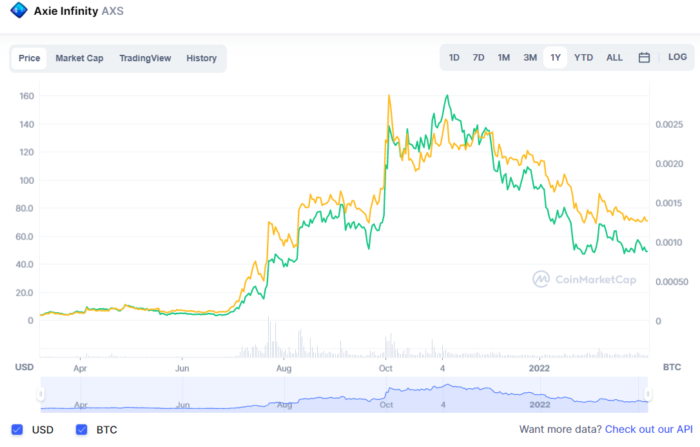
The growth of play-to-earn gaming, led by Axie Infinity, where engagement with a younger generation of gamers in countries like the Philippines shows how this can make a real financial difference to people’s lives. This is also why the role of DeFi in the metaverse, can be so important in providing people with a low-cost way to earn, save and send money from person to person. Back in October last year it hit a $3 billion equity valuation. Token Terminal estimates AXS is driving about $28.9 million in weekly revenue. Annualized, this equates to $1.5 billion in revenue, which is comparable to blockbuster games in the traditional gaming sector. Last month, Axie reduced production of its main in-game rewards to avoid what its blog post describes as “total and permanent economic collapse.” These changes should make a positive difference. However, as the chart from CoinMarketCap shows, the value appears to correlate heavily to the price of Bitcoin.
Tracking the price of AXS vs BTC (AXS: see green trend line; BTC orange trend line)
Decentraland (MANA)
Decentraland is an Ethereum-based blockchain-powered virtual-reality pioneer. Decentraland has the largest market capitalization in the metaverse space, and as one of the early adopters, the company is well-positioned to maintain its dominance in this space. Decentraland is divided into LAND parcels that are NFTs, and LAND ownership gives users complete control over what they build. In total there are 90,601 land parcels, and the LAND NFTs can be purchased using Decentraland’s native token MANA.
Users in Decentraland can use MANA tokens to buy and develop land, as well as some of the game’s tools to create spaces and works of art. Users are free to create whatever they want. Decentraland also holds various entertainment activities regularly, with users able to attend parties, play games, and visit digital art exhibitions. Decentraland recently hosted the world’s first multi-day music festival, with many well-known artists performing. Adding to the utility, as reported by Motley Fool, this month it will host Metaverse Fashion Week from March 24–27, featuring global brands, including Tommy Hilfiger, and Dolce & Gabbana.
The Sandbox (SAND)
Sandbox is similar to Decentraland in that users can use SAND tokens to purchase land, build houses, and share games on the purchased land. Sandbox has announced several collaborations in recent months, including top NFT marketplace OpenSea, Snoop Dogg, and The Walking Dead. At the same time, it recently completed a US$93 million round of financing led by Softbank, a leading investor in the blockchain space. There are three billion SAND tokens, and a third of its total supply is circulating at $3.06. Compared to MANA, SAND has been hit harder by the market downturn, with a drop in the last month alone from $4.20 in early Feb to $2.90 on March 7, a 30% decrease. However, recent price aside the fundamentals suggests SAND is a good bet for the future, based on a successful implementation of their project roadmap to date.
Coming back to the guiding thesis about the importance of community ownership for the longer-term viability of metaverse tokens one of the key benefits of Sandbox is that it’s decentralized both in name and in terms of its community governance. Indeed, the play-to-earn approach type revenue is shared throughout the gaming ecosystem via tokens, while Sandbox users can earn a passive income by charging other users to access their land. With both rewards and fees paid in SAND underline how this core web3 approach to community ownership supports the value of the SAND token to investors.
Somnium Space (CUBE)
Somnium Space is another metaverse ecosystem BigONE believes is worth investigating. Somnium space’s goal is to create an immersive metaverse. Users can buy lands, customize their avatars, and invest in real estate in Somnium, which was founded in 2017. Gemini supports the Somnium space, and the FTX exchange recently built a metaverse headquarters on the Somnium space.
In the last month, its native token $CUBE’s price movement has been very similar to SAND’s. The market capitalization of CUBE is $59 million, with 12.5 million circulating supply out of a total supply of 100 million. Somnium Space is ideal for users to build their real estate using their builder tools and create custom avatars using the Unity SDK. In addition, in 2019 they partnered with Sony to allow users to create full embodiment avatars of themselves in minutes alongside any 3D models for Somnium Store. Sony’s VR store in Somnium Space was among the world’s first.
Investing in the future of the metaverse
By providing more incentives and giving back to users, the metaverse will constantly flip the script and change how things will be done. BigONE anticipates a more transparent, open, and fully decentralized experience from the vibrant creative landscapes and avatars. The landscape itself will be visually stunning, a virtual place where the imagination is no longer constrained. Clearly, the development of a fully functional metaverse has the potential to fundamentally alter how people interact with the digital world. A collective virtual experience would reimagine the creative industry and open new doors for creators, gamers, and artists. BigONE Chairman Anndy Lian said: “The metaverse is here to stay, it’s clear the success already of Sandbox and Decentraland shows it has tremendous potential to bring people together. That potential in terms of GameFi we can see with Axie Infinity’s play-to-earn gaming which is making a real difference to people’s lives. However, there remain obstacles to its growth. Countries like China and South Korea have had laws about converting in-game tokens into fiat currency for nearly 15 years, for instance.
“However, I believe like any disruptive paradigm-shifting technology, which is attracting the attention of global players such as Facebook and governments keen to keep control of the internet, there are risks involved. But I’m optimistic that the decentralized community-owned development of an interoperable metaverse will deliver lasting value to both users and investors,” Lian added.
Any references to projects in this article are purely for information and should not be deemed financial advice, or promotional.
Plans including raising the crypto tax threshold and legalizing ICOs are welcome, but will they give South Korea the shakeup it needs?
The recent news that the incoming South Korean president is planning to boost the country’s crypto industry is welcome news, particularly in light of the economic power of South Korea not just regionally but also globally.
President Yoon Suk-Yeol plans to raise the current crypto tax threshold from around $2,000 to approximately $40,000. The current president Moon Jae-in lost the opportunity to take the country forward with a more positive crypto policy, in a country where last year Koreans invested over $43 billion in crypto assets in 2021.In April 2021 younger investors filed a number of petitions for example complaining how crypto assets were being taxed at a less favorable rate than stocks. Now this victory means that their voice is being heard, which I believe is great news, not just for the crypto industry, but for this new generation of investors. But at the same time, as someone involved in the Korean market since 2017 while I welcome the reports coming out of Yoon’s Presidential Transition Committee, I also know what matters is what happens after the new president takes office on May 10.
There is a risk the new government decides to allow investing in ICOs, IEOs, and STOs only to those above a certain income, to accredited investors. Certainly, the news of a new Basic Digital Asset Law, to enable the recovery of funds lost from illegal trades and scams is very welcome. But at the same time, a balance has to be struck, so the younger generation of investors in their 20s and 30s, who consist of around 36% of the market, feel they have a stake in the new system.
I also note that play-to-earn games are still illegal with no plans to change that. So, it’s somewhat ironic that the recent $620 million hack of Axie Infinity was reportedly carried out under the auspices of the North Korean government. While South Korea and the US are therefore looking to work more closely on cybercrime, there is a risk that the US will also seek to put pressure on the South Koreans to take a more highly regulated approach to crypto more in line with emerging US policy.
Will the prospect of a growing NFT market bear fruit?
What I do expect is for the market in NFTs in South Korea to grow in the future. And I think this presents a window of opportunity for the new government to take a positive approach. While the Financial Services Commission (FSC) is reportedly working to introduce NFT rules, this is yet to happen. Another potential source of frustration within the investor community is the complexity of using exchanges with different travel rule systems.
Among the big four exchanges Upbit, Bithumb, Coinone, and Korbit (with over 95% of the crypto market share), there are two travel rule systems. Upbit with the lion’s share of the exchange market has adopted its home-grown Verify VASP program, while the remainder follows another system. So, it’s perhaps good to know that Yoon’s Presidential Transition Committee is also “looking to grant more cash-to-crypto licenses to crypto trading platforms in efforts to dilute the local crypto exchanges oligopoly”.
Another overlapping issue is the dominance of the Upbit exchange in the South Korean crypto market. What’s interesting to me is seeing the concerted move by local banks to enter the crypto market. Part of the banks’ motivation to approach the incoming government is down to the fact that Upbit has over 80% of the market share.
This is underlined by the fact that Dunamu, operator of Upbit, posted a net income of 2.2 trillion won (around $1.8 billion) last year, with the figure growing 46-fold on-year. The news reportedly “shocked onlookers, as it drew near Woori Financial Group, a major banking group here. Woori posted a net income of nearly 2.6 trillion won in the same period”, according to the Korea Herald.
Banks fight for a slice of the crypto pie
Allowing banks to take apart on a more equal footing with exchanges certainly marks a step forward with potential implications for competition in regional crypto markets as well as internationally. Certainly, in Singapore, we have seen a tightening of regulations since the ICO boom years of 2017/18 which attracted so many crypto startups.
This stricter regulation has prompted startups to leave for the likes of more crypto-friendly Dubai, including global exchange Binance which recently withdrew an application to register in Singapore, instead setting up an office in the UAE.
The economic risks of not moving fast enough are also shown in the UK, where despite government plans for crypto growth there’s been significant criticism of its regulator, the FCA, for being too slow in processing crypto license applications to allow crypto startups to operate.
So, while I believe South Korea is likely to try to be more open, it’s going to be a tricky path to walk to keep all the different segments onboard, from crypto industry stakeholders to expectant younger investors. The ‘proof is in the pudding’ as they say, because while the incoming government might talk about plans to legalize ICOs it may in the fine print only be available to people who have say $1 million in assets.
However, on a more optimistic note, I do agree with crypto commentators such as Anthony Pompliano that South Korea’s crypto plans are potentially a significant step on the world stage. Yoon Suk-yeol is the first head of state from a major economy that says it plans to take crypto really seriously, including protecting the public; however, it’s also worth noting that outlined plans to set up a dedicated government agency for crypto and NFTs did not make it into the final copy of his campaign pledges.
Speaking recently in Korea on the same platform with a member of the People’s Power Party, I said that crypto and blockchain was the future. We now have to wait and see how well that promise and potential is delivered.