Understanding the Blockchain Space: Opportunities and Challenges for Investors – Anndy Lian

Understanding the Blockchain Space: Opportunities and Challenges for Investors – Anndy Lian

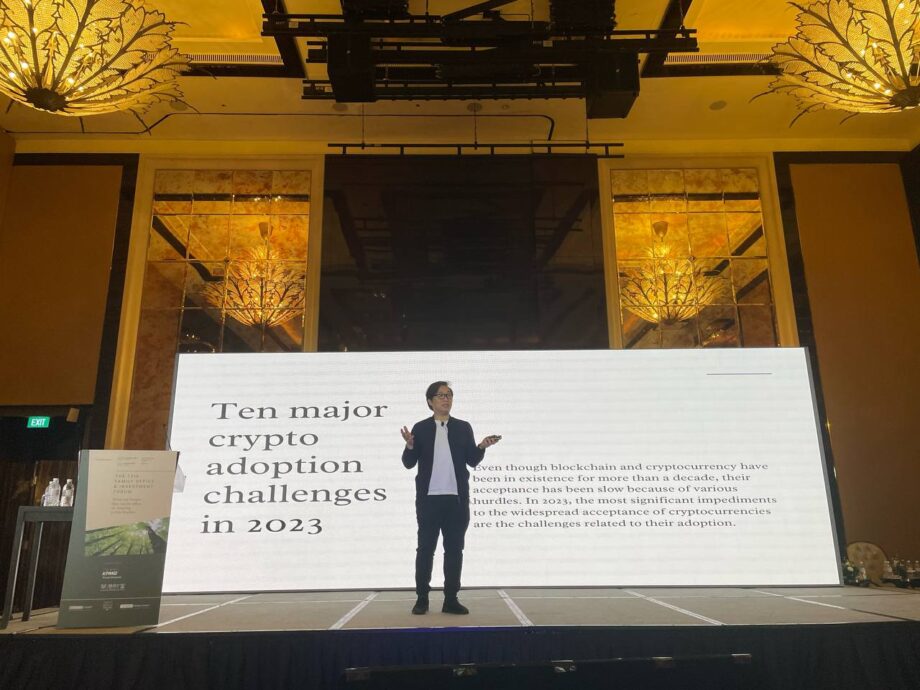
Anndy Lian, intergovernmental blockchain advisor spoke at the 12th Family Office & Investment Forum in Singapore organized by Campden Club. The theme for the event is “Thrive and Prosper: How Family Office are Adapting to New Realities”.

The global pandemic has brought about a new set of challenges for family offices, which are private wealth management firms that cater to the ultra-wealthy. The economic uncertainty and market volatility have forced family offices to adapt to new realities and change their strategies to protect their clients’ wealth and ensure long-term prosperity.

One of the key ways family offices are adapting is by embracing technology. Blockchain and cryptocurrency are two topics that are widely discussed in the investment space.

Blockchain technology and cryptocurrency have been making headlines for over a decade now, and yet their widespread adoption has been slow due to various challenges. In 2023, the most significant hurdles facing the adoption of cryptocurrencies are related to their acceptance. Anndy highlighted the top ten major crypto adoption challenges in 2023 that investors should be aware of during his keynote speech.

1. Lack of Understanding of What Cryptocurrency is and How it Works.
This lack of understanding can lead to a lack of trust in the technology, which makes it difficult for people to adopt it as a means of payment or investment.

2. Volatility.
The value of cryptocurrencies can change rapidly, making it difficult for investors to make informed decisions.

3. Lack of Regulatory Frameworks.
Governments and regulatory bodies have been slow to develop policies that govern the use of cryptocurrencies, which makes investors wary of investing in them.

4. Uncertainty Regarding Taxation.
This uncertainty can discourage investors from investing in cryptocurrencies.

5. Security Risks.
Hacking and other cyberattacks can lead to the loss of cryptocurrencies, which can be devastating for investors.

6. Transaction Irreversibility.
Transactions on the blockchain are irreversible, which means that if a mistake is made, it cannot be reversed. This makes it essential for investors to be careful when making transactions.

7. Scalability Issues.
As the number of transactions on the blockchain increases, the network can become congested, leading to slow transaction times and increased fees.

8. Lack of Merchant Adoption.
Without merchants accepting cryptocurrencies as payment, it is challenging for people to use them as a means of payment.

9. Network Congestion.
It can lead to slow transaction times and increased fees. This can discourage investors from using cryptocurrencies for transactions.

10. Lack of Trust in Digital Currencies.
Finally, a lack of trust in digital currencies is a significant hurdle to their widespread adoption.

Lian also explored ten different ways to make money from cryptocurrency.

1. Crypto Saving.
Many blockchain projects and decentralized finance (DeFi) platforms offer high-interest rates for users who deposit their cryptocurrencies.

2. Protocol Tokens.
Protocol tokens are cryptocurrencies that are used to power decentralized applications (dApps) and blockchain protocols.

3. Application Tokens.
Application tokens are cryptocurrencies that are used to access and use specific dApps.

4. Staking.
Staking is a process that involves holding cryptocurrencies in a wallet to support the network’s operations.

5. Yield Farming.
Yield farming involves providing liquidity to DeFi platforms in exchange for rewards.

6. Crypto Stocks.
Several publicly traded companies offer exposure to the cryptocurrency market through their stock offerings.

7. Other Crypto Securities.
These include exchange-traded funds (ETFs), futures, and options.

8. Exchange-Traded Products.
Exchange-traded products (ETPs) are investment vehicles that allow investors to gain exposure to cryptocurrencies through their brokerage accounts.

9. Bitcoin Proxy Stocks.
Bitcoin proxy stocks are stocks of publicly traded companies that have exposure to the cryptocurrency market.

10. Web4.
Web4 is a new concept that aims to create a decentralized internet that is owned and controlled by users.

The Campden Club is a global membership organization that brings together family offices, ultra-high net worth individuals, and private investors to network, share knowledge and expertise, and discuss issues related to family wealth management and preservation. Founded in 1987, the club has over 200 member families from around the world and hosts regular events and forums to facilitate discussions on various topics, including wealth management, philanthropy, investment opportunities, family governance, and succession planning. Members of the Campden Club gain access to a network of like-minded individuals and family offices, as well as exclusive content, research, and resources related to family wealth management.

Anndy Lian is an early blockchain adopter and experienced serial entrepreneur who is known for his work in the government sector. He is a best selling book author- “NFT: From Zero to Hero” and “Blockchain Revolution 2030”.

Currently, he is appointed as the Chief Digital Advisor at Mongolia Productivity Organization, championing national digitization. Prior to his current appointments, he was the Chairman of BigONE Exchange, a global top 30 ranked crypto spot exchange and was also the Advisory Board Member for Hyundai DAC, the blockchain arm of South Korea’s largest car manufacturer Hyundai Motor Group. Lian played a pivotal role as the Blockchain Advisor for Asian Productivity Organisation (APO), an intergovernmental organization committed to improving productivity in the Asia-Pacific region.

An avid supporter of incubating start-ups, Anndy has also been a private investor for the past eight years. With a growth investment mindset, Anndy strategically demonstrates this in the companies he chooses to be involved with. He believes that what he is doing through blockchain technology currently will revolutionise and redefine traditional businesses. He also believes that the blockchain industry has to be “redecentralised”.

j j j

Anndy Lian Spoke at Kenya National Innovation Agency Webinar Series: Redecentralise, Revalue & Reform Blockchain businesses in 2023

Anndy Lian Spoke at Kenya National Innovation Agency Webinar Series: Redecentralise, Revalue & Reform Blockchain businesses in 2023

Kenya National Innovation Agency (KENIA) is the leading innovation organisation in Kenya. Dr Tonny Omwansa, CEO of KENIA hosted Anndy Lian to their Webinar Series. The topic is “Redecentralise, Revalue & Reform Blockchain businesses in 2023”.

In 2023, the blockchain business is expected to continue its growth and evolution. The widespread adoption of blockchain technology is likely to drive innovation in various industries such as finance, supply chain management, digital identity, and more. Decentralized finance (DeFi) is predicted to gain more traction, with more people investing in cryptocurrencies and decentralized platforms. The use of blockchain for secure and transparent voting systems is also expected to gain more attention.

Challenges such as scalability, interoperability, and regulatory issues still remain. Nevertheless, as the technology matures, it is likely that solutions to these challenges will emerge, further driving the growth of the blockchain business.

Anndy Lian shared that adopting blockchain technology in a business supply chain can bring numerous benefits such as improved transparency, enhanced security, reduced costs, and increased efficiency.

Here are some steps to follow when adopting blockchain technology in a business supply chain:

Identify the problem: The first step is to identify the pain points in the current supply chain and determine how blockchain technology can be used to address them.

Conduct a feasibility study: A feasibility study should be conducted to determine the potential benefits and costs of adopting blockchain technology in the supply chain.

Choose the right platform: Select a blockchain platform that is suitable for your business needs and that supports the features and functions required for your supply chain.

Develop a pilot project: Develop a small-scale pilot project to test the feasibility and effectiveness of the proposed solution.

Implement the solution: Implement the blockchain solution in the supply chain by integrating it with existing systems and processes.

Monitor and evaluate: Monitor and evaluate the performance of the solution and make adjustments as needed.

Expand the solution: Once the solution has been proven to be effective, expand it to the rest of the supply chain.

Continuously improve: Continuously monitor and evaluate the solution and make improvements as necessary to ensure its ongoing success.

Anndy Lian added: “It’s important to work with experts in blockchain technology to ensure a successful implementation. A well-designed and properly implemented blockchain solution can bring significant benefits to a business supply chain, making it more efficient, secure, and transparent.”

Dr Tonny concluded that blockchain innovation continues to drive new and exciting developments in the technology and its applications, offering new opportunities for businesses and individuals alike.

Dr. Tonny K. Omwansa is also the founding Director of the C4DLab, University of Nairobi’s Innovation Hub. He is also the founder and chairman of the Nairobi Innovation Week which brings numerous stakeholders shaping Kenya’s Innovation Ecosystem. He lecturers at the School of Computing and Informatics, University of Nairobi in Kenya and is the co-author of “Money, Real Quick: Kenya’s disruptive mobile money innovation”.

He holds a PhD in Information Systems in which he researched on the adoption of mobile financial services at the base of the pyramid in Kenya. Besides consultancy services in technology and innovation issues, he is very active in research and capacity building. His research interests are in the design, adoption and impact of innovative low-cost and appropriate technologies in developing countries.

Anndy Lian is a well-rounded business strategist based in Asia. He offers advice across multiple industries for both local and international companies, as well as public listed corporations and governments. With early involvement in the blockchain space, Lian is a seasoned entrepreneur, author, investor, board member, and keynote speaker.

His latest publication, “NFT: From Zero to Hero,” is a guide for anyone eager to explore the potential of NFTs. The book encourages readers to embrace the limitless possibilities of this new technology and to become “heroes” in their own right by taking advantage of its early stages. “NFT: From Zero to Hero” can be purchased on Amazon and Bybit, with over 8,000 copies sold.

In 2022, Lian received an Hon Doctoral Degree from Ulaanbaatar Erdem University, in recognition of his contribution to the advancement of productivity science in Mongolia.

This event is organised by Kenya National Innovation Agency (KENIA). And supported by Block Review, Redecentralise, Blockcast.cc and GoChapaa.


Anndy Lian is an early blockchain adopter and experienced serial entrepreneur who is known for his work in the government sector. He is a best selling book author- “NFT: From Zero to Hero” and “Blockchain Revolution 2030”.

Currently, he is appointed as the Chief Digital Advisor at Mongolia Productivity Organization, championing national digitization. Prior to his current appointments, he was the Chairman of BigONE Exchange, a global top 30 ranked crypto spot exchange and was also the Advisory Board Member for Hyundai DAC, the blockchain arm of South Korea’s largest car manufacturer Hyundai Motor Group. Lian played a pivotal role as the Blockchain Advisor for Asian Productivity Organisation (APO), an intergovernmental organization committed to improving productivity in the Asia-Pacific region.

An avid supporter of incubating start-ups, Anndy has also been a private investor for the past eight years. With a growth investment mindset, Anndy strategically demonstrates this in the companies he chooses to be involved with. He believes that what he is doing through blockchain technology currently will revolutionise and redefine traditional businesses. He also believes that the blockchain industry has to be “redecentralised”.

j j j

BWB2022 Day 3 First Mover Stage 앤디 리안Anndy Lian

BWB2022 Day 3  First Mover Stage 앤디 리안Anndy Lian

BWB 2022, hosted by Busan Metropolitan City was held at BEXCO for 3 days from Oct. 27th (Thu.) to the 29th (Sat).

With the theme of “Blockchain, City and Life”, as an extension of last year’s NFT Busan 2021, BWB 2022 featured conferences for the advancement of the blockchain industry and provide a space to obtain insight as well as to share information.

Anndy Lian, Book Author of NFT: From Zero to Hero presented his views on Trends Shaping the Future of NFT.

In his speech, he reminded all to go back to basics.

1. The 5 P’s of Marketing – Product, Price, Promotion, Place and People – are key marketing elements used to position a business strategically. Most of us, whilst still understanding what makes an NFT valuable, have forgotten that these are also the key elements for an NFT project to succeed. The industry is filled with people who are focusing on short-term hypes and price pumps. This is more obvious when the market is bullish; all kinds of projects get a price push upward no matter what you launch and draw.

He went on by saying that the regulation of NFT is a must, and we need to understand its importance.

2. As we can see, the market for NFTs is still growing, and it will take some time until an appropriate regulatory framework for NFTs is put in place. Having said that, governments worldwide have already begun developing NFT norms and standards, proving that they are seriously interested in these digital assets.

Additionally, you should be aware that the phenomenal success of NFTs will undoubtedly result in fraudulent activities. For this reason, it is becoming more and more crucial to conduct your research before purchasing or investing in NFT collections or projects.

3. Lastly, he also hoped that the general public and enthusiasts of NFT should understand what the market is like. Do not just be fooled by fake statistics. He cited NFT wash trading as an example.

Wash trading makes it difficult for non-fungible token enthusiasts to gauge genuine market interest in NFT collections. It also inflates and skews the amount of trading in marketplaces, misleading analysts about what’s going on on trading platforms.

Anndy Lian is an all-rounded business strategist in Asia. He has provided advisory across a variety of industries for local, international, public listed companies and governments. He is an early blockchain adopter and experienced serial entrepreneur, book author, investor, board member and keynote speaker.

Anndy Lian is an early blockchain adopter and experienced serial entrepreneur who is known for his work in the government sector. He is a best selling book author- “NFT: From Zero to Hero” and “Blockchain Revolution 2030”.

Currently, he is appointed as the Chief Digital Advisor at Mongolia Productivity Organization, championing national digitization. Prior to his current appointments, he was the Chairman of BigONE Exchange, a global top 30 ranked crypto spot exchange and was also the Advisory Board Member for Hyundai DAC, the blockchain arm of South Korea’s largest car manufacturer Hyundai Motor Group. Lian played a pivotal role as the Blockchain Advisor for Asian Productivity Organisation (APO), an intergovernmental organization committed to improving productivity in the Asia-Pacific region.

An avid supporter of incubating start-ups, Anndy has also been a private investor for the past eight years. With a growth investment mindset, Anndy strategically demonstrates this in the companies he chooses to be involved with. He believes that what he is doing through blockchain technology currently will revolutionise and redefine traditional businesses. He also believes that the blockchain industry has to be “redecentralised”.

j j j