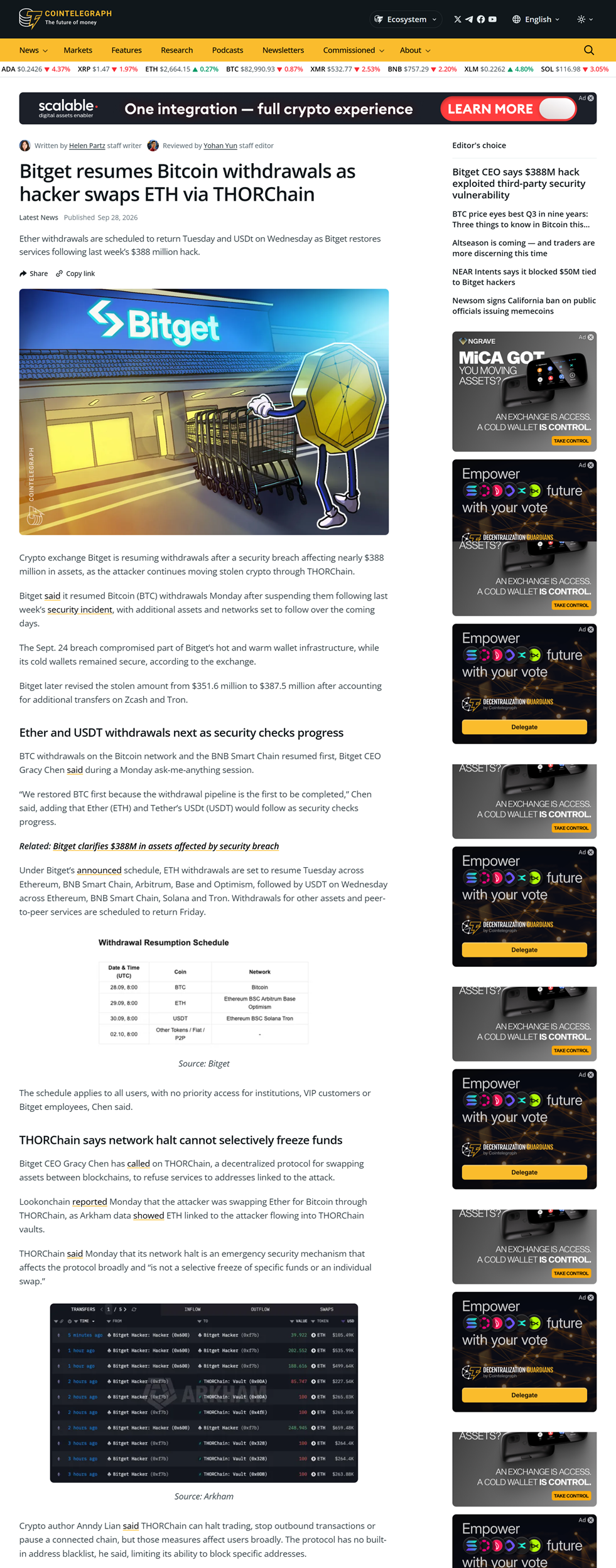
Bitget resumes Bitcoin withdrawals as hacker swaps ETH via THORChain

Bitget resumes Bitcoin withdrawals as hacker swaps ETH via THORChain

Crypto exchange Bitget is resuming withdrawals after a security breach affecting nearly $388 million in assets, as the attacker continues moving stolen crypto through THORChain.

Bitget said it resumed Bitcoin (BTC) withdrawals Monday after suspending them following last week’s security incident, with additional assets and networks set to follow over the coming days.

The Sept. 24 breach compromised part of Bitget’s hot and warm wallet infrastructure, while its cold wallets remained secure, according to the exchange.

Bitget later revised the stolen amount from $351.6 million to $387.5 million after accounting for additional transfers on Zcash and Tron.

Ether and USDT withdrawals next as security checks progress

BTC withdrawals on the Bitcoin network and the BNB Smart Chain resumed first, Bitget CEO Gracy Chen said during a Monday ask-me-anything session.

“We restored BTC first because the withdrawal pipeline is the first to be completed,” Chen said, adding that Ether (ETH) and Tether’s USDt (USDT) would follow as security checks progress.

Under Bitget’s announced schedule, ETH withdrawals are set to resume Tuesday across Ethereum, BNB Smart Chain, Arbitrum, Base and Optimism, followed by USDT on Wednesday across Ethereum, BNB Smart Chain, Solana and Tron. Withdrawals for other assets and peer-to-peer services are scheduled to return Friday.

The schedule applies to all users, with no priority access for institutions, VIP customers or Bitget employees, Chen said.

THORChain says network halt cannot selectively freeze funds

Bitget CEO Gracy Chen has called on THORChain, a decentralized protocol for swapping assets between blockchains, to refuse services to addresses linked to the attack.

Lookonchain reported Monday that the attacker was swapping Ether for Bitcoin through THORChain, as Arkham data showed ETH linked to the attacker flowing into THORChain vaults.

THORChain said Monday that its network halt is an emergency security mechanism that affects the protocol broadly and “is not a selective freeze of specific funds or an individual swap.”

Crypto author Anndy Lian said THORChain can halt trading, stop outbound transactions or pause a connected chain, but those measures affect users broadly. The protocol has no built-in address blacklist, he said, limiting its ability to block specific addresses.


Source: https://ct.com/news/bitget-btc-withdrawal-hacker-eth-swap-thorchain
 

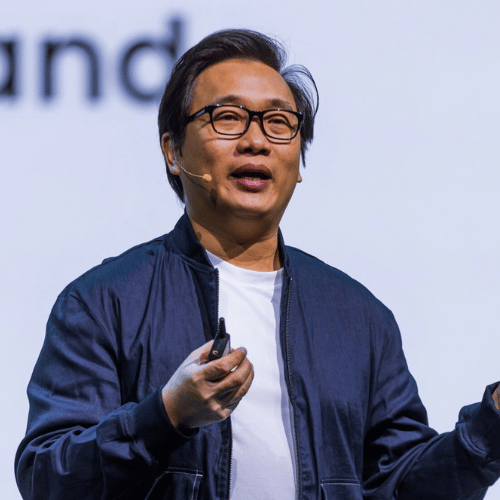
Anndy Lian is an early blockchain adopter and experienced serial entrepreneur who is known for his work in the government sector. He is a best selling book author. The latest book is Web4: The Age of Autonomous Intelligence.


j j j

Gulf tech firms turn to Hong Kong and Singapore as Iran war grinds on

Gulf tech firms turn to Hong Kong and Singapore as Iran war grinds on
Paul Bratby had already drawn up plans for expanding to Hong Kong when war broke out in the Middle East earlier this year.
But the founder of xBratAI, a Dubai-based AI-powered trading signals platform, soon brought that timeline forward as the Iran conflict dragged on and widened in scope.

“Our Hong Kong entity had been scheduled for a few years later, but we established it in early 2026,” he said.

Bratby is not alone in looking east. As missiles continue to target Gulf capitals and shipping lanes, digital businesses and investors are increasingly setting up shop in Hong Kong and Singapore.

“The war has influenced the pace of expansion into East Asian hubs more than it has redrawn the map. Firms that can relocate cheaply have done so,” Bratby said, adding: “Hong Kong and Singapore are now treated as primary growth markets.”

For many, these new Asian bases supplement established operations in Abu Dhabi and Dubai, creating what Anndy Lian, a Singapore-based adviser to governments on blockchain and information technology, calls a “dual-hub” model.

“We are not seeing an outright exodus from the Gulf, but we are witnessing an accelerated shift towards proactive geopolitical hedging,” he said. “Major digital and tech enterprises are no longer content with relying on a single operational anchor.”

Ali Moosa, executive vice-chairman of Bahrain-headquartered Singapore Gulf Bank, said the conflict had accelerated Gulf businesses’ use of Asian financial hubs.

“Business continues during uncertainty,” he said. “Companies still need to pay suppliers, buy equipment, meet payroll and complete projects.”

In the long term, greater access to Asian capital and investment could support growth in the Gulf, Moosa said.

The closer the Gulf becomes to Asia, the more capital Gulf businesses can access and the more opportunities they can pursue- Ali Moosa, Singapore Gulf Bank

“The closer the Gulf becomes to Asia, the more capital Gulf businesses can access and the more opportunities they can pursue,” he said, adding he expected “many of these relationships to continue after the immediate disruption ends”.

The disruption could last for some time, however, as the conflict continues to widen.

At the weekend, Yemen’s Iran-backed Houthis claimed missile and drone strikes on “sensitive” sites in the Saudi capital Riyadh and on an Aramco facility in the Red Sea oil export hub of Yanbu.

Britain has agreed to help Saudi Arabia’s military counter the Houthis, whose attacks have increasingly threatened shipping near the Bab el-Mandeb chokepoint.

Meanwhile, Singaporean financial institutions have been setting up cross-border digital networks and multicurrency settlement methods to carry Gulf capital into a region undergoing an unprecedented infrastructure boom, driven by the race for AI data centre capacity.

Building AI infrastructure was enormously capital intensive, Lian said, pointing to the huge amounts of upfront investment required for high-voltage power grids, industrial cooling systems and the like.

“Middle Eastern institutional capital is uniquely suited to this demand,” he said. “Gulf investors possess deep familiarity with massive, energy-intensive infrastructure projects, and they are deploying liquidity directly into Southeast Asia’s digital backbone.”

The Asia-Pacific’s financial services industry is forecast to nearly double in value to US$4.8 trillion by 2035, according to a Deloitte report published last month – overtaking the United States, whose industry is projected to reach US$4.3 trillion over the same period.

Gulf sovereign wealth funds were hungry for exposure to Asia’s consumer digital economy and industrial supply chains, and Asian fund managers and technology consortiums were more than happy to oblige, Lian said.

Iranian attacks on data centres in Bahrain and the United Arab Emirates led to service outages earlier in the conflict, fuelling a surge of interest in Southeast Asian alternatives, said Raj Kapoor, founder of the India Blockchain Alliance.

This had “introduced something that technology companies historically treated as an unlikely tail risk”, he said.

Even so, Kapoor said the Gulf would remain central to the global AI buildout as tech companies had already sunk billions of US dollars into the region, with government backing and it “therefore makes little sense” for them “simply to abandon those markets”.

“So I see this mainly as diversification rather than relocation,” he said.


Source: https://www.scmp.com/week-asia/economics/article/3368387/gulf-tech-firms-turn-hong-kong-and-singapore-iran-war-grinds

Anndy Lian is an early blockchain adopter and experienced serial entrepreneur who is known for his work in the government sector. He is a best selling book author. The latest book is Web4: The Age of Autonomous Intelligence.

j j j

India’s push to secure place in global chip supply has ‘secret weapon’: its people

India’s push to secure place in global chip supply has ‘secret weapon’: its people
India is betting big on domestic manufacturing of semiconductors – the microscopic brains that power everything electronic from cars to AI processing – in an ambitious bid to slash imports and boost its local industry.

But observers say the country should set its sights even higher upstream on the value chain by mobilising its “secret weapon” – a talent pool that could realise its dream to turn “Make in India” into “Engineer in India”.

New Delhi earlier this week launched the second phase of its mission with a budget of US$13 billion to build an industrial ecosystem spanning chip design to manufacturing. Building on the first phase, which focused heavily on foundational industrial set-up, the second expands support across the entire supply chain, including developing a large manpower pool.

The move on Monday comes as other countries in the region, such as Japan and Singapore, outline multibillion-dollar development plans for their semiconductor industries following chip shortages during the Covid-19 pandemic that exposed dependency on a handful of East Asian manufacturers.

Delhi has already approved 12 semiconductor manufacturing projects across six states. Three – Micron, Keynes Semicon and CG Semi – have started commercial production this year. They primarily handle assembly, testing and packaging rather than advanced wafer fabrication.

An industrial partnership between India’s Tata Electronics and Taiwan’s Powerchip Semiconductor Manufacturing Corporation plant in the western Indian state of Dholera is targeting to roll out its first batch of chips in December. Tata also signed a US$11 billion memorandum of understanding with Dutch technology giant ASML on May 16 to make advanced chips for industries ranging from car manufacturing to AI.

In for the long-term

Analysts say that building a semiconductor industry ecosystem requires strong implementation and planning over the long term because it needs a complex value chain divided into design, fabrication, as well as assembly and testing.

“Establishing a complete semiconductor ecosystem is a marathon, not a sprint,” said Anndy Lian, a Singapore-based adviser to governments on information technology systems.

He suggested that India build not only fabrication units for complex microchips and integrated circuits but also downstream systems to handle back-end processing after they are made. “These are less capital-intensive and faster to operationalise than fabs, allowing the country to build a skilled workforce and supplier network while major fabs remain under construction.”

Hard infrastructure is also vital because highly sensitive semiconductor manufacturing needs pure water, uninterrupted power and specialised chemicals. “A single voltage fluctuation can ruin a wafer batch. India must create plug-and-play industrial parks where utilities are guaranteed to international standards, not just promised,” Lian said.

Though India has lagged behind in semiconductor manufacturing such as the US, China and Taiwan, it has a strategic advantage because it has been a hub for semiconductor research and design. It has the world’s largest pool of chip design engineers – but lacks fab-floor operators – responsible for day-to-day manufacturing of silicon wafers – and process engineers who transform raw silicon into working microchips.

Bolstering its large talent pool would be a crucial “secret weapon” for India in gaining a competitive edge, Lian said, urging public-private partnerships with universities offering specialised semiconductor curricula. “The goal should be to move from Make in India to Engineer in India.”

According to a report by government think tank NITI Aayong in May, India imports 90 to 95 per cent of its semiconductors. This dependence could become a major economic and strategic vulnerability as domestic demand is projected to exceed US$200 billion by 2035.

India’s Information Technology Minister Aswini Vaishnaw told reporters earlier this month that the country had set a target of developing 100,000 engineers for the semiconductor industry. The global semiconductor industry is projected to face a shortage of about 1 million workers by 2032.

India has already achieved its target of developing 85,000 semiconductor engineers in four years, against a target timeline of 10 years, according to the minister. Semiconductor design programmes are now offered in 355 universities across India, including institutions in smaller towns and cities.

Chip consciousness

In addition, the federal government runs programmes subsidising up to 50 per cent of project costs for semiconductor manufacturing, supplemented by support from state governments.

Indian policymakers were conscious about the criticality of semiconductors in technology systems, said Sunil Sinha, an economics professor at the Institute for Development and Communication in Chandigarh.

“That is why there is a serious effort to increase semiconductor production in India. Still, the issue is not just production of chips but what generation chips you are producing. Is it something on which AI can ride upon?” he asked.

Raj Kapoor, founder and CEO of India Blockchain Alliance said that the second phase of India’s semiconductor mission showed there was growing recognition that the challenge would be to not just build fabrication facilities but an entire ecosystem to support them.

While the Tata-ASML agreement showed India’s intent for advanced chipmaking, the true test would be translating that into access for the country’s longer-term semiconductor ambitions, he said.

India’s strategy is notably different from the technological race pursued by the global semiconductor leaders to produce cutting-edge chips. Delhi appeared more focused on manufacturing chips where “demand remains substantial and barriers to entry are lower”, Kapoor said.

Still, Sinha said, even the most basic chips would have a significant economic impact because that meant local industries would not need to import them.

Source:
 

Anndy Lian is an early blockchain adopter and experienced serial entrepreneur who is known for his work in the government sector. He is a best selling book author. The latest book is Web4: The Age of Autonomous Intelligence.

j j j