Navigating the privacy paradox in Web3: Insights from DeCC Day at Consensus 2024

Navigating the privacy paradox in Web3: Insights from DeCC Day at Consensus 2024

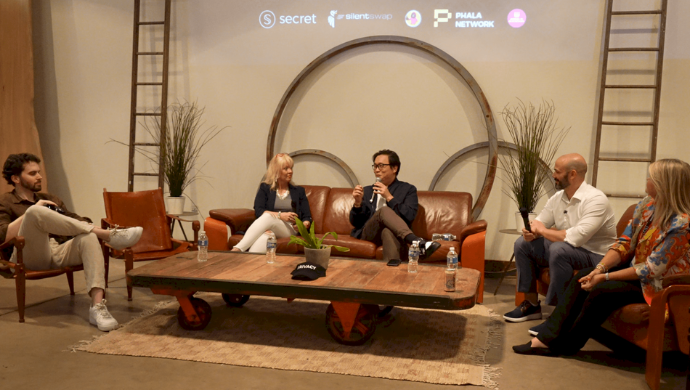
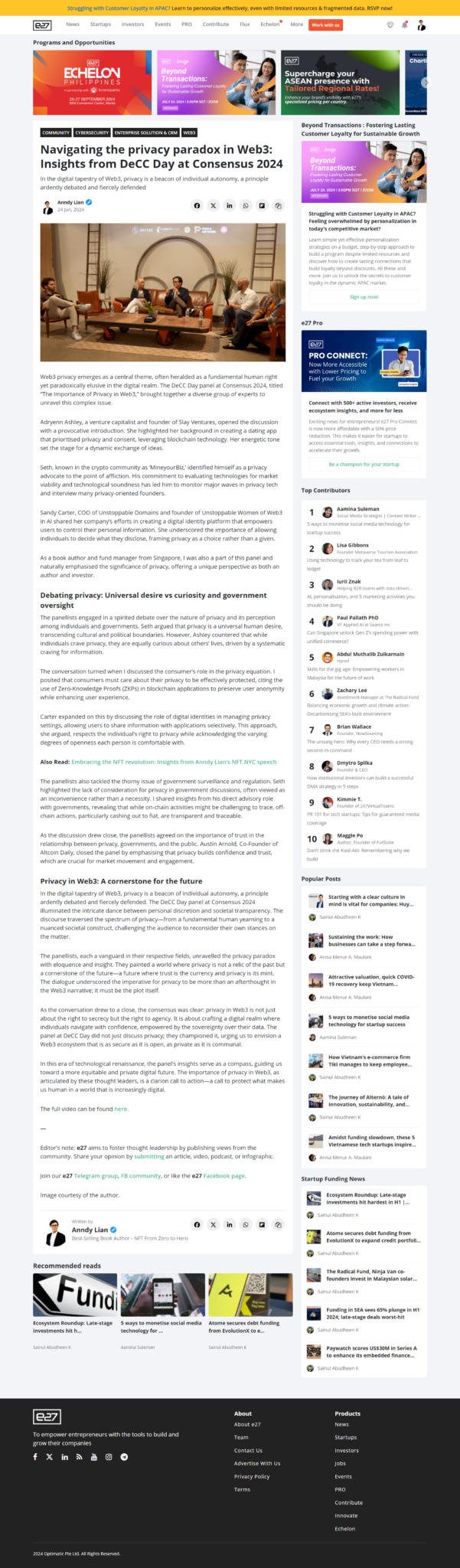
Web3 privacy emerges as a central theme, often heralded as a fundamental human right yet paradoxically elusive in the digital realm. The DeCC Day panel at Consensus 2024, titled “The Importance of Privacy in Web3,” brought together a diverse group of experts to unravel this complex issue.

Adryenn Ashley, a venture capitalist and founder of Slay Ventures, opened the discussion with a provocative introduction. She highlighted her background in creating a dating app that prioritised privacy and consent, leveraging blockchain technology. Her energetic tone set the stage for a dynamic exchange of ideas.

Seth, known in the crypto community as ‘MineyourBiz,’ identified himself as a privacy advocate to the point of affliction. His commitment to evaluating technologies for market viability and technological soundness has led him to monitor major waves in privacy tech and interview many privacy-oriented founders.

Sandy Carter, COO of Unstoppable Domains and founder of Unstoppable Women of Web3 in AI shared her company’s efforts in creating a digital identity platform that empowers users to control their personal information. She underscored the importance of allowing individuals to decide what they disclose, framing privacy as a choice rather than a given.

As a book author and fund manager from Singapore, I was also a part of this panel and naturally emphasised the significance of privacy, offering a unique perspective as both an author and investor.

Debating privacy: Universal desire vs curiosity and government oversight

The panellists engaged in a spirited debate over the nature of privacy and its perception among individuals and governments. Seth argued that privacy is a universal human desire, transcending cultural and political boundaries. However, Ashley countered that while individuals crave privacy, they are equally curious about others’ lives, driven by a systematic craving for information.

The conversation turned when I discussed the consumer’s role in the privacy equation. I posited that consumers must care about their privacy to be effectively protected, citing the use of Zero-Knowledge Proofs (ZKPs) in blockchain applications to preserve user anonymity while enhancing user experience.

Carter expanded on this by discussing the role of digital identities in managing privacy settings, allowing users to share information with applications selectively. This approach, she argued, respects the individual’s right to privacy while acknowledging the varying degrees of openness each person is comfortable with.

Also Read: Embracing the NFT revolution: Insights from Anndy Lian’s NFT.NYC speech

The panellists also tackled the thorny issue of government surveillance and regulation. Seth highlighted the lack of consideration for privacy in government discussions, often viewed as an inconvenience rather than a necessity. I shared insights from his direct advisory role with governments, revealing that while on-chain activities might be challenging to trace, off-chain actions, particularly cashing out to fiat, are transparent and traceable.

As the discussion drew close, the panellists agreed on the importance of trust in the relationship between privacy, governments, and the public. Austin Arnold, Co-Founder of Altcoin Daily, closed the panel by emphasising that privacy builds confidence and trust, which are crucial for market movement and engagement.

Privacy in Web3: A cornerstone for the future

In the digital tapestry of Web3, privacy is a beacon of individual autonomy, a principle ardently debated and fiercely defended. The DeCC Day panel at Consensus 2024 illuminated the intricate dance between personal discretion and societal transparency. The discourse traversed the spectrum of privacy—from a fundamental human yearning to a nuanced societal construct, challenging the audience to reconsider their own stances on the matter.

The panellists, each a vanguard in their respective fields, unravelled the privacy paradox with eloquence and insight. They painted a world where privacy is not a relic of the past but a cornerstone of the future—a future where trust is the currency and privacy is its mint. The dialogue underscored the imperative for privacy to be more than an afterthought in the Web3 narrative; it must be the plot itself.

As the conversation drew to a close, the consensus was clear: privacy in Web3 is not just about the right to secrecy but the right to agency. It is about crafting a digital realm where individuals navigate with confidence, empowered by the sovereignty over their data. The panel at DeCC Day did not just discuss privacy; they championed it, urging us to envision a Web3 ecosystem that is as secure as it is open, as private as it is communal.

In this era of technological renaissance, the panel’s insights serve as a compass, guiding us toward a more equitable and private digital future. The importance of privacy in Web3, as articulated by these thought leaders, is a clarion call to action—a call to protect what makes us human in a world that is increasingly digital.

The full video can be found here.


Source: https://e27.co/navigating-the-privacy-paradox-in-web3-insights-from-decc-day-at-consensus-2024-20240622/

Anndy Lian is an early blockchain adopter and experienced serial entrepreneur who is known for his work in the government sector. He is a best selling book author- “NFT: From Zero to Hero” and “Blockchain Revolution 2030”.

Currently, he is appointed as the Chief Digital Advisor at Mongolia Productivity Organization, championing national digitization. Prior to his current appointments, he was the Chairman of BigONE Exchange, a global top 30 ranked crypto spot exchange and was also the Advisory Board Member for Hyundai DAC, the blockchain arm of South Korea’s largest car manufacturer Hyundai Motor Group. Lian played a pivotal role as the Blockchain Advisor for Asian Productivity Organisation (APO), an intergovernmental organization committed to improving productivity in the Asia-Pacific region.

An avid supporter of incubating start-ups, Anndy has also been a private investor for the past eight years. With a growth investment mindset, Anndy strategically demonstrates this in the companies he chooses to be involved with. He believes that what he is doing through blockchain technology currently will revolutionise and redefine traditional businesses. He also believes that the blockchain industry has to be “redecentralised”.
j j j

Navigating the Privacy Paradox in Web3: Insights from DeCC Day at Consensus 2024

Navigating the Privacy Paradox in Web3: Insights from DeCC Day at Consensus 2024

Web3 privacy emerges as a central theme, often heralded as a fundamental human right yet paradoxically elusive in the digital realm. The DeCC Day panel at Consensus 2024, titled “The Importance of Privacy in Web3,” brought together a diverse group of experts to unravel this complex issue.

Adryenn Ashley, a venture capitalist and founder of Slay Ventures, opened the discussion with a provocative introduction, highlighting her background in creating a dating app that prioritized privacy and consent, leveraging blockchain technology. Her energetic tone set the stage for a dynamic exchange of ideas.

Anndy Lian, a book author and fund manager from Singapore, expressed his passion for privacy, emphasizing its significance in various conferences he attends. His perspective as an author and investor provided a unique lens through which to view the privacy debate.

Seth, known in the crypto community as ‘MineyourBiz,’ identified himself as a privacy advocate to the point of affliction. His commitment to evaluating technologies for market viability and technological soundness has led him to monitor major waves in privacy tech, interviewing many privacy-oriented founders.

Sandy Carter, COO of Unstoppable Domains and founder of Unstoppable Women of Web3 in AI, shared her company’s efforts in creating a digital identity platform that empowers users to control their personal information. She underscored the importance of allowing individuals to decide what they disclose, framing privacy as a choice rather than a given.

The panellists engaged in a spirited debate over the nature of privacy and its perception among individuals and governments. Seth argued that privacy is a universal human desire, transcending cultural and political boundaries. However, Adryenn countered that while individuals crave privacy for themselves, they are equally curious about others’ lives, driven by a systematic craving for information.

The conversation took a turn when Anndy brought up the consumer’s role in the privacy equation. He posited that consumers must care about their privacy for it to be effectively protected, citing the use of Zero-Knowledge Proofs (ZKPs) in blockchain applications as a means to preserve user anonymity while enhancing user experience.

Sandy expanded on this by discussing the role of digital identities in managing privacy settings, allowing users to selectively share information with applications. This approach, she argued, respects the individual’s right to privacy while acknowledging the varying degrees of openness each person is comfortable with.

The panelists also tackled the thorny issue of government surveillance and regulation. Seth highlighted the lack of consideration for privacy in government discussions, often viewed as an inconvenience rather than a necessity. Andy shared insights from his direct advisory role with governments, revealing that while on-chain activities might be challenging to trace, off-chain actions, particularly cashing out to fiat, are transparent and traceable.

As the discussion drew to a close, the panellists agreed on the paramount importance of trust in the relationship between privacy, governments, and the public. Austin Arnold, Co-founder of Altcoin Daily closed the panel by emphasizing that privacy builds confidence and trust, which are crucial for market movement and engagement.

In the digital tapestry of Web3, privacy stands as a beacon of individual autonomy, a principle ardently debated and fiercely defended. The DeCC Day panel at Consensus 2024 illuminated the intricate dance between personal discretion and societal transparency. The discourse traversed the spectrum of privacy—from a fundamental human yearning to a nuanced societal construct, challenging the audience to reconsider their own stances on the matter.

The panellists, each a vanguard in their respective fields, unravelled the privacy paradox with eloquence and insight. They painted a world where privacy is not a relic of the past but a cornerstone of the future—a future where trust is the currency and privacy its mint. The dialogue underscored the imperative for privacy to be more than an afterthought in the Web3 narrative; it must be the plot itself.

As the conversation drew to a close, the consensus was clear: privacy in Web3 is not just about the right to secrecy but the right to agency. It is about crafting a digital realm where individuals navigate with confidence, empowered by the sovereignty over their data. The panel at DeCC Day did not just discuss privacy; they championed it, urging us to envision a Web3 ecosystem that is as secure as it is open, as private as it is communal.

In this era of technological renaissance, the panel’s insights serve as a compass, guiding us toward a more equitable and private digital future. The importance of privacy in Web3, as articulated by these thought leaders, is a clarion call to action—a call to protect what makes us human in a world that is increasingly digital.

Anndy Lian is an early blockchain adopter and experienced serial entrepreneur who is known for his work in the government sector. He is a best selling book author- “NFT: From Zero to Hero” and “Blockchain Revolution 2030”.

Currently, he is appointed as the Chief Digital Advisor at Mongolia Productivity Organization, championing national digitization. Prior to his current appointments, he was the Chairman of BigONE Exchange, a global top 30 ranked crypto spot exchange and was also the Advisory Board Member for Hyundai DAC, the blockchain arm of South Korea’s largest car manufacturer Hyundai Motor Group. Lian played a pivotal role as the Blockchain Advisor for Asian Productivity Organisation (APO), an intergovernmental organization committed to improving productivity in the Asia-Pacific region.

An avid supporter of incubating start-ups, Anndy has also been a private investor for the past eight years. With a growth investment mindset, Anndy strategically demonstrates this in the companies he chooses to be involved with. He believes that what he is doing through blockchain technology currently will revolutionise and redefine traditional businesses. He also believes that the blockchain industry has to be “redecentralised”.
j j j

6 NFT Trends to Watch Out For in 2024: Insights from Anndy Lian

6 NFT Trends to Watch Out For in 2024: Insights from Anndy Lian

Non-fungible tokens (NFTs) are a true yin and yang within the Web3 world.

For all the fun in trading images — and trading on the value of images — that happens, there are plenty of compelling use cases that are likely to enter the wider world.

Techopedia spoke to governmental advisor and author Anndy Lian about his take on the trajectory of NFTs and their impact across various industries, informed by his address this month at NFT NYC 2024.

NFT.NYC is a conference that brings together the global NFT community and web3 professionals in New York City.

Anndy’s session was on April 4, 2024, at the main stage. His topic was titled “NFT Revolution 2024: Trends & Future Predictions” and followed his speech last year called ‘Think Bigger.’

Following his speech, Lian, who is also the author of NFT: From Zero to Hero, outlined his thoughts to Techopedia, focussing on trends, use cases, and the future shape of the market.

Key Takeaways

  • In a conversation with Anndy Lian at NFT NYC 2024, the trajectory of NFTs and their broad impact across industries was discussed.
  • Key trends to watch this year include RWA NFTs, NFT ETFs, AI NFTs, the rise of memes and collections by renowned artists, and ‘photographs as NFTs’.
  • The ERC 404 Hybrid token standard will blend fungible and non-fungible token features.
  • Solana and Binance Smart Chain are pivotal in the NFT boom, with mature infrastructure and community support

6 Key NFT Trends in 2024

RWA NFTs: Digitizing the Physical World

Real-World Asset (RWA) NFTs allow tangible assets like real estate, intellectual property, and fine art to be tokenized into liquid digital formats.

This trend is not just about tokenization but about improving accessibility and creating new markets and liquidity opportunities

For instance, Nexum.ai is leveraging NFTs to revolutionize supply chain financing, showcasing the technology’s practical benefits in traditional industries.

NFT ETFs: Diversification and Institutional Involvement

NFT Exchange-Traded Funds (ETFs) are emerging as opportunities for investors. By offering a diversified portfolio of NFTs, these ETFs provide a level of exposure similar to institutional-grade assets. Backed by credible entities, NFT ETFs could democratize access to the NFT market, allowing for broader participation and investment.

AI NFTs

AI NFTs represent a fusion of artificial intelligence with the NFT ecosystem. Platforms like copx.ai are at the forefront, wrapping NFTs around AI trading tools. This integration makes NFTs more accessible and functional, providing users with exclusive market insights and trades, thus adding a layer of intelligence to the NFT experience.

Meme with a Twist

The Squid Bros, a collection of 10,000 PFPs by SquidGrow created by renowned artist Mike S. Miller, known for his work with Marvel, DC, and Game of Thrones, exemplifies the power of community and intellectual property.

This project demonstrates how strong community backing and robust IP can elevate a meme-inspired NFT collection to new heights, creating value and engagement.

Photographs as NFTs: Capturing Authenticity

Seed.Photo’s selective process has led to a unique collection of photographs minted as NFTs. This approach appeals to major brands seeking authenticity and artistic value.

By curating real photographs as NFTs, Seed.Photo is setting a new standard for quality and exclusivity in the NFT marketplace.

The ERC 404 Hybrid Token Standard

ERC 404 marks a significant innovation in the blockchain world, blending the versatility of fungible tokens with the uniqueness of non-fungible tokens, and offering unique investor opportunities.

This hybrid approach could potentially unlock new functionalities and use cases for digital assets, making them more adaptable and valuable across various applications.

Solana & BNB: The Blockchain Networks Fueling the NFT Boom

Lian emphasized the role of blockchain networks such as Solana and Binance Smart Chain in the current NFT boom, which offer the necessary infrastructure and community support for the development and trade of NFTs.

He praised the chains for these features:

Solana

Lian said:

“It has a high throughput and low fees for NFTs, making it an ideal environment for NFT creation and trade.


“It supports a fully decentralized on-chain experience for artists and collectors, with features like auctions and perpetual royalties coded directly into the NFTs.


“Solana’s NFT standard and minting program offer extreme customizability, backed by a suite of tools which empower creators to launch their NFT storefronts and engage with their audience directly.”

BNB Chain

Lian said:

“BNB Chain offers Ethereum Virtual Machine (EVM) compatibility, which allows for the utilization of Ethereum’s well-established standards and tools.


This compatibility has positioned them as a competitive alternative for NFT creators, especially those seeking lower fees and a supportive community.


“Their marketplace provides a high liquidity platform for users to launch and trade NFTs, further bolstered by multi-chain support for seamless transfers between BSC and other networks.”

Lian added that a synergistic ecosystem for NFTs is important but that “Solana and BNB Chain have each carved out a niche, offering distinct advantages that cater to the diverse needs of the NFT community.”

The Bottom Line

Anndy Lian’s insights at NFT NYC and Techopedia reflect the power within NFTs to redefine ownership and artistic expression in the digital realm.

The speculators come first, but as technology and adoption continue, real purposes evolve, and 2024 will likely be no exception.


Source: https://www.techopedia.com/nft-trends-insights-from-anndy-lian

Anndy Lian is an early blockchain adopter and experienced serial entrepreneur who is known for his work in the government sector. He is a best selling book author- “NFT: From Zero to Hero” and “Blockchain Revolution 2030”.

Currently, he is appointed as the Chief Digital Advisor at Mongolia Productivity Organization, championing national digitization. Prior to his current appointments, he was the Chairman of BigONE Exchange, a global top 30 ranked crypto spot exchange and was also the Advisory Board Member for Hyundai DAC, the blockchain arm of South Korea’s largest car manufacturer Hyundai Motor Group. Lian played a pivotal role as the Blockchain Advisor for Asian Productivity Organisation (APO), an intergovernmental organization committed to improving productivity in the Asia-Pacific region.

An avid supporter of incubating start-ups, Anndy has also been a private investor for the past eight years. With a growth investment mindset, Anndy strategically demonstrates this in the companies he chooses to be involved with. He believes that what he is doing through blockchain technology currently will revolutionise and redefine traditional businesses. He also believes that the blockchain industry has to be “redecentralised”.

j j j