
War pause, market gain: Why geopolitical hope isn’t enough to sustain this rally

War pause, market gain: Why geopolitical hope isn’t enough to sustain this rally

Major stock indexes closed with mixed results on Tuesday, April 7, 2026, as traders digested a significant geopolitical shift that momentarily redirected market sentiment. The S&P 500 and Nasdaq Composite managed late-session recoveries to post marginal gains, while the Dow Jones Industrial Average slipped into negative territory. This divergence reflects a market carefully weighing the promise of de-escalation against the persistent fragility of global trade. The S&P 500 advanced 0.08 per cent to settle at 6,616.85, erasing an intraday decline of 1.2 per cent once news of a two-week ceasefire between the United States and Iran began circulating. This marked the index’s fifth consecutive day of gains, a testament to resilient investor appetite despite elevated uncertainty.

The Nasdaq Composite followed a similar trajectory, gaining 0.10 per cent to finish at 22,017.85, supported by a late risk-on rotation as ceasefire hopes reduced immediate fears of supply chain disruption. The Dow Jones Industrial Average declined 0.18 per cent, or 85.42 points, to close at 46,584.46. Its performance was weighed down by a sharp 3.39 per cent drop in Walmart, a loss that offset a remarkable 9.37 per cent surge in UnitedHealth Group. This intra-index dispersion highlights how sector-specific dynamics continue to play out against a broader macro backdrop.

The primary catalyst for the session’s volatility was geopolitical. President Trump’s agreement to a two-week suspension of bombing on Iran, intended to allow for negotiations and the reopening of the Strait of Hormuz, triggered an immediate reassessment of risk. Energy markets reacted swiftly, with crude oil prices plunging following the ceasefire announcement. West Texas Intermediate crude fell roughly four per cent to trade just above US$108/barrel, after peaking above US$110 earlier in the session. This move underscores how sensitive commodity markets remain to Middle East tensions, even when those tensions appear to be temporarily dialing back. Simultaneously, traditional safe-haven assets saw renewed interest. Gold rose more than one per cent to trade above US$4,700/ounce, while Treasury yields eased slightly, with the 10-year yield falling to 4.30 per cent. This combination of falling oil and rising gold paints a picture of a market that remains cautious, viewing the ceasefire as a pause rather than a permanent resolution.

Looking ahead, the Asia-Pacific region appears poised to build on the late US recovery. Australian shares are set to open higher on April 8, with ASX 200 futures up 13 points, a gain of 0.14 per cent. This tentative optimism exists within a fragile global trade environment. The United Nations Conference on Trade and Development reports that, while global trade growth has carried over into 2026, it remains vulnerable due to rising trade costs and persistent disruptions in the Middle East. This context is crucial for understanding the limited upside in equity indexes. Investors are not ignoring geopolitical progress, but they are not betting the farm on its durability either.

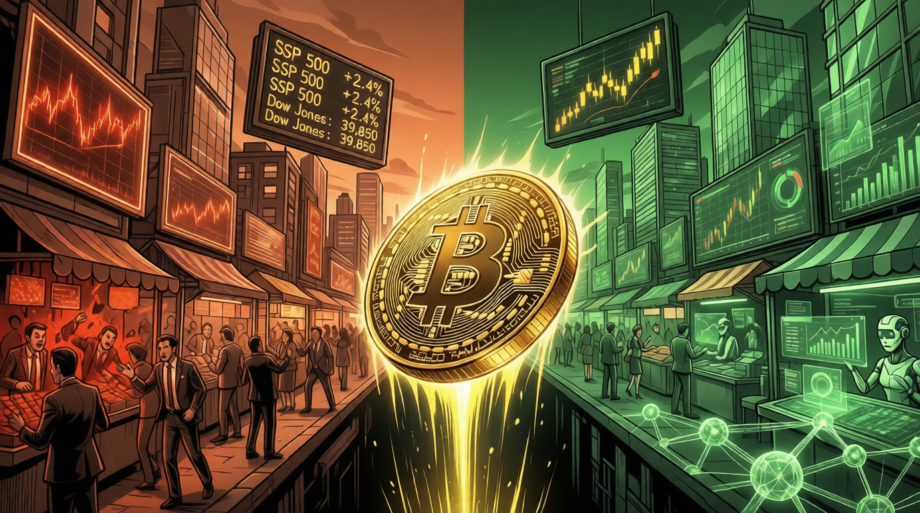
The cryptocurrency market presented a starkly different picture, surging 4.01 per cent over 24 hours to reach a total market capitalisation of US$2.45T. This move demonstrates a powerful, though not isolated, risk appetite. The crypto market now shows a 97 per cent correlation with the S&P 500, indicating that both arenas are responding to the same macro drivers, particularly shifts in geopolitical risk and liquidity expectations. The primary engine for the crypto rally was a landmark regulatory development. The SEC and CFTC jointly issued a binding interpretive rule on March 17 and 18, 2026, classifying 16 major assets, including Bitcoin and Ethereum, as non-security digital commodities. This move resolves a decade of legal ambiguity and directly encourages institutional participation by reducing the regulatory overhang that has long constrained traditional finance from engaging deeply with core crypto assets. This is not a minor technicality. It represents a fundamental shift in the operating landscape for digital assets in the United States.

Bitcoin itself provided foundational momentum, posting a seven-day gain of 5.79 per cent while its market dominance rose to 58.68 per cent. This strength in the leading asset created a platform for broader speculation. Capital rotated into high-beta sectors, with the Layer-1 category outperforming the broader market by 1.62 per cent. Privacy-focused assets also saw intense interest, with Zcash surging 26.88 per cent on narratives linking privacy technology with AI-driven financial tools. This selective risk-taking suggests an improvement in overall confidence, though the Altcoin Season Index remains at 34, down 2.86 per cent in 24 hours. A sustained move above 50 on that index would signal that a more widespread altcoin rally is taking hold.

The near-term trajectory for crypto hinges on key technical levels and upcoming regulatory dialogue. The market must hold above the US$2.45T pivot point, which aligns with the 38.2 per cent Fibonacci retracement level. A successful test of this support could pave the way toward a move to US$2.49T, the 23.6 per cent Fibonacci level. The most important near-term event is the SEC’s scheduled roundtable on the CLARITY Act on April 16, 2026. Positive commentary from this dialogue could extend the current bullish momentum, while any unexpected negative developments could trigger swift profit-taking. On the downside, a daily close below US$2.34T, the 78.6 per cent Fibonacci level, would invalidate the short-term bullish structure and indicate a deeper correction is likely.

From my perspective, this market action reinforces a critical thesis. The convergence of traditional and digital asset markets is accelerating, driven by macro forces and regulatory clarity rather than isolated speculation. The 97 per cent correlation between crypto and the S&P 500 is not a sign of crypto losing its innovative edge, but rather evidence that it is maturing into a legitimate component of the global financial system. The regulatory clarity provided by the SEC and CFTC is a watershed moment, not because it endorses any particular technology, but because it finally applies a sensible framework that recognises the unique properties of decentralised digital commodities. This allows institutional capital to participate with greater confidence, which in turn reduces volatility and fosters more sustainable growth.

A straightforward answer to the title, “We need more new money to flow in to see a change.” For now, it will be sideways.


Source: https://e27.co/war-pause-market-gain-why-geopolitical-hope-isnt-enough-to-sustain-this-rally-20260408/

Anndy Lian is an early blockchain adopter and experienced serial entrepreneur who is known for his work in the government sector. He is a best selling book author- “NFT: From Zero to Hero” and “Blockchain Revolution 2030”.

Currently, he is appointed as the Chief Digital Advisor at Mongolia Productivity Organization, championing national digitization. Prior to his current appointments, he was the Chairman of BigONE Exchange, a global top 30 ranked crypto spot exchange and was also the Advisory Board Member for Hyundai DAC, the blockchain arm of South Korea’s largest car manufacturer Hyundai Motor Group. Lian played a pivotal role as the Blockchain Advisor for Asian Productivity Organisation (APO), an intergovernmental organization committed to improving productivity in the Asia-Pacific region.

An avid supporter of incubating start-ups, Anndy has also been a private investor for the past eight years. With a growth investment mindset, Anndy strategically demonstrates this in the companies he chooses to be involved with. He believes that what he is doing through blockchain technology currently will revolutionise and redefine traditional businesses. He also believes that the blockchain industry has to be “redecentralised”.

j j j

Bitcoin holds US$71K as Ethereum surges 15%: What’s driving the US$2.44T crypto rally

Bitcoin holds US$71K as Ethereum surges 15%: What’s driving the US$2.44T crypto rally

The digital asset market edged higher, climbing 0.63 per cent to reach a total capitalisation of US$2.44T over the past 24 hours. This modest advance reflects a market searching for direction amid competing forces, with momentum in the Ethereum ecosystem and institutional staking flows providing the primary lift. The move shows a moderate 50 per cent correlation with the S&P 500, which itself rose 0.5 per cent to approximately 6,591.90, suggesting that macro drivers continue to influence both traditional and digital asset classes.

Ethereum’s ecosystem stands out as the clear leader, with its market capitalisation surging by 15.58 per cent over the past 24 hours. This outperformance stems from concrete institutional activity rather than speculative fervour. BitMine Immersion Technologies launched MAVAN, an institutional Ethereum staking platform that now holds over 3.14M ETH, representing roughly US$6.8B in committed capital. This development matters because it channels yield-seeking institutional money into the network, reducing immediate sell pressure and reinforcing Ethereum’s role as a core settlement layer. The ongoing dialogue around Ethereum’s L1 and L2 strategy further strengthens this narrative, positioning the network as foundational infrastructure rather than merely a speculative vehicle. When large players allocate billions toward staking, they signal confidence in the protocol’s long-term value accrual, and that confidence tends to ripple through the broader market.

Derivatives data support a healthier backdrop for this advance. Total open interest rose 3.34 per cent while Bitcoin liquidations fell 49 per cent to US$44.92M, indicating that the recent squeeze on over-leveraged positions has eased. The average funding rate remains positive at 0.0017 per cent, indicating balanced leverage rather than excessive bullish speculation. Meanwhile, the Fear and Greed Index ticked up to 36, still in Fear territory but a notable improvement from extreme levels. These metrics suggest that spot buying and staking activity, not leveraged gambling, drive the current uptick. I view this as a constructive shift because markets advance more sustainably when grounded in real demand rather than fleeting leverage. A sustained drop in liquidation volumes and stabilisation of funding rates would further confirm that the market foundation is strengthening.

The near-term trajectory hinges on clear technical levels and upcoming catalysts. Bitcoin must hold above US$71,000 to maintain bullish momentum, while the total market cap needs to stay above the 50 per cent Fibonacci retracement support at US$2.41T. A confirmed break above the US$2.49T resistance, which aligns with the 23.6 per cent Fibonacci level, could open a path toward US$2.56T. Conversely, failing to hold US$2.41T would invalidate the bounce and likely trigger a retest of lower support near US$2.33T. The potential launch of Morgan Stanley’s spot Bitcoin ETF, ticker MSBT, represents a key upcoming catalyst that could influence institutional flows. I watch these levels closely because they reflect not just price action but the market’s collective assessment of risk and opportunity. Technical structure matters most when it aligns with fundamental drivers, and right now, Ethereum staking inflows provide that alignment.

Traditional markets provided a supportive backdrop for this crypto advance. The Dow Jones Industrial Average gained 0.7 per cent, adding 305.43 points to close at 46,429.49, while the Nasdaq Composite advanced 0.8 per cent to 21,929.83, supported by strength in AI-related technology stocks like Nvidia and AMD. European indices posted strong gains, with the FTSE 100 rising 1.42 per cent, the DAX advancing 1.41 per cent, and the CAC 40 climbing 1.33 per cent. Asian markets showed mixed but generally positive performance, with the Nikkei 225 surging 3.08 per cent to 53,860 points, the Straits Times Index gaining 1.10 per cent, and the Hang Seng rising 0.88 per cent. This global equity strength reflects cautious optimism about geopolitical developments, including reports that the United States delivered a potential ceasefire plan to Iran, easing some immediate fears of a wider Middle East conflict. I note that crypto’s moderate correlation with equities means it can benefit from this risk-on sentiment while still responding to its own unique catalysts.

Commodity and currency markets added nuance to the macro picture. Brent Crude rose slightly to US$102.97 per barrel, up 0.74 per cent on the day, indicating that energy supply concerns persist even as geopolitical tensions ease. The 10-year Treasury yield reached 4.38 per cent, reflecting investor expectations that interest rates may remain elevated for longer, which typically pressures risk assets. The Bloomberg Dollar Spot Index rose 0.2 per cent as the euro and pound weakened slightly against the greenback, suggesting some safe-haven demand for the US currency. Bitcoin traded around US$70,727, up one per cent, aligning with the broader crypto market advance. I see these cross-asset moves as important context because they shape the liquidity environment in which digital assets operate. When Treasury yields rise and the dollar strengthens, crypto faces headwinds, and the current advance shows that ecosystem-specific catalysts can offset broader macro pressure.

Labour market data and global economic outlooks also influence investor positioning. US initial jobless claims were expected at 211K, signalling a cooling but still resilient labour market, which affects Federal Reserve policy expectations. The OECD released its Interim Economic Outlook, highlighting the shift towards embedded finance as a structural market driver, a trend that directly intersects with blockchain and digital asset adoption. I view embedded finance as a critical frontier because it represents the seamless integration of financial services into everyday digital experiences, and blockchain technology enables the transparency and efficiency that this integration demands. When major institutions acknowledge these structural shifts, it reinforces the long-term case for decentralised infrastructure, even if short-term price action remains volatile.

The key question centres on whether institutional staking demand continues to grow and whether Bitcoin can sustain its key support levels amid ongoing macro uncertainty. Will Ethereum’s role as a yield-generating asset attract enough capital to offset broader headwinds from elevated Treasury yields and a strong dollar? For now, the data supports a constructive but measured outlook, with clear levels to watch and catalysts to monitor as the market navigates this complex macro landscape.


Source: https://e27.co/bitcoin-holds-us71k-as-ethereum-surges-15-whats-driving-the-us2-44t-crypto-rally-20260326/

Anndy Lian is an early blockchain adopter and experienced serial entrepreneur who is known for his work in the government sector. He is a best selling book author- “NFT: From Zero to Hero” and “Blockchain Revolution 2030”.

Currently, he is appointed as the Chief Digital Advisor at Mongolia Productivity Organization, championing national digitization. Prior to his current appointments, he was the Chairman of BigONE Exchange, a global top 30 ranked crypto spot exchange and was also the Advisory Board Member for Hyundai DAC, the blockchain arm of South Korea’s largest car manufacturer Hyundai Motor Group. Lian played a pivotal role as the Blockchain Advisor for Asian Productivity Organisation (APO), an intergovernmental organization committed to improving productivity in the Asia-Pacific region.

An avid supporter of incubating start-ups, Anndy has also been a private investor for the past eight years. With a growth investment mindset, Anndy strategically demonstrates this in the companies he chooses to be involved with. He believes that what he is doing through blockchain technology currently will revolutionise and redefine traditional businesses. He also believes that the blockchain industry has to be “redecentralised”.
j j j

Binance cracks down on market makers: What traders need to know now

Binance cracks down on market makers: What traders need to know now

Binance just announced stricter rules for market makers and token issuers, and this move deserves careful attention from anyone watching how crypto markets mature. The exchange now requires projects to disclose their market maker identity, legal entity, and key contract terms covering inventory and fee handling. It explicitly bans profit-sharing and guaranteed-return arrangements between projects and market makers, as well as opaque token lending that permits broad, undefined use of borrowed tokens. These structures often hide incentives that drive manipulative behaviour.

They will also monitor market maker activity more closely, watching for selling that conflicts with vesting schedules, one-sided quote provision, or trading that artificially inflates volume. The platform reserves the right to blacklist firms that engage in these practices. Bloomberg separately notes a prohibition on any revenue-sharing models tied to market-making on Binance. This is not a minor policy tweak. It represents a fundamental shift toward transparency in a part of crypto markets that has long operated in the shadows.

Market makers play a vital role in healthy trading environments. They tighten spreads and provide depth, allowing traders to enter and exit positions without excessive slippage. But when market makers receive payments to pump volumes or support price levels at all costs, they create fake liquidity that misleads traders about real demand. The new Binance rules aim to separate genuine market making from arrangements designed to manufacture the appearance of activity. By forcing disclosure of who the market maker is and what they can do, and by banning profit-sharing and price-manipulation deals, Binance tries to reduce conflicts of interest and wash trading that drew criticism after past market meltdowns. Tokens that relied on aggressive, opaque market making to appear healthier than they truly were could see wider spreads or lower volumes in the near term. Projects with organic demand and clean arrangements may stand out more clearly once the noise fades. This short-term discomfort could actually help investors distinguish between substance and spectacle.

The real test of these new rules will be enforcement. Binance says it will take swift, decisive action against misconduct, including blacklisting market makers. But it remains unclear whether blacklisted entities will be publicly named or only handled internally. Transparency about enforcement would strengthen the credibility of this policy shift. Without public accountability, bad actors could simply migrate to less scrutinised venues while continuing similar practices. Watch how liquidity metrics change, especially for smaller or recently listed tokens. Persistent widening spreads or sharp drops in reported volume could signal that prior activity depended heavily on now-constrained arrangements.

Also, watch whether rival exchanges adopt similar policies or position themselves as more flexible alternatives. If Binance’s stricter stance becomes an industry norm, it could reduce room for aggressive market making across the entire ecosystem, not just on one venue. That would represent meaningful progress toward more honest price discovery.

These changes reflect a necessary evolution in how crypto markets operate. I have seen how opaque arrangements can undermine trust. When market makers and projects hide their relationships, they create information asymmetry that harms retail participants the most. Requiring disclosure does not eliminate all manipulation, but it raises the cost of deceptive behaviour and makes it easier for observers to spot red flags. Banning profit sharing between projects and their market makers removes a powerful incentive to coordinate trades that serve internal interests rather than genuine supply and demand. This aligns with a broader principle I hold: decentralised systems work best when incentives are transparent and aligned with long-term network health, not short-term price engineering.

That said, I approach these rules with measured optimism. Regulation and self-regulation in crypto must balance market integrity with innovation. Overly rigid constraints could push legitimate market-making activity offshore or into decentralised venues where oversight is minimal. The goal should not be to eliminate market making but to ensure it serves real liquidity needs rather than marketing narratives. Binance’s focus on specific harmful practices, such as front-running token release schedules or providing one-sided quotes, shows a nuanced understanding of where manipulation occurs. This targeted approach is more promising than blanket restrictions that might stifle useful activity. I also believe that traditional financial tests, such as the Howey test, often fail to capture the realities of decentralised systems. Similarly, market-making rules designed for traditional equities may not translate perfectly to crypto. Binance appears to be crafting rules specific to the dynamics of digital asset markets, which is the right direction.


Source: https://e27.co/binance-cracks-down-on-market-makers-what-traders-need-to-know-now-20260326/

Anndy Lian is an early blockchain adopter and experienced serial entrepreneur who is known for his work in the government sector. He is a best selling book author- “NFT: From Zero to Hero” and “Blockchain Revolution 2030”.

Currently, he is appointed as the Chief Digital Advisor at Mongolia Productivity Organization, championing national digitization. Prior to his current appointments, he was the Chairman of BigONE Exchange, a global top 30 ranked crypto spot exchange and was also the Advisory Board Member for Hyundai DAC, the blockchain arm of South Korea’s largest car manufacturer Hyundai Motor Group. Lian played a pivotal role as the Blockchain Advisor for Asian Productivity Organisation (APO), an intergovernmental organization committed to improving productivity in the Asia-Pacific region.

An avid supporter of incubating start-ups, Anndy has also been a private investor for the past eight years. With a growth investment mindset, Anndy strategically demonstrates this in the companies he chooses to be involved with. He believes that what he is doing through blockchain technology currently will revolutionise and redefine traditional businesses. He also believes that the blockchain industry has to be “redecentralised”.

j j j