Solana Labs GameShift May Unite Web3 and Blockchain Gaming

Solana Labs GameShift May Unite Web3 and Blockchain Gaming

Solana Labs, the company behind the fast and scalable Solana blockchain, has recently launched the beta version of GameShift, a platform that aims to simplify the integration of Web3 features into games.

GameShift promises to offer game developers a single, easy-to-use API that handles all the blockchain complexity under the hood, allowing them to focus on creating immersive and engaging gaming experiences.

But will it really change the blockchain gaming landscape and enable more games to be launched? Here are some of the key aspects and implications of this innovative platform.

How Does GameShift Work?

GameShift is a unified blockchain game development API that leverages the power and efficiency of the Solana blockchain. It allows game developers to access a full stack of trusted third-party Web3 components on Solana through a single API without needing blockchain coding or knowledge. Some of the features include:

  • User wallets: Integrates with popular wallet providers such as Phantom, Sollet, and Coin98, enabling users to easily connect their wallets to games and manage their assets.
  • NFT minting: Enables game developers to create and mint unique and verifiable digital assets, such as characters, items, skins, and collectibles, using the Metaplex protocol.
  • In-game marketplaces: Allows game developers to create and customize their own branded in-game marketplaces, where users can buy, sell, and trade their NFTs using the Crossmint protocol.
  • Credit card on-ramps: Enables users to purchase NFTs and other in-game assets using fiat currency through credit card payments using the Coinflow protocol.
  • Analytics and insights: Provides game developers with access to data and metrics about their games, such as user behavior, engagement, retention, and revenue, using the Metakeep protocol.

GameShift is designed to be Web2-friendly, meaning that it uses familiar technologies and interfaces that game developers are already accustomed to, such as REST API, SDKs, and Unity, and Unreal engines. It also aims to provide a seamless and user-friendly experience for gamers, who can enjoy the benefits of Web3 gaming without having to deal with the technicalities and frictions of blockchain.

What are the Benefits of GameShift?

GameShift offers several benefits for both game developers and gamers, such as:

  • Faster and more accessible game development: Reduces the time, cost, and complexity of developing blockchain games by providing a single solution that handles all the Web3 components and integrations. Game developers can focus on the core gameplay and design aspects rather than the backend infrastructure and blockchain coding.
  • Higher quality and diversity of games: Enables game developers to create high-quality and diverse games that can rival those of traditional PC, console, and mobile games. It supports various genres and styles of games, from casual and social games to RPGs and MMOs and from 2D and 3D graphics to VR and AR experiences.
  • More revenue and engagement opportunities: Allows game developers to monetize their games and create new revenue streams by leveraging the play-to-earn and play-to-own models. Game developers can reward their users with cryptocurrency and NFTs for playing their games and also earn a share of the transactions that occur in their in-game marketplaces. It also enables game developers to increase user engagement and retention by offering users more ownership, control, and customization over their in-game assets and experiences.

What is the Impact and Potential of GameShift?

GameShift is a promising and innovative platform that has the potential to revolutionize the blockchain gaming industry and attract more game developers and gamers to the Web3 space. It may also have a positive impact on the broader blockchain and crypto ecosystem by driving more adoption and innovation and by creating more use cases and value for Solana and its native token, SOL.

They are still in the early stages of development. However, it has already attracted some interest and attention from game developers and investors and is powered by industry partners like Crossmint, Coinflow, and Metakeep. This is a good start for them.

It is expected to launch more games and features on its platform in the near future and to expand its user base and network effect. Personally, I think they may also explore more opportunities, such as:

  • Interoperability and cross-chain gaming: They may enable game developers and gamers to interact and exchange assets and data across different blockchains and platforms, creating more diversity and interoperability in the Web3 gaming ecosystem.
  • Social and community gaming: It may foster more social and community aspects in Web3 gaming by enabling game developers and gamers to create and join groups, clans, guilds, and DAOs and to communicate and collaborate with each other through chat, voice, and video features.
  • Immersive and realistic gaming: They may enhance the immersive and realistic aspects of Web3 gaming by enabling game developers and gamers to use VR and AR technologies and to create and experience lifelike and dynamic virtual worlds and environments.

The Bottom Line

Gameshift has the potential to shake up the world of blockchain gaming. It simplifies and speeds up the process of adding Web3 features to games, making it easier for game developers. It could completely transform blockchain gaming, enabling more games to launch.

For developers, it’s like a one-stop shop that takes care of all the complicated Web3 stuff, and for gamers, it offers a smooth and user-friendly experience with all the benefits of Web3 gaming.

And it’s not just about games. This platform could have a positive impact on the wider blockchain and crypto world. It might encourage more people to get involved and develop new ideas. It could even boost the value of Solana and its native token, SOL.

Right now, the platform is still in beta, and it hasn’t hosted any games yet. But it’s already getting much attention from game developers and investors. They’ve also announced some cool partnerships with other prominent players in the gaming world.

They plan to launch more games and features soon and explore all kinds of exciting possibilities for Web3 gaming, like making games work together, creating social gaming experiences, and diving into immersive gaming.


Source: https://www.techopedia.com/solana-labs-gameshift-may-unite-web3-and-blockchain-gaming

Anndy Lian is an early blockchain adopter and experienced serial entrepreneur who is known for his work in the government sector. He is a best selling book author- “NFT: From Zero to Hero” and “Blockchain Revolution 2030”.

Currently, he is appointed as the Chief Digital Advisor at Mongolia Productivity Organization, championing national digitization. Prior to his current appointments, he was the Chairman of BigONE Exchange, a global top 30 ranked crypto spot exchange and was also the Advisory Board Member for Hyundai DAC, the blockchain arm of South Korea’s largest car manufacturer Hyundai Motor Group. Lian played a pivotal role as the Blockchain Advisor for Asian Productivity Organisation (APO), an intergovernmental organization committed to improving productivity in the Asia-Pacific region.

An avid supporter of incubating start-ups, Anndy has also been a private investor for the past eight years. With a growth investment mindset, Anndy strategically demonstrates this in the companies he chooses to be involved with. He believes that what he is doing through blockchain technology currently will revolutionise and redefine traditional businesses. He also believes that the blockchain industry has to be “redecentralised”.

j j j

Anndy Lian: Bitcoin Price Surges to $35,000, More Gains Ahead

Anndy Lian: Bitcoin Price Surges to $35,000, More Gains Ahead

Bitcoin, the world’s largest and most popular cryptocurrency, has been on a bullish streak lately, reaching $35,000 for the first time since May 2022. The digital asset has more than doubled in value this year as investors flock to it amid inflation fears, regulatory developments, and growing adoption.

One of the main drivers of Bitcoin’s rally is the anticipation of a spot Bitcoin exchange-traded fund (ETF) approval by the U.S. Securities and Exchange Commission (SEC). A spot ETF would allow investors to buy and sell Bitcoin directly on regulated stock exchanges without having to deal with crypto platforms or custody issues.

Several companies have applied for a spot in Bitcoin ETF, including BlackRock (NYSE:BLK), WisdomTree, Invesco Galaxy, Wise Origin, VanEck, Bitwise, and Valkyrie Digital Assets. The SEC has postponed its decision on these applications until November, but some analysts believe that the regulator will eventually greenlight at least one of them.

A spot Bitcoin ETF would be a game-changer for the crypto industry, as it would boost the liquidity, accessibility, and legitimacy of Bitcoin. It would also attract more institutional and retail investors to the market, creating more demand and driving up the price.

Another factor that is fueling Bitcoin’s rise is the upcoming halving event in 2024. The halving is a process that reduces the reward for mining new blocks of Bitcoin by 50% every four years. This creates a scarcity effect that increases the value of each coin. The halving also coincides with a cyclical pattern of Bitcoin’s price movements, which tend to peak about a year after each halving.

The last halving occurred in May 2020, when the reward dropped from 12.5 to 6.25 bitcoins per block. Since then, Bitcoin has surged from around $9,000 to over $35,000. The next halving is expected to happen in May 2024, when the reward will drop to 3.125 bitcoins per block. Many experts believe that this will trigger another bull run that could push Bitcoin to new heights.

One of them is Peter Brandt, a legendary trader and analyst who has been following Bitcoin since 2011. Brandt has recently shared his bullish chart that predicts new all-time highs for Bitcoin by the third quarter of 2024. He says that Bitcoin has hit its bottom at around $25,000 in July 2023 and will break out of its long-term range by mid-2024. He also suggests that Bitcoin will go through a period of consolidation or sideways movement until then.

Brandt’s chart shows that Bitcoin follows a series of bullish impulses followed by periods of correction. He expects that Bitcoin will reach around $40,000 in the short term, based on its convincing break above the $32,000 level. He then forecasts that Bitcoin will correct to around $30,000 before resuming its uptrend and reaching new highs above $70,000 by Q3 2024.

Brandt is not alone in his optimistic outlook. Other analysts have also made bold predictions for Bitcoin’s future price. Some of them include:

  • Alistair Milne, founder of Altana Digital Currency Fund, predicts that Bitcoin will surge to $45,000 depending on what happens with inflation.
  • Dan Tapiero, co-founder of 10T Holdings and Gold Bullion International, who believes that Bitcoin could reach $100,000 by 2025.
  • Tim Draper, billionaire investor and founder of Draper Associates and DFJ Venture Capital, expects that Bitcoin will hit $250,000 by mid-2023.
  • John McAfee, a software entrepreneur and crypto advocate, who claims that Bitcoin will reach $1 million by 2025.

Why I Think Bitcoin Will Drop to $29,000 Before Surging to $40,000

Bitcoin, the world’s leading cryptocurrency, has been on a roller coaster ride this year, reaching new highs and lows. As of writing this article, Bitcoin is trading at around $35,000, up from its recent low of $25,000 in July 2023. However, I believe that this rally is not sustainable and that Bitcoin will face another major correction before it can break out of its long-term range and reach new heights.

There are several reasons why I think Bitcoin will drop to $29,000 before it can surge to $40,000 and above. These include:

  • The lack of a spot Bitcoin ETF approval by the SEC
  • The increasing competition from other cryptocurrencies and technologies
  • The diminishing returns of the halving effect

Let me explain each of these points in detail.

The lack of a spot Bitcoin ETF approval by the SEC

One of the main catalysts for Bitcoin’s recent rally is the expectation of a spot Bitcoin ETF approval by the U.S. Securities and Exchange Commission (SEC). A spot ETF would allow investors to buy and sell Bitcoin directly on regulated stock exchanges without having to deal with crypto platforms or custody issues.

However, I think that this expectation is too optimistic and that the SEC will not approve any spot Bitcoin ETF anytime soon. The SEC has been very cautious and sceptical about Bitcoin and crypto in general, citing issues such as market manipulation, fraud, volatility, liquidity, custody, and investor protection.

The SEC has already postponed its decision on several spot Bitcoin ETF applications until November, but I doubt that it will grant any approval by then. The SEC has rejected or delayed every Bitcoin ETF proposal since 2013, and I don’t see any reason why it would change its stance now.

Therefore, I think that the market is overestimating the probability of a spot Bitcoin ETF approval and that this will lead to disappointment and sell-off when the SEC announces its verdict. I expect that this will trigger a downward pressure on Bitcoin’s price and push it below $30,000.

The increasing competition from other cryptocurrencies and technologies

Another factor that could weigh on Bitcoin’s price is the increasing competition from other cryptocurrencies and technologies that offer faster, cheaper, more scalable, and more innovative solutions.

Bitcoin is the first and most dominant cryptocurrency, but it is not the only one. There are thousands of other cryptocurrencies that have emerged since Bitcoin’s inception in 2009, each with its own features, advantages, and disadvantages.

Some of these cryptocurrencies are challenging Bitcoin’s supremacy in different aspects, such as:

  • Ethereum, which is the second-largest cryptocurrency by market cap and the leading platform for smart contracts, decentralized applications (DApps), decentralized finance (DeFi), non-fungible tokens (NFTs), and more.
  • Cardano, which is the third-largest cryptocurrency by market cap and a rival to Ethereum that claims to offer a more scalable, secure, and sustainable platform for smart contracts and DApps.
  • Solana, which is the fifth-largest cryptocurrency by market cap and a high-performance blockchain that boasts over 50,000 transactions per second (TPS), low fees, and interoperability with other blockchains.
  • Dogecoin, which is the ninth-largest cryptocurrency by market cap and a meme-inspired coin that has gained popularity among retail investors and celebrities such as Elon Musk.

These are just some examples of the many alternatives to Bitcoin that are gaining traction and adoption in the crypto space. These cryptocurrencies are not only competing for market share but also for innovation and development.

While Bitcoin has a loyal fan base and a strong network effect, it also suffers from some limitations and challenges that could hinder its growth potential. Some of these include:

  • Its slow transaction speed of around 7 TPS, makes it unsuitable for micropayments or high-frequency transactions
  • Its high transaction fees of around $10 per transaction, which make it expensive for small or frequent transfers
  • Its limited scalability is due to its fixed block size of 1 MB, which limits its capacity to handle more transactions per second
  • Its high energy consumption is due to its proof-of-work (PoW) consensus mechanism, which requires a lot of computing power and electricity to secure the network
  • Its lack of programmability due to its simple scripting language, which limits its ability to support complex functions or applications

These limitations could make Bitcoin less attractive or relevant compared to other cryptocurrencies or technologies that offer better solutions or features. Therefore, I think that Bitcoin will face more competition and pressure from other players in the crypto space and that this will affect its price negatively.

The diminishing returns of the halving effect

A third reason why I think Bitcoin will drop to $29,000 before it can surge to $40,000 is the diminishing returns of the halving effect.

The halving is a process that reduces the reward for mining new blocks of Bitcoin by 50% every four years. This creates a scarcity effect that increases the value of each coin. The halving also coincides with a cyclical pattern of Bitcoin’s price movements, which tend to peak about a year after each halving.

The last halving occurred in May 2020, when the reward dropped from 12.5 to 6.25 bitcoins per block. Since then, Bitcoin has surged from around $9,000 to over $35,000. The next halving is expected to happen in May 2024, when the reward will drop to 3.125 bitcoins per block.

Many experts believe that this will trigger another bull run that could push Bitcoin to new heights. However, I think that this effect will be weaker and less predictable than before.

There are several reasons why I think the halving effect will diminish over time. These include:

  • The decreasing impact of the reward reduction on the supply and demand of Bitcoin. As the reward gets smaller and smaller, it will have less influence on the inflation rate and the market price of Bitcoin. For instance, the first halving in 2012 reduced the inflation rate from 50% to 25%, while the fourth halving in 2024 will reduce it from 1.8% to 0.9%. This means that the supply shock will be less significant and less noticeable than before.
  • The increasing difficulty and cost of mining Bitcoin. As the reward gets smaller and smaller, it will become harder and more expensive for miners to break even or make a profit. This could lead to some miners exiting or reducing their operations, which could affect the security and stability of the network. It could also create more selling pressure on the market, as miners need to sell some of their coins to cover their expenses.
  • The decreasing correlation between the halving and the price cycles of Bitcoin. As Bitcoin matures and becomes more influenced by other factors such as adoption, regulation, innovation, and competition, it will become less dependent on the halving as a price driver. The halving may not be as reliable or accurate as a predictor or indicator of future price movements as before.

Therefore, I think that the halving effect will not be as strong or consistent as before and that it will not be enough to propel Bitcoin to new highs without other positive catalysts or developments.

Conclusion

Of course, these predictions are not guaranteed to come true and should be taken with a grain of salt. Bitcoin is a volatile and unpredictable asset that can be influenced by many factors beyond anyone’s control. Some of the risks and challenges that could affect Bitcoin’s price include:

  • Regulatory uncertainty and crackdowns from governments and central banks
  • Cyberattacks and hacks on crypto platforms and users
  • Technical issues and bugs in the Bitcoin network or software
  • Competition from other cryptocurrencies and technologies
  • Market manipulation and fraud by whales and bad actors
  • Loss of confidence and trust among investors and users

Therefore, anyone who is interested in investing in Bitcoin should do their own research and due diligence before making any decisions. They should also be aware of the potential rewards and risks involved and be prepared for high volatility and price swings.

Bitcoin is a revolutionary and innovative invention that has changed the world of finance and technology. It has also created a new asset class that offers unprecedented opportunities and challenges for investors and users. As Bitcoin enters its second decade of existence, it will continue to evolve and grow, and possibly reach new heights that no one can imagine.


Source: https://in.investing.com/analysis/anndy-lian-bitcoin-price-surges-to-35000-more-gains-ahead-200601620


Anndy Lian is an early blockchain adopter and experienced serial entrepreneur who is known for his work in the government sector. He is a best selling book author- “NFT: From Zero to Hero” and “Blockchain Revolution 2030”.

Currently, he is appointed as the Chief Digital Advisor at Mongolia Productivity Organization, championing national digitization. Prior to his current appointments, he was the Chairman of BigONE Exchange, a global top 30 ranked crypto spot exchange and was also the Advisory Board Member for Hyundai DAC, the blockchain arm of South Korea’s largest car manufacturer Hyundai Motor Group. Lian played a pivotal role as the Blockchain Advisor for Asian Productivity Organisation (APO), an intergovernmental organization committed to improving productivity in the Asia-Pacific region.

An avid supporter of incubating start-ups, Anndy has also been a private investor for the past eight years. With a growth investment mindset, Anndy strategically demonstrates this in the companies he chooses to be involved with. He believes that what he is doing through blockchain technology currently will revolutionise and redefine traditional businesses. He also believes that the blockchain industry has to be “redecentralised”.

j j j

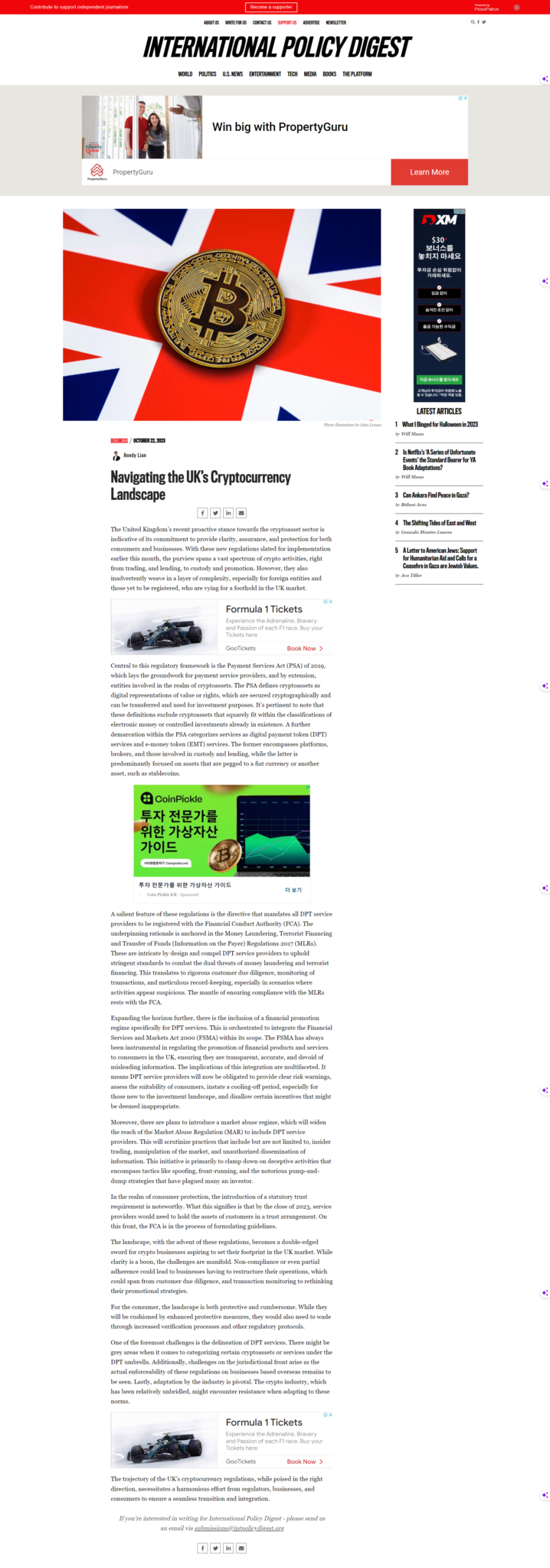
Navigating the UK’s Cryptocurrency Landscape

Navigating the UK’s Cryptocurrency Landscape

The United Kingdom’s recent proactive stance towards the cryptoasset sector is indicative of its commitment to provide clarity, assurance, and protection for both consumers and businesses. With these new regulations slated for implementation earlier this month, the purview spans a vast spectrum of crypto activities, right from trading, and lending, to custody and promotion. However, they also inadvertently weave in a layer of complexity, especially for foreign entities and those yet to be registered, who are vying for a foothold in the UK market.

Central to this regulatory framework is the Payment Services Act (PSA) of 2019, which lays the groundwork for payment service providers, and by extension, entities involved in the realm of cryptoassets. The PSA defines cryptoassets as digital representations of value or rights, which are secured cryptographically and can be transferred and used for investment purposes. It’s pertinent to note that these definitions exclude cryptoassets that squarely fit within the classifications of electronic money or controlled investments already in existence. A further demarcation within the PSA categorizes services as digital payment token (DPT) services and e-money token (EMT) services. The former encompasses platforms, brokers, and those involved in custody and lending, while the latter is predominantly focused on assets that are pegged to a fiat currency or another asset, such as stablecoins.

A salient feature of these regulations is the directive that mandates all DPT service providers to be registered with the Financial Conduct Authority (FCA). The underpinning rationale is anchored in the Money Laundering, Terrorist Financing and Transfer of Funds (Information on the Payer) Regulations 2017 (MLRs). These are intricate by design and compel DPT service providers to uphold stringent standards to combat the dual threats of money laundering and terrorist financing. This translates to rigorous customer due diligence, monitoring of transactions, and meticulous record-keeping, especially in scenarios where activities appear suspicious. The mantle of ensuring compliance with the MLRs rests with the FCA.

Expanding the horizon further, there is the inclusion of a financial promotion regime specifically for DPT services. This is orchestrated to integrate the Financial Services and Markets Act 2000 (FSMA) within its scope. The FSMA has always been instrumental in regulating the promotion of financial products and services to consumers in the UK, ensuring they are transparent, accurate, and devoid of misleading information. The implications of this integration are multifaceted. It means DPT service providers will now be obligated to provide clear risk warnings, assess the suitability of consumers, instate a cooling-off period, especially for those new to the investment landscape, and disallow certain incentives that might be deemed inappropriate.

Moreover, there are plans to introduce a market abuse regime, which will widen the reach of the Market Abuse Regulation (MAR) to include DPT service providers. This will scrutinize practices that include but are not limited to, insider trading, manipulation of the market, and unauthorized dissemination of information. This initiative is primarily to clamp down on deceptive activities that encompass tactics like spoofing, front-running, and the notorious pump-and-dump strategies that have plagued many an investor.

In the realm of consumer protection, the introduction of a statutory trust requirement is noteworthy. What this signifies is that by the close of 2023, service providers would need to hold the assets of customers in a trust arrangement. On this front, the FCA is in the process of formulating guidelines.

The landscape, with the advent of these regulations, becomes a double-edged sword for crypto businesses aspiring to set their footprint in the UK market. While clarity is a boon, the challenges are manifold. Non-compliance or even partial adherence could lead to businesses having to restructure their operations, which could span from customer due diligence, and transaction monitoring to rethinking their promotional strategies.

For the consumer, the landscape is both protective and cumbersome. While they will be cushioned by enhanced protective measures, they would also need to wade through increased verification processes and other regulatory protocols.

One of the foremost challenges is the delineation of DPT services. There might be grey areas when it comes to categorizing certain cryptoassets or services under the DPT umbrella. Additionally, challenges on the jurisdictional front arise as the actual enforceability of these regulations on businesses based overseas remains to be seen. Lastly, adaptation by the industry is pivotal. The crypto industry, which has been relatively unbridled, might encounter resistance when adapting to these norms.

The trajectory of the UK’s cryptocurrency regulations, while poised in the right direction, necessitates a harmonious effort from regulators, businesses, and consumers to ensure a seamless transition and integration.


Source: https://intpolicydigest.org/navigating-the-uk-s-cryptocurrency-landscape/

Anndy Lian is an early blockchain adopter and experienced serial entrepreneur who is known for his work in the government sector. He is a best selling book author- “NFT: From Zero to Hero” and “Blockchain Revolution 2030”.

Currently, he is appointed as the Chief Digital Advisor at Mongolia Productivity Organization, championing national digitization. Prior to his current appointments, he was the Chairman of BigONE Exchange, a global top 30 ranked crypto spot exchange and was also the Advisory Board Member for Hyundai DAC, the blockchain arm of South Korea’s largest car manufacturer Hyundai Motor Group. Lian played a pivotal role as the Blockchain Advisor for Asian Productivity Organisation (APO), an intergovernmental organization committed to improving productivity in the Asia-Pacific region.

An avid supporter of incubating start-ups, Anndy has also been a private investor for the past eight years. With a growth investment mindset, Anndy strategically demonstrates this in the companies he chooses to be involved with. He believes that what he is doing through blockchain technology currently will revolutionise and redefine traditional businesses. He also believes that the blockchain industry has to be “redecentralised”.
j j j