The internet has transformed the way we live, work, and connect with each other. From the early days of the World Wide Web to the rise of social media and e-commerce, the internet has become an integral part of our daily lives. However, it is clear that the current internet infrastructure has its limitations, including issues related to centralization, data privacy, and lack of intelligence. Enter Web4, a new vision for an intelligent and decentralized web that addresses these challenges and unlocks a world of new possibilities.
Understanding Web4:
Web4 represents a paradigm shift in how we envision and interact with the internet. It builds upon the principles of Web3 (decentralization) and integrates advanced technologies such as artificial intelligence (AI), blockchain, and the Internet of Things (IoT) to create a more intelligent and decentralized web ecosystem. Web4 aims to empower individuals, enhance privacy, and foster innovation while leveraging the potential of AI to provide personalized and context-aware experiences.
Key Features of Web4:
Decentralization: Web4 embraces the core tenets of Web3, ensuring that power and control are distributed across a network of interconnected nodes. By moving away from centralized entities and adopting decentralized architectures such as blockchain, Web4 reduces the risk of single points of failure, censorship, and data breaches. This decentralized approach fosters trust, transparency, and resilience in the web infrastructure.
Artificial Intelligence: AI is at the heart of Web4, enabling intelligent automation, data analysis, and decision-making. Through machine learning, natural language processing, and computer vision, Web4 systems can understand and interpret user data, preferences, and behavior. This allows for personalized recommendations, intelligent assistants, and context-aware applications that adapt to individual needs and provide a more intuitive and efficient user experience.
Enhanced Privacy and Security: Web4 prioritizes user privacy and data security. It leverages cryptographic techniques and decentralized identity systems to empower individuals with greater control over their personal information. With Web4, users can choose how their data is shared and accessed, reducing the risks associated with centralized data storage and surveillance. This focus on privacy strengthens user trust and encourages widespread adoption.
Interoperability and Open Standards: Web4 promotes interoperability and open standards, allowing different applications and platforms to seamlessly communicate and share data. By embracing common protocols and APIs, Web4 enables the creation of a vibrant ecosystem where innovative solutions can easily integrate and collaborate. This fosters competition, diversity, and rapid technological advancements, benefitting users and driving innovation forward.
Democratization of Innovation: Web4 empowers individuals and small businesses by reducing barriers to entry and enabling participation in the digital economy. Through decentralized platforms and smart contracts, Web4 enables peer-to-peer transactions, crowdfunding, and new funding models such as initial coin offerings (ICOs) and decentralized finance (DeFi). This democratization of innovation ensures that the benefits of the web are accessible to all, irrespective of geographical location or financial resources.
Potential Applications:
Web4’s intelligent, decentralized nature opens up a wide range of potential applications across various sectors:
Governance and Democracy: Web4 can facilitate transparent and decentralized governance models, enabling citizen participation, voting systems, and smart contracts that automate governance processes. This can lead to more accountable and inclusive decision-making at local, national, and global levels.
Supply Chain and Logistics: Web4 can revolutionize supply chain management by providing real-time tracking, transparency, and traceability. By leveraging blockchain and IoT technologies, Web4 enables secure and efficient supply chain operations, reducing fraud, improving product authenticity, and optimizing logistics processes.
Healthcare and Telemedicine: Web4 can transform healthcare by enabling secure and interoperable health records, personalized medicine, and telemedicine services. AI-powered diagnostics, remote monitoring, and decentralized data sharing can improve patient outcomes, facilitate research, and enhance collaboration among healthcare providers.
Smart Cities and Sustainability: Web4 can contribute to the development of smart cities that optimize resource usage, enhance energy efficiency, and improve urban planning. Through intelligent sensor networks and data analytics, Web4 can enable real-time monitoring, predictive maintenance, and sustainable infrastructure management.
Conclusion:
Web4 represents a bold vision for the future of the internet, one that embraces decentralization, artificial intelligence, and user empowerment. By combining these elements, Web4 has the potential to revolutionize various industries, enhance privacy and security, and democratize access to innovation. However, realizing the full potential of Web4 requires collaboration, standardization, and ethical considerations to ensure that the benefits are accessible to all while safeguarding user rights and societal values. As we embark on this new era of the web, let us envision and build a future that empowers individuals, fosters innovation, and creates a more inclusive and intelligent digital world.
Anndy Lian is an early blockchain adopter and experienced serial entrepreneur who is known for his work in the government sector. He is a best selling book author- “NFT: From Zero to Hero” and “Blockchain Revolution 2030”.
Currently, he is appointed as the Chief Digital Advisor at Mongolia Productivity Organization, championing national digitization. Prior to his current appointments, he was the Chairman of BigONE Exchange, a global top 30 ranked crypto spot exchange and was also the Advisory Board Member for Hyundai DAC, the blockchain arm of South Korea’s largest car manufacturer Hyundai Motor Group. Lian played a pivotal role as the Blockchain Advisor for Asian Productivity Organisation (APO), an intergovernmental organization committed to improving productivity in the Asia-Pacific region.
An avid supporter of incubating start-ups, Anndy has also been a private investor for the past eight years. With a growth investment mindset, Anndy strategically demonstrates this in the companies he chooses to be involved with. He believes that what he is doing through blockchain technology currently will revolutionise and redefine traditional businesses. He also believes that the blockchain industry has to be “redecentralised”.
The topic of regulating and overseeing cryptocurrency has gained momentum in American politics for multiple reasons. There is a rising apprehension about the use of cryptocurrency for unlawful activities, such as money laundering, terrorism financing, and tax evasion. Consequently, there is a demand for stricter regulations and supervision to prevent such activities.
There is also an increasing curiosity about the potential advantages of cryptocurrency, such as enhanced financial inclusion and better cross-border payments. This has given rise to pro-crypto politicians who endorse the growth and acceptance of cryptocurrency in the United States.
Increase in Crypto Lobbying
Firstly, in recent years, there has been a notable surge in the use of cryptocurrencies and blockchain technology worldwide, leading to a need for supportive regulatory frameworks. This trend is evident in the United States, where the amount of money spent on lobbying related to cryptocurrencies has skyrocketed for the past six years.
According to a report by Money Mongers, there has been an increase of 922% in crypto lobbying expenditure in the US since 2016. This significant spending indicates that organizations involved in the cryptocurrency industry are investing heavily in efforts to influence policymakers and shape public policy. The top spenders in 2022 were Coinbase, Blockchain Association, and Robinhood, which are all prominent players in the cryptocurrency space.
The fact that these companies are allocating large sums of money for lobbying efforts suggests that they understand the importance of regulatory clarity and consistency for the long-term success of the industry. By influencing lawmakers and policymakers, they can help shape laws and regulations that support their business models and promote growth and innovation in the cryptocurrency industry.
It is important to note that regulation in the cryptocurrency space remains highly fragmented and decentralized, with different states adopting varying approaches. One state, Wyoming, has taken a unique approach to cryptocurrency regulation by exempting the buying, selling, issuing, or taking custody of payment instruments in the form of virtual currency or receiving virtual currency for transmission from licensing as money transmission under state law.
This move could attract more cryptocurrency businesses and investors to the state. However, at the federal level, there is still no consistent legal approach to regulating cryptocurrencies and developing federal cryptocurrency legislation remains a work in progress.
The Financial Crimes Enforcement Network (FinCEN) does not consider cryptocurrencies as legal tender, and the regulation of cryptocurrency exchanges varies from state to state. These inconsistencies could pose challenges for businesses and investors in the cryptocurrency space as they navigate the complex and evolving regulatory landscape.
The Pandemic Has Accelerated the Adoption of Cryptocurrencies
Secondly, in my personal observations, the COVID-19 pandemic has significantly impacted various aspects of our daily lives, including the way we handle transactions and make payments. With the highly contagious nature of the virus, there has been a surge in the adoption of contactless transactions, leading to the growth of digital payment methods. Hence, cryptocurrencies have gained popularity as a means of payment.
Cryptocurrencies like Bitcoin, Ethereum, and Litecoin have become a safe and secure way to make payments without the need for physical contact. The decentralized nature of cryptocurrencies and the use of blockchain technology to record transactions make them an attractive option for people who prioritize secure and transparent payment methods.
Additionally, the pandemic has caused increased economic uncertainty, with many people losing jobs or experiencing reduced income. In this situation, cryptocurrencies have become a way to protect wealth and preserve value. Cryptocurrencies are not tied to traditional financial systems and are, therefore, seen as a way to protect against inflation and other economic risks.
The pandemic has accelerated the adoption of digital technologies, including cryptocurrencies, as people seek out safe, secure, and contactless payment methods. As the world continues to navigate the challenges posed by the pandemic, it is likely that the use of cryptocurrencies will continue to grow, further establishing them as a mainstream means of payment.
Interest in Blockchain Technology
Thirdly, Politicians worldwide have shown interest in blockchain technology due to its potential to transform various industries. Its decentralized and transparent nature provides several advantages, such as enhanced security, efficiency, and accountability. Many politicians have acknowledged the potential of blockchain technology to drive innovation, create job opportunities, and improve transparency.
In addition to this, cryptocurrencies have attracted significant attention from politicians due to their disruptive potential in the financial industry. Banks and financial institutions have dominated the traditional financial system for centuries, and cryptocurrencies offer an opportunity to challenge this status quo. Pro-crypto politicians see this as a chance to provide an alternative to traditional finance and empower individuals.
Several countries have introduced regulations to support the growth of the cryptocurrency industry, including Japan, which became the first country to regulate cryptocurrencies as legal tender, and Malta, which has established itself as a hub for blockchain and cryptocurrency businesses. In the United States, politicians and regulatory bodies are engaging in discussions about regulating cryptocurrencies effectively while promoting innovation and protecting consumers.
While there is no doubt about the potential of blockchain technology and cryptocurrencies to transform various industries, there are also concerns about the risks associated with their use. These risks include the potential for fraud and money laundering, as well as the lack of oversight and regulation in some areas of the cryptocurrency industry.
Despite these concerns, the increasing recognition of the potential of blockchain technology and cryptocurrencies among politicians is a positive development for the industry. As more politicians and regulatory bodies engage in discussions about how to regulate and promote innovation in the cryptocurrency space, the industry is likely to continue growing and maturing, offering new opportunities for businesses and individuals.
The Banking Crisis Shifted the Narrative Surrounding Cryptocurrencies
Fourthly, the recent banking crisis in the United States has caused a major shift in the way people perceive cryptocurrencies. As experts suggest, the collapse of Credit Suisse and deposit runs on regulated U.S. banks have resulted in consumers exploring alternative options, including cryptocurrencies. Bobby Lee, a well-known figure in the crypto industry, also agrees with this notion, stating that the banking crisis has made investors view cryptocurrencies as a safe haven from the hazards of the traditional financial system.
A report by JPMorgan highlights that the banking crisis is perceived as a vindication of the crypto ecosystem. As a result, some experts believe that this crisis has created the perfect environment for a crypto revolution, leading Bitcoin through a significant bull run.
Furthermore, this crisis has brought to light the potential risks associated with traditional banking systems, which has allowed investors to explore the range of non-speculative use cases for Bitcoin. This first wave of bank failures since the inception of Bitcoin is considered a crucial test for cryptocurrencies.
The perceived reduction in the safety and security of traditional investments, such as gold and stocks, has led to a renewed focus on the ‘digital gold’ narrative. Cryptocurrencies, especially Bitcoin, are now considered a safe haven asset in times of economic uncertainty.
This has resulted in an upsurge in interest and adoption of cryptocurrencies as more people look for alternative investment options. This interest could be attributed to the increasing awareness of the potential risks associated with traditional investments and the growing trust in the security and stability of cryptocurrencies.
Crypto-friendly banks have a crucial role to play in promoting the adoption of cryptocurrencies. These banks offer faster transactions, fewer geographical restrictions, and better KYC and authentication processes compared to traditional banks. Therefore, this could lead to increased adoption, as it provides a better user experience for those looking to invest in cryptocurrencies.
I would even argue that crypto needs banks to promote adoption. If more traditional banks become open to cryptocurrencies, this could lead to a more stable and secure financial system. Increased adoption will result in greater stability and trust in cryptocurrencies as a viable alternative investment option.
Who Are the Pro-crypto Politicians?
The younger generation in the United States has shown a high level of interest in cryptocurrencies and digital assets. According to a survey conducted by SoFi in March 2023, over 36% of workers expressed interest in receiving cryptocurrency as part of their paycheck. With that change, I do see that politicians are taking their own stand on cryptocurrencies.
When I spoke to my crypto-native friends, they said to me that Republicans are generally more supportive of cryptocurrencies, with some even promoting Bitcoin as a form of currency. Democrats, on the other hand, have expressed concerns about the risks associated with cryptocurrencies and have taken steps to regulate them. I think it is worth noting that different politicians have taken different positions on this matter, regardless of their party affiliation.
Here is a list of 10 pro-crypto politicians in the United States, in my humble opinion:
Francis Suarez – Suarez is one of several local politicians in the US with a crypto-friendly stance. He took office as the mayor of Miami in 2017 and soon became the first American politician to take 100% of their salary in Bitcoin. He has also been hailed as one of the leading proponents of cryptocurrency adoption in the US.
J.D. Vance – Vance is a pro-crypto politician who won a Senate primary in Ohio in 2022. He has publicly disclosed that he holds Bitcoin valued at around $250,000.
Tim Ryan – Ryan is a pro-crypto politician who won a Senate primary in Ohio in 2022. He shares similar views with Portman, the incumbent he was challenging, on many crypto-related pieces of legislation in the Senate.
Andrew Yang – Yang is a former Democratic presidential candidate who has been an advocate for cryptocurrencies. He has previously stated that he believes cryptocurrencies and blockchain technology have the potential to create a more transparent and accountable government.
Cynthia Lummis – Lummis is a Senator from Wyoming who has been a vocal advocate for Bitcoin and cryptocurrency. She believes that Bitcoin can be an effective store of value, and has criticized the U.S. dollar for losing its value over time due to inflation. Lummis also supports the idea of a decentralized financial system and sees cryptocurrencies as a way to achieve this.
Bill Foster – Foster is a Congressman from Illinois who has been a vocal advocate for cryptocurrency. He serves as one of the chairs of the Congressional Blockchain Caucus along with Republican Congressman Tom Emmer from Minnesota. Foster has co-sponsored bills related to the regulation of digital assets, including the Central Bank Digital Currency Study Act of 2021.
Ro Khanna – Khanna is a Congressman from California who has been a vocal advocate for cryptocurrency. He has emphasized that blockchain is simply a technology with the potential to decentralize ownership and economic opportunity.
Patrick McHenry – McHenry is a Congressman from North Carolina and has been a vocal advocate for cryptocurrency in Congress. He has been actively involved in crafting policies that will govern the cryptocurrency industry and has pledged to regulate cryptocurrencies along with President Joe Biden and other lawmakers.
Ted Cruz – Cruz is a Senator from Texas who has been a vocal advocate for cryptocurrency. He has proposed making Texas a “crypto oasis” and has introduced legislation to require vendors on Capitol Hill to accept crypto payments. He has also pushed for the adoption of cryptocurrency within Congress using incentives such as food.
Eric Adams – As the newly elected mayor of New York City, Eric Adams has made cryptocurrency a significant part of his platform and has committed to taking his first three paychecks into office in Bitcoin.
The Future of Cryptocurrency Regulation in America
The future of cryptocurrency regulation in the United States is currently uncertain and evolving. Although federal regulations have not been implemented yet, several states have created their own regulations. For instance, as mentioned above, Wyoming has excluded specific virtual currency activities from being licensed as money transmission under state law.
Nevertheless, the Securities and Exchange Commission (SEC) has recently reopened a proposed regulation from the previous year that could potentially impact decentralized finance (DeFi) in the future.
Moreover, the Biden administration has shown interest in regulating stablecoins and mitigating their potential risk to consumers. It is expected that as the cryptocurrency market continues to grow, regulators in the US and around the world will establish more regulations to protect consumers and prevent fraud.
To stay current with the latest regulations, it is essential for companies, investors, and stakeholders to consult qualified legal advisors. Clear regulations will instill confidence in companies and create a secure environment for investors. The demand for regulations from the cryptocurrency industry is an indication of its seriousness and intent to expand globally.
The United States’ influence on the cryptocurrency industry has led to many watching them closely, akin to an ‘American Big Brother’ for the sector. Despite the uncertainty, I believe it is important to remain positive and keep track of the latest developments to adapt and thrive in this evolving industry.
Anndy Lian is an early blockchain adopter and experienced serial entrepreneur who is known for his work in the government sector. He is a best selling book author- “NFT: From Zero to Hero” and “Blockchain Revolution 2030”.
Currently, he is appointed as the Chief Digital Advisor at Mongolia Productivity Organization, championing national digitization. Prior to his current appointments, he was the Chairman of BigONE Exchange, a global top 30 ranked crypto spot exchange and was also the Advisory Board Member for Hyundai DAC, the blockchain arm of South Korea’s largest car manufacturer Hyundai Motor Group. Lian played a pivotal role as the Blockchain Advisor for Asian Productivity Organisation (APO), an intergovernmental organization committed to improving productivity in the Asia-Pacific region.
An avid supporter of incubating start-ups, Anndy has also been a private investor for the past eight years. With a growth investment mindset, Anndy strategically demonstrates this in the companies he chooses to be involved with. He believes that what he is doing through blockchain technology currently will revolutionise and redefine traditional businesses. He also believes that the blockchain industry has to be “redecentralised”.
Over the past weeks, social media platforms have been buzzing with tales of traders who seemingly hit the jackpot by investing in the PEPE meme coin. These stories of overnight success raise an important question: Can meme coins truly be relied upon as a means to accumulate wealth, or are they akin to playing the lottery and relying on luck?
To find the answer, we must explore the diverse strategies employed by various socio-economic classes when engaging with the lottery. The comparison between meme coins and lotteries sheds light on the different perspectives towards wealth accumulation.
Meme coins, for those unfamiliar, are digital currencies inspired by internet memes. Unlike traditional cryptocurrencies, meme coins typically lack practical applications beyond being traded and shared among users. Their value is heavily influenced by social media sentiment and other factors, leading to substantial price swings and the potential for market manipulation. While meme coins carry significant risks, they have amassed a substantial following of individuals who see them as a means of challenging established financial systems and connecting with like-minded communities online.
The PEPE meme coin, in particular, experienced a staggering 9,071% surge in value prior to its listing on Binance, reaching an astounding market capitalization of $1.8 billion. However, cautionary advice is now being shared among traders due to the coin’s recent breach of crucial trend and support levels. Meme coins, especially those developed by anonymous teams, are susceptible to “rug pulls,” where developers abandon the project, leading to a collapse in value. Additionally, price volatility tends to be most pronounced during Asian trading hours.
Examining the contrasting strategies of wealth accumulation, we encounter the renowned billionaire investor Warren Buffet, whose approach involves investing in stable, blue-chip stocks that closely align with the growth of the US economy. By consistently maintaining a funding rate 2-3% below his peers, Buffet has managed to accumulate a personal fortune of $112.8 billion. His success imparts two vital lessons: investing in well-established blue-chip companies without unnecessary risks is sufficient, and remaining invested over an extended period allows for substantial wealth accumulation. Hence, prioritizing safety and longevity are key factors in achieving financial prosperity.
On the other hand, we have the allure of the lottery, where the promise of instant wealth with minimal effort and investment proves irresistible to many. Despite the astronomical odds of winning a jackpot (1 in 300 million for Powerball), the average player spends close to $200 per year, which accumulates to a significant sum over time. Surprisingly, research suggests that those who fall into the lower socio-economic class tend to play the lottery regardless of the odds, while wealthier individuals only participate when the jackpot offers substantial returns. For the wealthy, a $10 million win may not make a significant impact, but a jackpot exceeding $100 million piques their interest.
In essence, the PEPE meme coin and the lottery represent two sides of the same coin. Both offer the allure of swift wealth with minimal investment, but both carry substantial risks. While Buffet’s investment strategy prioritizes safety and is grounded in long-term schemes, playing the lottery or investing in meme coins resembles a game of chance, hoping for the best outcome.
What Other Meme Coins Are Making Waves?
The surge in popularity of meme coins can be attributed to various factors, including the growing fascination with cryptocurrencies and the relative ease of creating new digital currencies. Several meme coins have garnered attention for their clever branding and incorporation of popular culture references, which have fueled interest and speculation. The social media-driven aspect of meme culture has also played a significant role, with influencers and online communities endorsing their preferred coins and spreading the word to their followers.
This has created a frenzied environment of buying and selling, as investors aim to capitalize on the hype and take advantage of the unpredictability of these highly speculative assets.
Here are several meme coins that have gained popularity and attention:
AiDoge: AiDoge positions itself as a new web3 platform for meme creation and sharing using AI technology. The project has gained significant attention, with its presale reportedly raising over $5.5 million.
Ordi: Ordi is a meme coin paying homage to the Ordinals protocol, which is currently the largest with a value of $400 million.
BOB: BOB is an AI bot that provides tweet summaries to Twitter users who reply with “@ExplainThisBob”. Its programming includes automatic responses to tweets made by Elon Musk, which have earned BOB praise from Musk himself and garnered a large following of several thousand users.
MONG: MONG is a recently launched meme cryptocurrency project in 2023. What sets MONG Coin apart from other meme cryptocurrencies is its association with an established NFT collection called MONGS NFT, which was created in January 2022. The collection features 6,943 NFTs, with each NFT portraying a distinct mungo (mongoose).
TURBO: TURBO is an innovative cryptocurrency with a unique token economy that aims to become the meme coin of the future. Unless many other meme coins, TURBO is developed almost exclusively using ChatGPT.
LADYS: Milady Meme Coin has its native token called LADYS, which can be utilized to pay for online goods and services. The token’s value received a lot of attention after Elon Musk tweeted about the Milady NFT meme. Currently, the market capitalization of this meme token has exceeded $100 million.
WOJAK: WOJAK is a new ERC-20 token, inspired by the famous Wojak meme. Since its inception, the token has gained massive momentum and at its peak, it has surged over 1000%.
Floki: Floki is a cryptocurrency that initially started as a meme coin inspired by the dog of Elon Musk. However, it has now transformed into a complete Web3 ecosystem that comprises NFTs, DeFi, a metaverse, and prepaid gift cards for Visa and Mastercard. The project has gained a lot of attention as it was recently added to the list of cryptocurrencies on Binance.
XRdoge: XRdoge is a meme coin on the XRP ledger. Similar to Floki, they are not a new meme coin. The reason why they are mentioned is that I felt that XRP needs to have their own doge and have some fun. The fun elements could bring more hype to the Ripple ecosystem.
The newer memes that are trying to ride on the PEPE waves, like BIBI, BOBO, PEPO, and PIPI would need to find their own niche very soon. Other Chinese-themed coins like Pogai and LowB got to gather more mandarin speaking communities to join in the fun. If you are a Cate, SquidGrow, TSUKA or Renewable coin and not part of the frog or dog craze, you just got to wait for your turn to shine.
It is worth mentioning that while newer meme coins have recently gained significant popularity, older meme coins such as Doge, Shiba Inu, Pitbull, RichQuack, Saitama, Baby Doge, Safemoon continue to thrive by actively maintaining their community and working on their projects. This demonstrates their commitment to longevity and a sustained presence in the ever-changing world of cryptocurrency. The level of dedication and perseverance displayed by these coins is a positive indication for the meme coin industry, as it suggests that some of these coins may have staying power beyond just a momentary hype cycle. The continued relevance and demand for these older meme coins highlight their ability to maintain a loyal following and leave a lasting impact, even in the midst of emerging trends and shifting market conditions.
In conclusion
It should be noted, however, that meme coins are known for their strong online communities, driven by hype and speculation, and may not necessarily have serious real-world use cases or underlying technology.
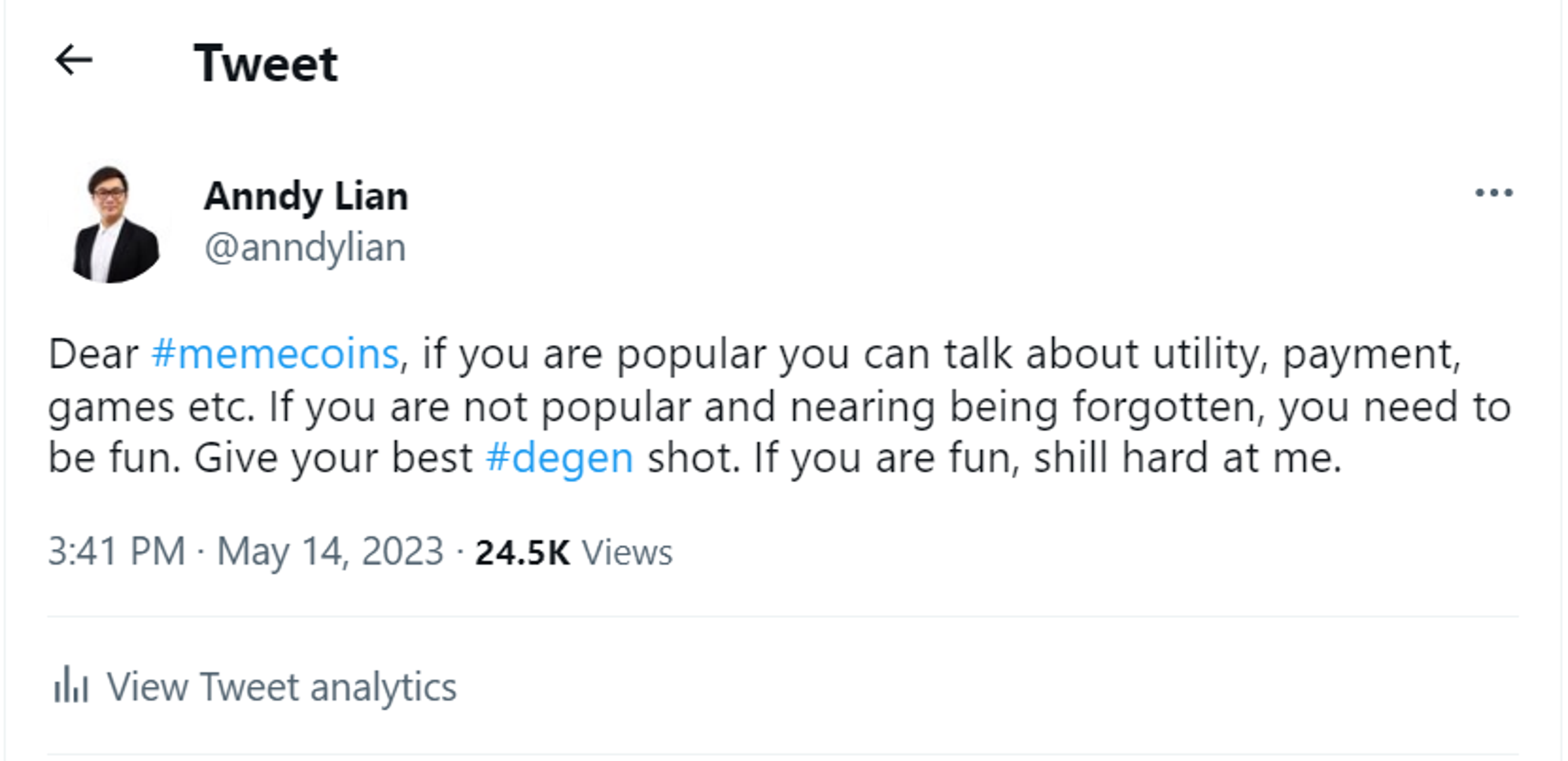
Like what I have mentioned on Twitter: “Dear #memecoins, if you are popular you can talk about utility, payment, games etc. If you are not popular and nearing being forgotten, you need to be fun…”
The underlying for its success would still be community and having fun together. If a meme coin survives the initial stages and gains support from its community, its games, NFTs, or even metaverse would have a much higher chance of success. Their new revenue streams would be vital for them to survive in the bear market and beyond.
It’s essential to consider the risks and rewards of any investment opportunity carefully. While the promise of quick wealth might be tempting, long-term, low-risk investments are the safest and most reliable way to accumulate wealth.
Anndy Lian is an early blockchain adopter and experienced serial entrepreneur who is known for his work in the government sector. He is a best selling book author- “NFT: From Zero to Hero” and “Blockchain Revolution 2030”.
Currently, he is appointed as the Chief Digital Advisor at Mongolia Productivity Organization, championing national digitization. Prior to his current appointments, he was the Chairman of BigONE Exchange, a global top 30 ranked crypto spot exchange and was also the Advisory Board Member for Hyundai DAC, the blockchain arm of South Korea’s largest car manufacturer Hyundai Motor Group. Lian played a pivotal role as the Blockchain Advisor for Asian Productivity Organisation (APO), an intergovernmental organization committed to improving productivity in the Asia-Pacific region.
An avid supporter of incubating start-ups, Anndy has also been a private investor for the past eight years. With a growth investment mindset, Anndy strategically demonstrates this in the companies he chooses to be involved with. He believes that what he is doing through blockchain technology currently will revolutionise and redefine traditional businesses. He also believes that the blockchain industry has to be “redecentralised”.