Binance CEO Says Exchange ‘Pulled Back’ Bids on Bankrupt US Firms

Binance CEO Says Exchange ‘Pulled Back’ Bids on Bankrupt US Firms

Major crypto exchange Binance is holding off on any plans to invest in embattled crypto firms in the United States.

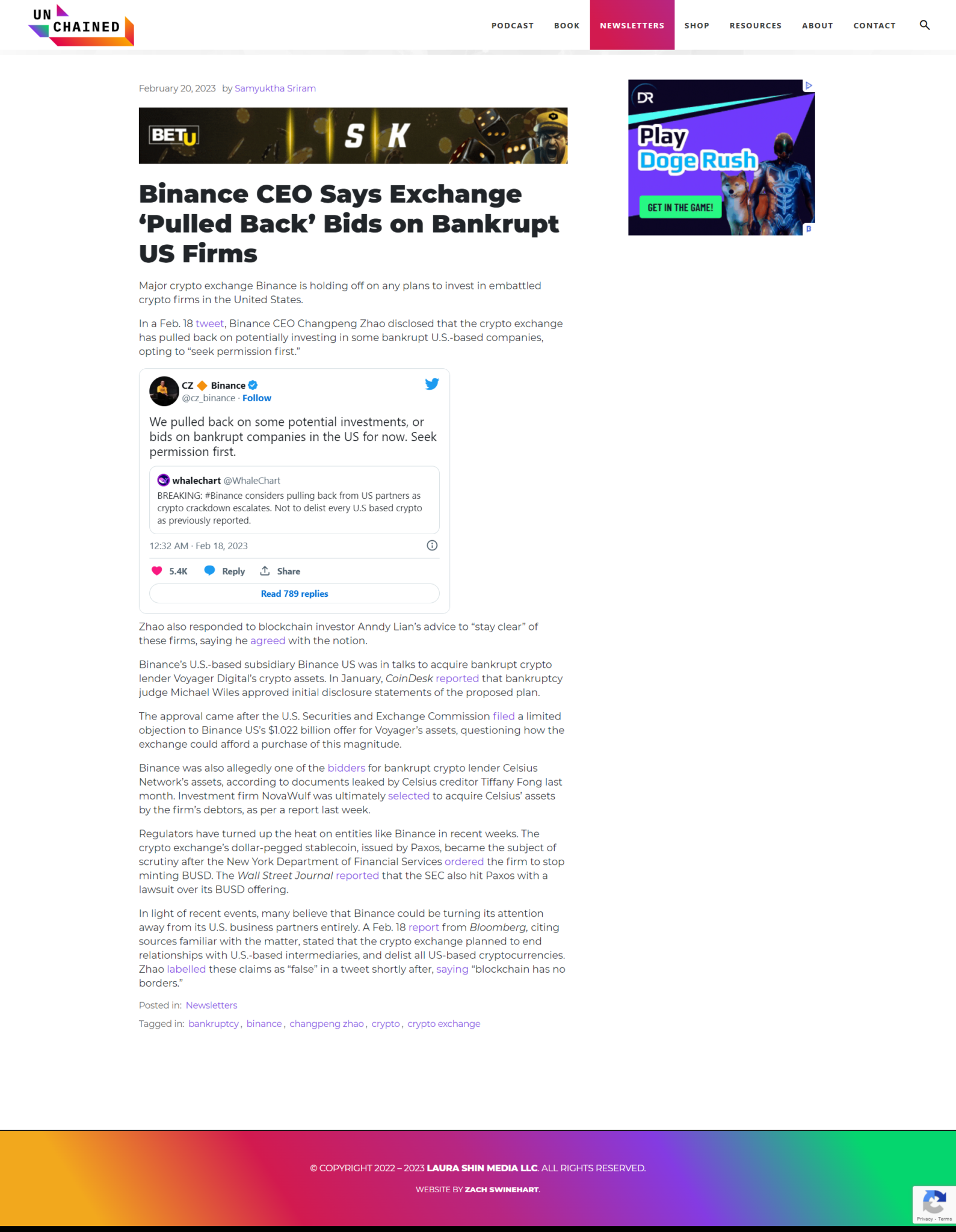
In a Feb. 18 tweet, Binance CEO Changpeng Zhao disclosed that the crypto exchange has pulled back on potentially investing in some bankrupt U.S.-based companies, opting to “seek permission first.”

Zhao also responded to blockchain investor Anndy Lian’s advice to “stay clear” of these firms, saying he agreed with the notion.

Binance’s U.S.-based subsidiary Binance US was in talks to acquire bankrupt crypto lender Voyager Digital’s crypto assets. In January, CoinDesk reported that bankruptcy judge Michael Wiles approved initial disclosure statements of the proposed plan.

The approval came after the U.S. Securities and Exchange Commission filed a limited objection to Binance US’s $1.022 billion offer for Voyager’s assets, questioning how the exchange could afford a purchase of this magnitude.

Binance was also allegedly one of the bidders for bankrupt crypto lender Celsius Network’s assets, according to documents leaked by Celsius creditor Tiffany Fong last month. Investment firm NovaWulf was ultimately selected to acquire Celsius’ assets by the firm’s debtors, as per a report last week.

Regulators have turned up the heat on entities like Binance in recent weeks. The crypto exchange’s dollar-pegged stablecoin, issued by Paxos, became the subject of scrutiny after the New York Department of Financial Services ordered the firm to stop minting BUSD. The Wall Street Journal reported that the SEC also hit Paxos with a lawsuit over its BUSD offering.

In light of recent events, many believe that Binance could be turning its attention away from its U.S. business partners entirely. A Feb. 18 report from Bloomberg, citing sources familiar with the matter, stated that the crypto exchange planned to end relationships with U.S.-based intermediaries, and delist all US-based cryptocurrencies. Zhao labelled these claims as “false” in a tweet shortly after, saying “blockchain has no borders.”


Source: https://unchainedpodcast.com/binance-ceo-says-exchange-pulled-back-bids-on-bankrupt-us-firms/

Anndy Lian is an early blockchain adopter and experienced serial entrepreneur who is known for his work in the government sector. He is a best selling book author- “NFT: From Zero to Hero” and “Blockchain Revolution 2030”.

Currently, he is appointed as the Chief Digital Advisor at Mongolia Productivity Organization, championing national digitization. Prior to his current appointments, he was the Chairman of BigONE Exchange, a global top 30 ranked crypto spot exchange and was also the Advisory Board Member for Hyundai DAC, the blockchain arm of South Korea’s largest car manufacturer Hyundai Motor Group. Lian played a pivotal role as the Blockchain Advisor for Asian Productivity Organisation (APO), an intergovernmental organization committed to improving productivity in the Asia-Pacific region.

An avid supporter of incubating start-ups, Anndy has also been a private investor for the past eight years. With a growth investment mindset, Anndy strategically demonstrates this in the companies he chooses to be involved with. He believes that what he is doing through blockchain technology currently will revolutionise and redefine traditional businesses. He also believes that the blockchain industry has to be “redecentralised”.

j j j

As Bitcoin Hits $25,000 Ceiling, Experts Say Investors Turning To Crypto As A Safe Haven

As Bitcoin Hits $25,000 Ceiling, Experts Say Investors Turning To Crypto As A Safe Haven

The world’s largest digital currency Bitcoin (CRYPTO: BTC) broke the $25,000 mark last week, reaching a new high for 2023, a stark contrast to November when the cryptocurrency saw a significant drop to a 2022 low of $15,742 following the FTX (CRYPTO: FTT) crisis.

The apex crypto’s value began to increase again in January and continued to do so over the course of the month.

The last time BTC’s value was around $25,000 was in mid-June of last year, after which it dropped to a range of $19,000 to $21,000 where it remained stagnant for several months.

btc_1.png

According to the experts, the surge in BTC’s price has made it an attractive option for those who are skeptical of traditional financial institutions.

Azra Kojadinovic, President of, the Serbia Chapter says the recent surge in BTC prices has sparked renewed interest in cryptocurrencies, and it is likely that this trend will continue in the future.

“BTC’s long-term outlook remains positive, and ETH’s increasing popularity as a platform for creating dApps is driving its growth. As the adoption of cryptocurrencies continues to increase, the future of the cryptocurrency market looks bright,” Kojadinovic said.

According to Whitney Setiawan, research analyst at crypto exchange Bitrue, along with BTC’s rise, Ethereum (CRYPTO: ETH) has also breached $1,700 for the first time in more than 3 months.

“While enthusiasm is high, we may see long-term holders taking their gains, leading to a somewhat visible negative correction in short to mid-term. However, this recent upsurge has shown that the industry is becoming somewhat immune to negative regulatory pressures, and investors are taking positions that could change their bottom line in the future,” Setiawan said.

Jenny Zheng, BD Lead, Bybit Web3 says with the proliferation of businesses and merchants embracing BTC as a viable payment option, the demand for the cryptocurrency has experienced a marked increase, thereby propelling its value upwards.

“This groundswell of adoption is further reinforced by the rising prevalence of BTC wallets, indicating a mounting number of individuals purchasing and retaining BTC as a secure store of value or investment vehicle. The recent trend of generating BTC non-fungible tokens (NFTs) is expected to exert additional pressure on adopting BTC,” according to Zheng.

The surge in BTC price is not solely attributed to its intrinsic value but is also heavily influenced by the current global economic climate.

The unprecedented nature of the pandemic has caused economic turmoil, resulting in market volatility and leaving investors with a sense of insecurity.

Anndy Lian, an intergovernmental blockchain expert, says investors, in response, are increasingly turning to alternative investments that offer a hedge against inflation and economic instability.

“BTC is viewed by many as a safe haven asset, and its decentralized nature makes it an attractive option for those skeptical of traditional financial institutions,” he says.

At the time of publication on Sunday, Bitcoin was trading at $24,571, down 2% in 24 hours, but up over 11% in the past seven days.

Source:

Anndy Lian is an early blockchain adopter and experienced serial entrepreneur who is known for his work in the government sector. He is a best selling book author- “NFT: From Zero to Hero” and “Blockchain Revolution 2030”.

Currently, he is appointed as the Chief Digital Advisor at Mongolia Productivity Organization, championing national digitization. Prior to his current appointments, he was the Chairman of BigONE Exchange, a global top 30 ranked crypto spot exchange and was also the Advisory Board Member for Hyundai DAC, the blockchain arm of South Korea’s largest car manufacturer Hyundai Motor Group. Lian played a pivotal role as the Blockchain Advisor for Asian Productivity Organisation (APO), an intergovernmental organization committed to improving productivity in the Asia-Pacific region.

An avid supporter of incubating start-ups, Anndy has also been a private investor for the past eight years. With a growth investment mindset, Anndy strategically demonstrates this in the companies he chooses to be involved with. He believes that what he is doing through blockchain technology currently will revolutionise and redefine traditional businesses. He also believes that the blockchain industry has to be “redecentralised”.

j j j

Exploring the Thriving NFT Market and the Rise of Bitcoin NFTs

Exploring the Thriving NFT Market and the Rise of Bitcoin NFTs

According to data provided by NFT aggregation site CryptoSlam, non-fungible token (NFT) sales saw a significant rise of 8.5% during the period from February 10 to February 16 on a global scale.

The total sales volume for the week reached a staggering US$304 million, marking an increase from the previous week’s US$280 million in NFT sales.

The last two days of this seven-day period saw a notable spike in sales, with Thursday alone accounting for over 30% of the total sales volume, reaching a daily sales sum of US $92.9 million.

This single-day sales figure is the highest it has been since May 2022. The average price for NFT assets sold on Thursday was US $463.09, which is approximately 265% higher than the average price of US $175.57 on Tuesday.

According to Yohann Calpu, the chief marketing officer at CryptoSlam, this sudden surge in sales can be largely attributed to the Blur token airdrop that occurred on Tuesday.

The NFT market continues to thrive, with significant increases in sales indicating a growing interest in this innovative and exciting sector.

Blur, a feeless NFT marketplace, recently unveiled its Blur tokens and granted a 60-day window for users to collect their airdropped coins. As of 2:30 p.m. Singapore time, the cryptocurrency was valued at US $0.90, based on CoinGecko data.

Based on the DappRadar, Blur’s NFT marketplace has experienced a trading volume of US $471.7 million in the last 30 days, overtaking OpenSea, the current market leader with US 448.9 million.

While many are talking about Blur, I am watching Bitcoin NFTs closely.

Bitcoin NFTs are quickly becoming a hot new trend in the world of digital collectibles. The launch of the Ordinals protocol on the Bitcoin blockchain by software engineer Casey Rodarmor has provided a novel way to mint NFTs on the Bitcoin blockchain.

This has led to a surge in interest in Bitcoin assets, with many people excited about the possibilities of this new technology.

The Ordinals protocol allows users and builders to inscribe each “sat” (short for Satoshi) with data, including smart contracts, which can then be used to create NFTs on the blockchain.

One of the key differences between Ethereum-based NFTs and Bitcoin NFTs is that Ethereum NFTs typically point to off-chain data on the IPFS system, while all the data for Bitcoin NFTs is inscribed on-chain using the Ordinals protocol.

This provides a more secure and trustworthy way of creating and trading NFTs.

The introduction of Ordinal Punks is expected to change the game for Bitcoin NFTs. These digital collectibles are tradeable artifacts that are inscribed on the Bitcoin blockchain, and they have been incredibly popular with buyers so far.

The 10,000-piece collection has already been sold out, with some individual pieces selling for millions of dollars. However, one of the challenges with the project is that there is currently no centralized marketplace to buy and sell the crypto art once it has been minted.

This means that buyers and sellers must rely on social media channels like Discord to find each other and negotiate transactions.

Despite the popularity of Bitcoin NFTs, some Bitcoin maximalists have pushed back against the trend, arguing that it goes against the idea of Bitcoin as a financial asset. They believe that NFTs are simply a waste of network space and resources.

However, proponents of Bitcoin NFTs believe that they represent a new and exciting way to create digital collectibles that are secure, trustworthy, and unique.

Scott Tripp, President of Redecentralise Canada, commented: “Bitcoin is often considered to be one of the most decentralized cryptocurrencies due to its distributed network of nodes and miners.

The Bitcoin blockchain is maintained by a decentralized network of nodes that are spread across the globe and work together to validate transactions and add new blocks to the chain.

The decentralized nature of the Bitcoin network may appeal to creators and collectors who are looking for a more secure and censorship-resistant platform for their NFTs. Overall, while the potential for Bitcoin NFTs exists, it remains to be seen how popular they will become in the future.”

To buy a Bitcoin NFT, users must first download a Bitcoin-compatible wallet and make it compatible with Ordinals. They can then either create and inscribe their own Ordinal or find an existing owner and purchase one from them.

However, buying Bitcoin NFTs can be a risky process as there is no centralized marketplace or regulation. Buyers and sellers must navigate social media channels and online communities to find each other, and there is always the risk of fraud or scams.

Despite these challenges, the growing popularity of Bitcoin NFTs suggests that they are here to stay and will likely continue to evolve and grow in the coming years.

Intergovernmental expert and best-selling book author Anndy Lian echoed, “Bitcoin NFTs, as unique digital assets created and traded on the Bitcoin blockchain, can certainly be seen as a decentralized innovation.

While the technical limitations of the Bitcoin network mean that the creation and transfer of NFTs may not be as seamless as it is on other blockchain platforms such as Ethereum, the potential for Bitcoin NFTs to be a more decentralized and secure option for creators and collectors is certainly noteworthy.”

Some people in the NFT industry have expressed concerns about the environmental impact of Bitcoin NFTs. Bitcoin is known for its high energy consumption due to its consensus mechanism, which uses a lot of computational power.

Minting NFTs on Bitcoin could therefore contribute to the carbon footprint of the blockchain.

Despite the concerns, the rise of Bitcoin NFTs and the Ordinals protocol has created a new avenue for the NFT industry to explore.

As the industry continues to evolve, we can expect to see more experimentation with different blockchain protocols and the emergence of new use cases for NFTs beyond art and collectibles.

In conclusion, the rise of Bitcoin NFTs and the Ordinals protocol has created a new way of minting and owning unique digital collectibles on the Bitcoin blockchain. While the concept may face some backlash, it also presents an opportunity for the NFT industry to evolve and expand.


Source:  https://hackernoon.com/exploring-the-thriving-nft-market-and-the-rise-of-bitcoin-nfts
Anndy Lian is an early blockchain adopter and experienced serial entrepreneur who is known for his work in the government sector. He is a best selling book author- “NFT: From Zero to Hero” and “Blockchain Revolution 2030”.

Currently, he is appointed as the Chief Digital Advisor at Mongolia Productivity Organization, championing national digitization. Prior to his current appointments, he was the Chairman of BigONE Exchange, a global top 30 ranked crypto spot exchange and was also the Advisory Board Member for Hyundai DAC, the blockchain arm of South Korea’s largest car manufacturer Hyundai Motor Group. Lian played a pivotal role as the Blockchain Advisor for Asian Productivity Organisation (APO), an intergovernmental organization committed to improving productivity in the Asia-Pacific region.

An avid supporter of incubating start-ups, Anndy has also been a private investor for the past eight years. With a growth investment mindset, Anndy strategically demonstrates this in the companies he chooses to be involved with. He believes that what he is doing through blockchain technology currently will revolutionise and redefine traditional businesses. He also believes that the blockchain industry has to be “redecentralised”.

j j j