Apples and oranges? How the Ethereum Merge could affect Bitcoin (With additional commnets)

Apples and oranges? How the Ethereum Merge could affect Bitcoin (With additional commnets)

Additional comments by Anndy Lian on top of what CoinTelegraph has mentioned.

The Merge is the right direction for cleaner crypto mining. The more direct impact I see after the transition is that bitcoin becomes the biggest target for green activists. There were more reports about bitcoin’s energy usage and mostly negative.

And because of the switch, many experts also said miners would forgo POW mining, but I say otherwise. I see the ETH POW Forks projects are working hard. The miner communities are now more united now than ever. For example, Bitmain also brought down the prices of their Antminers to help the miners get back into profits. These various factors helped the miners offset their operating costs in this bear market, keeping them alive.

Additionally, a good point to highlight is bitcoin’s hash rate. The hash rate continues to surge, recording new all-time high daily. The chip shortage has turned around, and the price of GPU is now at a more reasonable value. Taking GeForce RTX 3090 Ti, for example, the MSRP is $2,000, and it came down to $1,030 in September. These are positive signs for bitcoin.

As I have said before the transition, the impact of The Merge will not have too much boost for the crypto industry in the short run. What Vitalik has planned for Ethereum is a long-term vision. As for bitcoin, it is another kind of animal; it is the big brother. If bitcoin drops, the impact on every other cryptocurrency is inevitable.


Apples and oranges? How the Ethereum Merge could affect Bitcoin

While the Ethereum Merge failed to move Bitcoin from a price standpoint, the industry believes we have yet to see the effects of its shift from PoW to PoS.

It’s been a month since Ethereum said goodbye to an essential feature its blockchain shared with Bitcoin. Called the Ethereum Merge, the long-hyped upgrade was widely celebrated, with the blockchain ecosystem. However, for the mainstream audience or even for the average trader, it felt more like a Star Wars Day celebrated by sci-fi geeks than an early Christmas.

As the Ethereum Merge occurred on Sept. 15, the most extensive blockchain ecosystem parted ways with the proof-of-work (PoW), the energy-hungry consensus mechanism that makes Bitcoin tick. The Ethereum blockchain now works on a more eco-friendly proof-of-stake (PoS) mechanism that doesn’t require any mining activities, leaving thousands of miners worldwide scratching their heads.

Price-wise, Bitcoin is yet to take a hit from the fundamental shift of its closest competitor. A whole month has passed since the Ethereum Merge, and the BTC price is still stuck between $18,000 and $20,000.

However, the overarching mainstream narrative of “Bitcoin should contribute to the world, not destroy it by depleting energy resources” is rekindled with Ethereum’s significant switch to a system that keeps blockchain alive with minimal resource consumption.

Ethereum avoided a dead end

Cointelegraph reached out to industry insiders to get a clearer picture of the Ethereum Merge’s impact on Bitcoin.

“PoW was a dead end for Ethereum,” says Tansel Kaya, a lecturer at Kadir Has University and the CEO of blockchain developer Mindstone, “Because an Ethereum network that doesn’t scale can not live up to its promise.”

However, the Bitcoin community is not happy with the way its biggest price competitor took, according to Kaya. The BTC community often criticizes PoS for being vulnerable to censorship, he remarked, adding:

“If what [Bitcoin maximalists] say is true, Ethereum will either turn into a docile fintech network that is censored by governments, or a centralized structure like EOS, controlled by wealthy investors.”

Speaking to Cointelegraph, Gregory Rogers, CEO and founder of crypto-based gifting platform Graceful.io, noted that the Merge solidified the two distinct blockchains’ positions in the market. “Ethereum remains the transaction chain of choice with its increased speed and reduced fees,” Rogers said, adding, “Bitcoin is now the store of value of choice. They were already headed in this direction, but the Merge simply clarifies it.”

From a price point, though, multichain marketplace UnicusOne founder and CEO Tashish Raisinghani believes that Bitcoin price will take a hit. “The crypto industry had a hard time because of macro-level challenges which resulted in the current bear market,” he said, adding that the Merge would make Ethereum more sustainable compared to Bitcoin, “Which hasn’t yet been able to recover from the Chinese mining crackdown in 2021.”

PoW is unrivaled in network security

Addressing the energy side of the argument, John Belizaire, CEO of eco-focused data center company Soluna Computing, told Cointelegraph that even though Ethereum’s switch to PoS could save energy, “It will also undermine the core decentralization aspect of cryptocurrency.”

Although Bitcoin’s PoW consensus mechanism is energy-intensive, it is also fundamental to the blockchain and “is the best choice for any cryptocurrency that prioritizes network security.”

Co-locating flexible crypto mining centers with renewable energy plants can help stabilize the electric grid, solve renewables’ wasted energy issue, and provide an abundant source of cheap energy to crypto miners, Belizaire added.

The Merge united crypto miners

Bitmain also brought down the prices of Antminers, its flagship crypto mining units, to help miners get back into profits, he added:

Despite the Merge, Ether miners won’t simply forgo PoW mining just because Ethereum Classic is not minted via mining anymore, according to Anndy Lian, author of the book NFT: From Zero to Hero. Lian told Cointelegraph that the EthereumPoW (ETHW) project — the result of a hard fork after the Merge — is working hard and the miner community is more united than ever.

“These various factors helped the miners offset their operating costs in this bear market, keeping them alive.”

Joseph Bradley, the head of business development for Web3 service provider Heirloom, likened Bitcoin to “a global risk asset that is correlated to TradFi markets.” Bradley told Cointelegraph that, although Ether may be traded similarly, it still has neither the market depth nor the size that Bitcoin has. “Do we expect the world to become more or less chaotic in the coming years?” he asks rhetorically, answering:

“Most people would lean towards more chaotic. Security will matter during this time. Bitcoin will become even more important. Expensive energy will create innovation with miners — They will most likely move toward positioning Bitcoin mining as an extension of the electrical grid itself.”

Bitcoin and Ethereum: “Apples and oranges”

Not everyone agrees that the Ethereum Merge will have an impact on Bitcoin, though. Martin Hiesboeck, head of research at crypto exchange Uphold, dismissed a direct comparison between Ethereum and Bitcoin as “apples and oranges.”

Hiesboeck told Cointelegraph that Ethereum is basically a “company controlled by venture capitalists,” that’s why the transition to proof-of-stake aims to improve its economic and environmental credentials:

“Bitcoin doesn’t need to do that. Bitcoin is not a brand. Bitcoin is a computer network. Its output represents money. Nobody owns it. There is no brand. No CEO.”

Khaleelulla Baig, the founder and CEO of crypto investment platform Koinbasket, supported Hiesboeck’s argument, telling Cointelegraph that the Merge won’t have any meaningful impact on Bitcoin as these assets serve different purposes.

Bitcoin’s purpose is “to prove itself as a superior store of value to fiat currencies,” according to Baig. The PoW mechanism goes well with the purpose of Bitcoin, “As it helps the network maintain the scarcity of 21 million BTC via its difficulty adjustment rate,” he added.

Bitcoin as a PoW and Ethereum as a PoS network are making significant contributions to the crypto-asset ecosystem by competing with their best features. Tansel Kaya summarizes: “Having two distinct approaches rather than one is more suitable for the spirit of decentralization.”


Source: https://cointelegraph.com/news/apples-and-oranges-how-the-ethereum-merge-could-affect-bitcoin

Anndy Lian is an early blockchain adopter and experienced serial entrepreneur who is known for his work in the government sector. He is a best selling book author- “NFT: From Zero to Hero” and “Blockchain Revolution 2030”.

Currently, he is appointed as the Chief Digital Advisor at Mongolia Productivity Organization, championing national digitization. Prior to his current appointments, he was the Chairman of BigONE Exchange, a global top 30 ranked crypto spot exchange and was also the Advisory Board Member for Hyundai DAC, the blockchain arm of South Korea’s largest car manufacturer Hyundai Motor Group. Lian played a pivotal role as the Blockchain Advisor for Asian Productivity Organisation (APO), an intergovernmental organization committed to improving productivity in the Asia-Pacific region.

An avid supporter of incubating start-ups, Anndy has also been a private investor for the past eight years. With a growth investment mindset, Anndy strategically demonstrates this in the companies he chooses to be involved with. He believes that what he is doing through blockchain technology currently will revolutionise and redefine traditional businesses. He also believes that the blockchain industry has to be “redecentralised”.


j j j

Magic Eden, largest Solana-based NFT platform, makes royalty fees optional

Magic Eden, largest Solana-based NFT platform, makes royalty fees optional

The platform said the move was in line with growing market trends, but some are concerned about what it means for the industry.

Magic Eden, the largest non-fungible token (NFT) marketplace in the Solana ecosystem, has moved to make paying NFT creator royalty fees optional, following in the footsteps of rival marketplaces which have eaten into its market share in recent months.

The platform will also be waiving all platform fees for the foreseeable future, Magic Eden said in a Twitter thread announcing the changes on Saturday.

Anndy Lian, author of the new book “NFT: From Zero to Hero,” told Forkast the attempt to win back users by lowering or removing fees surprised him as he was doubtful of the long-term sustainability of the plan.

“For [an] NFT platform, where the secondary market is at a really bad situation right now, I am doubtful whether the zero fees are going to work very well,” he said.

NFT royalties give the original creator a percentage of the sale price each time that NFT creation is sold.

Magic Eden is a giant in the Solana ecosystem, controlling roughly 90% of all sales, and almost nine times the Solana sales of leading NFT marketplace OpenSea, which added support for Solana NFTs in April 2022.

Magic Eden also raised US$130 in series B fundraising in June, bringing its valuation to US$1.6 billion, and cementing its status as a “unicorn,” a privately held start-up with a valuation over US$1 billion.

“This is not a decision we take lightly,” Magic Eden said in a tweet announcing the move, while also acknowledging the industry has been slowly moving towards optional creator royalties for a while. “We understand this move has serious implications for the ecosystem. We also hope it is not a permanent decision.”

Royalties for NFTs are typically set to between 5% and 10% and are often encoded into the smart contract of the NFT itself. Marketplaces are able to rework the code around the sales of these NFTs, however, effectively allowing them to set the fees to whatever they like.

In the case of Magic Eden now, that fee now will be left up to the user to decide whether or not to pay. However, if users choose not to pay the fee, they risk being excluded from the full utility or perks of owning the NFT, the platform warned.

Removing this structure incentivizes creators to lift their prices in order to compensate for this loss of income, he said, which could add extra pressure to an already struggling market that is currently extremely sensitive to pricing.

The issue is compounded if smaller marketplaces follow Magic Eden’s lead, which Lian said they will be incentivized to do.

“So, it goes back to the whole equation: How long is this bear market going to be and how long can you sustain that kind of strategy?” Lian said, “If I’m not wrong, maybe [Magic Eden] can for the next two, three, four years, maybe. But I’m not so sure about the rest.”

Lian explained this was being done to artificially increase an NFT’s trading volume to give the impression it is more highly sought-after than it actually is. This not only discredits the industry but deceives unwitting buyers into potentially paying inflated prices for NFTs.

The issue has become so prevalent on Magic Eden in the few days since fees were removed that OpenSea has since announced it is in the process of temporarily blocking Solana collections from the Top and Trending list on its homepage to avoid “gaming” those numbers.

Secondary monthly NFT sales in September were only US$550 million, an almost 90% decrease from its high in January 2022. NFT creators, marketplaces and collectors alike have had to make difficult choices about how to respond to the difficult market conditions.

“There’s a lot of uncertainty. Based on the current charts, we should still be going down or going sideways for the next quarter or so,” he said.


Source: Magic Eden, largest Solana-based NFT platform, makes royalty fees optional (forkast.news)

Anndy Lian is an early blockchain adopter and experienced serial entrepreneur who is known for his work in the government sector. He is a best selling book author- “NFT: From Zero to Hero” and “Blockchain Revolution 2030”.

Currently, he is appointed as the Chief Digital Advisor at Mongolia Productivity Organization, championing national digitization. Prior to his current appointments, he was the Chairman of BigONE Exchange, a global top 30 ranked crypto spot exchange and was also the Advisory Board Member for Hyundai DAC, the blockchain arm of South Korea’s largest car manufacturer Hyundai Motor Group. Lian played a pivotal role as the Blockchain Advisor for Asian Productivity Organisation (APO), an intergovernmental organization committed to improving productivity in the Asia-Pacific region.

An avid supporter of incubating start-ups, Anndy has also been a private investor for the past eight years. With a growth investment mindset, Anndy strategically demonstrates this in the companies he chooses to be involved with. He believes that what he is doing through blockchain technology currently will revolutionise and redefine traditional businesses. He also believes that the blockchain industry has to be “redecentralised”.

j j j

BTC / USD forecast: Can bitcoin reverse downward trend as crypto winter bites?

BTC / USD forecast: Can bitcoin reverse downward trend as crypto winter bites?

Since its November 2021 all-time high, Bitcoin (BTC), the world’s biggest cryptocurrency, has lost over 70% of its value, in line with the broad cryptocurrency markets. The harsh crypto winter was sparked by surging inflation, risk-off sentiment amid recession fears and the crash of the TerraUSD (UST) stablecoin.

Will the cryptocurrency pioneer ever resurface? We take a look at the key factors driving the BTC/USD forecast in 2023 and beyond.

What is BTC/USD?

BTC/USD is the exchange rate of bitcoin against the US currency. BTC to USD measures how many USD are required to purchase one bitcoin.

Created in 2009, Bitcoin, the first ever decentralised digital currency, acts as a peer-to-peer payments system. It uses no central authorities or banks to manage transactions, which are instead organised “collectively by the network”.

The cryptocurrency was invented  by an anonymous person or group of people under the pseudonym Satoshi Nakamoto. It has since established itself as one of the most popular digital assets. The first ever BTC token, the so-called genesis block, was mined in January 2009.

Bitcoin’s blockchain uses a Proof-of-Work (PoW) consensus mechanism, which is secured by miners verifying BTC transactions in exchange for BTC reward. The process is known as crypto mining.

These rewards are cut in half after every 210,000 blocks are mined, or approximately every four years, in halving events, thus reducing the amount of overall BTC coins in circulation and raising the cryptocurrency’s price by cutting supply.

The most recent halving event took place on 11 May 2021, when bitcoin’s block reward was reduced to 6.25BTC. The next halving event is estimated to take place in 2024.

In addition to being a “peer-to-peer version of electronic cash” bitcoin is also now used as a store of value. Bitcoin has a maximum supply of 21 million tokens.

BTC/USD price history

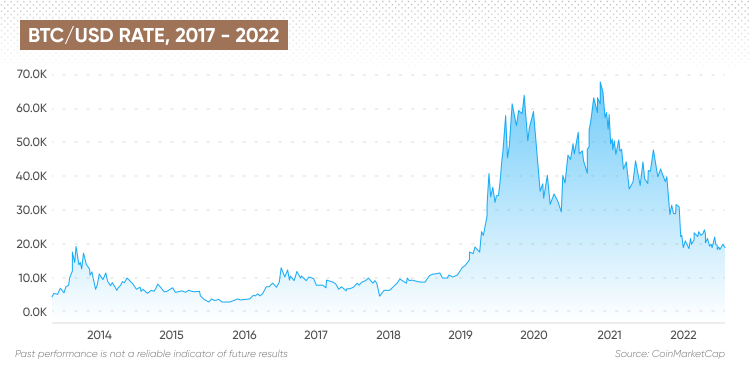
It has taken BTC to USD around eight years to surge past $1,000 since its launch in 2009. In 2017, the cryptocurrency saw a good run, rising by 1,600% within a year from $1,044.4 at the start of January 2017 to $17,760.3 by 20 December 2017 – a then all-time high.

However, a steep sell-off at the start of 2018 interfered, bringing the bitcoin’s price down to $7,637.86 by 8 February 2018. BTC continued to decline falling to $3,000 by 10 December 2018.

The cryptocurrency peaked once again in the beginning of July 2019, surpassing $12,000 for a brief time before losing over 58% of its value and dropping to $5,000 by 13 March 2020.

BTC/USD RATE 2017-2022

In 2021, the cryptocurrency enjoyed another bull run, the biggest in its history. By 8 January 2021, the token was valued at around $ 39,000. On 16 April 2021, bitcoin reached its first peak at $63,258.51 – a surge of around 62%. BTC’s price continued to rise, reaching the all-time high of $67,549.74 on 9 November 2021.

In 2022, the coin has been experiencing one of the harshest crypto winters yet, losing nearly 72% since the November 2021 highs, and is currently (12 October) hovering at $19,000.

What’s shaping the BTC/USD forecast?

The cryptocurrency market has been affected by a number of factors in 2022 such as with the war in Ukraine, the collapse of the TerraUSD (UST) stablecoin and rising inflation. Peter Eberle, president and chief investment officer of Castle Funds, told Capital.com:

“The first half of 2022 was horrible for equity, bond and crypto markets. A confluence of macro factors such as Russia’s invasion of Ukraine, US Policy makers’ slow realisation that inflation was real, then the aggressive pivot to higher interest rates, supply chain issues due to China’s Covid polices all led to a steep sell off across markets.”

Eberle added that Terra’s “meltdown”, which led to the subsequent fall of its sister cryptocurrency, LUNA, “created cascading liquidations across multiple platforms”, affecting not only the BTC/USD price but also several hedge funds, including Three Arrow Capital and Celsius Network.

On 9 June, bitcoin briefly traded above $31,000, however, this soon turned into a selloff, which saw the cryptocurrency lose over 90% of its minor gains, falling to $19,000 10 days later. Since then, BTC has been fluctuating, trading between $23,000 and $19,000.

“At the end of the 2nd quarter many in the industry were waiting for the proverbial ‘next shoe to drop’, but fortunately things calmed down,” Eberle noted.

Anndy Lian, chief digital advisor at the Mongolian Productivity Organisation and author of NFT: From Zero to Hero, said that bitcoin’s price depends on the outcomes of the Federal Reserve’s (Fed) meetings and decisions on monetary policy tightening, as well as latest inflation readings such as Producer Price Index (PPI) and the Consumer Price Index (CPI).

“However, I am not pessimistic. The mining companies have endured tough times. Despite the high hash rate, bitcoin’s price has not significantly increased. This signals that the miners are not piling the network to obtain big gains on bitcoin, they are confident that the mining business will do well now that the network has proven staying power.”

Historically, October has been a good month for cryptocurrencies, with bitcoin’s price change averaging at 14.6% gain in October since 2011, Capital.com’s seasonality research showed. Yet this year proves to be different.  Castle Fund’s Eberle noted:

“The third quarter of 2022 showed consolidation in the crypto market while equities and bonds continue to slump. The Dow Jones Industrial Average dropped 6.2%, Bitcoin dropped 2% but saw significantly lower volatility and the broader crypto market capitalization increased by 8.5%.”

Bitcoin to US dollar forecasts are currently focusing on macro events, Eberle added, specifically the Fed’s interest decisions, the future outcomes of the Russia-Ukraine conflict and the US midterm elections that are due to take place on 8 November. In addition, Eberle added some historical outlook concerning bitcoin’s past halving events:

“In 2015 BTC bottomed 547 days before the halving and in 2018 is occurred 517 before. The next halving is estimated to happen in April or May of 2024 so if history repeats we should be nearing the beginning of the next bull market.”

BTC/USD forecast 2022 and beyond

Despite the latest downward price action, algorithm-based forecasting service Wallet Investor gave a bullish BTC/USD forecast at the time of writing (12 October). The site noted that BTC was “a very good long-term investment”.

Based on its analysis of past price performance, WalletInvestor predicted that BTC/USD could trade at $25,373.90 in 2023 and surge to $47,496.74 in 2027.

DigitalCoinPrice supported the positive BTC/USD forecast but saw a speedier pace of growth in the following years, expecting the cryptocurrency to reach $24,206.47 by the end of 2022 and $43,340.43 by the end of 2023.

Its BTC/USD forecast for 2025 showed the cryptocurrency reaching $77,238.07 on average and $94,929.40 in 2027. The platform’s long-term BTC/USD forecast for 2030 expected the cryptocurrency to surge to $266,189.92 on average.

Lian did share the bullish sentiment on BTC to USD forecast:

“Bitcoin price hovers around $19,400, up 1.9% in the last week. Zooming out, it has gained 1% in value for the past 30 days. Unless we see the S&P 500 go down to 3200, bitcoin can go below the $13,000 region, else I think it will continue to trend sideways for the next few weeks.”

However, Lian noted that a positive aspect to highlight would be bitcoin’s hash rate which continues to surge.

Note that BTC/USD predictions can be wrong. Analysts’ and algorithm-based predictions shouldn’t be used as a substitute for your own research.

Always conduct your own due diligence on the stock before trading, looking at the latest news, a wide range of analyst commentary, technical and fundamental analysis. Note that past performance does not guarantee future returns. And never trade money you cannot afford to lose.


Source: https://capital.com/btc-usd-forecast-dollar-bitcoin-price

Anndy Lian is an early blockchain adopter and experienced serial entrepreneur who is known for his work in the government sector. He is a best selling book author- “NFT: From Zero to Hero” and “Blockchain Revolution 2030”.

Currently, he is appointed as the Chief Digital Advisor at Mongolia Productivity Organization, championing national digitization. Prior to his current appointments, he was the Chairman of BigONE Exchange, a global top 30 ranked crypto spot exchange and was also the Advisory Board Member for Hyundai DAC, the blockchain arm of South Korea’s largest car manufacturer Hyundai Motor Group. Lian played a pivotal role as the Blockchain Advisor for Asian Productivity Organisation (APO), an intergovernmental organization committed to improving productivity in the Asia-Pacific region.

An avid supporter of incubating start-ups, Anndy has also been a private investor for the past eight years. With a growth investment mindset, Anndy strategically demonstrates this in the companies he chooses to be involved with. He believes that what he is doing through blockchain technology currently will revolutionise and redefine traditional businesses. He also believes that the blockchain industry has to be “redecentralised”.
j j j
