Can Play-to-Earn gaming replace traditional jobs?

Can Play-to-Earn gaming replace traditional jobs?

Web3, the latest iteration of the Internet, has radically changed the gaming business by integrating unique features involving blockchain, cryptos and non-fungible tokens (NFTs).

The question that arises now is whether Play-to-Earn, or P2E, games can offer an alternative to traditional wage employment for people looking to move out of their jobs, whatever be the reason.

Gaming in the Web2 era was controlled by tech enterprises and involved players shelling out money to the developers. The advent of P2E gaming, completely decentralized, has put power in the hands of the players, who can tokenize in-game assets in the form of unique NFTs, a form of digital assets, for ownership rights.
According to a study by market researcher Absolute Reports, the global P2E NFT gaming market size was estimated to be worth $776.9 million in 2021, having received a fillip from the COVID-19 pandemic.

The market is forecast to reach a readjusted size of $2.8 billion by 2028, expanding at a Compound Annual Growth Rate of 20.4 percent during 2022-2028.

P2E cannot replace regular jobs

Ishank Gupta, advisor to IndiGG, the largest gaming DAO (decentralised autonomous organisation) in India, says P2E games can be a potential second source of income, but cannot replace earnings through traditional jobs.

Gupta believes that emerging markets like India will drive the Web3 gaming adoption.

When asked to elucidate, he said mobile data was most affordable in India with the average cost of 1GB of 4G data at Rs 20. The country is also a “mobile first” nation with over 700 million smartphones.

India is expected to be home to 500 million players by 2024, creating a sizable (mobile-first) market for game creators, he said, adding that app install statistics show 17% of all game downloads come from India.

“In the world of Web3, where everyone is still at the starting line, we may acquire a head start and become first movers in the business by taking steps to establish an indisputable community that interacts with Web3 games and goods. When it comes to gaming, India is regarded as an important market,” Gupta says.

Experts point out that the future of work is being redefined by new technologies, with blockchain —  a database that stores information in a digital format — being the most important development that happened in the past 10 years.

Back in 2021 in emerging economies, the first generation of games like Axie Infinity was able to replace ordinary jobs.

Driving a taxi or being a delivery driver made less money than a middle-level P2E Axie player.

However, the first generation of P2E has a lot of holes in terms of game depth, tokenomics, overall dynamics and aesthetics.

Corruption, inflation driving users toward Web3

Asked about the fascination with P2E games in emerging economies, Martin Repetto, CEO and co-founder of Mokens League, says rampant corruption, high inflation and depreciation of local currencies have created the perfect ecosystem for crypto to be the king.

“The combination of trying to escape high taxes with badly rendered services, inflation, and economic freedom, makes it perfect for Blockchain games and DApps (decentralised applications) to triumph. There is no coincidence that the most successful Play-To-Earn games came from emerging markets/economies/countries,” Repetto says.

P2E growth depends on per capita GDP

P2E is one of the ways to earn an additional income, but it may not work for all countries.

In Singapore, for example, Gross Domestic Product (GDP) per capita reached a record high of US $66,176.39 in 2021. Even so, the cost of living is high and the P2E concept is harder to attract the 9-5 working class because it may not be able to pay even for their monthly groceries.

In Kenya, where GDP per capita is expected to reach US $1,550.00 by the end of 2022, P2E is viable.

In fact, in Kenya play-to-earn, when positioned well, can reduce the unemployment rate and increase overall GDP.

India will be the outsourcing factory for Web3

Anndy Lian, Chief Digital Advisor to the Mongolian Productivity Organization, says the revenue from Web2 gaming goes to the gaming companies, but Web3 gaming is better distributed.

“Users get rewarded for their efforts and their assets can be further monetized. NFTs are in-game assets, not in-game expenses, anymore because you can resell your NFTs in the secondary market; if you promote harder, you can command a higher price. The value of your assets is in your own hands,” he says.

He adds that India is very developed in Web2 and many users are transiting to Web3 and a big pool of developers will make India the biggest outsourcing factory for Web3.

Future of Web3 gaming

The platform’s development and level of user interaction will determine how well it does.

The platform will gradually attract additional developers, users, and practical outcomes as it goes through its motions.

Over time, the platform’s market valuation will increase as more users and developers join it.

P2E is an idea that is gradually gaining hold among gamers. However, it still has a long way to go before it can take the place of traditional jobs.

The platform doesn’t currently have the gamers and developers it needs to grow and succeed and will become more reliable and popular as it evolves further.

This will encourage other developers to produce their own games for the system, accelerating the growth of the metaverse crypto.

Saurabh Tiwari, a Pune-based Web3 enthusiast, and an avid gamer, told Moneycontrol that NFT-based games were previously a grey area, just like TikTok was initially.

“Playing games definitely can be a long-term career option if planned properly because the loyalty amounts, once a gamer creates his own community and followers, are huge.

Multinational companies are investing big in the space which only goes on to show they see huge potential here in the long run,” Tiwari said.


Source: https://www.moneycontrol.com/news/business/can-play-to-earn-gaming-replace-traditional-jobs-9271761.html

Anndy Lian is an early blockchain adopter and experienced serial entrepreneur who is known for his work in the government sector. He is a best selling book author- “NFT: From Zero to Hero” and “Blockchain Revolution 2030”.

Currently, he is appointed as the Chief Digital Advisor at Mongolia Productivity Organization, championing national digitization. Prior to his current appointments, he was the Chairman of BigONE Exchange, a global top 30 ranked crypto spot exchange and was also the Advisory Board Member for Hyundai DAC, the blockchain arm of South Korea’s largest car manufacturer Hyundai Motor Group. Lian played a pivotal role as the Blockchain Advisor for Asian Productivity Organisation (APO), an intergovernmental organization committed to improving productivity in the Asia-Pacific region.

An avid supporter of incubating start-ups, Anndy has also been a private investor for the past eight years. With a growth investment mindset, Anndy strategically demonstrates this in the companies he chooses to be involved with. He believes that what he is doing through blockchain technology currently will revolutionise and redefine traditional businesses. He also believes that the blockchain industry has to be “redecentralised”.

j j j

ADA/BTC prediction: Will Vasil hardfork turn around Cardano’s downward trend?

ADA/BTC prediction: Will Vasil hardfork turn around Cardano’s downward trend?

Bitcoin (BTC), the first cryptocurrency and the most valuable coin, is losing steam in 2022 amid a wider shift in market sentiment. Meanwhile, Cardano’s (ADA) long-awaited Vasil hard fork failed to trigger bullishness.

What does it mean for the ADA/BTC forecast? Here we take a look at the Cardano (ADA) to Bitcoin (BTC) cryptocurrency pair and factors shaping the ADA/BTC exchange rate.


What is ADA/BTC?

ADA/BTC represents the exchange rate between ADA, the native cryptocurrency of the Cardano blockchain, and BTC, the native coin on the Bitcoin Network.

Maxim Shilo, digital assets analyst at CoinLoan, explained that to determine the ADA/BTC rate, the coins’ prices are calculated separately, then added together, noting:

“If BTC rises 4.5%, and ADA rises 2.5% at the same time, then ADA/BTC price is down 2% respectively…There might be some differences, which are for market makers to spread on.”

Bitcoin was created in 2009 as a digital alternative to cash. Since its launch, the cryptocurrency has started to act as a store of value. It’s been compared to gold as a hedge against inflation.

Bitcoin’s key feature is mining. This is done through a blockchain that connects all public BTC transactions together. The blockchain uses a Proof-of-Work (PoW) consensus mechanism through which miners compete to solve mathematical equations and confirm the legitimacy of transactions. Miners are rewarded in BTC.

BTC tokens also undergo halving events roughly every four years. This is when the number of the BTC coins in circulation is reduced by half, making the token scarcer and raising its price.

Cardano was launched in 2017 as a third-generation crypto platform that uses the Proof-of-Stake (PoS) consensus mechanism. The blockchain prides itself in being the first ever crypto platform “to be founded on peer-reviewed research and developed through evidence-based methods”.

Cardano’s key focus is on being sustainable. In September 2021 the platform introduced smart contract capability, which means that the blockchain can now also support the creation of decentralised apps (dApps), new tokens, decentralised finance (DeFi) games, non-fungible tokens (NFTs) and more – one of the key factors that makes it stand out compared to BTC.

The platform was developed in “eras”, each named after a prominent historical figure in the fields of literature and computer science, such as Byron, Shelley, Goguen, Basho and Voltaire.

As of 30 September, the blockchain’s era is Basho, which introduced more scaling and optimisation to Cardano. Voltaire will be the last era in the blockchain’s development, which will bring governance to the system.

ADA/BTC historical rate chart

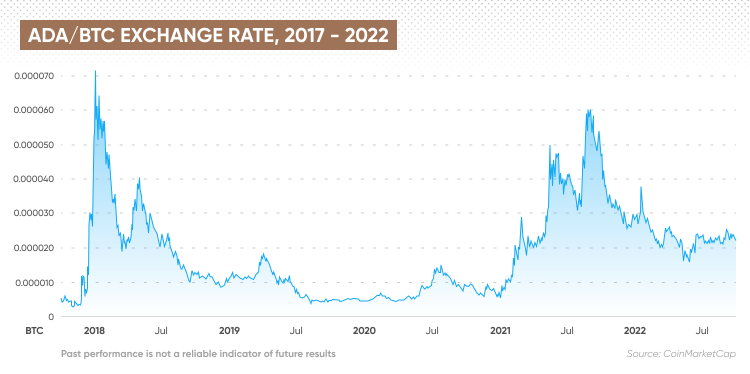
The ADA/BTC exchange rate surged 1,373.4% in the four months after the launch of the ADA token, trading at 0.00007103BTC in January 2018. At the same time the ADA price in USD jumped more than 4,800% to $1.0797. This was when ADA reached its all-time high against BTC.

Between 2018 and 2020 the exchange rate moved sideways, peaking at 0.00001811BTC and 0.00001495BTC in April 2019 and July 2020, respectively. In 2021, ADA regained its momentum against bitcoin.

ADA/BTC EXCHANGE RATE, 2017-2022

Between January and September 2021, the ADA/USD rate surged over 800%, with ADA enjoying the peak of 0.00006008BTC. The jump was mostly driven by bullish sentiment for Cardano, with ADA trading at a record high of $2.9682 in September 2021.

But, wider sentiment in the cryptocurrency markets shifted. ADA/USD swinged lower, losing over 20% year-to-date. Separately, ADA and BTC have lost 68% and 58% of their value in 2022, respectively (as of 30 September).

Is the Vasil fork driving ADA/BTC?

Cardano’s long-awaited Vasil mainnet upgrade, which aims to improve the blockchain’s scalability and increase the network’s capacity, was launched on 22 September after several delays. The Cardano Foundation said on Twitter.

Full Vasil capability became available on 27 September. In addition to that, the Cardano blockchain activated the Plutus V2 cost model, which delivered lower transaction costs for smart contracts.

This update was expected to boost ADA’s value, but failed to do so. According to Anndy Lian, chief digital advisor at the Mongolian Productivity Organisation and author of NFT: From Zero to Hero, “this is mainly due to the financial uncertainty globally.”

“Marco risks led by a very hawkish US Fed have also weighed down ADA’s price movement after Vasil’s launch,” he told Capital.com.

The ADA/BTC exchange rate dropped by 5.5 % between 22 and 29 September, during the hype in the run-up to the fork’s launch.

Shilo agreed that this phenomenon was linked to wider macro-economic factors stemming from a troubled global economy and a wider bear market. “Macro doesn’t really care about the updates or future promises,” he said.

Shilo added that Cardano was not the only token affected by macroeconomics on the brink of a big upgrade, using Ethereum’s Merge as an example.

Lian noted that although ADA failed to jump after the Vasil fork, their voting power has increased by 53%, noting:

“This means that more ADA was being used across proposals in Project Catalyst with 11% of all the circulating ADA being used in Catalyst Fund9, which is a community-driven initiative that allows users to vote and determines the future direction of the ecosystem.”

According to Lian “more utility and support from the community means better potential for the development of the token”.

In other news, the Cardano Foundation is preparing for an events season, which will kick off in October 2022. The Foundation is due to participate in a number of key crypto events that could affect an ADA/BTC forecast.

In November, Cardano will hold the Cardano Summit 2022 in Switzerland, which will focus on presentations and updates from developers of Cardano’s decentralised applications (dApps).

ADA/BTC forecast for 2022 and beyond

Based on the analysis of ADA’s past price performance, as of 30 September, the algorithm-based forecasting service WalletInvestor predicted that ADA/USD could fall to $0.0423 in 2023. The platform did not provide a price prediction for 2027.

In terms of its bitcoin prediction, the site saw BTC/USD trade at $30,274.06 in 2023 and reach $74,480.14 by 2027.

While WalletInvestor did not provide a direct Cardano/Bitcoin forecast, data suggested that the exchange rate could be 0.000000567BTC in 2023.

DigitalCoinPrice predicted that ADA/USD could rise to $0.46 by the end of 2022, $0.99 in 2023 and $1.76 in 2025. Its long-term prediction saw the coin reaching $6.04 in 2030.

The site also gave an upbeat BTC/USD forecast, expecting the coin to average at $20,403 in 2022, $44,579 in 2023, $79,430 in 2025 and surpass $273,000 in 2030.

DigitalCoinPrice’s ADA/BTC forecast for 2022 expected the pair to reach 0.00002255BTC. In 2023, the ADA/BTC prediction saw the exchange rate falling to 0.00002221BTC. The site’s ADA/BTC forecast for 2025 stood at 0.00002216BTC. Its long-term ADA/BTC forecast for 2030 was 0.00002212BTC.

Shilo stressed that bitcoin has relative strength to altcoins and added that in his opinion the ADA/BTC forecast is pointing downwards:

“It’s unlikely that [ADA] will outperform BTC. I can’t see it happening in the near term. Only very few selected coins have done so in the long term, and historically the chances are very slim. Given that the price is trading in the range and is in no man’s land against BTC, it’s clearly pointing toward a downward trend.”

Note that analysts’ and algorithm-based forecasts can be wrong and shouldn’t be used as a substitute for your own research. Always conduct your own due diligence before trading, and never trade money you cannot afford to lose.


Source: https://capital.com/ada-btc-prediction-cardano-bitcoin-vasil-hardfork

Anndy Lian is an early blockchain adopter and experienced serial entrepreneur who is known for his work in the government sector. He is a best selling book author- “NFT: From Zero to Hero” and “Blockchain Revolution 2030”.

Currently, he is appointed as the Chief Digital Advisor at Mongolia Productivity Organization, championing national digitization. Prior to his current appointments, he was the Chairman of BigONE Exchange, a global top 30 ranked crypto spot exchange and was also the Advisory Board Member for Hyundai DAC, the blockchain arm of South Korea’s largest car manufacturer Hyundai Motor Group. Lian played a pivotal role as the Blockchain Advisor for Asian Productivity Organisation (APO), an intergovernmental organization committed to improving productivity in the Asia-Pacific region.

An avid supporter of incubating start-ups, Anndy has also been a private investor for the past eight years. With a growth investment mindset, Anndy strategically demonstrates this in the companies he chooses to be involved with. He believes that what he is doing through blockchain technology currently will revolutionise and redefine traditional businesses. He also believes that the blockchain industry has to be “redecentralised”.

j j j

XRP, ADA, Meme Coins Become Object of Interest for Author of Bestselling NFT Book, Anndy Lian

XRP, ADA, Meme Coins Become Object of Interest for Author of Bestselling NFT Book, Anndy Lian

Anndy Lian, international blockchain expert who positions himself as a thought leader on social media platforms and is the author of a book called “NFT: from Zero to Hero,” has taken to Twitter to pick its followers’ brains about whether he should invest in altcoins such as XRP, ADA and IOTA. Judging from his tweet, Lian is already a holder of meme cryptocurrencies.

Judging from his tweet, Lian is already a holder of meme cryptocurrencies.

“XRP, ADA, IOTA or should I stay with #meme?”

From his tweet, Anndy Lian is considering making a purchase of some leading altcoins, including top 10 XRP and ADA, as well as IOTA, CRO and NEAR.

He also says that he could stay with the meme; however, he does not specify exactly which meme coins he holds – DOGE, SHIB, FLOKI, BabyDoge or some canine coins with smaller capitalizations.

From his earlier tweets posted in September, it is clear that Lian has been following the main events in the crypto industry, such as Cardano’s Vasil and Ethereum’s Merge hard forks.

He has not disclosed which cryptocurrencies he holds.

“NFT: from Zero to Hero” is Lian’s second book, according to his LinkedIn page. In 2019, he also co-authored a book titled “Blockchain Revolution 2030.” By now, 8,000 copies of the former have been sold.

This crypto influencer considers buying SHIB

Crypto influencer David Gokhshtein, former U.S. congressional candidate who founded Gokhshtein Media, has tweeted that yesterday he nearly purchased meme token Shiba Inu.

Gokhshtein has been bullish on the second largest meme token throughout the year, praising its model and its metaverse. He holds both Dogecoin and SHIB. Recently, he tweeted that it is okay to hold both, while some in the armies of both tokens find it hard to find a mutual understanding.

On Wednesday, Gokhshtein also shared that he had been considering buying more XRP tokens to expand his XRP bag. He believes that if Ripple wins the current legal battle against the SEC that has been going on since 2020, it will become a major driver not only for Ripple and XRP but for the entire crypto industry too.

As part of his challenge, he also considers buying some LUNC.

Read more on U.Today https://u.today/xrp-ada-meme-coins-become-object-of-interest-for-author-of-bestselling-nft-book-anndy-lian

Anndy Lian is an early blockchain adopter and experienced serial entrepreneur who is known for his work in the government sector. He is a best selling book author- “NFT: From Zero to Hero” and “Blockchain Revolution 2030”.

Currently, he is appointed as the Chief Digital Advisor at Mongolia Productivity Organization, championing national digitization. Prior to his current appointments, he was the Chairman of BigONE Exchange, a global top 30 ranked crypto spot exchange and was also the Advisory Board Member for Hyundai DAC, the blockchain arm of South Korea’s largest car manufacturer Hyundai Motor Group. Lian played a pivotal role as the Blockchain Advisor for Asian Productivity Organisation (APO), an intergovernmental organization committed to improving productivity in the Asia-Pacific region.

An avid supporter of incubating start-ups, Anndy has also been a private investor for the past eight years. With a growth investment mindset, Anndy strategically demonstrates this in the companies he chooses to be involved with. He believes that what he is doing through blockchain technology currently will revolutionise and redefine traditional businesses. He also believes that the blockchain industry has to be “redecentralised”.

j j j