Fortune: Crypto trading in India plummets as much as 70% as new hurdles scare off investors

Fortune: Crypto trading in India plummets as much as 70% as new hurdles scare off investors

The cryptocurrency boom in India, which has the world’s second-largest community of crypto investors, may be turning into a bust.

“In general, we have seen trading volumes [on Indian exchanges] come down by 30%-40% in the last two to three weeks,” Nischal Shetty, founder and CEO of WazirX, India’s biggest cryptocurrency trading exchange told Fortune.

Other Indian crypto exchanges say their trading volumes have been hit too.

Sumit Gupta, co-founder and CEO at CoinDCX, blames the 30-35% drop in trading volume on his exchange, one of India’s largest, on global and domestic factors. Bitcoin has been stagnant at $39,000 to $40,000 for several months, while large traders have slowed their activity due to new taxes, he says.

Atulya Bhatt, co-founder of BuyUcoin, an Indian cryptocurrency exchange, says trading volume on his platform has fallen up to 70% “since the new taxation came in this month.”

Drops in trading volume vary from exchange to exchange, but volumes on most crypto platforms have dipped 30%-40% in April from the prior month, says Raj Kapoor, founder of India Blockchain Alliance, a trade body for the crypto industry.

“It is just the beginning. Volumes will drop substantially if there is no [government] intervention,” says Kapoor. “It is not going to be healthy for a nation like ours. When you have an elephant in the room [like crypto], you have to learn how to dance with it or get trampled.”

The double whammy of new taxes and limited payment mechanisms has soured crypto investors’ sentiment in the South Asian country, home to 25 million investors who hold assets worth more than $6 billion—putting the future of crypto in India in doubt.

India’s new budget, which took effect when the new fiscal year started on April 1, imposed a 30% capital gains tax on cryptocurrency earnings, the same rate the government applies to winnings from horse racing and a significant increase from the previous scheme that didn’t specify taxes for crypto but applied income-based rates that maxed out at 30%. Under the new tax rules, cryptocurrencies are subject to a heavier tax than traditional asset classes like stocks, which are taxed at varying rates starting at 10%. The 30% tax rate on cryptocurrency gains applies even to earners whose total annual income is below INR 250,000 or $3,300 and are otherwise exempt from paying income tax.

“That is causing a lot of fear and stress in the younger population who are into crypto trading,” says Shetty.

In addition to the 30% tax on earnings, the finance ministry is levying a 1% tax on every crypto transaction starting in July in an effort to rein in speculative trading.

“Historical data indicates that transaction taxes significantly reduce trading volumes,” says. Kristin Boggiano, president of crypto exchange Cross Tower.

Italy, for example, introduced a 0.1% tax on equity transactions in 2012 that caused a 35% decline in trading volumes over a two-year period, Boggiano says.

A recent decision by Indian banks to stop funneling rupees to crypto exchanges via state-run Unified Payments Interface (UPI) is also hitting trading volume.

Typically, investors could transfer money from their banks to a crypto exchange wallet over UPI, India’s ubiquitous payments processor that’s responsible for 75% of all crypto transactions in India, according to Shetty’s estimates. Once the transfer hits a wallet, investors can use the money to trade cryptocurrencies, such as Bitcoin. But earlier this month, banks severed that financial plumbing, says Shetty.

The trouble started after Nasdaq-listed crypto exchange Coinbase, which launched rupee-based operations in India earlier this month, publicly said that its users could easily deposit funds to their accounts on the exchange using UPI, throwing the behind-the-scenes payments system into a glaring spotlight. In response to the ad, the state-run National Payments Corporation of India (NPCI), which runs UPI, said it was not aware that the payment platform was being used to buy cryptocurrencies.

The statement by the Payments Corporation caused banks to second-guess the legality of routing payments to crypto exchanges. Banks have operated in a state of semi-limbo regarding crypto transactions for years after the country’s Supreme Court in 2020 overturned an order by the Reserve Bank of India for financial institutions to cut all ties with individuals and businesses dealing in cryptocurrency. The Supreme Court said the order violated the freedom of trade guaranteed by India’s Constitution, freeing up banks to facilitate crypto transactions until the latest NPCI statement delivered another dose of ambiguity.

Without access to UPI, crypto investors are finding it tough to deposit money from bank accounts to their wallets on crypto exchanges.

“We are on a wait and watch mode,” BuyUcoin’s Bhatt. “We are hoping that this is a temporary situation.”

India’s crypto enthusiasts had been hoping that the sector’s era of uncertainty was coming to a close.

Last year, Reserve Bank of India governor Shaktikanta Das said he had “serious concerns” about the potential risks of cryptocurrencies, and the government had proposed prohibiting certain private cryptocurrencies. However, the imposition of taxes on crypto earnings had signaled the government’s intent to regulate digital assets, rather than ban them outright.

But the new tax burden and UPI saga have cast the market back into the unknown, and industry executives say scores of startups in blockchain and crypto are exploring bases outside of India as a result.

“What we are seeing is a flight of funds to outside the country. A lot of people are opening payment wallets outside of India,” Kapoor says. High volume traders and firms are opting for locations like Dubai because it’s easier for crypto businesses to operate there, says Kapoor.

This week, India’s Business Today reported that WazirX founders Shetty and Siddharth Menon had shifted their base of operations from India to Dubai. In an interview with Fortune, Shetty declined to comment on the report. “WazirX is headquartered in Mumbai and Bengaluru, and there is no change in our operating procedure,” the company said in a statement.

BuyUcoin’s Bhatt admits the company has considered relocating from India but says that “[moving is] not a topmost priority as we would like to serve users in India.”

Anndy Lian, Singapore-based chairman of BigOne Exchange, a cryptocurrency exchange based in the Netherlands, expects investors to leave India’s crypto market for rivals in Singapore and Dubai.

“Constantly, we have been asked by Indian communities to start in India. We do not have intentions to set up a base in India currently,” Lian says. “If the regulations are clearer, we might consider.”


Original Source: https://fortune.com/2022/04/23/india-cryptocurrency-exchanges-trading-regulation-tax-upi-payments-wazirx-coindcx-buyucoin/


Anndy Lian is an early blockchain adopter and experienced serial entrepreneur who is known for his work in the government sector. He is a best selling book author- “NFT: From Zero to Hero” and “Blockchain Revolution 2030”.

Currently, he is appointed as the Chief Digital Advisor at Mongolia Productivity Organization, championing national digitization. Prior to his current appointments, he was the Chairman of BigONE Exchange, a global top 30 ranked crypto spot exchange and was also the Advisory Board Member for Hyundai DAC, the blockchain arm of South Korea’s largest car manufacturer Hyundai Motor Group. Lian played a pivotal role as the Blockchain Advisor for Asian Productivity Organisation (APO), an intergovernmental organization committed to improving productivity in the Asia-Pacific region.

An avid supporter of incubating start-ups, Anndy has also been a private investor for the past eight years. With a growth investment mindset, Anndy strategically demonstrates this in the companies he chooses to be involved with. He believes that what he is doing through blockchain technology currently will revolutionise and redefine traditional businesses. He also believes that the blockchain industry has to be “redecentralised”.

j j j

Sandbox (SAND) coin price prediction: What’s next for the token?

Sandbox (SAND) coin price prediction: What’s next for the token?

SAND, the coin of blockchain-based play-to-earn metaverse Sandbox, has a had a good week rising 15% to reach $2.93 today (21 April).

However this comes after a disappointing first half to the month when it was at $3.79 but slid down as low as $2.6.

The latest boost comes after reports that majority owner, the blockchain gaming developer Animoca Brands, was trying to raise $400m from new and existing investors. Last November it raised $93 million in a round led by SoftBank Vision Fund 2.

What is the outlook for the coin? What is a realistic future price target? What factors could shape any Sandbox coin price prediction for 2022, 2025 and 2030?

In this article we look at the latest analyst Sandbox price predictions, news and analysis to help you decide if you shoud make SAND part of your portfolio.

What is a Sandbox coin?

Sandbox is a play-to-earn game that combines blockchain technology and non-fungible tokens (NFTs) in a three-dimensional (3D) metaverse. It focuses on user-generated content which helps further develop the platform.

The game was initially known as two separate mobile hits: The Sandbox, which was launched in 2011, and The Sandbox Evolution, which was launched in 2016. Together, the two games generated around 40 million downloads across the Android and iOS platforms.

In 2018, the games’ developer, Pixowl, was acquired by Hong Kong-based game software company Animoca Brands which integrated the popular games into the blockchain ecosystem.

Sandbox is hosted on the Ethereum network and is powered by SAND, an ERC-20-based token.

Inspired by major game-creation systems such as Minecraft and Roblox, Sandbox allows players not just to create their own worlds and games, but also to have true ownership of their creations as NFTs. In exchange for participating and playing, players earn SAND tokens.

According to the metaverse’s whitepaper, the current game market limits creator rights and ownership, an issue which Sandbox aims to overcome “while accelerating blockchain adoption to grow the blockchain gaming market”.

The game itself is split into three parts:

  • VoxEdit, where players can create and animate 3D objects such as people, animals, tools and foliage. These are then exported into The Sandbox marketplace, where they become game ASSETS and are sold as NFTs.
  • The Sandbox marketplace where users can upload, publish and sell their ASSETS as ERC-721 and ERC-1155 tokens. The Marketplace launched on 30 March 2021.
  • GAMEMAKER, where players who own ASSETS can use them to play the game itself. Players can place their ASSETS within a piece of LAND (an ERC-721 token) that they own within the Sandbox metaverse. This LAND can be decorated with a number of ASSETS which can be given predefined behaviours through visual scripting nodes. Thus, players are able to turn their LAND into a potential full game experience. Several LANDS can be combined by players to form an ESTATE.

The SAND token fuels the platform and can be earned by selling ASSETS, by owning LAND which can be rented or populated with content to increase its value, and/or by building and monetising games through the GAME MAKER function on the LANDS that are owned by players.

The token also:

  • Gives players access to the platform. Players use SAND tokens to play games, make in-game purchases and customise their avatars. SAND is also charged to upload ASSETS on the marketplace and purchase Gems that define an ASSET’s rarity and scarcity.
  • SAND holders are granted governance and can exercise voting rights on key features within the project’s roadmap.
  • Players can stake their SAND tokens in order to earn more. This is also the only way that players can earn the Gems and Catalysts that are needed for ASSET creation.

Players get to keep 95% of their SAND revenue.

The total supply of SAND coins stands at three billion, with 1.16 billion in circulation. The token reached over $3.39bn in market capitalisation and is ranked the 41st largest cryptocurrency by CoinMarketCap as of 21 April 2022.

SAND price driven by partnership & investor news

The Sandbox token’s outlook started to look much more positive at the start of February 2021, following Sandbox’s partnership with cryptocurrency price-tracking website CoinMarketCap for the latter to release an NFT collection on the metaverse.

In the following months, the token’s price kept moving sideways before it reached $3.22 on 3 November 2021, after the metaverse announced on 2 November that it had gained $93m from Softbank Vision Fund 2 investors, which would help the platform scale up its growth strategy, operations and player acquisition.

By then, Sandbox already had over 165 partners, including popular US rapper Snoop Dogg, and famous TV series The Walking Dead and the Smurfs. The project had also partnered up with Liberty City Ventures, Galaxy Interactive and Adidas Originals.

On 25 November 2021, the token had reached its all-time high of $8.4 – a 16,387% surge since its launch at $0.051 on 15 August 2020.

On 1 December 2021 Sandbox announced that players could purchase plots next to the one where Snoop Dogg was building his mansion, Snoopverse. This led the SAND token to grow by just 2.% from $6.58 on 1 December to $6.71 the following day.

Following an overall drop in bitcoin and ether prices at the start of December, SAND also fell by 29% to $4.78 by mid-month, despite having secured partnerships with 10 exchanges, as well as a MAUER NFT collection memorialising the Berlin wall.

On 21 December 2021, the metaverse’s partner, Canadian electronic music producer deadmau5, announced the launch of his NFT collection on the Sandbox marketplace which pushed the SAND token’s price up to $6.73 on 26 December, an increase of by 41% from its 14 December low.

Bank of America strategist Haim Israel said on 1 December that the metaverse will make cryptocurrencies even more popular than they already were, thus boosting price targets for many metaverse-based crypto tokens including SAND. On 18 January 2022, investment firm JP Morgan Chase agreed with BoA’s bullish predicament by publishing a report saying that the metaverse industry could possibly reach over $1t in yearly revenues. The firm’s report mentioned Sandbox as one of the “main metaverse platforms”.

However, the token’s value line on the chart started to decline once again, amid a general dip in the crypto market at the start of 2022 due to the possibility of tightening monetary policy and geopolitical tensions.

What’s next for the metaverse?

One silver lining for the SAND token price was Snoop Dogg’s announcement on 27 January 2022 that he would be launching a series of Snoop Dogg metaverse avatars on the platform. The news pushed the token’s price by 61.28% from $2.99 on 22 January to $4.81 on 8 February 2022. The NFTs were minted on 22 February and have the potential to hike the token’s price once again.

In more recent SAND coin news, partnerships with Gucci and Ubisoft  were unable to offset the overall bearish forecast in the markets, with the token reaching $3.11 on 22 February – a 35.4% drop since 8 February.

The platform also partnered with Warner Music Group which will create a music-themed world in the metaverse as the platform plans to launch its first virtual concerts in the third quarter of 2022.

A mobile version of the metaverse is anticipated for some time in the fourth quarter of 2022.

BigOne Exchange chair Anndy Lian told Capita.com that Sandbox heavily relies on Ethereum’s performance, making the token quite volatile.

“Personally, I do like the developments of the project. But I do want to point out some angles for improvement. Firstly, the project relies heavily on Ethereum’s performance. I do think that, given the right situation, they should look at building on another blockchain or even their own chain.

“Secondly, their game needs to be attractive enough to draw in more users while retaining the old ones. I hope to see more game enhancement and token utility that comes along with it.”

Sandbox coin price prediction 2022-2030

Algorithm-based forecasting service WalletInvestor gave a bullish SAND price prediction at the time of writing (21 April), calling it an “awesome long-term investment”.

Based on its analysis of the cryptocurrency’s past performance, the forecasting service’s SAND crypto price prediction was it could trade at $6.4 by April 2023 and reach $21.2 in five years.

DigitalCoinPrice supported the bullish Sandbox crypto price prediction but at a much slower pace, seeing the coin reach $3.77 in 2022 and $5.57 by 2025.

The site’s SAND prediction was that the token was expected to hit $6.53 in 2027 and by 2030, the token’s price could reach $13.34

Please note that Sandbox predictions can be wrong. SAND coin price predictions shouldn’t be used as a substitute for your own research. Always conduct your own due diligence before investing. And never invest or trade money you cannot afford to lose.

Analyst views on SAND

Bitbank crypto market analyst Yuya Hasegawa told Capital.com that upbeat comments on the Sandbox metaverse from financial institutions like Bank of America and JP Morgan, as well as sales of collaborative items with celebrities and popular brands, are attracting investors to the platform.

Hasegawa was interviewed before Russia invaded Ukraine on 24 February 2022.

“However, although SAND and some other metaverse-related tokens have outperformed bitcoin in the last quarter, the current market environment – not limiting to the crypto market – is heavily affected by the situation at the Russia-Ukraine border and investors are being quite defensive,” he noted.

“So, even though SAND has a lot of growth potential in the long run, as the industry itself is still in a sort of ‘experimental’ or ‘developmental’ phase, the financial market as a whole has to wait and see how the situation at the Russia-Ukraine border rolls out.”

Invezz data analyst Dan Ashmore added that the token managed to piggyback off the wider boom in the metaverse caused by Facebook rebranding to Meta in October.

“Further fuel was provided via high-profile partnerships, including Gucci, Warner Music Group and Snoop Dogg (offering shopping experiences, virtual concerts and playable avatars respectively). Particularly exciting going forward is the focus on user-generated content.

“Objects and interactive games can be created and sold on the marketplace. With the internet increasingly focused on content creation (YouTube, TikTok etc), ATH above $8 could be achievable in the next year or two, although that will depend on the wider crypto market,” he concluded.


Original Source: https://capital.com/sandbox-sand-coin-price-prediction

Anndy Lian is an early blockchain adopter and experienced serial entrepreneur who is known for his work in the government sector. He is a best selling book author- “NFT: From Zero to Hero” and “Blockchain Revolution 2030”.

Currently, he is appointed as the Chief Digital Advisor at Mongolia Productivity Organization, championing national digitization. Prior to his current appointments, he was the Chairman of BigONE Exchange, a global top 30 ranked crypto spot exchange and was also the Advisory Board Member for Hyundai DAC, the blockchain arm of South Korea’s largest car manufacturer Hyundai Motor Group. Lian played a pivotal role as the Blockchain Advisor for Asian Productivity Organisation (APO), an intergovernmental organization committed to improving productivity in the Asia-Pacific region.

An avid supporter of incubating start-ups, Anndy has also been a private investor for the past eight years. With a growth investment mindset, Anndy strategically demonstrates this in the companies he chooses to be involved with. He believes that what he is doing through blockchain technology currently will revolutionise and redefine traditional businesses. He also believes that the blockchain industry has to be “redecentralised”.
j j j

Solana price prediction: Where is the SOL coin headed?

Solana price prediction: Where is the SOL coin headed?

Dubbed the ‘Ethereum killer’, Solana’s native cryptocurrency, SOL, saw its price grow almost tenfold last year. However in recent months, the token has been struggling to pick up speed, losing nearly 70% of its value by mid-March 2022.

A recent spike in major outages faced by the blockchain threw many investors off, with SOL’s price falling to $107.24 by 20 April 2022.

On 12 April 2022, Solana was listed on Robinhood, with high hopes of attracting new investors. Can it regain past highs, and what’s in store for the Solana (SOL/USD) forecast?

What is Solana?

Unlike many other popular blockchains that operate using Proof-of-Work (PoW) or Proof-of-Stake (PoS) algorithms, Solana was the first to introduce a Proof-of-History (PoH) algorithm, which allows the blockchain to operate quickly while staying secure and decentralised.
Founded in 2017 by former Qualcomm employee and Dropbox software engineer Anatoly Yakovenko and his colleague Greg Fitzgerald, Solana’s main goal was to create an open-source project that implemented a new, high-performance permissionless blockchain.

Because of its PoH algorithm, Solana can process over 250,000 transactions a second , marking it as a competitor to Ethereum (ETH), the second highest cryptocurrency by market capitalisation, as of 20 April. Ethereum has become the leader in decentralised finance (DeFi) due to its compatibility with smart contracts, which enable the building of decentralised applications (dApps).

However, while Ethereum remains the second largest cryptocurrency, its popularity has also made the blockchain very expensive and slow to use, which allowed for the creation of Solana.

According to Solana’s official website, the platform is “the fastest blockchain in the world and the fastest growing ecosystem in crypto, with thousands of projects spanning DeFi, NFTs, Web3 and more”.

In addition to being fast, Solana is also cheap – average fees are less than $0.1 – and censorship-resistant, allowing the application to remain open and run freely.

Solana allows users to:

  • Mint, sell and trade non-fungible tokens (NFTs) at high throughput and low prices. As of 20 April, over 5.7m NFTs have been created on the network.
  • Create their own DeFi projects and easily write smart contracts aided by the blockchain’s high transaction throughput, very low fees, low latency and great efficiency.
  • Build Web3 games, which will operate at lightning speed.
  • Accept payments in cryptocurrencies.

Solana’s ecosystem covers a number of lending protocols, DeFi projects, NFT marketplaces, Web3 Apps and decentralised exchange (DEX) projects. It also includes Phantom, a Solana wallet built for DeFi and NFTs, and Audius, a decentralised music sharing platform.

Solana is powered by its native cryptocurrency, SOL, an ERC-20 token running on the Ethereum network. SOL is used to pay for transaction fees and any purchases in the Solana ecosystem and staking.

The total supply of SOL tokens exceeds 511m, with over 333m tokens currently in circulation, according to data provided by CoinMarketCap at the time of writing (20 April).

The SOL cryptocurrency has a market capitalisation of more than $35bn and is the 7th most popular token, above Dogecoin (DOGE), Terra (LUNA) and Shiba Inu (SHIB).

Will SOL coin price go up or down? Technical outlook

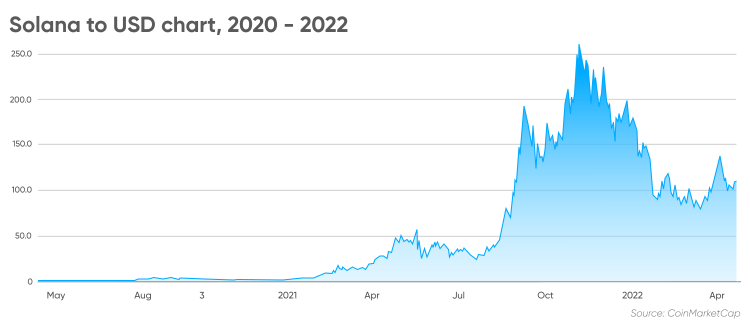
Since SOL’s launch in 2020, the coin has struggled to pick up any momentum moving sideways for around 10 months before starting to gain speed by the end of February 2021.
Between late February 2021 and mid-July 2021, the token battled values that dropped as low as $13 and did not exceed $56.

However, when the token’s value finally started to rise at the beginning of August 2021, it did so very quickly, surging by 407.1% within a month, up from $37.67 on 8 August 2021 to $191.04 on 8 September 2021, a then record high.

Solana to USD chart, 2020 - 2022

The SOL cryptocurrency reached an all-time high on 6 November 2021, hitting $258.93 – a 35.5% surge on its September 2021 value. The bullish trend was in line with other cryptocurrencies, including Ethereum (ETH), Bitcoin (BTC) and Binance (BNB).

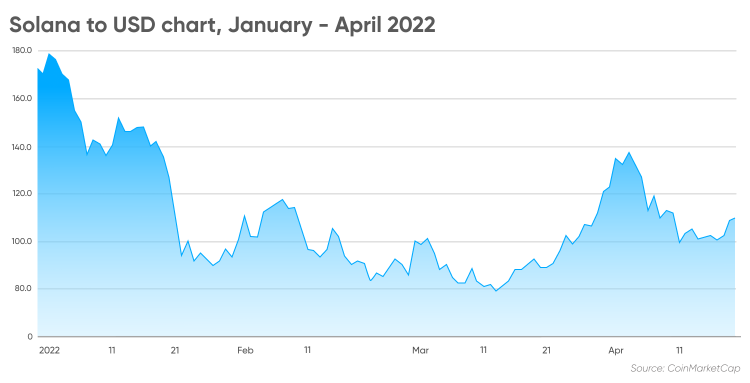
Since then, however, the trend has reversed, with the SOL token price decreasing by 65%, down to $78.94 by 13 March 2022, amid broad negative market sentiment as tensions started to rise on the Russia-Ukraine border and the outbreak of the war.

A mini surge occurred in the following three weeks as the coin managed to win back 73.2% of its value, rising to $136.78, following the publication of Solana’s energy use report, which stated that the blockchain’s carbon footprint has greatly decreased since December 2021.

Solana to USD chart, January - April 2022

SOL token technical analysis provided by CoinCodex showed that short-term sentiment for the coin was pretty neutral at the time of writing (20 April), with 22 indicators pointing to ‘sell’ and 8 to ‘buy’.

relative strength index (RSI) reading of 27 was in oversold territory. A reading of 30 or below would indicate that the asset is becoming undervalued and a trend reversal is likely to occur. The token is trading above its five-and 10-day moving averages, yet close to its R1 resistance level of $110.82.

Is Solana (SOL) a good investment?

Some of the biggest SOL coin news came as the platform announced a change in the leadership of its Solana Foundation Council on 18 April 2022. The council was established in 2020 with the aim of advancing the adoption of decentralised technologies as a public good. It’s been helping the Solana ecosystem develop.
On 29 March 2022, Solana launched Solana Pay, a “build your own online store” application on its blockchain. It allows users to create a storefront and accept low-fee, global payments directly into their wallets without the need for a bank or credit card.

Since launching, over 600 merchants have engaged with Solana Pay while others started incorporating the ecosystem into their payment flows, thus encouraging space for new investors to join the blockchain.

What is your sentiment on ETH/USD?

On 1 April 2022, the platform also announced that the Solana Hacker House World Tour will be making a comeback in new cities globally, including London, Tokyo and Barcelona, sparking international interest.

Additionally on 12 April 2022, Solana was listed on Robinhood, which, according to BigONE Exchange chair in Asia, Anndy Lian, is likely to boost SOL coin’s future price.

“An equally impressive partnership which has supported the bullish price… is the 12 April news from popular app Robinhood that it was listing SOL for the first time,” he said.

Lian told Capital.com that in addition to the listing, the price of the SOL coin to USD has been driven by debate sparked by Tesla (TSLA) CEO Elon Musk’s bid to buy Twitter (TWTR).

“This announcement over the Web3 future of the social networking platform, prompted FTX crypto exchange CEO Sam Bankman-Fried to suggest Twitter could move on-chain using the low-cost, high-speed Solana blockchain.”

In the past, Solana has hinted at wanting to work with Musk, replying to his tweets on the social media platform.

In addition, Lian told Capital.com that FTX’s investment in its own NFT platform on Solana , as well as OpenSea’s beta version launch on the blockchain, could boost SOL coin’s future price.

“Set in the context of pressure on altcoins, the outlook for the token price could be modestly optimistic after a bearish beginning to 2022,” he told Capital.com.

“Recent partnerships news support this thesis, and it’s also supported by the ‘Social Solana Prices Estimates’ on CoinMarketCap; with over 5000 voting (median average) for a 17.75% increase in price to $121.49 by the end of April; and over 2000 voting for a $127.42 price level by the end of May.”

On the minus side, however, It’s important to note that the blockchain is prone to network outages. During March and April 2022, Solana suffered nine network outages, seven of which were determined as “major”.

“The two key risks are firstly, if the bottom falls out of the altcoin market due to a ‘black swan’ event such as a Russian default impacting the wider markets; and a specific risk being if Solana suffers another serious network outage which leaves not just users but partners looking to other layer 1 options for a low cost, high speed blockchain alternative to Ethereum,” Lian told Capital.com.

Solana prediction 2022-2025, 2030

Despite recent bearish SOL token price action, algorithm-based forecasting service Wallet Investor gave a bullish SOL coin price prediction at the time of writing (20 April).
The site noted that SOL is “an awesome investment”, adding that it has a long-term earning potential of 576.24%.

Based on its analysis of past price performance, the website expected that the token could trade at $226.371 in 2023 and jump to $726.904 by 2027.

DigitalCoinPrice supported the positive Solana (SOL) crypto price prediction, but projected a much slower pace of growth in the following years, predicting that the token could rise to $150.10 by the end of 2022, $207.89 by the end of 2024 and $230.34 by the end of 2025.

For the end of 2028, the site projected a $387.31 SOL price target. Its long-term SOL future price prediction suggested that the cryptocurrency could have the potential to reach $523.61 by 2030.

Note that price predictions can be wrong. Forecasts shouldn’t be used as a substitute for your own research. Always conduct your own due diligence. And never invest or trade money you cannot afford to lose.


Original Source: https://capital.com/solana-sol-price-prediction-is-it-a-solid-investment


Anndy Lian is an early blockchain adopter and experienced serial entrepreneur who is known for his work in the government sector. He is a best selling book author- “NFT: From Zero to Hero” and “Blockchain Revolution 2030”.

Currently, he is appointed as the Chief Digital Advisor at Mongolia Productivity Organization, championing national digitization. Prior to his current appointments, he was the Chairman of BigONE Exchange, a global top 30 ranked crypto spot exchange and was also the Advisory Board Member for Hyundai DAC, the blockchain arm of South Korea’s largest car manufacturer Hyundai Motor Group. Lian played a pivotal role as the Blockchain Advisor for Asian Productivity Organisation (APO), an intergovernmental organization committed to improving productivity in the Asia-Pacific region.

An avid supporter of incubating start-ups, Anndy has also been a private investor for the past eight years. With a growth investment mindset, Anndy strategically demonstrates this in the companies he chooses to be involved with. He believes that what he is doing through blockchain technology currently will revolutionise and redefine traditional businesses. He also believes that the blockchain industry has to be “redecentralised”.
j j j