Singapore’s crypto players face added scrutiny under new law

Singapore’s crypto players face added scrutiny under new law

SINGAPORE — Singapore on Tuesday passed a law that extends its cryptocurrency regulations to companies with a local presence that provide digital token services outside the city-state, as authorities further tighten rules around the emerging industry.

Lawmakers approved the Financial Services and Markets Bill 2022, which was brought up in parliament for debate on Monday. The law brings digital token service providers created in Singapore but who provide their services elsewhere under the purview of domestic regulators.

The legislation covers industry players who deal in Bitcoin, Ethereum and other digital currencies, facilitate their exchange or offer financial advice on the sale of these tokens, among other activities.

Crypto players operating in Singapore and serving the local market are already regulated by the city-state’s central bank. They are required by law to adhere to licensing requirements as well as be able to guard against money laundering and terrorist financing.

But those who do not provide digital token services in the city-state were not under the same oversight. The new law changes this, requiring all crypto players, whether they serve the local or foreign markets, to come under the same licensing requirements.

“Sad, disappointed — we went 10 steps backwards,” said a member of a crypto lobby group in Singapore who spoke on condition of anonymity. The source questioned the necessity of digital asset players with a base in the city-state being licensed if they do not target domestic consumers, which was a worry for the central bank. “So MAS [the Monetary Authority of Singapore, the city-state’s financial regulator and central bank] is making the assumption that the license is like gold — that everyone will want to get it?”

Alvin Tan, a board member of the MAS, explained the state’s reasoning to parliament on Monday.

“We could be exposed to reputational risks brought by digital token service providers created in Singapore, and which provide services relating to virtual assets such as Bitcoin outside Singapore,” he said. “The FSM Bill seeks to mitigate such risks by licensing these players and imposing AML/CFT requirements on them.”

Singapore is not alone in tightening its scrutiny of the booming crypto sector.

Last month, Thailand issued a ban against payments using cryptocurrencies and other digital assets in a bid to maintain stability in financial markets.

China has banned all cryptocurrency payments and services for disrupting the “economic and financial order.”

In 2019, Japan’s Financial Services Agency imposed stricter information technology requirements on licensed exchanges, following security breaches and hacking incidents that marred the industry.

In January, Singapore published a set of guidelines instructing crypto players to stop marketing or advertising their offerings to retail investors in public spaces, both physical and virtual, calling the trading of such assets “highly risky and not suitable for the general public.”

The law approved on Tuesday has also garnered some positive reactions.

Singapore-based Anndy Lian, chairman of Netherlands-registered crypto trading platform BigONE Exchange, told Nikkei Asia that the city-state’s enhanced regulations are “reasonable.”

“If you walk the ground hard enough, you will see many bad actors and dubious crypto companies using Singapore as a base of their operations,” he said. “We need to properly regulate things so that the bad actors won’t affect this industry’s image.”

Even before the new law hit the books, the MAS had been busy processing license requests. In January it said there were about 180 applications for permits, more than 60 of which were withdrawn or rejected. Only a handful of applicants were successful, though others were awaiting the central bank’s decision.

With the tightened regulations, the central bank is poised to sift through a batch of additional license requests as Singapore-based crypto players that mainly deal overseas are now required to meet the state’s standards if they want to use the city for their operations.

In March, Singapore-based payments company Digital Treasures Center, which provides a platform to facilitate cryptocurrency transactions, said it received in-principle approval from MAS to provide digital payment token services.

Desmond Yong, its chief strategy officer, told Nikkei that crypto players will need to devote additional resources to monitor foreign transactions so as not to run afoul of the new law.

“For companies that are unable to fulfill the AML/CFT requirement, they will need to move out to other countries,” he said. “But with more governments regulating cryptocurrency in different jurisdictions, these companies will soon find it hard to operate.”


Original Source: https://asia.nikkei.com/Spotlight/Cryptocurrencies/Singapore-s-crypto-players-face-added-scrutiny-under-new-law


Anndy Lian is an early blockchain adopter and experienced serial entrepreneur who is known for his work in the government sector. He is a best selling book author- “NFT: From Zero to Hero” and “Blockchain Revolution 2030”.

Currently, he is appointed as the Chief Digital Advisor at Mongolia Productivity Organization, championing national digitization. Prior to his current appointments, he was the Chairman of BigONE Exchange, a global top 30 ranked crypto spot exchange and was also the Advisory Board Member for Hyundai DAC, the blockchain arm of South Korea’s largest car manufacturer Hyundai Motor Group. Lian played a pivotal role as the Blockchain Advisor for Asian Productivity Organisation (APO), an intergovernmental organization committed to improving productivity in the Asia-Pacific region.

An avid supporter of incubating start-ups, Anndy has also been a private investor for the past eight years. With a growth investment mindset, Anndy strategically demonstrates this in the companies he chooses to be involved with. He believes that what he is doing through blockchain technology currently will revolutionise and redefine traditional businesses. He also believes that the blockchain industry has to be “redecentralised”.


j j j

Dogecoin up 40% in 3 weeks! Is there more steam left?

Dogecoin up 40% in 3 weeks! Is there more steam left?

New Delhi: For the last few weeks, Dogecoin has been the cryptocurrency to watch out for. The largest memetoken has rallied about 40 per cent in the last three weeks.

Dogecoin was flying high after the reports surfaced that Elon Musk owns a 9.2 per cent stake in the micro blogging website Twitter. This makes Musk the largest shareholder in the company.

The stake in Twitter of Elon Musk, who is fondly called as the ‘Doge Father’ by fans, propelled a strong rise in the Dogecoin prices, with speculators flocking to the memetoken.

Dogecoin hit $0.1553 levels on Tuesday, rising more than 5 per cent in the last 24 hours. Its marketcap topped the $20 billion mark, after a long period, the data from Coinmarketcap suggested.

However, the popular crypto token is trading about 77 per cent below its all-time peak of $0.6848 hit in June 2021. On a year to date basis, the crypto token has tumbled about 20 per cent.

However, market experts believe that Dogecoin is likely to continue to have positive momentum and the gains will sustain, on both technical and fundamental basis.

Vikram Subburaj, CEO of Giottus Crypto Exchange, said that Elon Musk’s Twitter investment has led Dogecoin to break out from a bearish structure with price action forming higher lows and higher highs.

“Doge has retested the trendline resistance and has held as support. Overcoming resistance at $0.175 and $0.195 will further indicate signs of strength. Doge faced rejection at these levels during its downtrend,” he added, decoding the charts.

There is no dearth of those who are expecting Dogecoin to do a ‘Twitter’ again and expecting the crypto asset to deliver solid returns in the near future. A number of players see Dogecoin as synonymous with Musk.

Echoing the similar tone, Anndy Lian, Chairman, BigONE Exchange said, “Twitter stock has rallied about 25 per cent after Elon Musk’s stake in the social media company. Speculators are expecting Dogecoin to have a similar impact if not more.”

Despite being a vocal critic of Twitter, Musk has been flirting with the possibility of having his own platform. Many now are expecting Musk to, perhaps, buyout Twitter.

A few market experts believe that Musk’s push is the major driving factor behind the rally in Dogecoin, whereas others said that is not all about Musk only. The memecoin has an army of faithful believers, who are the driving force.

“Dogecoin is tied to Musk’s actions on the positive side while it remains volatile and influenced by wider market structure in a downtrend,” Subburaj added.

The trading volumes of Dogecoin have been astronomical as the Doge token worth more than $2.57 billion exchanged hands in the last 24 hours, registering a rise of 125 per cent. There are more than 132.67 billion Dogecoins in circulation.

Shivam Thakral, CEO of BuyUcoin said that Dogecoin is the most popular Memecoin, and finds robust support from the mercurial figures like Elon Musk.

“The recent tweet by Elon in support of the German travel site ‘GetYourGuide’ announcing that Dogecoin will be accepted as a mode of payment sparked investor interest in Doge,” he added.

Market experts advise investors to be cautious while investing the memecoin. Dogecoin remains a volatile investment with no fundamental utility, they say.

“We advise investors to stick to a certain set of crypto assets according to their risk appetite given no possibility of offsetting losses from one crypto to another in the new tax regime,” said Subburaj from Giottus.

Lian from BigONE suggested investors look for the long term. “For those who are dealing with derivatives, monitor the price carefully and start off with lower leverages,” he cautioned the traders.

Anndy Lian is an early blockchain adopter and experienced serial entrepreneur who is known for his work in the government sector. He is a best selling book author- “NFT: From Zero to Hero” and “Blockchain Revolution 2030”.

Currently, he is appointed as the Chief Digital Advisor at Mongolia Productivity Organization, championing national digitization. Prior to his current appointments, he was the Chairman of BigONE Exchange, a global top 30 ranked crypto spot exchange and was also the Advisory Board Member for Hyundai DAC, the blockchain arm of South Korea’s largest car manufacturer Hyundai Motor Group. Lian played a pivotal role as the Blockchain Advisor for Asian Productivity Organisation (APO), an intergovernmental organization committed to improving productivity in the Asia-Pacific region.

An avid supporter of incubating start-ups, Anndy has also been a private investor for the past eight years. With a growth investment mindset, Anndy strategically demonstrates this in the companies he chooses to be involved with. He believes that what he is doing through blockchain technology currently will revolutionise and redefine traditional businesses. He also believes that the blockchain industry has to be “redecentralised”.

j j j

STRONG coin price prediction: Can token regain growth?

STRONG coin price prediction: Can token regain growth?

StrongBlock is the first of its kind decentralised platform attempting to make launching nodes, necessary for the smooth running of blockchains, cheaper and easier.

Its native cryptocurrency, STRONG token, has had quite the journey since launching in 2020, enjoying a rather fruitful 2021. Yet since then, the coin started to dramatically fall in the second half of January 2021, unable to reach past heights.

Can STRONG rise back to its October 2021 value and which factors are driving the STRONG/USD forecast?

What is the STRONG coin?

StrongBlock was founded in 2018 by ‘blockchain pioneers’ David Moss, Brian Abramson and Corey Lederer with the goal  to easily add secure, decentralised blockchains to any application.

It had taken the company, however, two years to launch its Blockchain-as-a-Service (BaaS) platform.

By tackling one of the biggest problems new blockchains face, StrongBlock managed to become the first and only blockchain-agnostic protocol that rewards its users for running nodes.

Nodes, which are vital for the existence of any blockchain, keep full copies of blockchain transactions but are hard to create and pricey to operate. This leads many nodes to run outdated software, store incomplete blockchain histories and be intermittently offline.

StrongBlock’s Nodes-as-a-Service (NaaS) function lets cryptocurrency miners create nodes in seconds. In turn, miners are rewarded in the form of the blockchain’s native cryptocurrency, STRONG, for maintaining the node without having to run their device 24/7.

Rewards can be boosted with StrongBlock non-fungible tokens (NFTs) that are available in four categories: bronze, silver, gold and platinum.

Once a node is launched, it can be used by anyone to access the blockchain the node was built for. So far, StrongBlock supports hundreds of nodes built for Polygon, Ethereum and Sentinel. The approximate amount to set up and run a full Ethereum node is $113.11 per month.

Being listed as an eligible node on StrongBlock is free, however, users should expect a mining deposit to amount to 10 STRONG tokens.

STRONG is an ERC-20 cryptocurrency built on the Ethereum network. Its original supply amounted to 10 million, however, after launching the second version of its Decentralised Finance (DeFi) protocol, StrongBlock ended up burning 94% of the original tokens limiting the supply to around 535,000 STRONG coins.

In the second version of its tokenomics paper, StrongBlock noted that the token:

  • Is primarily used for rewards.
  • Supports a low-inflation model with rewards mostly generated through node participation that may adjust in accordance to token valuation over time. In addition, deflationary measures will also be used including the burning of STRONG tokens in some transactions.
  • Establishes governance, which will eventually determine how StrongBlock works as a decentralised network.
  • Is helping the project reach a model of long-term, self-sustaining growth.

As of the time of writing (1 April), StrongBlock is rewarding 444,676 nodes.

Over 138,000 coins are currently in circulation, according to data provided by CoinMarketCap at the time of writing. STRONG currently has a market capitalisation surpassing $16m (£12.2m) and is ranked as the 828th largest cryptocurrency.

STRONG price analysis: Bear trend

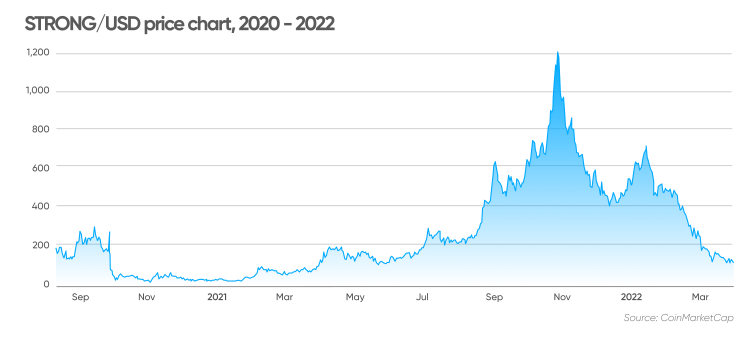
The STRONG cryptocurrency embarked on quite the journey during its two years in circulation. After reaching a record high of $1,193.31 on 28 October 2021, the StrongBlock coin failed to regain those levels, slumping to the $116 mark, as of 1 April 2022.

After a mini peak of $708.97 on 14 January 2022 the STRONG token started to drastically drop, losing 35.48% of its value in 10 days. Throughout February 2022, the STRONG coin value lost 47% amid broad negative market sentiment as tensions rose on the Russia-Ukraine border.

STRONG/USD price chart, 2020 – 2022

In the most recent STRONG coin news, the project announced that the StrongBlock had reached 270,000 nodes on 27 January 2022.

The number of nodes being activated on StrongBlock drastically increased in February 2022 from 285,000 on 3 February to 350,000 on 27 February. In addition, the token celebrated great success as it debuted third on the top 10 US trending coins for the week chart on CoinGecko on 18 February. This gave investors hope that the token’s price could still resurface.

STRONG’s price continued to decrease in the next couple of weeks, falling to $113.62 on 26 March 2022, its lowest value that month.

Last year STRONG’s price action seemed hopeful as it surged to a record high of $1,193.31 on 28 October 2021 as the blockchain announced the start of its metal NFT lottery where miners would be eligible to qualify to purchase one StrongBlock metal NFT for its original price in STRONG.

In terms of STRONG technical analysis, the short-term sentiment for the token was largely bearish as at the time of writing (1 April).

Relative Strength Index (RSI) reading of 31 was extremely close to the oversold territory. A reading of 30 or below would indicate that the asset has become undervalued and a trend reversal is likely. Meanwhile, the token was trading below its three, five and 10-day moving averages, indicating a bearish trend.

STRONG token price prediction: Key drivers

On 28 February 2022, StrongBlock published its roadmap for 2022 underlining some key goals including:

  • The launch of its new token, STRONGER, which plans to solve a number of problems that followed the success of the NaaS DApp.
  • The release of several new features including two new, different types of nodes, a node marketplace and node transfer.
  • The platform’s intention to build a Layer 1, EVM-compatible blockchain protocol that will be known as StrongChain with the bigger goal in mind of moving its NaaS platform to StrongChain and creating a community-oriented model that will unlock new economic layers, increase sustainability, make STRONG more resilient, and lay a new foundation for growth.

BigONE Exchange chair in Asia, Anndy Lian, told Capital.com that the token’s price could be struggling due to the platform being unable to gain retail investor understanding.

“STRONG brings more decentralisation to the current decentralised space by offering multi chain third party external nodes and other data oracles to build robustness and efficiency,” Lian exclusively told Capital.com.

“They believe the best way to adopt blockchain is through DAO governance and reward the community sufficiently. This idea works well on the paper but may not be well understood by the retail investors as a whole. Things might change when they list in the more major exchanges,” he added.

Thus far, the STRONG token has been listed on ChainSwap and Poloniex Exchange.

In the recent announcement by the project, StrongBlock warned investors to beware of scams, suggesting it has been prone to attacks in the past.

StrongBlock (STRONG) price prediction 2022 – 2025

Despite the latest downward price action, algorithm-based forecasting service WalletInvestor gave a bullish STRONG crypto price prediction at the time of writing (1 April). The site noted that STRONG is “an awesome long-term investment”, adding that it has a long-term earning potential amounting to 1,343.3%.

Based on its analysis of past price performance, Wallet Investor predicted that STRONG could cost $460.507 in 2023 and reach $1,751.200 by 2027.

DigitalCoinPrice supported the positive STRONG/USD forecast but saw a much slower pace of growth in the following years, expecting the token to grow to $167.83 by the end of 2022 and reach $248.68 by the end of 2025.

By the end of 2027, the site predicted that the price of STRONG coin could reach $376.08. Its long-term STRONG token forecast showed the cryptocurrency reaching $553.34 by 2030.

Note that predictions about the future of STRONG can be wrong. Forecasts and analyst expectations shouldn’t be used as a substitute for your own research. Always conduct your own due diligence and rely on your own projections, and never invest or trade money you cannot afford to lose.


Original Source: https://capital.com/strongblock-strong-coin-price-prediction

Anndy Lian is an early blockchain adopter and experienced serial entrepreneur who is known for his work in the government sector. He is a best selling book author- “NFT: From Zero to Hero” and “Blockchain Revolution 2030”.

Currently, he is appointed as the Chief Digital Advisor at Mongolia Productivity Organization, championing national digitization. Prior to his current appointments, he was the Chairman of BigONE Exchange, a global top 30 ranked crypto spot exchange and was also the Advisory Board Member for Hyundai DAC, the blockchain arm of South Korea’s largest car manufacturer Hyundai Motor Group. Lian played a pivotal role as the Blockchain Advisor for Asian Productivity Organisation (APO), an intergovernmental organization committed to improving productivity in the Asia-Pacific region.

An avid supporter of incubating start-ups, Anndy has also been a private investor for the past eight years. With a growth investment mindset, Anndy strategically demonstrates this in the companies he chooses to be involved with. He believes that what he is doing through blockchain technology currently will revolutionise and redefine traditional businesses. He also believes that the blockchain industry has to be “redecentralised”.
j j j