Here’s How Shibetoshi Sees Dogecoin Succeeding as a Digital Currency

Here’s How Shibetoshi Sees Dogecoin Succeeding as a Digital Currency
IN BRIEF
  • Billy Markus, the co-creator of Dogecoin, believes that the meme coin needs to market itself as a digital currency.
  • In the past, Markus had agreed that DOGE is “fast, scalable, and inexpensive.”
  • Dogecoin’s creator argues against it being a “shit token.”
Billy Markus, the co-creator of Dogecoin, took to Twitter today to suggest that Dogecoin needs to promote itself as a digital currency.

The American programmer argued that “if you want dogecoin to succeed, continue to be relevant, and have a reason and need to exist, utility comes from using it, accepting it, and showing others the benefits to do so.”

With that, Markus urged the community to contribute to the core development of the project instead of creating unnecessary hype. He commented, “speculation has brought attention. work brings utility.”

In the past as well, Markus had stated that “hype doesn’t last,” but only “attracts get rich quick people.” Instead, projects need to focus on “lasting value,” the creator had reiterated.

Dogecoin, which was a bitcoin spin-off and arguably the first real ‘meme coin,’ had garnered attention after DogeFather Elon Musk fuelled its social media following. But along with that, Musk and Markus have often agreed over Twitter exchanges that DOGE is “people’s crypto.” However, the original meme coin continues to attract critics, especially as it stands as the twelfth-largest crypto.

Arguing against DOGE being just another useless meme token, Markus also commented that “it’s a satirical cryptocurrency made for sillies that randomly caught on.” And, in his opinion, the meme tokens of today “[have] no use case.”

As we recall, Markus considers that DOGE is “fast, scalable, and inexpensive,” in contrast to his definition of ‘shit tokens.’

DOGE recovers

When it comes to Dogecoin’s price action, it has recently enjoyed some recovery along with the broader crypto market. The coin’s major hike also came this week when Elon Musk asked his followers if a new social media platform is needed.

In response, Musk seemed to like the idea of Boardroom Capital chairman, who suggested buying Twitter and replacing the blue bird with DOGE. With that, Anndy Lian, Chairman, BigONE Exchange highlighted the impact of the Twitter exchange on Dogecoin’s value:

In the past week, DOGE prices have gone up by over 17% and were trading at $0.1447 at the time of press. Despite that, it remains around 80% below its all-time-high valuation of $0.731578 reached last year in May.


Original Source: https://beincrypto.com/shibetoshi-dogecoin-succeeding-digital-currency/

Anndy Lian is an early blockchain adopter and experienced serial entrepreneur who is known for his work in the government sector. He is a best selling book author- “NFT: From Zero to Hero” and “Blockchain Revolution 2030”.

Currently, he is appointed as the Chief Digital Advisor at Mongolia Productivity Organization, championing national digitization. Prior to his current appointments, he was the Chairman of BigONE Exchange, a global top 30 ranked crypto spot exchange and was also the Advisory Board Member for Hyundai DAC, the blockchain arm of South Korea’s largest car manufacturer Hyundai Motor Group. Lian played a pivotal role as the Blockchain Advisor for Asian Productivity Organisation (APO), an intergovernmental organization committed to improving productivity in the Asia-Pacific region.

An avid supporter of incubating start-ups, Anndy has also been a private investor for the past eight years. With a growth investment mindset, Anndy strategically demonstrates this in the companies he chooses to be involved with. He believes that what he is doing through blockchain technology currently will revolutionise and redefine traditional businesses. He also believes that the blockchain industry has to be “redecentralised”.

j j j

Elvantis price prediction: Where next for the ELV token?

Elvantis price prediction: Where next for the ELV token?

Launched in the midst of a non-fungible token (NFT) and metaverse hype train, the ELV coin, responsible for the smooth operation of the Elvantis ecosystem, has had quite the journey during its first few months in circulation.

The ELV token surged by 101.53% in the first four days following its launch, up from $0.07567 on 10 February 2022 to $0.1525 on the 14th.

The token’s success, however, was not long lived; the ELV coin value started to drastically decline after reaching its all time high of $0.1542 on 17 February. The coin is currently trading at $0.06295 (as of 22 March).

Is this the right time to join the digital universe? Let’s have a look at the Elvantis crypto price prediction for 2022, 2025 and 2030 to find out more.

What is Elvantis (ELV)?

According to its official website, the Elvantis ecosystem is a “metaverse-inspired online NFT game that combines what you love about gaming with the addictive thrill of collectables”.

Set in an immersive space ecosystem, the project juggles with the idea of merging art and NFTs with video games and crypto earnings as it strives to build a community that creates a self-sustaining and profitable “living organism”, as stated in its whitepaper.

The game operates as a storyline that guides players through a metaverse as they look for rewards in an open world with the help of a Treasure Map. Rewards come in NFT form as unique, collectable cards that have a number of utilities besides their artistic value.

Players can explore the Elvantis ecosystem as bounty hunters or build a farm and earn items that can be given away or traded on the platform’s own marketplace. Aliens fill the role of avatars in this intergalactic universe and each player has the opportunity to expand the skills of their alien making them better and stronger.

The aliens, known as Elvantinians, can travel through the entirety of the Elvantis universe and collect a number of items (NFTs) from chests and adventures that will help them grow stronger and more powerful; get to rule over countless planets; battle each other as well as a number of mythical creatures for rewards and enlarge their empires.

Players keep their collected NFTs in a Relic Album. Players receive extra rewards as the album is being filled up.

The Elvantis ecosystem was built on the Binance Smart Chain (BSC) but has crossed into the Ethereum network as well. Its native coin, ELV, was built on the Ethereum network and operates as an ERC-20 cryptocurrency.

The ELV token can be used for:

  • NFT staking and farming
  • Participating in in-game battles
  • Hunting for treasures with the use of the Treasure Map
  • Trading and selling items on the marketplace
  • Completing sections of the Relic Album

The maximum supply of the ELV cryptocurrency amounts to 300m, meanwhile over 44.8m are in circulation as of 22 March 2022. The token reached over $2.8m in market capitalisation and is ranked as the 3461st  largest cryptocurrency by CoinMarketCap as of 22 March 2022.

The project is in the early stages of its production and still has a long way to go until fully launched.

ELV token value: Key drivers

The ELV crypto price took off within a week of the token’s launch, surging by 103.77% from $0.07567 on 10 February 2022 to $0.1542 on 17 March, an all-time high value, as seen on the chart below.

A successful launch was triggered by the ELV token being listed on a number of crypto platforms, including CoinMarketCap, Coinstats, DappRadar and CoinAlpha. The coin was also ranked second biggest gainer on CoinMarketCap four days following its launch and releasing its chests function.

The token’s advance was not long-lived, however, as the ELV coin value started to rapidly decline, falling by 56.45% to $0.06714 exactly a week after reaching its all-time high.
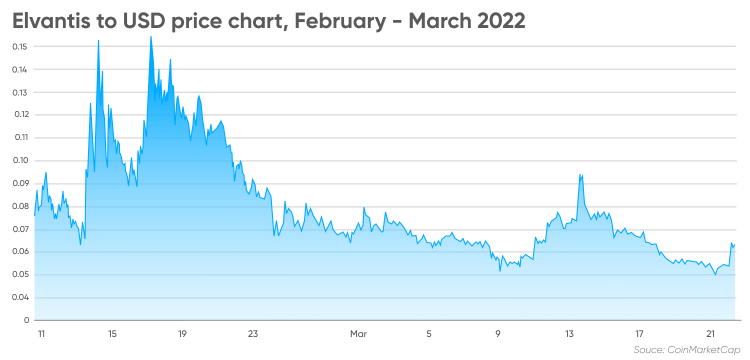
Elvantis to USD price chart, February - March 2022

The bearish trend in the Elvantis coin price was likely the aftermath of the Russian invasion of Ukraine, which sent crypto markets tumbling.

An untimely debut did not help the Elvantis crypto value gain momentum despite the platform’s constant development and promises of more to come.

In the recent Elvantis coin news, on 24 February 2022 the platform announced that it would be launching a new series of NFT avatars known as “The Crypto Legends”. The avatars include virtual NFT figurines of twenty “legendary” names that were immortalised due to the “great realizations and the influence that they had on the course of Universal events”.

Some of the “legends” featured include: American rapper Snoop Dogg, who has on several occasions expressed his interest in the metaverse and a number of NFT projects; Tesla CEO Elon Musk; the presumed pseudonym of the team that created Bitcoin, Satoshi Nakamoto; Binance CEO Changpeng Zhao and computer programmer John McAfee.

However, even a star-studded NFT collection did not help boost the ELV coin value, which by 9 March had fallen o $0.05174, its all-time low.

Further negative news followed as US President Joe Biden announced that his administration would be signing an executive order that includes new initiatives on cryptocurrency regulation.

The ELV cryptocurrency continued on a bearish trend until it surged by 81.17% to $0.09374 on 13 March 2022 from its 9 March value after the platform announced the launch of a giveaway that would see players win 50 NFTs and $10,000 in ELV tokens.

Since the token’s mini-surge in mid-March, the Elvantis cryptocurrency has not been looking very good as it lost 32.84% of its value and dropped to $0.06295 on 22 March 2021.

Invezz’s data analyst Dan Ashmore pointed out that the bearish outlook faced by the ELV cryptocurrency is due to its untimely launch.

“Shedding nearly two thirds of its value in the last month, Elvantis is suffering from a stuttering market as crypto and stocks alike pull back.”

by Dan Ashmore, Invezz

“Elvantis is a prime example of how important it is to time your launch well in the world of crypto. Akin to how companies in the stock market often pull initial public offerings (IPO) in response to macro events, the sentiment in the market is vital to nascent cryptocurrencies, especially given the rampant speculation from retail in the alt-coin sector,” he told Capital.com.

“Shedding nearly two thirds of its value in the last month, Elvantis is suffering from a stuttering market as crypto and stocks alike pull back. Altcoins, high beta assets as they are, have felt the brunt of this as investors have moved risk-off in response to the precarious geopolitical climate.

“Elvantis presents as an especially high risk investment given it is still in production, and the appetite from investors for such assets is simply not there right now, as they seek to retreat back the risk curve rather than move further out.”

Ashmore believes that if the token aspires to reach its February digits it is vital for it to be picked up by the wider market.

BigONE Exchange Chairman in Asia, Anndy Lian agreed with Ashmore, on the token’s unlucky launch.

“As of today, I think the price of the coin has reflected the market sentiments. If investors want to see a spike in price the project must launch their play-to-earn gaming according to the market’s condition. It would be better if it is accompanied by a good listing too,” he added.

Elvantis NFT: A metaverse in development

The Elvantis ecosystem is far from being finalised and currently in “full development”. On 10 March 2022, the platform announced that it is carrying out minigame test runs.

On 14 March, the platform launched the NFT Farm, a minigame where players can stake a variety of their NFTs in order to win ELV tokens. This was followed by the launch of “The Crypto Legends” collection on 20 March.

According to the platform’s roadmap, players can expect many more updates to come in the following years including the launch of:

  • Five new NFT collections.
  • The platform’s marketplace.
  • The alpha version of the play-to-earn metaverse.
  • The app for ANDROID and IOS.
  • New partnerships.
  • Cross-chain development with Ethereum, Matic and Solana.

It is important to note that because Elvantis is a relatively new project in the play-to-earn metaverse and decentralised finance (DeFi) industry, it may not achieve broader adoption.

ELV price prediction: Will the token surpass its bearish trend?

Algorithm-based forecasting site Wallet Investor gave a negative Elvantis token price prediction at the time of writing (22 March), calling it a “bad long-term investment”.

Based on its analysis of the cryptocurrency’s past performance, the site predicted that the ELV cryptocurrency could trade at $0.00351 by 2023. The platform did not provide an Elvantis (ELV) coin price prediction for 2026.

DigitalCoinPrice, on the other hand, echoed the opposite sentiment in its Elevantis crypto prediction, seeing the coin reach $0.0876 by the end of 2022 and $0.13 by December 2025.

The site predicted that ELV would surpass its all-time high by the end of 2028 reaching $0.25. Its long-term ELV coin forecast showed the cryptocurrency reaching $0.31 by 2030.

Note that algorithm-based Elevantis price predictions can be wrong. Forecasts shouldn’t be used as a substitute for your own research. Always conduct your own due diligence before investing. And never invest or trade money you cannot afford to lose.


Original Source: https://capital.com/elevantis-elv-price-prediction

Anndy Lian is an early blockchain adopter and experienced serial entrepreneur who is known for his work in the government sector. He is a best selling book author- “NFT: From Zero to Hero” and “Blockchain Revolution 2030”.

Currently, he is appointed as the Chief Digital Advisor at Mongolia Productivity Organization, championing national digitization. Prior to his current appointments, he was the Chairman of BigONE Exchange, a global top 30 ranked crypto spot exchange and was also the Advisory Board Member for Hyundai DAC, the blockchain arm of South Korea’s largest car manufacturer Hyundai Motor Group. Lian played a pivotal role as the Blockchain Advisor for Asian Productivity Organisation (APO), an intergovernmental organization committed to improving productivity in the Asia-Pacific region.

An avid supporter of incubating start-ups, Anndy has also been a private investor for the past eight years. With a growth investment mindset, Anndy strategically demonstrates this in the companies he chooses to be involved with. He believes that what he is doing through blockchain technology currently will revolutionise and redefine traditional businesses. He also believes that the blockchain industry has to be “redecentralised”.

j j j

As India seeks firm footing on cryptocurrency, investors await clarity

As India seeks firm footing on cryptocurrency, investors await clarity

Almost two months after the government proposed a taxation policy for income from trading in virtual digital assets (VDAs), there is still a lack of clarity on various aspects, experts said.

According to Pratik Gauri, founder of 5ireChain, a blockchain ecosystem, the wavering clarifications and piecemeal developments indicate that the government is feeling its way through the subject of crypto regulation, and with little or no precedent to go by, it is trying to find a foothold in understanding the various challenges it will face in implementation once regulations are in place.

“One thing that I’ve repeated in the past and would like to re-emphasise is that the Reserve Bank of India (RBI) and the government are grappling with the reality that cryptocurrencies are not a fad and are here to stay,” said Gauri.
The government proposed in the Budget 2022 on February 1 that income from the transfer of any virtual digital asset be taxed at 30 percent. It said no deduction of any expenditure or allowance will be allowed while computing such income, except the cost of acquisition. It also proposed that a loss from the transfer of VDAs cannot be set off against any other income.

This week on March 21, the government clarified that losses from the transfer of virtual digital assets cannot be set off against gains from another. Neither can mining costs be treated as acquisition cost for tax deduction.

With no headway being made on a bill to regulate cryptocurrencies, it’s still not clear whether digital currencies are legal. Although investors say the tax provisions have effectively legalised crypto trading, Finance Minister Nirmala Sitharaman has said that taxing cryptocurrencies does not mean it has been legalised – that matter is still being considered.

Tracing VDAs

Taxation and legality issues apart, there are concerns over the enactment of certain provisions that show up in the finer details.

“From the perspective of crypto exchanges, the biggest challenge the many platforms will face is traceability of cryptocurrencies and VDAs,” said Gauri. “With the government putting the onus of this aspect on the exchanges, it’ll be a real challenge to balance innovation in the crypto world along with efforts to keep things private.”

Among the challenges in implementing the crypto tax provisions will be the monitoring of investor activity and preventing them from accessing more favourable crypto markets abroad. The crypto regulations that are in the offing and the severe tax incidence will be detrimental to the development of India’s crypto ecosystem, experts said.

“February 1, 2022, marked another day that the crypto industry and the crypto community would like to roll back,” said Raj Kapoor, founder of India Blockchain Alliance. “The community has taken strong exception to the government’s clarification on the taxation of cryptocurrencies as it is sure to have a stymieing impact. The lack of a provision to offset losses will drive away investors from KYC-compliant exchanges and will leave them literally with the devil’s alternative of accessing grey markets and offshore havens, completely defeating the very purpose of the tax.”

The proposed taxation measures will discourage retail investment in the emerging asset class because it denies them the benefit of setting off losses. Investors could cough up a heavy tax even if their trading activity suffers an overall loss.

Experts said there could be a flight of funds, restrained retail participation, and novel ways to circumvent these provisions, defeating the very purpose of taxing VDAs.

Aliasgar Merchant, developer relations engineer at Ignite, which works in the blockchain space, said the idea put forward by the government is tricky and does not take into consideration all aspects of crypto trading.

Instead of the offset regulation placing an unnecessary burden on the retail investor, a solution could be to have taxes based on exchanges and not individual VDAs, just as profit and loss are cumulatively treated for equity transactions across stock exchanges, Merchant said.

Looking for loopholes

“Another aspect totally overlooked by the Indian government is the presence of decentralised crypto exchanges as these platforms are out of the reach of government entities, making it difficult to audit and control transactions that take place through them. Such stringent laws which are heavily flawed will open doors to people looking for loopholes and may spark a move to decentralised crypto exchanges,” Merchant added.

Additionally, for those engaged in mining of VDAs, the government has clarified that all costs and investments towards equipment can’t be adjusted against any gains. Such expenses will be treated as a capital investment and only depreciation may be allowed to be claimed against them.

The measures may constrain India’s potential to develop into a global hub for crypto activity – in the way local information technology companies did – and extend use-cases of VDAs, experts said.

“While the Ministry of Finance works actively on regulating crypto, it’s crucial to understand that despite the various challenges, the industry holds immense potential,” said Raghav Gupta, founder of Equidei, which operates a decentralised finance platform.

Need for innovation

According to Gupta, it’s equally pertinent to incentivise innovation. Blockchain-based technology must be cultivated by providing developers ample space to grow so that India doesn’t miss the Web3 revolution.

Web3 refers to the next version of the internet where services run on blockchain and are decentralised.

Anndy Lian, Asia chairman of BigONE Exchange, a crypto trading platform, said it will be quite a task keeping track of VDAs.

“My question to the Indian government is: how are you going to account for each and every VDA? There are almost a few new coins every day in the market,” he said. “Assuming they bought 50 new coins each year, the effort for the investor to report tax and the regulators to monitor it would be a big issue. I urge the government to take progressive steps for crypto taxation. By doing so, you will see healthier trades and more foreign investments flowing into the country.”

All eyes will now be on the long-awaited cryptocurrency bill, although recent developments may be a reason for tempering hopes with caution.

Original Source: https://www.moneycontrol.com/news/business/cryptocurrency/as-india-seeks-firm-footing-on-cryptocurrency-investors-await-clarity-8273811.html

Anndy Lian is an early blockchain adopter and experienced serial entrepreneur who is known for his work in the government sector. He is a best selling book author- “NFT: From Zero to Hero” and “Blockchain Revolution 2030”.

Currently, he is appointed as the Chief Digital Advisor at Mongolia Productivity Organization, championing national digitization. Prior to his current appointments, he was the Chairman of BigONE Exchange, a global top 30 ranked crypto spot exchange and was also the Advisory Board Member for Hyundai DAC, the blockchain arm of South Korea’s largest car manufacturer Hyundai Motor Group. Lian played a pivotal role as the Blockchain Advisor for Asian Productivity Organisation (APO), an intergovernmental organization committed to improving productivity in the Asia-Pacific region.

An avid supporter of incubating start-ups, Anndy has also been a private investor for the past eight years. With a growth investment mindset, Anndy strategically demonstrates this in the companies he chooses to be involved with. He believes that what he is doing through blockchain technology currently will revolutionise and redefine traditional businesses. He also believes that the blockchain industry has to be “redecentralised”.

j j j