Op-ed by Anndy Lian: The rise of the use of blockchain and crypto in Southeast Asia

Op-ed by Anndy Lian: The rise of the use of blockchain and crypto in Southeast Asia
By Anndy Lian – Oct 29, 2021 | 09:25 AM GMT+7

TheLEADER A recent Chainalysis report showing stellar growth in cryptocurrency adoption in Central and Southeast Asia (CSAO), making it the fourth-largest crypto market in the world, should come as no surprise.

According to the blockchain analytics firm, the region saw a 2 per cent growth in global market share between July 2020 and June 2021. Which may on face value does not sound significant, but this growth made CSAO the fourth-largest cryptocurrency market in the world, with over $572.5 billion in value sent during the year. This number represents 14 per cent of total global cryptocurrency transactions – and a growth rate of 706 per cent for the region for the year July 2020 to June 2021.

This rosy regional picture of Southeast Asian crypto development had a reality check when on September 24th, the People’s Bank of China (PBoC) announced that all cryptocurrency transactions in China are illegal.

“Virtual currency-related business activities are illegal financial activities,” the PBoC confirmed, warning it “seriously endangers the safety of people’s assets”. Is this a sign that crypto innovation in Southeast Asia is stalled, or are there good reasons for optimism despite the China ban?

“We will see an increasing exodus of Chinese crypto entrepreneurs, and I believe it will lead to a diffusion of crypto technology in Southeast Asia and accelerate the rise of Southeast Asia as a hotbed of crypto innovation,” said Singapore-based Lily Z. King, writing in Forkast.

King suggested an upside to all the FUD caused by the ban, which will drive a significant decentralization of crypto power from China to other markets, particularly Southeast Asia.

“As the economy of Southeast Asia has been heavily impacted by the Covid-19 crisis, the new inflow of crypto capital and technology might bring a much-needed boost for their digital economy. Taking the long-term perspective, this diffusion is good for the builder-type among Chinese crypto entrepreneurs and is good for the crypto movement globally,” she concluded.

If that thesis is correct, what existing trends in crypto/blockchain are likely to simply accelerate, rather than jump-starting new innovation?

In the Chainalysis report, which to note looks wider than Southeast Asia to include central Asia and Oceania, there has been a marked growth in decentralized finance (DeFi) activity. From May 2020, DeFi activity (as a share of all transaction volume) skyrockets, reaching above 50 per cent by February. This activity is primarily driven by Uniswap, Instadapp, and dydx, with significant activity on Compound, Curve, AAVE, and 1inch.

But behind these insights what can we see in regional user and business adoption that can help understand the possible impacts of the China ban?

The island-state of Singapore is widely regarded as a leading force for crypto and blockchain adoption. According to a Hacker Noon article, there are 634 companies incorporated in Singapore related to crypto, with a total value of $8.3 billion according to CoinMarketCap.

Despite this existing activity, in late 2020, a new multi-million-dollar program was launched to strengthen Singapore’s blockchain ecosystem. One of the program leaders, the Infocomm Media Development Authority (IMDA), said the need for such support was due to the lack of large-scale successful use cases outside the fintech sector which was hampering mainstream adoption.

“Its nascence means end-user companies have a lack of codified business models on how to work together using blockchain’s trusted environment. The industry is showing signs of silo-ed, specialized, blockchain solutions rather than interoperable network blockchains,” said IMDA.

The IMDA also noted that support for startups seeking like-minded partners was lacking. While the Singapore Blockchain Ecosystem Report 2020, published at the end of last year, found that the coronavirus pandemic had accelerated the application of blockchain technology, used to verify health credentials.

A key driver for crypto businesses setting up shop in Singapore, independent of the latest China ban, is the regulatory clarity provided by the Monetary Authority of Singapore (MAS). And indeed, Singapore is already home to many Chinese crypto companies, including Binance, the world’s largest cryptocurrency exchange founded in China.

“Singapore provides the regulatory clarity with various regulations for different kinds of crypto activities (payment tokens, securities, custody, crypto fund management, etc.). Naturally, that would be attractive for any crypto companies, whether from China or elsewhere, to consider setting up shop in Singapore,” said Chia Hock Lai, co-chairman of Blockchain Association Singapore.

Consider the demographics of the region’s top six economies (Singapore, Indonesia, Malaysia, the Philippines, Thailand, and Vietnam) with a combined population of around 580 million, of which half are aged below 35.

In terms of grassroots adoption of crypto, as opposed to business adoption in Southeast Asia, Vietnam not only tops the rankings for the region but for the world when calculated in terms of the transaction volumes for peer-to-peer (P2P) platforms.

As Chainalysis reported, for their 2021 global report, many residents use P2P cryptocurrency exchanges as their primary on-ramp into cryptocurrency, often because they don’t have access to centralized exchanges. Another reason given for the high uptake in Vietnam is the interest in gambling, which as its illegal gives a boost to demand for such activities through crypto-assets.

Southeast Asia also has a sizable unbanked population, primarily found in Indonesia, the Philippines, and Vietnam. Of the estimated 1.7 billion unbanked people today, 290 million live in the region. This is another contributing factor behind the high P2P uptake, certainly, it’s why Facebook’s crypto wallet Novi is predicted to have a high uptake in the region.

In the Philippines for example, 71 per cent of adults do not have a bank account, according to a 2019 report by the country’s central bank. And unlike the US where younger users have failed to drive Facebook adoption, in the Philippines, almost 33 per cent of the users are aged 18 to 24. This user profile is supported by figures from Metamask, with Filipinos making up a fifth of its ten million active monthly users – driven by the success of the NFT-based game Axie Infinity which allows people to earn by playing.

“The largest swath of gamers on the platform come from the island nation – a little more than 40 per cent – according to the powerhouse behind Axie Infinity, a Vietnamese startup called Sky Mavis,” according to Business Insider.

“The biggest driver for crypto over the next few years is not going to be DeFi, it’s not going to be opening up centralized exchanges. It’s going to be GameFi,” Lu said in a recent Forkast report.

“GameFi is going to drive the crypto adoption in Southeast Asia and South Asia…blockchain games and a play-to-earn sector is what is going to take the adoption of non-crypto users and [turn] them into crypto users once they realize that they can earn more money or supplement their earnings with the game where they can play for two hours, three hours. It’s pretty crazy,” Lu confirmed.

The rich diversity of crypto adoption, whether successful crypto-based businesses or grassroots play-to-earn gamers, shows that there is great potential in Southeast Asia.

While Singapore in many ways is leading the way, the need as identified by the IMDA for interoperable network blockchains underlines that there has to be coordinated action from all stakeholders, to make Singapore the world’s leading user of decentralized technology, faced with the concerted efforts of the Chinese state to be the dominant blockchain power.

Whether it’s better serving the needs of the unbanked, or leading the way in the use of blockchain to spur medical research, the opportunities for innovation are there for the taking.


Original Source: https://e.theleader.vn/the-rise-of-the-use-of-blockchain-and-crypto-in-southeast-asia-1635393795663.htm
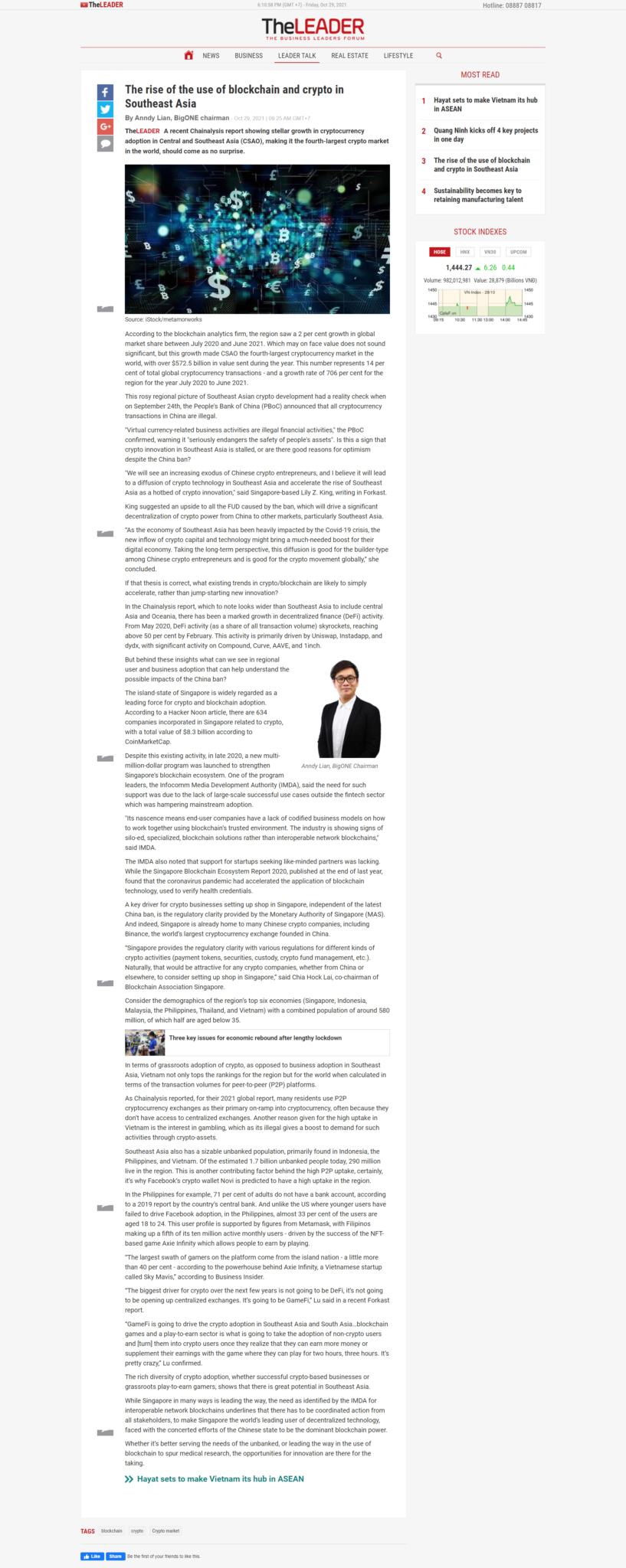
 

Anndy Lian is an early blockchain adopter and experienced serial entrepreneur who is known for his work in the government sector. He is a best selling book author- “NFT: From Zero to Hero” and “Blockchain Revolution 2030”.

Currently, he is appointed as the Chief Digital Advisor at Mongolia Productivity Organization, championing national digitization. Prior to his current appointments, he was the Chairman of BigONE Exchange, a global top 30 ranked crypto spot exchange and was also the Advisory Board Member for Hyundai DAC, the blockchain arm of South Korea’s largest car manufacturer Hyundai Motor Group. Lian played a pivotal role as the Blockchain Advisor for Asian Productivity Organisation (APO), an intergovernmental organization committed to improving productivity in the Asia-Pacific region.

An avid supporter of incubating start-ups, Anndy has also been a private investor for the past eight years. With a growth investment mindset, Anndy strategically demonstrates this in the companies he chooses to be involved with. He believes that what he is doing through blockchain technology currently will revolutionise and redefine traditional businesses. He also believes that the blockchain industry has to be “redecentralised”.

j j j

Anndy Lian tells Yahoo Finance “It is good to see another mainstream listed company [GAMESTOP] heading into the crypto space”

Anndy Lian tells Yahoo Finance “It is good to see another mainstream listed company [GAMESTOP] heading into the crypto space”

GameStop NFT Marketplace Rumors Swirl — What It Means for the Future of the Meme Stock

GameStop is going meta. The company, which reached a somewhat cult status among the Reddit army with its meme stock, has posted a slew of NFT-platform and Web3 gaming jobs on its career page this week, and rumors are flying as to what and when the company will launch.

The company also has a barebone website dedicated to an NFT platform, which says “We welcome exceptional engineers (solidity, react, python), designers, gamers, marketers, and community leaders. If you want to join our team, send your profile or something you’ve built to: nfteam@gamestop.com.”

“Just like we saw with Amazon hiring for crypto and blockchain specialists earlier this year, we’re seeing more and more companies looking to integrate crypto and blockchain into their roadmaps,” Stephen Stonberg, CEO of Bittrex Global, told GOBankingRates. “The future includes crypto as well as its underlying technology blockchain — which has proven to be a catalyst of innovation in so many sectors outside of its well-known home base. Blockchain is really the key to a metaverse-esque future for gaming, retail, the medical sector, and other industries. It’s exciting to see frontrunners in each market category push for the integration of blockchain within their respective sector.”

The job postings include three director of marketing- NFT platform positions; three senior software engineers- NFT platform positions; and two product owner- Head of Web3 gaming positions.

Tobias Batton, Founder and CEO at Ex Populus, an entertainment brand and publishing platform built entirely on Ethereum, told GOBankingRates that “GameStop holds a very special place in the heart of the game and investment community and it’s encouraging to see the company leverage its resources to create an innovative new platform that drives the industry forward.”

Batton added that it is inevitable that smart contracts will become ubiquitous and commonplace in the commerce of games and even within the games themselves. NFTs in video games are the likely species of blockchain technology to lead the way in the mass adoption of crypto and its various appendages.

“We are cheering for GameStop and are eager to meet them in the arena as a competitor,” Batton said.

Anndy Lian, Chairman, BigONE Exchange and founding member of NFT studio and marketplace INFLUXO, echoes the sentiment, telling GOBankingRates that “it is good to see another mainstream listed company heading into the crypto space.”

“Many of my friends think that this is a bullish sign for investors. I also see Redditors are claiming that they will buy more GME Shares when the marketplace happens. There will be an overflow to the crypto markets, too. From our exchange’s perspective, we have received more inquiries about listing of NFT Marketplaces in the last 24 hours, Lian added. “With the added publicity, I believe more companies will ride on the waves and take this as a chance. This would also mean that we will see more blockchain and crypto adoption through storefront locations, for example. Web 3.0 marketplace will be greater when more people are talking and using it.”

GameStop started getting in the news last January, when retail traders on the subreddit group WallStreetBets, who were intent on taking down hedge-fund short sellers by buying shares of stocks that didn’t seem to have much of a chance of success, sent stocks, including GameStop, soaring (and then crashing). This led to a slew of events, including a record 400% weekly gain for the week ending Jan. 29, which triggered intense regulatory scrutiny. Last week, the Securities and Exchange Commission (SEC) released its much-anticipated report on the GameStop frenzy, “the most famous meme stock, which raised questions about market structure and investor protections at the beginning of the year.”


Original Source: https://finance.yahoo.com/news/gamestop-nft-marketplace-rumors-swirl-201145555.html

Anndy Lian is an early blockchain adopter and experienced serial entrepreneur who is known for his work in the government sector. He is a best selling book author- “NFT: From Zero to Hero” and “Blockchain Revolution 2030”.

Currently, he is appointed as the Chief Digital Advisor at Mongolia Productivity Organization, championing national digitization. Prior to his current appointments, he was the Chairman of BigONE Exchange, a global top 30 ranked crypto spot exchange and was also the Advisory Board Member for Hyundai DAC, the blockchain arm of South Korea’s largest car manufacturer Hyundai Motor Group. Lian played a pivotal role as the Blockchain Advisor for Asian Productivity Organisation (APO), an intergovernmental organization committed to improving productivity in the Asia-Pacific region.

An avid supporter of incubating start-ups, Anndy has also been a private investor for the past eight years. With a growth investment mindset, Anndy strategically demonstrates this in the companies he chooses to be involved with. He believes that what he is doing through blockchain technology currently will revolutionise and redefine traditional businesses. He also believes that the blockchain industry has to be “redecentralised”.

j j j

Anndy Lian Speaks at American Digital Week: ‘Decentralized Finance – What are the Opportunities?’

Anndy Lian Speaks at American Digital Week: ‘Decentralized Finance – What are the Opportunities?’

Anndy Lian, Chairman of BigONE Exchange gave a speech at the American Digital Week event on 19 October 2021, 13:00 – GMT. His topic is about ‘Decentralized Finance – What are the Opportunities?’

The following is the summary of his speech.

This is a fantastic time to be in DeFi, driven by short and long term drivers from the explosive growth of the NFT market overtaking DeFi, the new breed of play-to-earn games or GameFi, to rise of the ‘metaverse’ as the next big thing, there’s also a lot to unpick which is exciting an a little daunting if you are new to it.

But let’s start with some basics for those of you new to DeFi. A decentralized finance (DeFi) system allows people to create financial products or “smart contracts” that execute actions automatically on the blockchain – without any bank, brokerage, exchange, or corporation acting as an intermediary.

At the end of July 2021, the market capital for DeFi products was hovering near $80 billion. While that was down from its May peak of more than $89 billion, pundits believe growth will continue in the coming year as DeFi projects mature. Key to that maturity process is innovation DeFi – creating opportunities to profitably shape a decentralized future you’ll be sure to want to be a part of.

Let’s start with non-fungible tokens or more commonly known as NFTs. The NFT industry has exploded in popularity this year. There was more than $2.5 billion in sales volume during the first half of 2021 and it has only accelerated since then. OpenSea, the most popular NFT marketplace, saw more than $3 billion in NFT sales volume just during the month of August.

So what’s driving this demand in NFTs? The fact is that digital natives would rather own digital goods than physical goods, which means that we are watching the digitization of the collectibles industry. These digital natives want to use the NFTs as a way to play games, transact with each other, and generally recreate the collectibles industry. Another perspective, as outlined recently by popular crypto podcaster Pomp, is that we are watching the birth of a new type of status:

“Each individual that would normally drop $50,000 to $1,000,000 to purchase a car, watch, house, boat, etc is now realizing that you can spend the same money on a digital good and flex in front of more people on the internet. Only so many friends can check out your house and be impressed. But millions of people a month will see your Twitter avatar. These NFTs are a great example of where I would expect billions, if not trillions, of dollars to be made in the coming years.”

As Pomp says, just as every business had to figure out an internet strategy in the 1990s, every business is going to have to figure out their bitcoin strategy and every business is going to have to figure out their NFT strategy as well.

Speaking at the recent Paris ETH event EthCC Ben Lakoff, co-founder of NFT-protocol Charged Particles highlighted NFTs as in-game items and in the metaverse as examples: “There’s actually a new publicly traded exchange-traded fund, META. In your brokerage account, you can now get exposure to the metaverse plays that are publicly traded.”

Talking of the metaverse just a few weeks ago Facebook CEO Mark Zuckerberg said within five years Facebook would be a “metaverse company” while Satya Nadella, Microsoft’s CEO, said they were investing in the “enterprise metaverse.” Simply put, whoever can integrate NFTs and payment with the metaverse may well lead the biggest change in online culture and economy since the birth of the web in the 1990s. A view supported by David Raszucki, head of the $50 billion Roblox Corporation, who sees the emergence of the metaverse as profound a shift as the invention of the internet and the world wide web.

In a close fit with the vision of an open metaverse, play to earn crypto games are built on the fundamental need for a place that is available to everyone and owned by no one in particular. An amalgam of gaming and decentralized finance (DeFi), ‘GameFi’ refers to the intersection between blockchain-based gaming and decentralized financial instruments in all their guises: yield farming, lending/borrowing, algorithmic stablecoins, token minting instruments, etc.

“Crypto has been looking for a mass market use case,” Andrew Tu, an executive at quantitative trading firm Efficient Frontier, told CoinDesk. “Gaming is a sector that people have been hyping up for a long time. It’s the first area of crypto where the average Joe without a huge understanding of crypto or blockchain can participate.”
This rise in popularity of GameFi and associated tokens has captured the attention of the wider crypto market, especially in the longer-term trend of NFTs and the metaverse. The fund’s goal is to support developers and create GameFi projects by building decentralized finance (DeFi) content, the foundation said in a press release.

“GameFi is going to be the next big thing that makes the DeFi, NFT and the larger crypto space easy to understand and be involved in,” said Sun.

A striking example of how the rise of GameFi is driving the value of tokens came in early August with Axie Infinity, the popular crypto gaming platform on Ethereum, which raked in more than $220 million in revenue in 30 days to early August, making it the top revenue generator among all DeFi protocols and blockchains, Ethereum included, according to data from Token Terminal.

Not surprisingly this phenomenal price growth has caught traders and crypto market watchers’ attention. News BTC said, “Axie Infinity has been on an absolute tear lately. The play-to-earn platform has become the face of a new integration of crypto and gaming that holds unbelievable potential. Axie Infinity has surpassed 1M daily active users and is generating more revenue than any protocol or platform with the lone exception of Ethereum. Yes, Axie Infinity is yielding more fee revenue than major platforms such as OpenSea, Uniswap, Bitcoin, or the Binance Smart Chain.”

One of the key problems associated with such rapid growth in the DeFi ecosystem is the increasing transaction costs, particularly the rapidly increasing Ethereum gas fees. To address this issue, many projects in the crypto space are starting to offer cross-chain functionality. One of the most successful innovators in this space has been Polkadot. The price of the Polkadot governance coin (DOT) has risen to over $30 from under $10 in August. This puts DOT’s market cap at over $30 billion, about the same size as Ethereum a year ago. Also worth noting is the rise of Solana, recently listed on BigOne exchange, another ‘Ethereum-killer’ with lightning fast transactions at a fraction of the price. The rapid increase in value is largely a result of crypto gaming and successful NFT launches. Amid a huge NFTs sales, resulted in a bull rally of the Solana and the price of its token SOL which, trading at $1.60 during the start of January, smashed its all-time high (ATH) $194.82 on September 7th, 2021.

The full video can be obtained at:

Anndy Lian is an early blockchain adopter and experienced serial entrepreneur who is known for his work in the government sector. He is a best selling book author- “NFT: From Zero to Hero” and “Blockchain Revolution 2030”.

Currently, he is appointed as the Chief Digital Advisor at Mongolia Productivity Organization, championing national digitization. Prior to his current appointments, he was the Chairman of BigONE Exchange, a global top 30 ranked crypto spot exchange and was also the Advisory Board Member for Hyundai DAC, the blockchain arm of South Korea’s largest car manufacturer Hyundai Motor Group. Lian played a pivotal role as the Blockchain Advisor for Asian Productivity Organisation (APO), an intergovernmental organization committed to improving productivity in the Asia-Pacific region.

An avid supporter of incubating start-ups, Anndy has also been a private investor for the past eight years. With a growth investment mindset, Anndy strategically demonstrates this in the companies he chooses to be involved with. He believes that what he is doing through blockchain technology currently will revolutionise and redefine traditional businesses. He also believes that the blockchain industry has to be “redecentralised”.

j j j