
On The Metaverse with Anndy Lian

On The Metaverse with Anndy Lian

HackerNoon Interviewer: First, tell us a bit about yourself. For example, name, profession, and personal interests.

My name is Anndy Lian. I have provided advisory across a variety of industries for local, international, public listed companies and governments. I am an early blockchain adopter and experienced serial entrepreneur, book author, investor, board member and keynote speaker.


Currently, I am appointed as the Chief Digital Advisor at Mongolia Productivity Organization, championing national digitization. I am also appointed as the Chairman, Asia for BigONE Exchange, a global cryptocurrency exchange started in 2017.


I believe in giving back to society. I am doing philanthropy work in Asia on my own, helping different grassroots organisations to aid several communities. On top of this, I am also the Non-Executive Chairman at EG Association, the social impact body of Elongate.

Please sum up what the metaverse is in 1 to 2 paragraphs.

Put simply, the metaverse is a virtual digital world that exists alongside the real world, though like the real world it’s got no single creator or commonly agreed on definition.


First used in Neil Stephenson’s 1992 fictional novel ‘Snow Crush’ the term metaverse refers to a loose federation of 3D immersive shared spaces, including social media, augmented reality, online gaming, and cryptocurrencies and NFTs.

Are you currently, directly or indirectly, working on building a metaverse?

At BigONE as an innovative cryptocurrency exchange, we are supporting projects developing decentralized finance (DeFi) which are key to building the payment rails for an interoperable metaverse – what I like to call the ‘metaverseFi’.


DeFi needs to play a key role in the development of the metaverse, to avoid two versions emerging: one dominated by the likes of Facebook, and the other built on open interoperable platforms. Together with NFTs, the role of DeFi is to provide the essential infrastructure for the vision of an open metaverse which liberates us to explore our online identities in both work and play.

In your opinion, is the metaverse inevitable, or is it just another passing trending tech topic that’ll lose hype?

It’s understandable that many regard the metaverse as a tech concept that may never fully materialize into the grand vision for a virtual world of the future. Certainly, in its recent review of the metaverse, the BBC concluded, “everything is in the early stages. The evolution of the metaverse – if it happens at all – will be fought among tech giants for the next decade, or maybe even longer”. Yet just a couple of days later it reported plans from Facebook to hire 10,000 people in the EU to work on the metaverse.


However, on its own, the involvement of tech titans like Facebook is not enough to make the metaverse inevitable unless people see real value in it. This is why the work Facebook is putting into building VR remote working apps for its Oculus VR headsets is particularly relevant in our post-COVID world of remote working.


That said, we believe the ultimate success of the metaverse will rely on the engagement of engaged individuals and communities, connected by their use of gaming worlds such as Fortnite and able to easily build their online identity and creative work through crypto-enabled NFTs.

Why is the metaverse such a revolutionary concept?

Tim Sweeney, the chief executive of Epic, which is behind the metaverse-like game Fortnite explained the potential impact:


“This Metaverse is going to be far more pervasive and powerful than anything else. If one central company gains control of this, they will become more powerful than any government, and be a god on Earth.”


Clearly, the development of a fully functional metaverse has the potential to fundamentally alter how people interact with the digital world. A collective virtual experience would reimagine the creative industry and open new doors for creators, gamers, and artists.


Just as smartphones created the mobile internet the revolutionary impact of the metaverse would not just be in a parallel digital world, but it is connecting the digital and physical worlds together for the first time in a seamless experience.


As Mark Zuckerberg outlined recently in his vision of the immersive metaverse this for example would allow you to take your office with you whenever you went, and in return allow colleagues to see the full context in which you are working, from anywhere around the world.

What can people build in the metaverse that we can’t build on the Internet, or in virtual reality today? What limitations of our current technology does the metaverse free us from?

Currently, our use of technology with smartphones isn’t in a simple sense that far removed from the vision of the metaverse, in that we are connected to our phone from waking up to going to sleep, talking to friends and colleagues, with a whole host of uses from dating apps to cryptocurrency trading. The vision for the metaverse is removed from what critics often see it as currently, a bolt-on VR headset like out of a scene from Ready Player One.


Rather it’s a place where we can merge our online and offline worlds together more naturally, so that for example in a workplace in the metaverse you would have a sense of being in the same physical space as people, as you do in the real world right now. But with the metaverse, we can dress our virtual selves as we see fit, attend the meeting from all corners of the world, and bring up documents and the like in a 3-D environment, rather than the current 2-D world of Zoom we deal with currently.


If you still cannot visualize what I am saying, for starters, you can find out more about metaverse from The Sandbox. You can experience, play, create, own real estate and monetize their virtual experiences. Snoop Dogg is there too.

How are the metaverse and blockchain related? Can we build a metaverse without blockchain technology?

A key reason why the future of the metaverse is inextricably linked to the use of blockchain technology comes down to the use of cryptocurrencies such as Ethereum as programmable payments rails. The properties of blockchain as inherently decentralized, trustless, and able to automatically compensate users means that developers can build apps for the metaverse confident they won’t be dependent on a proprietary payment currency as exists in online games currently, for example.


As metaverse guru Matthew Ball explains:


“Today, only a tiny fraction of online users and gamers even have a crypto wallet, and almost no brands and games issue NFTs. But irrespective of multi-month dips in the blockchain/crypto/NFT economy, we see more of these groups embrace blockchain-based experiences each month. This produces a virtual cycle that drives more users to register a wallet, mint an NFT, or integrate crypto assets.”


So, while we do not yet know what it will look like, or say when a metaverse is finally created, the key role of blockchain-based cryptocurrencies and NFTs in making it a reality is already apparent.

How quickly do you think the metaverse will be developed? How much can we expect metaverse tech to grow in the next 5 to 10 years?

The DeFi and NFT technology to enable payment and identity as well as interoperable wallets within different virtual worlds are already here, and only likely to accelerate in development following news of Facebook’s big bet in this sector.


Only in August this year the world’s first intelligent NFT was released by software developer Alethea AI this year, and later auctioned off for $478,000, while securing $16 million in funding via private token sale to create a metaverse populated by its bots. What’s interesting is that as AI bots, they have the potential to take the metaverse to the next level with “fully interactive, engaging and autonomous agents that can learn and evolve from the environment.”


Therefore, as more and more connected technologies come together, pulling together blockchain and AI, NFTs, and gaming, the rate of development could see a tipping point in the next few years, which makes talk of timescales less useful than the kind of exponential growth that is already taking place in new technologies such as electric vehicles and AI.


What is your hope for the metaverse? Do you have any worries or does the concept pose any threats?

The metaverse has a lot of potential to bring people together, not just corporate works connecting with their colleagues over virtual meetings, but also in giving hope to people who’ve had less opportunity to earn a living for themselves or learn new skills. Certainly, the growth of play-to-earn gaming, with the likes of Axie Infinity, where a younger generation of gamers in countries like the Philippines shows how this can make a real financial difference to people’s lives. This is also why the role of DeFi in the metaverse, can be so important in providing people with a low-cost way to earn, save and send money from person to person.


I believe like any radical technology, which is attracting the attention of large players such as Facebook and no doubt governments keen to keep control of the internet, there are risks involved as well as rewards. But I’m optimistic that the decentralized community-led nature of the development of an interoperable metaverse will ultimately have positive outcomes if user safety is a key part of it using NFT and blockchain solutions.

Thanks for your time! Any final words?

The development of the metaverse concept may still be in its early stages, but the example of Facebook’s backing shows it’s here to stay, as people’s activities and technologies converge online. While we do not yet know what it will look like or say when a metaverse is finally created, the key role of cryptocurrencies and NFTs in making it a reality is already apparent. With the combined involvement of tech giants, the advancement of cryptocurrencies, and the NFT sector, it appears to be a matter of when, not if, the metaverse will become mainstream!


Original Source: https://hackernoon.com/on-the-metaverse-with-anndy-lian

Anndy Lian is an early blockchain adopter and experienced serial entrepreneur who is known for his work in the government sector. He is a best selling book author- “NFT: From Zero to Hero” and “Blockchain Revolution 2030”.

Currently, he is appointed as the Chief Digital Advisor at Mongolia Productivity Organization, championing national digitization. Prior to his current appointments, he was the Chairman of BigONE Exchange, a global top 30 ranked crypto spot exchange and was also the Advisory Board Member for Hyundai DAC, the blockchain arm of South Korea’s largest car manufacturer Hyundai Motor Group. Lian played a pivotal role as the Blockchain Advisor for Asian Productivity Organisation (APO), an intergovernmental organization committed to improving productivity in the Asia-Pacific region.

An avid supporter of incubating start-ups, Anndy has also been a private investor for the past eight years. With a growth investment mindset, Anndy strategically demonstrates this in the companies he chooses to be involved with. He believes that what he is doing through blockchain technology currently will revolutionise and redefine traditional businesses. He also believes that the blockchain industry has to be “redecentralised”.

j j j

Anndy Lian: Decentralized Technologies Support Charity Causes and Beyond

Anndy Lian: Decentralized Technologies Support Charity Causes and Beyond

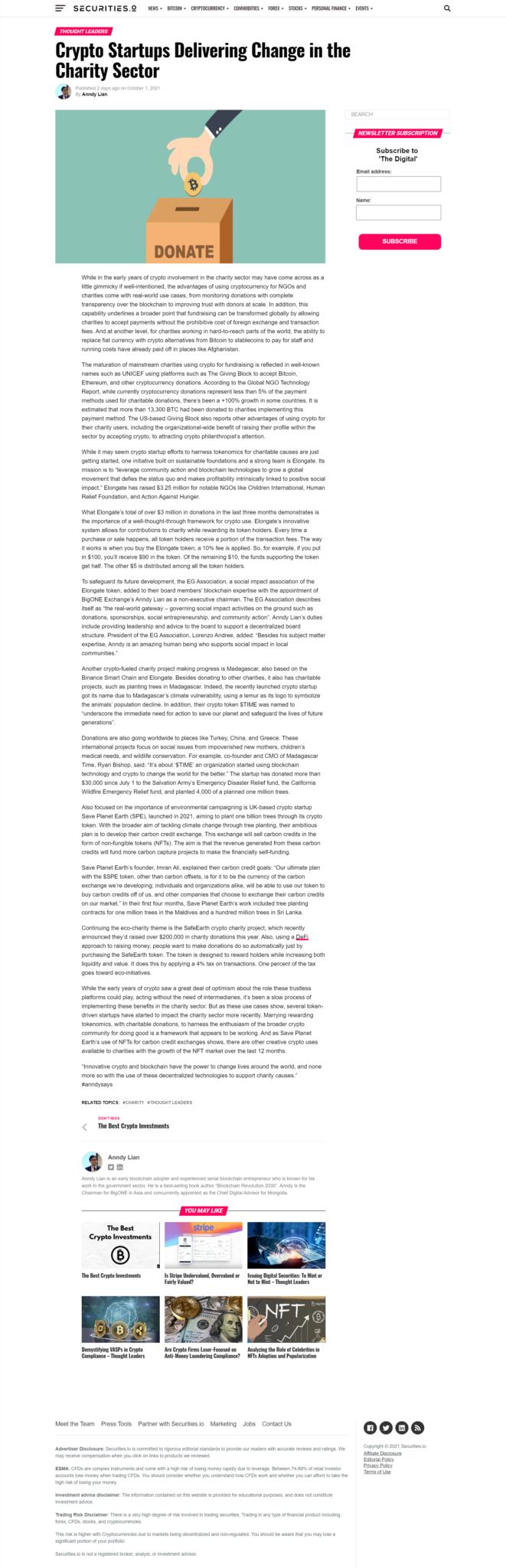
While in the early years of crypto involvement in the charity sector may have come across as a little gimmicky if well-intentioned, the advantages of using cryptocurrency for NGOs and charities come with real-world use cases, from monitoring donations with complete transparency over the blockchain to improving trust with donors at scale. In addition, this capability underlines a broader point that fundraising can be transformed globally by allowing charities to accept payments without the prohibitive cost of foreign exchange and transaction fees. And at another level, for charities working in hard-to-reach parts of the world, the ability to replace fiat currency with crypto alternatives from Bitcoin to stablecoins to pay for staff and running costs have already paid off in places like Afghanistan.

The maturation of mainstream charities using crypto for fundraising is reflected in well-known names such as UNICEF using platforms such as The Giving Block to accept Bitcoin, Ethereum, and other cryptocurrency donations. According to the Global NGO Technology Report, while currently cryptocurrency donations represent less than 5% of the payment methods used for charitable donations, there’s been a +100% growth in some countries. It is estimated that more than 13,300 BTC had been donated to charities implementing this payment method. The US-based Giving Block also reports other advantages of using crypto for their charity users, including the organizational-wide benefit of raising their profile within the sector by accepting crypto to attract crypto philanthropist’s attention.

While it may seem crypto startup efforts to harness tokenomics for charitable causes are just getting started, one initiative built on sustainable foundations and a strong team is Elongate. Its mission is to “leverage community action and blockchain technologies to grow a global movement that defies the status quo and makes profitability intrinsically linked to positive social impact.” Elongate has raised $3.25 million for notable NGOs like Children International, Human Relief Foundation, and Action Against Hunger. While just recently, it announced a seed donation to the Malala Fund, a fund “dedicated to working for a world where every girl can learn and lead.” Moving into its next phase of growth, Elongate in July announced a partnership with The Giving Block, intending to educate charities “about the untapped potential of cryptocurrency projects in creating social impact enabled by blockchain technologies”.

What Elongate’s total of over $3 million in donations in the last three months demonstrates is the importance of a well-thought-through framework for crypto use. Elongate’s system allows for both significant contributions to charity while rewarding its token holders a percentage of every transaction that occurs. Every time a purchase or sale happens, all existing token holders receive a portion of the transaction fees. The way it works is when you buy the Elongate token; a 10% fee is applied. So, for example, if you put in $100, you’ll receive $90 in the token. Of the remaining $10, the funds supporting the token get half. The other $5 is distributed among all the token holders. In other words, as you hold Elongate tokens, you earn the rewards from all other transactions.

As well as enabling individual donations and leveraging community action Elongate is soon to roll out a charity and consumer management platform, which it claims will be a first-of-its-kind marketplace that will bring together charities with organizations and individuals. “This platform will allow enterprises, consumers, and charities to receive, transfer and manage funds and donations in a transparent way. Donations or funds (BTC, BNB, and others) will be able to get traced to a specific project or person, for full transparency and accountability,” the charity confirmed. From the whitepaper, it’s clear their vision “to forge a revolutionary social impact ecosystem on the blockchain” doesn’t stop there. By buying Elongate tokens, members can vote on which projects to donate to using a community vote platform.

To safeguard its future development, the EG Association, a social impact association of the Elongate token, added to their board members’ blockchain expertise with the appointment of BigONE Exchange’s Anndy Lian as a non-executive chairman. The EG Association describes itself as “the real-world gateway – governing social impact activities on the ground such as donations, sponsorships, social entrepreneurship, and community action”. Anndy Lian’s duties include providing leadership and advice to the board to support a decentralized board structure. President of the EG Association, Lorenzo Andree, added: “Besides his subject matter expertise, Anndy is an amazing human being who supports social impact in local communities.”

Another crypto-fueled charity project making progress is Madagascar, also based on the Binance Smart Chain and Elongate. Besides donating to other charities, it also has charitable projects, such as planting trees in Madagascar. Indeed, the recently launched crypto startup got its name due to Madagascar’s climate vulnerability, using a lemur as its logo to symbolize the animals’ population decline. In addition, their crypto token $TIME was named to “underscore the immediate need for action to save our planet and safeguard the lives of future generations”.

The Madagascar team has set a goal to drive positive change while providing entertainment and games for its users. The current $TIME app is called “Spin the Wheel and Match Cards,” the first step for the planned casino. With plans to create games around lemur based NFT avatars that can be bought and traded to raise money for charity.

Donations are also going worldwide to places like Turkey, China, and Greece. These international projects focus on social issues from impoverished new mothers, children’s medical needs, and wildlife conservation. For example, co-founder and CMO of Madagascar Time, Ryan Bishop, said: “It’s about ‘$TIME’ an organization started using blockchain technology and crypto to change the world for the better.” The startup has donated more than $30,000 since July 1 to the Salvation Army’s Emergency Disaster Relief fund, the California Wildfire Emergency Relief fund, and planted 4,000 of a planned 1 million trees.

With a similar tokenomics to Elongate, the Madagascar team uses crypto for fundraising and enables token holders to raise funds as they trade. As outlined in the startup’s whitepaper: “Our crypto-project goal regarding the process of raising funds is making a bridge between a large stream of money and NGO’s/initiatives that need that money. So on one side, we have our investors who agreed when they traded our token that 2% goes to charity, and on the other side, we have different sorts of organizations we are going to fund with ‘charity wallet’ money.”

Also focused on the importance of environmental campaigning is UK-based crypto startup Save Planet Earth (SPE), launched in 2021, aiming to plant one billion trees through its crypto token. With the broader aim of tackling climate change through tree planting, their ambitious plan is to develop their carbon credit exchange. This exchange will sell carbon credits in the form of non-fungible tokens (NFTs). The aim is that the revenue generated from these carbon credits will fund more carbon capture projects to make the financially self-funding.

Save Planet Earth’s founder, Imran Ali, explained their carbon credit goals: “Our ultimate plan with the $SPE token, other than carbon offsets, is for it to be the currency of the carbon exchange we’re developing; individuals and organizations alike, will be able to use our token to buy carbon credits off of us, and other companies that choose to exchange their carbon credits on our market.” In their first four months, Save Planet Earth included tree planting contracts for one million trees in the Maldives and a hundred million trees in Sri Lanka, partnership with governments and NGOs.

Continuing the eco-charity theme is the SafeEarth crypto charity project, which recently announced they’d raised over $200,000 in charity donations this year. Also, using a DeFi approach to raising money, people want to do so by buying the SafeEarth token. The token is designed to reward holders while increasing both liquidity and value. It does this by applying a 4% tax on transactions. One percent of the tax goes toward eco-initiatives.

In addition, through this token, each holder is given a chance to vote on upcoming charitable incentives, with the charity with the most votes receiving the donations. Current charities supported range from The Ocean Cleanup, which aims to clean up the Great Pacific Garbage Patch and reduce the chances of more plastic waste entering the oceans by capturing them from rivers globally. In addition, the Water Project offers financial support and training to people in sub-Saharan Africa to build their water supply and purification systems.

As a part of SafeEarth’s plan to raise awareness for ecological causes, they’ve also started a #PlasticChallenge on Twitter, urging people to eliminate plastic waste. The challenge launched earlier this year rewards users from a prize pool of $3,600 in SafeEarth tokens. Since the challenge began, the startup reported, “the SafeEarth token has been listed on the number one DEX Uniswap, recorded $3 million in trading volume and locked away more than $1.5 million in liquidity”. Other milestones for Q3 include staking and mining, achieving listings on mainstream crypto exchanges, and developing the SafeEarth ecosystem.

While the early years of crypto saw a great deal of optimism about the role these trustless platforms could play, acting without the need of intermediaries, it’s been a slow process of implementing these benefits in the charity sector. But as these use cases show, several token-driven startups have started to impact the charity sector more recently. Marrying tokenomics with donations to harness the enthusiasm of the broader crypto community for doing good is a framework that appears to be working. While Save Planet Earth’s use of NFTs for carbon credit exchanges shows, there are other creative crypto uses available to charities with the growth of the NFT market over the last 12 months.

“Innovative crypto and blockchain have the power to change lives around the world, and none more so with the use of these decentralized technologies to support charity causes.” #anndysays


Shorten version: https://www.securities.io/crypto-startups-delivering-change-in-the-charity-sector/

Anndy Lian is an early blockchain adopter and experienced serial entrepreneur who is known for his work in the government sector. He is a best selling book author- “NFT: From Zero to Hero” and “Blockchain Revolution 2030”.

Currently, he is appointed as the Chief Digital Advisor at Mongolia Productivity Organization, championing national digitization. Prior to his current appointments, he was the Chairman of BigONE Exchange, a global top 30 ranked crypto spot exchange and was also the Advisory Board Member for Hyundai DAC, the blockchain arm of South Korea’s largest car manufacturer Hyundai Motor Group. Lian played a pivotal role as the Blockchain Advisor for Asian Productivity Organisation (APO), an intergovernmental organization committed to improving productivity in the Asia-Pacific region.

An avid supporter of incubating start-ups, Anndy has also been a private investor for the past eight years. With a growth investment mindset, Anndy strategically demonstrates this in the companies he chooses to be involved with. He believes that what he is doing through blockchain technology currently will revolutionise and redefine traditional businesses. He also believes that the blockchain industry has to be “redecentralised”.

j j j

Hackernoon Meet the Writer Anndy Lian: “Let’s work together to make crypto better”

Hackernoon Meet the Writer Anndy Lian: “Let’s work together to make crypto better”

This story is a part of Hacker Noon’s Meet the Writer series of interviews. The series is intended for tech professionals contributing the most insightful Hacker Noon stories to share more about their writing habits, ideas, and professional background (and maybe a hobby or two).

If you too would like to start contributing to Hacker Noon, you can do so here.


So let’s start! Tell us a bit about yourself. For example, name, profession, and personal interests.

My name is Anndy. I’m a business strategist and experienced serial entrepreneur with over 15 years of experience in Asia. I’ve worked in various industries for local, international, and publicly traded companies. I am currently Chairman of BigONE Exchange and Chief Digital Advisor at the Mongolian Productivity Organisation.

I’ve also written a best-selling book titled “Blockchain Revolution 2030”. With my co-authors, we share insights on how blockchain technology plays an important foundation for the Fourth Industrial Revolution.

I recently joined the EG Association, a social impact-driven organization that aims to use cryptocurrency to do good. To date, we have deployed more than $3 million supporting social impact initiatives on the ground.


Interesting! What was your latest Hackernoon Top story about?

My recent article focused on the rise of so-called reflective tokens, which are starting to be used more and more by crypto startups, such as SafeMoon. The tokenomics model differs significantly from that of other DeFi tokens. In simple terms it works by automatically charging a tax, which is usually 10% on each transaction.

The reflection mechanism is a relatively new concept in cryptocurrency circles, and it still requires a lot of fine-tuning before it can be widely adopted by other projects. However, in principle, it reduces panic selling to a bare minimum, which could be significant for the DeFi industry.


Do you usually write on similar topics? If not, what do you usually write about?

I think it’s important to write about the diversity of subjects in the blockchain and crypto industry, as it’s a sector that growing so quickly and with a lot of opportunities. I’m fascinated about ‘connecting the dots’ between business and technology, a great example being the use of DeFi and NFTs in developing an open metaverse.


Great! What is your usual writing routine like (if you have one?)

Before starting to write I believe it’s important to have a routine for reading each day. I try to find time to catch up with the main news headlines, as well as the main crypto news sites like Cointelegraph. Then when I come to writing I find that reading helps make my articles both accessible and valuable. I also get my inspiration from the governments that I am advising, their problems and questions become part of my writing content too.


Being a writer in tech can be a challenge. It’s not often our main role, but an addition to another one. What is the biggest challenge you have when it comes to writing?

The challenge is often one of translation, explaining technical details around say a new form of tokenomics to an interested but non-technical audience such as crypto investors.


What is the next thing you hope to achieve in your career?

I want to share the right kind of crypto knowledge with people. Right now many of the people I see in various communities are not being real. Some of them want their government to be decentralized, others want to be rich overnight by doing nothing, then some others are just here to create FUDs. If proper information is being shared and the users are aware of what is really happening, such ‘behaviours’ would be minimised.

Maybe this is not a career goal, it is more like an industry-wide goal that I set for myself.


Wow, that’s admirable. Now, something more casual: What is your guilty pleasure of choice?

Since getting grounded and not being able to travel, I have been very involved in donations and charitable works. In fact, those who know me, know that I am donating more than I spend. My guilty pleasure, for now, is walking into Hermes, buying a few pairs of shoes instead of donating. Then again, Zoom meetings did not need me to travel much, maybe a comfortable Uniqlo t-shirt would do just fine.


Do you have a non-tech-related hobby? If yes, what is it?

I enjoy travelling, meeting new people from all walks of life, and sharing ideas.


What can the Hacker Noon community expect to read from you next?

I’m always on the lookout for new topics in crypto and blockchain that illuminate and inspire my readers! I might be talking more about metaverse and gameFI. Let’s see.


#Thanks for taking the time to join our “Meet the writer” series. It was a pleasure. Do you have any closing words?

“The time is always right to do the right things.” I hope to gather more like-minded people to do that together for the crypto industry. Let’s work together to make crypto better!

Lastly, it’s great to join the Hacker Noon community and to share my writing on crypto and blockchain.


Original Source: https://hackernoon.com/meet-the-writer-anndy-lian-lets-work-together-to-make-crypto-better

Anndy Lian is an early blockchain adopter and experienced serial entrepreneur who is known for his work in the government sector. He is a best selling book author- “NFT: From Zero to Hero” and “Blockchain Revolution 2030”.

Currently, he is appointed as the Chief Digital Advisor at Mongolia Productivity Organization, championing national digitization. Prior to his current appointments, he was the Chairman of BigONE Exchange, a global top 30 ranked crypto spot exchange and was also the Advisory Board Member for Hyundai DAC, the blockchain arm of South Korea’s largest car manufacturer Hyundai Motor Group. Lian played a pivotal role as the Blockchain Advisor for Asian Productivity Organisation (APO), an intergovernmental organization committed to improving productivity in the Asia-Pacific region.

An avid supporter of incubating start-ups, Anndy has also been a private investor for the past eight years. With a growth investment mindset, Anndy strategically demonstrates this in the companies he chooses to be involved with. He believes that what he is doing through blockchain technology currently will revolutionise and redefine traditional businesses. He also believes that the blockchain industry has to be “redecentralised”.
j j j