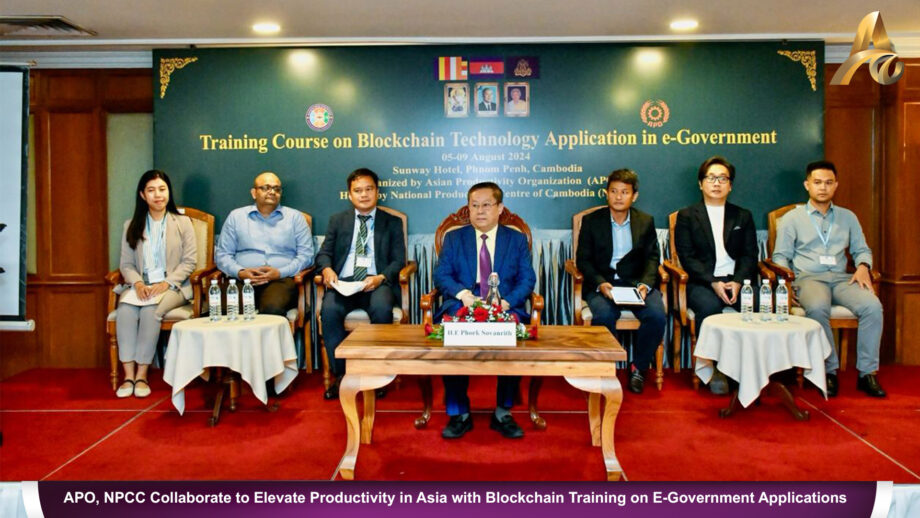
APO, NPCC Collaborate to Elevate Productivity in Asia with Blockchain Training on E-Government Applications

APO, NPCC Collaborate to Elevate Productivity in Asia with Blockchain Training on E-Government Applications

PHNOM PENH: The Asian Productivity Organization (APO) and the National Productivity Center (NPCC) of MISTI are co-hosting a training program on Blockchain Technology Application in e-Government from August 5-9, 2024, in Phnom Penh, aimed at enhancing productivity in the Asian region.

The event, presided over by H.E. Phork Sovanrith, MISTI’s Secretary of State and APO Director for Cambodia, brought together productivity representatives from various countries including Cambodia, India, Indonesia, Malaysia, Pakistan, the Philippines, Sri Lanka, Thailand, Turkey, and Vietnam.

“Blockchain technology has emerged as a transformative force in various sectors, including e-government initiatives in Cambodia. Its application can significantly enhance transparency, efficiency, and security in governmental processes,” said H.E. Phork Sovanrith.

Throughout the program, productivity representatives from the region will explore the practical applications of blockchain-driven solutions in e-governance systems. The objective is to help them grasp the importance of blockchain architecture in advancing e-government initiatives and improving service delivery by public-sector organizations, ultimately enhancing the efficiency and effectiveness of e-government programs through the integration of blockchain technology.

The Asian Productivity Organization promotes productivity in the Asia-Pacific region through collaborative activities, capacity building, and knowledge sharing to enhance economic growth and development.


Source: https://eacnews.asia/home/details/31596

Anndy Lian is an early blockchain adopter and experienced serial entrepreneur who is known for his work in the government sector. He is a best selling book author- “NFT: From Zero to Hero” and “Blockchain Revolution 2030”.

Currently, he is appointed as the Chief Digital Advisor at Mongolia Productivity Organization, championing national digitization. Prior to his current appointments, he was the Chairman of BigONE Exchange, a global top 30 ranked crypto spot exchange and was also the Advisory Board Member for Hyundai DAC, the blockchain arm of South Korea’s largest car manufacturer Hyundai Motor Group. Lian played a pivotal role as the Blockchain Advisor for Asian Productivity Organisation (APO), an intergovernmental organization committed to improving productivity in the Asia-Pacific region.

An avid supporter of incubating start-ups, Anndy has also been a private investor for the past eight years. With a growth investment mindset, Anndy strategically demonstrates this in the companies he chooses to be involved with. He believes that what he is doing through blockchain technology currently will revolutionise and redefine traditional businesses. He also believes that the blockchain industry has to be “redecentralised”.

j j j

How Blockchain Technology Is Transitioning From Hype To Practical Applications: Report

How Blockchain Technology Is Transitioning From Hype To Practical Applications: Report

Blockchain technology has moved beyond its peak in the innovation hype cycle, marking a significant shift over the past two to three years, according to a new report.

Global Uncertainties Shaping Innovation

The past five years have been anything but normal, marked by the global COVID-19 pandemic and escalating armed conflicts, the report by International Association for Trusted Blockchain Applications states.

These disruptions have fundamentally reshaped industrial priorities and policy agendas, particularly in the tech and IT sectors.

The energy price hikes following Russia’s invasion of Ukraine and the subsequent disruptions to global supply chains have necessitated a complete overhaul of industrial strategies.

“Blockchain technology is not at the top of the innovation hype cycle anymore, nor has it been for the last 2–3 years,” the report notes, attributing part of this shift to the cyclical nature of the industry, driven by the Bitcoin halving cycle every four years.

The Future Of Innovation

The report emphasizes that the next decade will see entire industries either thriving or struggling amid increasing cyber-criminal attacks, industrial asset threats, and a skilled labor shortage impacting hyper-automation and hyper-acceleration.

“Exponential technologies will have to deliver a lot more than parroting chatbots or meme coins,” the report states.

It argues for a thorough assessment of technological capabilities to ensure they serve as integral components of future industrial frameworks.

Blockchain’s Practical Capabilities

Blockchain technology, according to the report, offers several key capabilities: flexible transparency options, secure automation, a rich governance toolbox, strong cryptographic building blocks and efficient settlement capabilities.

These features make blockchain particularly suitable for registry use cases and enhancing sector-wide performance through gamification and new financing options.

“Blockchain technology can gamify the key performance tableau of entire sectors and bring new financing options and processes to drive efficiency across and in between industry sectors,” the report highlights.

It also points out that blockchain can enhance the resilience of infrastructures using on-chain logic and a unified tech stack.

Anndy Lian, an intergovernmental blockchain expert, praised key initiatives like EBSICatena-X, and DIVE for their potential to revolutionize sectors from supply chain to energy.

“The emphasis on sustainability and regulatory compliance is particularly commendable,” Lian said, adding that interoperability challenges and fostering a robust ecosystem of developers and entrepreneurs are crucial for maximizing blockchain’s impact.

Basile Maire, co-founder of D8X, emphasized the significant influence of regulatory landscapes on innovation.

“The report illustrates the transformative potential of tokenized assets in financial markets,” Maire noted, highlighting D8X’s role in this transformation by offering derivatives collateralized in tokenized yield-bearing tokens.

Michael Repetny, a core contributor at Marinade, said blockchain projects are no longer in a ‘hype’ phase.

“There are a lot more practical use cases and applicability across public and private sectors,” he said. Repetny also highlighted the role of regulatory frameworks like the EU’s MiCA in fostering growth and partnerships among blockchain projects,” he said.

Blockchain In Finance

The report underscores that blockchain has already made significant inroads into the heavily regulated finance sector.

It argues that the coming decade of exponential technologies will offer more financial leverage options, not fewer.

“It is not an echo of Silicon Valley’s techno-optimism – but if we extrapolate the trend of technological breakthroughs at various fronts, the demographic erosion of our educated workforces in the first world and our tumbling democratic foundation, then innovation is a must, not an option,” the report states.


Source: https://www.benzinga.com/markets/cryptocurrency/24/07/39891731/how-blockchain-technology-is-transitioning-from-hype-to-practical-applications-report

Anndy Lian is an early blockchain adopter and experienced serial entrepreneur who is known for his work in the government sector. He is a best selling book author- “NFT: From Zero to Hero” and “Blockchain Revolution 2030”.

Currently, he is appointed as the Chief Digital Advisor at Mongolia Productivity Organization, championing national digitization. Prior to his current appointments, he was the Chairman of BigONE Exchange, a global top 30 ranked crypto spot exchange and was also the Advisory Board Member for Hyundai DAC, the blockchain arm of South Korea’s largest car manufacturer Hyundai Motor Group. Lian played a pivotal role as the Blockchain Advisor for Asian Productivity Organisation (APO), an intergovernmental organization committed to improving productivity in the Asia-Pacific region.

An avid supporter of incubating start-ups, Anndy has also been a private investor for the past eight years. With a growth investment mindset, Anndy strategically demonstrates this in the companies he chooses to be involved with. He believes that what he is doing through blockchain technology currently will revolutionise and redefine traditional businesses. He also believes that the blockchain industry has to be “redecentralised”.

j j j

Consequences and Impacts of Blockchain Based Databases on Efficiency and Service Delivery | Turkey

Consequences and Impacts of Blockchain Based Databases on Efficiency and Service Delivery | Turkey

Blockchain technology has been a topic of great interest and discussion across various industries. Its potential to revolutionize efficiency and service delivery has captured the attention of many experts and professionals. In this article, we will explore some intriguing case studies and delve into the impact of blockchain databases on various sectors, highlighting the benefits it can offer in terms of streamlining processes and enhancing overall efficiency.

The Potential of Blockchain Technology
Blockchain technology, often associated with cryptocurrencies like Bitcoin, is a decentralized and immutable digital ledger. It offers a secure and transparent way of recording transactions, making it ideal for various applications beyond cryptocurrencies. The main keyword for this article, “blockchain technology,” will be emphasized to enhance its SEO-friendly aspect.

Blockchain’s Impact on Efficiency and Service Delivery
When it comes to efficiency and service delivery, blockchain technology holds immense potential. Let’s explore some case studies that exemplify how blockchain has transformed processes in different sectors:

Case Study 1: Smart Incorporation with Blockchain in Delaware
In this case study, the US state of Delaware is in the early stages of developing incorporation services on a blockchain-based smart contract system, replacing traditional paper-based processes. This digital approach streamlines the incorporation process, from filing documentation to legal structure, issuing shares, and conducting annual general meetings. By leveraging blockchain technology, the entire process becomes more efficient, reducing the time taken and eliminating manual interventions.

Case Study 2: Venezuela’s Petrol – The First Digital Currency
Venezuela took a groundbreaking step by introducing “petrol,” its digital currency, backed by its vast oil reserves. This move aimed to combat economic challenges, hyperinflation, and depreciation of the national currency. By employing blockchain technology to support the digital currency, Venezuela has enhanced the security and traceability of financial transactions. This has instilled confidence in the platform and stabilized the economy, paving the way for further innovations.

Case Study 3: E-Voting in Denmark
Denmark embraced blockchain technology to revolutionize its electoral process. By using blockchain for e-voting, Denmark introduced a transparent and tamper-proof system that ensures accurate voting results. This move fosters inclusiveness and accessibility, encouraging citizens to actively participate in the democratic process. The implementation aligns with the nation’s commitment to digital innovation and enhances the overall integrity of the election framework.

The Key to Success: Probing, Prioritizing, and Partnering
To harness the full potential of blockchain technology, governments and organizations must adopt a systematic approach:

Probing: Set up a dedicated team to review potential use cases for blockchain technology. The team should assess processes that can benefit from blockchain implementation and focus on areas where immediate and meaningful results can be achieved.

Prioritizing: Identify use cases with the greatest potential for positive impact and prioritize them for implementation. Start with smaller pilot trials to assess the feasibility and benefits before embarking on more extensive projects.

Partnering: Collaboration with the right technology partners is crucial. Seek partners who can provide expertise in blockchain development, technical standards, integration, and collaboration. This will ensure a comprehensive and successful blockchain implementation.

Embracing the Future
In conclusion, blockchain technology holds enormous potential to reshape efficiency and service delivery across various sectors. As we continue to explore and innovate with this technology, we must approach it with a strategic mindset, focusing on meaningful implementations and fostering collaboration between public and private sectors. By doing so, we can unlock the true potential of blockchain and drive positive change for our economies and societies.

This video is part of a consultation session on “Technical Expert Service on Improvement of Public Sector Efficiency Using Blockchain-based Database” by Anndy Lian. The implementing organizations include the Ministry of Industry and Technology of Turkiye and the Asian Productivity Organization. The event was held in Ankara and Bolu, Turkiye, from 4–7 July 2023.

Anndy Lian is an early blockchain adopter and experienced serial entrepreneur who is known for his work in the government sector. He is a best selling book author- “NFT: From Zero to Hero” and “Blockchain Revolution 2030”.

Currently, he is appointed as the Chief Digital Advisor at Mongolia Productivity Organization, championing national digitization. Prior to his current appointments, he was the Chairman of BigONE Exchange, a global top 30 ranked crypto spot exchange and was also the Advisory Board Member for Hyundai DAC, the blockchain arm of South Korea’s largest car manufacturer Hyundai Motor Group. Lian played a pivotal role as the Blockchain Advisor for Asian Productivity Organisation (APO), an intergovernmental organization committed to improving productivity in the Asia-Pacific region.

An avid supporter of incubating start-ups, Anndy has also been a private investor for the past eight years. With a growth investment mindset, Anndy strategically demonstrates this in the companies he chooses to be involved with. He believes that what he is doing through blockchain technology currently will revolutionise and redefine traditional businesses. He also believes that the blockchain industry has to be “redecentralised”.

j j j