Altcoin season 2.0: Smaller rallies, bigger fundamentals, better returns

Altcoin season 2.0: Smaller rallies, bigger fundamentals, better returns

The altcoin season we once knew, characterised by euphoric, indiscriminate rallies where virtually every token surged in unison with Bitcoin, is fading into memory. What is emerging in its place is something more deliberate, more strategic, and ultimately more sustainable: a new paradigm of altcoin performance driven not by blanket speculation but by thematic narratives, institutional validation, and a growing emphasis on actual utility. This evolution reflects the broader maturation of the cryptocurrency market, which no longer behaves like a frontier casino but increasingly resembles a structured, albeit still volatile, asset class.

One of the most significant forces behind this transformation is the steady influx of institutional capital. The approval and success of spot Bitcoin and Ethereum ETFs have opened the floodgates for passive investment vehicles that cater to traditional finance participants. These institutions favour liquid, well-audited, and compliant assets, which inherently tilts capital allocation toward the top of the market cap hierarchy.

Consequently, the days of obscure tokens with no product suddenly multiplying in value alongside market leaders appear to be waning. Instead, capital pools within established ecosystems or flows selectively into emerging projects that demonstrate real-world applicability, sound tokenomics, and regulatory awareness. The result is a market that rewards substance over noise.

This selectivity is further reinforced by the rise of narrative-driven cycles. Rather than chasing every new listing or fork, investors now move in thematic waves, rotating capital among tightly defined cohorts of assets that align with a compelling macro or technological storyline. Artificial intelligence stands as one of the most dominant narratives today.

Projects that integrate AI with blockchain infrastructure, not merely by slapping the label AI onto a whitepaper but by creating verifiable on-chain intelligence layers, decentralised model training, or data oracle networks, are capturing serious attention. The convergence of two of the most transformative technologies of our era creates a fertile ground for innovation, and capital follows where genuine synergy exists.

Meanwhile, DeFi continues to evolve beyond its initial boom-and-bust phases, with restaking emerging as a critical innovation. Protocols like EigenLayer have introduced mechanisms that allow staked ETH to secure additional services, dramatically increasing capital efficiency and creating new yield layers without issuing more tokens. This concept, leveraging existing trust assumptions to underwrite novel services, represents a sophisticated approach to value accrual. Investors now look not just at TVL or APY but at how protocols reuse and compound security, aligning incentives across multiple layers of the stack. Such depth was absent in earlier cycles and explains why today’s DeFi rallies are more targeted and technically nuanced.

Scalability remains a foundational driver as well. Layer-1 and Layer-2 ecosystems such as Solana, Avalanche, and Base have matured to the point where they can support complex applications at low cost and high speed. These networks are no longer just Ethereum competitors. They are thriving ecosystems with their own developer communities, user bases, and economic models. The performance of their native tokens often correlates with actual usage metrics, daily active addresses, transaction volumes, and stablecoin activity, rather than vague promises. As users and developers gravitate toward chains that deliver consistent performance, speculative interest follows, but with a stronger tether to fundamentals.

Of course, meme coins still play a role, but their function has shifted. They no longer lead the market. Instead, they punctuate it. Their rallies tend to be short, intense bursts that coincide with peaks in retail enthusiasm and broader market optimism. These episodes act as sentiment indicators rather than investment theses. When meme coins surge across the board, it often signals that retail FOMO has reached a fever pitch, a useful warning for more disciplined investors. In this evolved altcoin season, meme activity is tolerated as a cyclical release valve rather than a core strategy.

Crucially, the mechanics of liquidity have also changed. In past cycles, altcoins largely moved in the wake of Bitcoin, as traders sold BTC to rotate into smaller-cap assets. Today, stablecoins serve as the primary on-ramp and liquidity reservoir. Traders and institutions can deploy capital directly into altcoins using USDC or USDT pairs, bypassing Bitcoin entirely. This decoupling allows for more independent price action and enables narrative-specific rallies to occur without waiting for a Bitcoin top or pullback. It also means that altcoin performance is less a derivative of BTC momentum and more a function of its own fundamentals and market positioning.

Regulatory developments further shape this new landscape. While global crypto regulation remains fragmented, the direction of travel in major markets like the United States and the European Union is toward clearer frameworks. The potential approval of Ethereum spot ETFs and the ongoing discussions around regulating token sales, custody, and DeFi protocols signal a path toward legitimacy. Even cautious progress reduces uncertainty, encouraging institutional players to explore altcoins with stronger compliance postures or those that operate within regulatory grey zones that are steadily being clarified. This contrasts sharply with earlier cycles, where regulatory ambiguity often acted as a barrier rather than a catalyst.

All these forces converge to suggest that the next wave of altcoin outperformance will be highly selective. Investors can no longer rely on broad market beta to carry low-quality assets upward. Instead, success will require deep research, an understanding of technological differentiation, and the ability to map narratives to real adoption metrics. The market is rewarding projects that solve tangible problems, whether through scalable infrastructure, novel financial primitives, or bridges to traditional economies, while punishing those that offer nothing beyond hype or nostalgia.

This shift represents a healthy maturation. It may reduce the number of 100x opportunities available to casual participants, but it also increases the resilience and credibility of the entire ecosystem. Altcoins are no longer just speculative instruments. They are becoming the building blocks of a new financial architecture. In this context, the altcoin season is not dead. It has simply grown up. And those who understand the new rules of engagement will be best positioned to navigate its evolving contours.


Source: https://e27.co/altcoin-season-2-0-smaller-rallies-bigger-fundamentals-better-returns-20260105/


 

Anndy Lian is an early blockchain adopter and experienced serial entrepreneur who is known for his work in the government sector. He is a best selling book author- “NFT: From Zero to Hero” and “Blockchain Revolution 2030”.

Currently, he is appointed as the Chief Digital Advisor at Mongolia Productivity Organization, championing national digitization. Prior to his current appointments, he was the Chairman of BigONE Exchange, a global top 30 ranked crypto spot exchange and was also the Advisory Board Member for Hyundai DAC, the blockchain arm of South Korea’s largest car manufacturer Hyundai Motor Group. Lian played a pivotal role as the Blockchain Advisor for Asian Productivity Organisation (APO), an intergovernmental organization committed to improving productivity in the Asia-Pacific region.

An avid supporter of incubating start-ups, Anndy has also been a private investor for the past eight years. With a growth investment mindset, Anndy strategically demonstrates this in the companies he chooses to be involved with. He believes that what he is doing through blockchain technology currently will revolutionise and redefine traditional businesses. He also believes that the blockchain industry has to be “redecentralised”.

j j j

Bitcoin is Bigger in Asia with U.S. Supply Dropping 11% This Year

Bitcoin is Bigger in Asia with U.S. Supply Dropping 11% This Year

According to on-chain data, Asia has surpassed the United States in terms of active capital in Bitcoin and crypto markets.

Glassnode, an on-chain analytics service, announced on June 5 that the gap between US and Asia Bitcoin supplies held or transacted had grown.


According to Glassnode, the year-over-year change in BTC supply by geographical region shows a notable disparity. The US entities’ extreme dominance in 2020-21 has obviously reversed, with US supply dominance declining by 11% since mid-2022. Also, over the last year, European markets have been rather neutral, whereas Asian trading hours have seen a major increase in supply dominance.

The gap has grown wider as America becomes more hostile to Bitcoin and overall cryptocurrency sector while Asia opens up. “This is a distinct reversal from the 2020-21 bull cycle,” Glassnode observed.

The United States’ supremacy began to decline in 2021 and switched negative in mid-2022. This occurred at the same time as the Terra/Luna ecology collapsed and regulatory pressure increased. Since then, the government and federal officials have been on a mission to put an end to the industry through regulatory action.

Glassnode also noticed significant changes in stablecoin supply. Since the beginning of the year, the aggregate stablecoin supply from the top five issuers has decreased by 7.5%, or $10 billion.

A substantial chunk of this fall can be attributed to Circle’s USDC, which was once favored by US financial institutions. In 2023, the USDC supply has fallen by $15.7 billion, or 35%. Circle was also severely harmed as a result of its exposure to the now-defunct Silicon Valley Bank.

Why Is Southeast Asia a Crypto-Friendly Region?

Although cryptocurrency may have started in the G7 (if presumed that Satoshi Nakamoto is Japanese), underdeveloped countries have often been the most enthusiastic about adopting decentralized virtual currencies. The explanation is simple: the promise of financial democratization offered by cryptocurrency has a tremendous appeal in nations where huge segments of the population lack access to key banking services.

It is no coincidence that Asia’s two greatest developing countries, China and India, have imposed severe sanctions on cryptocurrency while rising Southeast Asia has not. Approximately 80% of individuals in both nations have bank accounts.

In comparison, up to 70% of Vietnamese, 66% of Indonesians, and 44% of Filipinos are unbanked. Regulators in these countries are, predictably, slower to restrict access to cryptocurrencies than their colleagues in China and India.

Also, this month, Hong Kong began enabling exchanges to facilitate trading, while in the West, legal proceedings against key exchanges in the United States represented a watershed moment for the industry.

Brian Armstrong, CEO of Coinbase, one of the targets of the SECs legal action, cautioned in an opinion article for MarketWatch that weak regulation would harm the United States.

“In the 1990s and early 2000s, smart—and tailored—regulation enabled the United States to define the Internet Age,” he wrote.

Regarding Hong Kong, Armstrong stated that China’s drive for the crypto story was “no surprise.”

Be it as it may,  some people familiar with the situation believe that US regulatory action against two big cryptocurrency exchanges, Coinbase and Binance, may serve as a model for Hong Kong and Singapore as they seek to combine expansion with investor safety.

The revelation has rattled investor confidence just as Hong Kong is attempting to position itself as a trading hub alongside Singapore, which already has such a framework in place.

US Actions May Be Used as Point of Reference

According to experts, the two cities may use the US action as a reference point, which might mean greater inspection of Bitcoin and crypto trades in Asia.

Anndy Lian, Singapore-based author of the book “NFT: From Zero to Hero” said that there would be a fallout for sure.

“Hong Kong and Singapore are taking measures to regulate the cryptocurrency industry by proposing new licensing regimes for virtual asset trading platforms,” he said .

The Securities and Futures Commission (SFC) in Hong Kong has asked for an evaluation of a proposal that would urge crypto trading platform operators to get the same licenses as securities traders.

According to Lian, other firms that were not applying had been asked to prepare for an orderly closure as well.

Securities, unlike other financial assets, are heavily regulated and require extensive disclosures to notify investors of potential dangers.

“These developments indicate that cryptocurrency exchanges seeking approval in Hong Kong and Singapore will have to adhere to new regulatory requirements and may be subject to increased scrutiny from regulators,” Lian concluded.

Julian Hosp, the CEO and co-founder of Cake Group, a fast-growing Southeast Asia’s digital assets innovator, asserted that the war that the US is waging on cryptocurrencies “shows no signs of abating, and it will only intensify as time wears on.”

He went on to say that the regulator’s action is part of a bigger trend that would most likely continue through the 2024 presidential election.

Rajagopal Menon, vice-president of WazirX stressed that the SEC’s lawsuit primarily focuses on actions that have taken place in the United States and their impact on American citizens. However, he warned that for regulators in Hong Kong, such as the Securities and Futures Commission, and Dubai’s Virtual Asset Regulatory Authority, the SEC’s lawsuit could serve as a point of reference or information.


Source: https://www.ccn.com/bitcoin-is-bigger-in-asia-than-us/

Anndy Lian is an early blockchain adopter and experienced serial entrepreneur who is known for his work in the government sector. He is a best selling book author- “NFT: From Zero to Hero” and “Blockchain Revolution 2030”.

Currently, he is appointed as the Chief Digital Advisor at Mongolia Productivity Organization, championing national digitization. Prior to his current appointments, he was the Chairman of BigONE Exchange, a global top 30 ranked crypto spot exchange and was also the Advisory Board Member for Hyundai DAC, the blockchain arm of South Korea’s largest car manufacturer Hyundai Motor Group. Lian played a pivotal role as the Blockchain Advisor for Asian Productivity Organisation (APO), an intergovernmental organization committed to improving productivity in the Asia-Pacific region.

An avid supporter of incubating start-ups, Anndy has also been a private investor for the past eight years. With a growth investment mindset, Anndy strategically demonstrates this in the companies he chooses to be involved with. He believes that what he is doing through blockchain technology currently will revolutionise and redefine traditional businesses. He also believes that the blockchain industry has to be “redecentralised”.

j j j

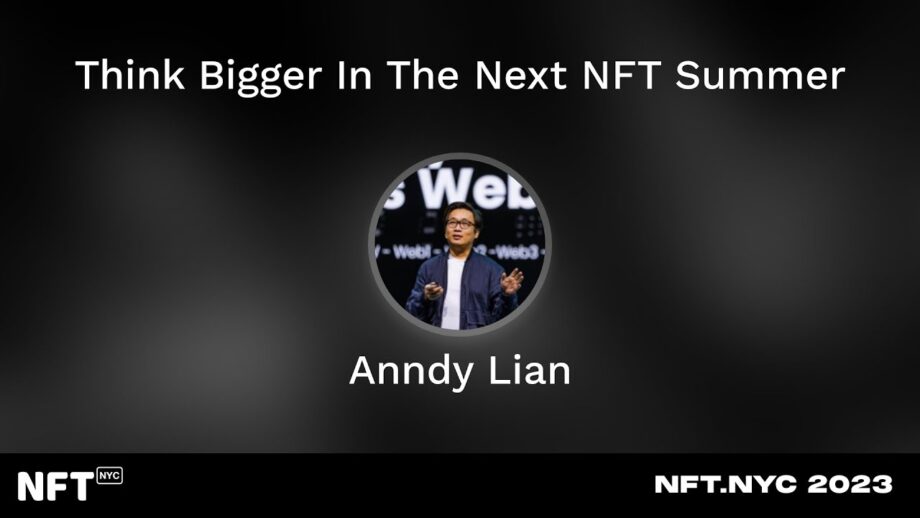
Think Bigger In The Next NFT Summer – Anndy Lian at NFT NYC 2023

Think Bigger In The Next NFT Summer – Anndy Lian at NFT NYC 2023

In the realm of NFTs (non-fungible tokens), it is crucial to think beyond mere speculation and embrace a more sustainable and innovative approach. Anndy Lian delves into the transformative power of NFTs and highlights the paradigm shift being witnessed in the industry. As big brands increasingly recognize the immense opportunities presented by NFTs, it is essential for crypto natives to think even bigger and contribute to the growth and long-term viability of this emerging sector.

Thinking Beyond Speculation:
While NFTs have garnered attention for their speculative nature, moving away from the short-term mindset and considering their broader implications is vital. Currently, the focus is on the price and potential financial gains of NFTs. However, NFTs should be viewed as a technology that can address specific needs and create new possibilities to truly unlock their value.

Leveraging the Power of Big Brands:
Prominent brands such as Gucci, Porsche, Starbucks, Amazon, and Red Bull have embraced NFTs as an opportunity to enhance engagement with their communities and promote the adoption of Web3 technology. These forward-thinking brands are not merely selling NFTs for quick profits but are instead investing in the future. By leveraging their influence and credibility, they are elevating the crypto industry and driving mainstream acceptance.

The Lessons from Tech Visionaries:
Historically, visionaries like Bill Gates and Jack Ma have foreseen the transformative potential of emerging technologies. Although initially met with skepticism, their predictions about the internet and e-commerce have become a reality. Similarly, the integration of NFTs into the strategies of major brands today signifies a shift towards a future where NFTs serve a purpose beyond speculation.

Seizing Opportunities for Growth:
Crypto natives must not lag behind in this rapidly evolving landscape. It is imperative to think bigger, demonstrate sustainability, and exhibit the true potential of NFTs. By showcasing the value and utility of NFTs, both in the Web3 and Web2 domains, crypto natives can prove their commitment to driving lasting change.

Embracing Innovation:
NFTs possess the power to transform various sectors, ranging from art and collectibles to membership programs and decentralized finance. However, it is crucial not to saturate the market by applying NFTs indiscriminately. Instead, identifying the inherent value in each asset and creating meaningful connections between the physical and digital realms will pave the way for a prosperous future.

Digital Assets as Catalysts for Change:
In the quest for a sustainable and interconnected world, NFTs emerge as revolutionary digital assets. By embracing this paradigm shift collectively, we have the potential to reshape industries, challenge traditional notions of value, and make a positive impact on a global scale. The journey towards a fully integrated Web3 experience may take time, but the transformation will be significant.

Conclusion:
As NFTs evolve beyond speculation and embrace a more sustainable approach, the importance of forward-thinking individuals and communities cannot be overstated. By thinking big and aligning with the vision of major brands, crypto natives can contribute to the growth and long-term success of NFTs. The future holds tremendous potential for innovative use cases and the integration of Web3 technology, and it is up to us to seize this opportunity and drive change. Together, we can revolutionize industries and establish NFTs as a catalyst for a more interconnected and prosperous future.

Anndy Lian is an intergovernmental blockchain expert. His recent book- NFT: From Zero to Hero, highlighted the core application of NFT technologies.

NFT NYC 2023 is one of the most highly anticipated events in the NFT space. With over 6,000 attendees, 1,500 speakers, and 500 brands, the conference provided a space for people to connect, debate, and learn

The original source of the video is from NFT.NYC official youtube channel: https://youtu.be/B00bpG_ovl4.

Anndy has also written a full article on how he sees big brands integrating with web3 at this link: https://cryptoslate.com/nfts-and-big-brands-exploring-new-possibilities/

Socials:

Facebook: http://www.facebook.com/anndylian
Twitter: http://www.twitter.com/anndylian
Instagram: http://www.instagram.com/liananndy
LinkedIn: https://www.linkedin.com/in/anndylian/
Homepage: http://www.anndy.com
YouTube: https://www.youtube.com/@AnndyLian

Anndy Lian is an early blockchain adopter and experienced serial entrepreneur who is known for his work in the government sector. He is a best selling book author- “NFT: From Zero to Hero” and “Blockchain Revolution 2030”.

Currently, he is appointed as the Chief Digital Advisor at Mongolia Productivity Organization, championing national digitization. Prior to his current appointments, he was the Chairman of BigONE Exchange, a global top 30 ranked crypto spot exchange and was also the Advisory Board Member for Hyundai DAC, the blockchain arm of South Korea’s largest car manufacturer Hyundai Motor Group. Lian played a pivotal role as the Blockchain Advisor for Asian Productivity Organisation (APO), an intergovernmental organization committed to improving productivity in the Asia-Pacific region.

An avid supporter of incubating start-ups, Anndy has also been a private investor for the past eight years. With a growth investment mindset, Anndy strategically demonstrates this in the companies he chooses to be involved with. He believes that what he is doing through blockchain technology currently will revolutionise and redefine traditional businesses. He also believes that the blockchain industry has to be “redecentralised”.

j j j