Session 2: Blockchain: Architecture and Platforms by Anndy Lian

Session 2: Blockchain: Architecture and Platforms by Anndy Lian

Anndy Lian, a renowned business strategist and blockchain expert, led a captivating training session for the Asian Productivity Organization (APO) and the National Productivity Centre (NPCC). For his session, he wanted to demystify the complex world of blockchain architecture, platforms, and their integration with other cutting-edge technologies.

Lian began by breaking down the fundamental building blocks of blockchain architecture. He explained how individual computers or devices, known as nodes, form the backbone of the network, each meticulously maintaining a copy of the blockchain and working collaboratively to validate transactions. He delved into the concept of the blockchain protocol, a set of rules and procedures that dictate the network’s operation, including the crucial consensus mechanisms that ensure all nodes agree on the blockchain’s state.

He then ventured into the different types of blockchains, each with unique characteristics and applications. Public blockchains, like Bitcoin and Ethereum, are open to anyone, operating in a decentralized and transparent manner. Private blockchains, on the other hand, are permissioned networks accessible only to a select group, often favored by organizations prioritizing efficiency and control. Lastly, hybrid blockchains combine elements of both, offering flexibility and scalability by controlling data visibility.

To illustrate blockchain’s real-world impact, Lian presented a compelling case study involving IBM and Maersk’s TradeLens platform. This innovative platform leverages blockchain to revolutionize global trade by digitizing and streamlining processes, addressing the challenges posed by traditional manual systems. TradeLens creates a transparent and tamper-proof system for tracking shipments and managing documentation, paving the way for a more efficient and secure global trade network.

Lian emphasized that blockchain’s potential is unlocked when integrated with other emerging technologies. He highlighted its synergy with Artificial Intelligence (AI) and Machine Learning, where blockchain can enhance AI models by securing data sharing for training and enabling the creation of decentralized AI systems. He also explored its role in the Internet of Things (IoT), where blockchain enhances security, transparency, and decentralized management of connected devices and data.

Looking towards the future, Lian discussed how blockchain can strengthen security and enable efficient device authentication in the rapidly evolving domains of 5G and Edge Computing. He also touched upon its potential in Augmented Reality (AR) and Virtual Reality (VR), where blockchain can enhance security and ownership of digital assets.

For government officials considering blockchain adoption, Lian offered practical advice. He encouraged starting small with a simple project to gain a practical understanding of the technology and its potential. He stressed the importance of clearly defining objectives, identifying the specific problem blockchain will solve, and understanding the data involved. Choosing the right platform is crucial, considering factors like security, scalability, support, and long-term viability. Finally, he emphasized prioritizing data security and privacy, implementing robust measures to protect sensitive information.

The session concluded with an engaging Q&A, where participants sought Lian’s insights on various aspects of blockchain technology. He addressed questions on consensus mechanisms, mining, 51% attacks, the proliferation of blockchain platforms, and interoperability challenges. Lian stressed the importance of choosing reputable platforms with solid backing and comprehensive documentation, advising participants to seek expert guidance for complex integrations.

Anndy Lian’s session provided invaluable insights into the transformative potential of blockchain technology. He demystified its complexities, offered practical guidance for implementation, and ignited the imagination of participants by showcasing its potential to revolutionize various sectors. As blockchain continues to evolve, its integration with other emerging technologies promises to unlock unprecedented opportunities for innovation and efficiency across industries and government services alike.


Anndy Lian is an early blockchain adopter and experienced serial entrepreneur who is known for his work in the government sector. He is a best selling book author- “NFT: From Zero to Hero” and “Blockchain Revolution 2030”.

Currently, he is appointed as the Chief Digital Advisor at Mongolia Productivity Organization, championing national digitization. Prior to his current appointments, he was the Chairman of BigONE Exchange, a global top 30 ranked crypto spot exchange and was also the Advisory Board Member for Hyundai DAC, the blockchain arm of South Korea’s largest car manufacturer Hyundai Motor Group. Lian played a pivotal role as the Blockchain Advisor for Asian Productivity Organisation (APO), an intergovernmental organization committed to improving productivity in the Asia-Pacific region.

An avid supporter of incubating start-ups, Anndy has also been a private investor for the past eight years. With a growth investment mindset, Anndy strategically demonstrates this in the companies he chooses to be involved with. He believes that what he is doing through blockchain technology currently will revolutionise and redefine traditional businesses. He also believes that the blockchain industry has to be “redecentralised”.
j j j

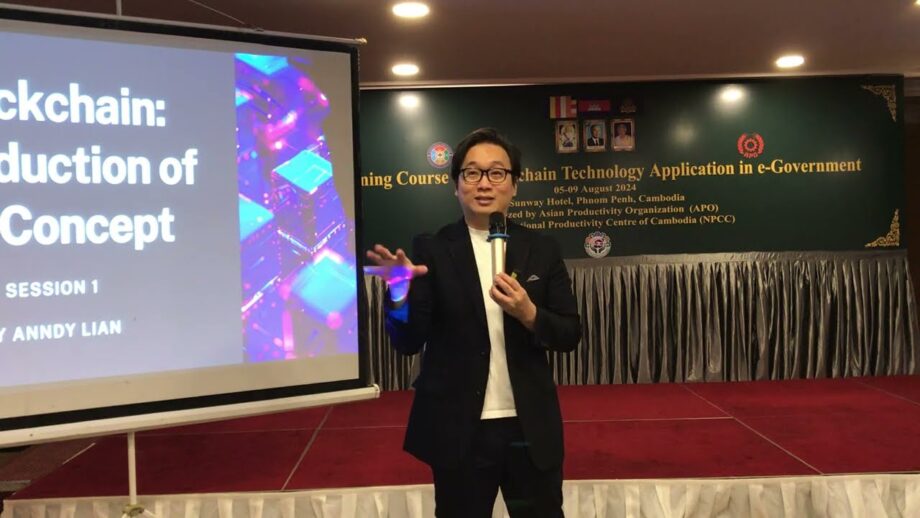
Session 1: Blockchain: Introduction of the Concept by Anndy Lian

Session 1: Blockchain: Introduction of the Concept by Anndy Lian

Blockchain: A Practical Introduction for Enhanced Transparency, Security, and Efficiency

This article summarizes a session led by Anndy Lian, a prominent blockchain expert, focusing on introducing blockchain technology and its real-world applications. The session was part of a training program co-hosted by The Asian Productivity Organization (APO) and the National Productivity Centre (NPCC) of MISTI, aimed at improving productivity in the Asian region.

Anndy Lian, drawing from his extensive experience as an advisor, investor, and chairman of various tech companies, provided a simplified yet comprehensive explanation of blockchain. He described it as a distributed database, or ledger, shared across a network of computers. This decentralized system allows for secure and transparent recording of transactions between parties in a permanent and efficient manner.

The session delved into the key characteristics of blockchain, emphasizing its open, distributed nature, peer-to-peer functionality, and permanence. Lian highlighted the use of cryptography in securing exchanges and ensuring the immutability of records. He explained how each transaction, represented as a block, is broadcasted across the network for approval before being added to the blockchain, creating a transparent and tamper-proof history.

The session further explored the impact of blockchain on various sectors. In the realm of cryptocurrency, blockchain’s secure transaction capabilities have challenged traditional banking norms. Lian provided examples of how financial institutions are leveraging blockchain for faster, more cost-effective international payments, crowdfunding, and securities management. He cited DBS Bank’s digital exchange as a real-world example of blockchain’s integration into existing financial systems.

The healthcare sector, too, benefits significantly from blockchain technology. Lian discussed how blockchain enhances patient data transparency, allowing for secure tracking of medical records and drug traceability. He shared examples of healthcare systems using blockchain for efficient record management, reducing fraud and improving trust. He also highlighted the potential of blockchain in incentivizing patient participation in treatment plans through micropayments and smart contracts.

Lian emphasized the importance of integrating blockchain with existing systems rather than replacing them entirely, especially in government sectors. He cited Estonia’s successful implementation of blockchain for digital identity, voting, and land titling as a prime example. He stressed the need for governments to start with smaller, manageable projects to demonstrate the value and efficiency of blockchain before scaling up.

The session concluded with a video showcasing Estonia’s digital transformation, highlighting how the country embraced technology to create a secure and efficient digital society. Lian emphasized that while replicating Estonia’s success in larger countries presents challenges, their approach offers valuable lessons for a world increasingly reliant on digital solutions.

Anndy Lian is an early blockchain adopter and experienced serial entrepreneur who is known for his work in the government sector. He is a best selling book author- “NFT: From Zero to Hero” and “Blockchain Revolution 2030”.

Currently, he is appointed as the Chief Digital Advisor at Mongolia Productivity Organization, championing national digitization. Prior to his current appointments, he was the Chairman of BigONE Exchange, a global top 30 ranked crypto spot exchange and was also the Advisory Board Member for Hyundai DAC, the blockchain arm of South Korea’s largest car manufacturer Hyundai Motor Group. Lian played a pivotal role as the Blockchain Advisor for Asian Productivity Organisation (APO), an intergovernmental organization committed to improving productivity in the Asia-Pacific region.

An avid supporter of incubating start-ups, Anndy has also been a private investor for the past eight years. With a growth investment mindset, Anndy strategically demonstrates this in the companies he chooses to be involved with. He believes that what he is doing through blockchain technology currently will revolutionise and redefine traditional businesses. He also believes that the blockchain industry has to be “redecentralised”.

j j j

Blockchain and AI copyright: A revolution in digital rights management

Blockchain and AI copyright: A revolution in digital rights management
The intersection of blockchain technology and artificial intelligence (AI) is an emerging frontier that holds great promise for addressing one of the most pressing issues in the digital age: copyright enforcement. With the proliferation of AI-generated content, the need for robust mechanisms to protect intellectual property rights has never been more critical.

This article explores how blockchain technology can provide innovative solutions to AI copyright challenges, offering a personal perspective on its potential supported by statistics and research.

The rise of AI-generated content

Artificial Intelligence has revolutionised content creation, bringing forth a new era where machines can produce music, art, literature, and more. AI algorithms, such as OpenAI’s GPT series, have demonstrated the ability to generate human-like text, while programs like DeepArt and DALL-E create visual art that rivals human artists. According to a report by MarketsandMarkets, the AI market size is expected to grow from US$150.2 billion in 2023 to US$1345.2 billion in 2030, reflecting the rapid adoption of AI technologies across various industries.

However, this surge in AI-generated content has raised significant questions about copyright ownership and enforcement. Traditional copyright laws, designed for human creators, struggle to address the complexities introduced by AI. Who owns the copyright to a piece of music composed by an AI? How can creators prove ownership and control the distribution of their work? These questions highlight the need for a new framework that can manage the unique challenges posed by AI-generated content.

Blockchain: A decentralised solution

Blockchain technology, with its decentralised and immutable nature, offers a promising solution to the challenges of AI copyright. At its core, blockchain is a distributed ledger that records transactions in a secure and transparent manner. Each block in the chain contains a timestamp and a link to the previous block, making it virtually tamper-proof. This inherent security and transparency make blockchain an ideal platform for managing digital rights.

One of the key advantages of blockchain is its ability to establish provenance and ownership. By recording the creation and subsequent transactions of digital content on a blockchain, creators can prove the originality and ownership of their work. This is particularly valuable for AI-generated content, where the line between human and machine authorship can be blurred.

Smart contracts and automated rights management

Smart contracts, self-executing contracts with the terms of the agreement directly written into code, are another powerful feature of blockchain technology that can revolutionise copyright management. These contracts can automatically enforce copyright terms, ensuring that creators are compensated for the use of their work.

For instance, an AI-generated piece of music could be embedded with a smart contract that specifies the terms of its use. Whenever the music is played, the smart contract can automatically collect royalties and distribute them to the rightful owner. This not only simplifies the process of rights management but also ensures that creators receive fair compensation without the need for intermediaries.

A notable example of blockchain-based rights management is the platform Audius, a decentralised music streaming service that uses blockchain to ensure artists retain control over their music and receive fair compensation. As of May 2024, the platform has has between 5 million and 6 million monthly active users, demonstrating the potential of blockchain to disrupt traditional industries and provide new opportunities for creators.

Challenges and considerations

While blockchain technology offers significant potential for AI copyright management, it is not without challenges. One of the primary concerns is the scalability of blockchain networks. As the volume of AI-generated content grows, the blockchain must be able to handle a large number of transactions efficiently. Current blockchain networks, such as Bitcoin and Ethereum, have faced scalability issues, leading to high transaction fees and slower processing times.

However, ongoing research and development in blockchain technology are addressing these issues. Layer 2 solutions, such as the Lightning Network for Bitcoin and Ethereum’s Optimistic Rollups, aim to increase transaction throughput and reduce costs. Moreover, newer blockchain platforms like Solana and Mantle are designed with scalability in mind, offering faster and more efficient networks.

Another consideration is the legal recognition of blockchain records. While blockchain provides a secure and transparent way to record ownership and transactions, the legal system must recognise these records for them to be effective in enforcing copyright. This requires updating existing copyright laws to accommodate blockchain technology and ensure its compatibility with legal standards.

The future of blockchain and AI copyright

Despite these challenges, the future of blockchain and AI copyright management looks promising. As both technologies continue to evolve, they are likely to become increasingly integrated, providing a robust framework for protecting digital rights in the age of AI.

One potential development is the creation of decentralised autonomous organisations (DAOs) for content creators. These organisations, governed by smart contracts, could provide a collective platform for creators to manage their rights, distribute their work, and receive fair compensation.

For example, an AI-generated artwork could be minted as a non-fungible token (NFT) on a blockchain, with the DAO managing its sale and distribution. The creator would retain ownership and receive royalties from secondary sales, ensuring ongoing compensation for their work.

Conclusion: A personal perspective

As an observer of technological trends, I am optimistic about the potential of blockchain to address the challenges of AI copyright. The decentralised and transparent nature of blockchain provides a robust framework for managing digital rights, ensuring that creators receive fair compensation and retain control over their work. While there are challenges to overcome, the ongoing development of blockchain technology and its integration with AI offer a promising path forward.

The rise of AI-generated content presents a unique opportunity to rethink traditional copyright laws and embrace new technologies that can better serve the needs of creators in the digital age. Blockchain, with its ability to establish provenance, enforce smart contracts, and provide a decentralised platform for rights management, is well-positioned to play a central role in this transformation.

As we move forward, it is essential for policymakers, creators, and technologists to collaborate and develop a legal framework that recognises the potential of blockchain and supports its adoption for AI copyright management. By doing so, we can create a more equitable and efficient system that benefits both creators and consumers, ensuring that the digital economy continues to thrive in the age of AI.

In conclusion, the integration of blockchain and AI represents a significant step forward in the evolution of digital rights management. By leveraging the strengths of both technologies, we can create a future where creators are empowered, intellectual property is protected, and innovation is encouraged. The journey may be challenging, but the potential rewards are immense, making it a worthwhile endeavour for all stakeholders involved.


Anndy Lian is an early blockchain adopter and experienced serial entrepreneur who is known for his work in the government sector. He is a best selling book author- “NFT: From Zero to Hero” and “Blockchain Revolution 2030”.

Currently, he is appointed as the Chief Digital Advisor at Mongolia Productivity Organization, championing national digitization. Prior to his current appointments, he was the Chairman of BigONE Exchange, a global top 30 ranked crypto spot exchange and was also the Advisory Board Member for Hyundai DAC, the blockchain arm of South Korea’s largest car manufacturer Hyundai Motor Group. Lian played a pivotal role as the Blockchain Advisor for Asian Productivity Organisation (APO), an intergovernmental organization committed to improving productivity in the Asia-Pacific region.

An avid supporter of incubating start-ups, Anndy has also been a private investor for the past eight years. With a growth investment mindset, Anndy strategically demonstrates this in the companies he chooses to be involved with. He believes that what he is doing through blockchain technology currently will revolutionise and redefine traditional businesses. He also believes that the blockchain industry has to be “redecentralised”.

j j j